

Face serums are easy to overcomplicate because the category includes everything from simple hydrating formulas to concentrated exfoliating or retinoid treatments. Two bottles labeled “serum” can therefore perform completely different jobs.
The most reliable way to choose one is to work backward from your skin rather than forward from the ingredient list. Decide what you actually want to improve, identify the type of ingredient that can address it, then check whether the formula fits your skin type and the products you already use.
What Is a Face Serum?
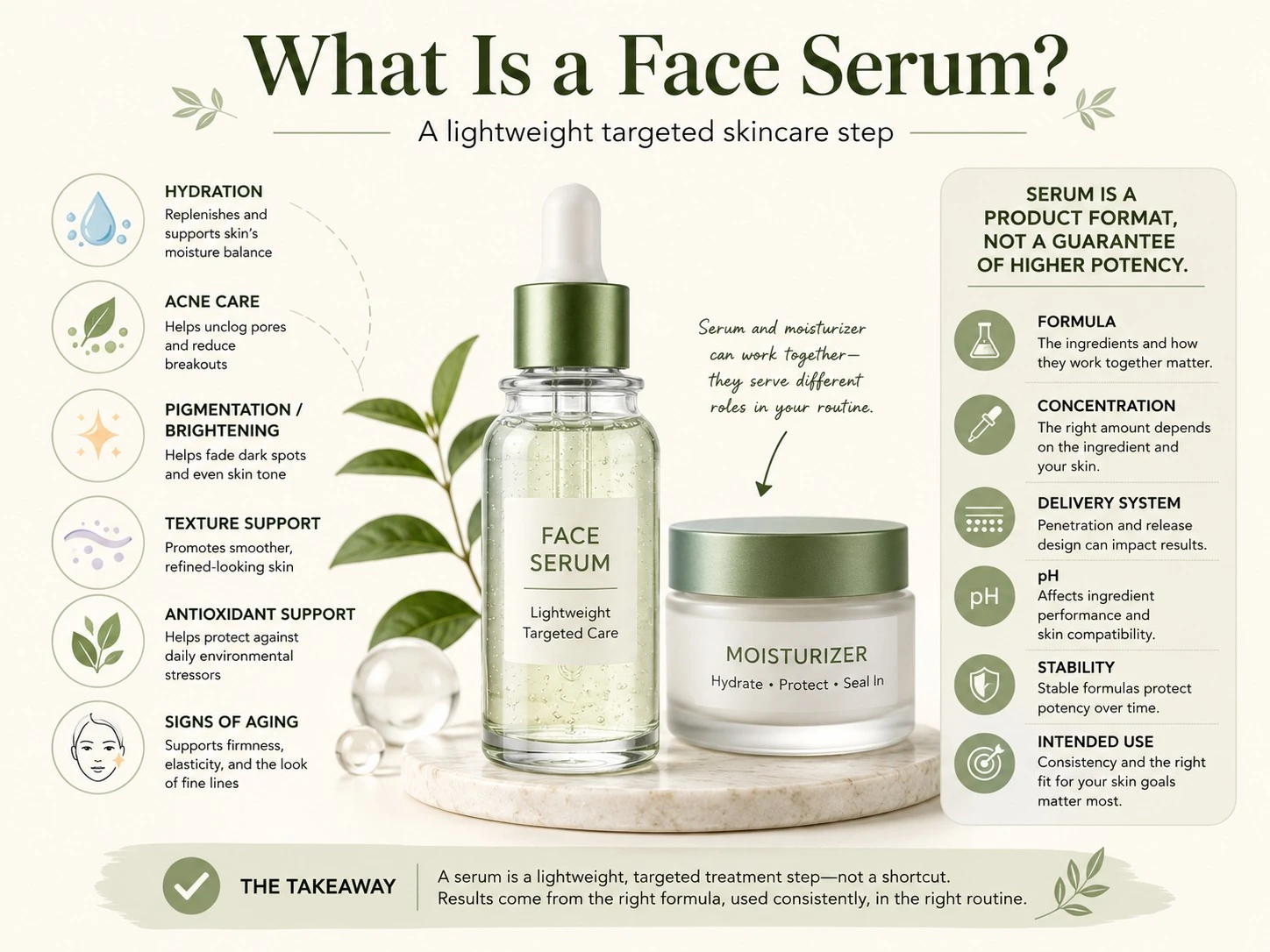
A face serum is a leave-on skincare format generally designed to deliver one or more targeted ingredients in a relatively lightweight vehicle. Some focus primarily on hydration, while others are formulated around acne, pigmentation, texture, antioxidant support, or signs of skin aging.
The word serum describes the product format more than a guaranteed level of potency. It does not automatically mean the product contains a higher percentage of active ingredients than every cream, toner, essence, or moisturizer. Formula composition, ingredient concentration, delivery system, pH, stability, and intended use still matter.
A serum also does not automatically replace moisturizer. A targeted serum and a moisturizer can perform different jobs in the same routine.
Do You Actually Need a Face Serum?
Not necessarily. A basic skincare routine can be built around cleansing, moisturizing, and sun protection, with targeted products added when they solve a specific problem.[6] A serum is therefore best viewed as an optional treatment or support step, not as a mandatory category everyone must use.
A serum becomes useful when you can clearly complete this sentence:
“I am adding this serum because I want it to help with ______.”
If the answer is only “because I feel like my routine should have a serum,” you may not need one yet.
Choose a Serum by Your Primary Skin Concern First
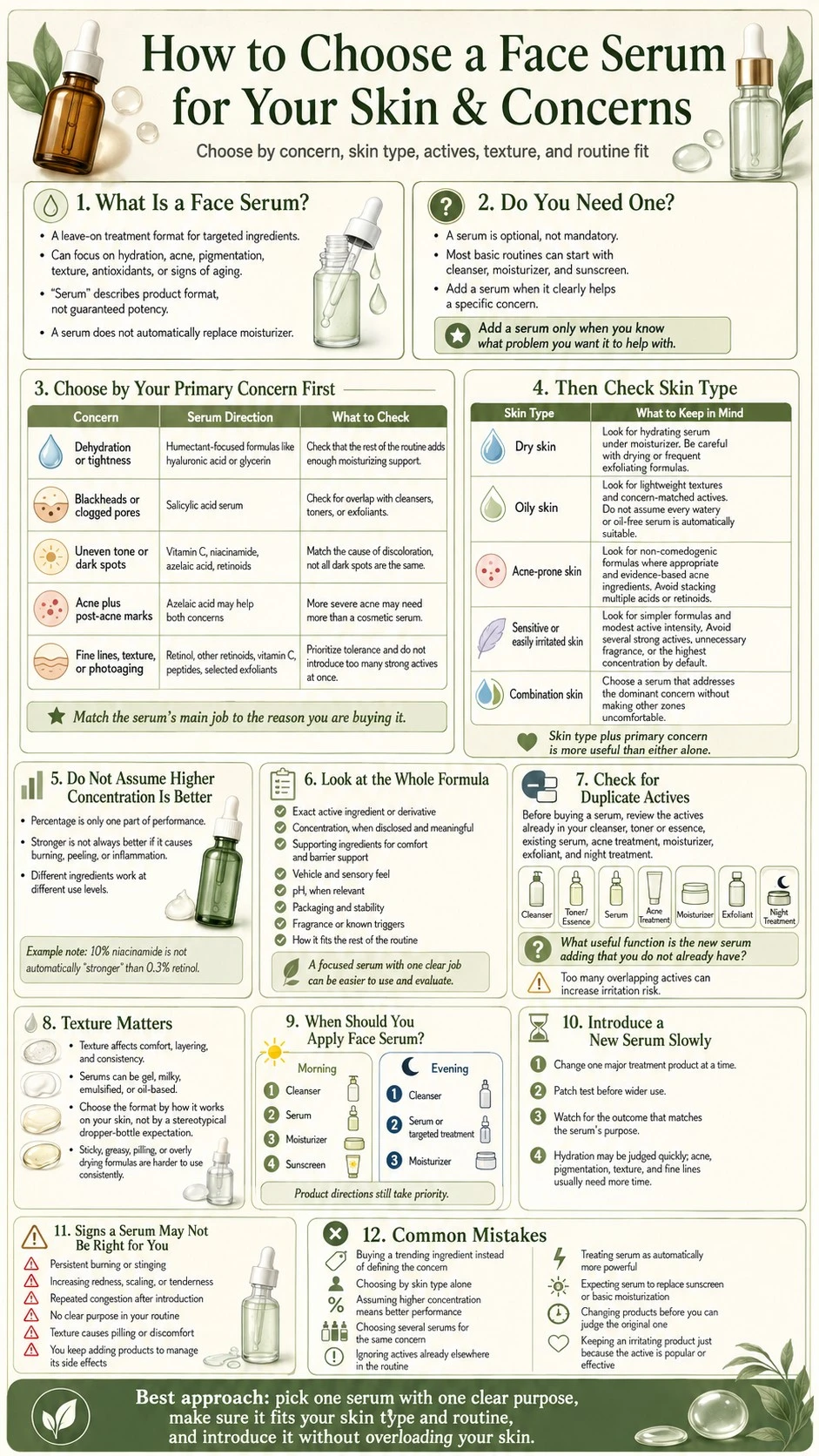
Your main concern is usually more useful than your skin type for deciding what the serum should actually do. Skin type then helps refine the texture, intensity, and supporting formula. Focusing on one priority can also reduce unnecessary product overlap and irritation.[1]
| Primary Concern | Serum Direction to Consider | What to Check Before Choosing |
|---|---|---|
| Dehydration or tightness | Humectant-focused formulas such as hyaluronic acid, glycerin, or similar hydrating systems | Make sure the rest of the routine provides enough moisturizing support rather than expecting a lightweight serum to solve significant dryness by itself |
| Blackheads or clogged pores | A carefully formulated salicylic acid serum may help when comedonal acne or congestion is the main issue[2] | Check whether another cleanser, toner, or exfoliant already supplies the same active |
| Uneven tone or dark spots | Options can include vitamin C, niacinamide, azelaic acid, retinoids, or other pigment-targeting systems depending on the cause[2][3] | Identify whether you are treating post-inflammatory marks, broader pigmentation, or another condition rather than assuming all dark spots behave the same |
| Acne plus post-acne marks | Azelaic acid can be relevant because acne and residual discoloration may overlap[2] | Moderate or severe acne may need a treatment plan that goes beyond a cosmetic serum |
| Fine lines, texture, or photoaging | Retinol, other appropriate retinoids, vitamin C, peptides, or selected exfoliating ingredients may fit depending on the goal[3] | Prioritize tolerance and avoid introducing several potentially irritating anti-aging actives at once |
You do not need the serum with the longest ingredient list. You need a formula whose primary job matches the reason you are buying it.
Then Check Whether the Serum Fits Your Skin Type
After selecting the treatment direction, use skin type to narrow the formula. If you are unsure whether your skin is oily, dry, combination, normal, or sensitive, start with What Is My Skin Type? Simple Test & Skincare Guide.
| Skin Type or Situation | What to Look For | What to Be Careful With |
|---|---|---|
| Dry skin | A hydrating serum that works comfortably beneath a moisturizer | Highly drying or frequently exfoliating formulas if the skin is already flaky or irritated |
| Oily skin | Lightweight textures and an active that targets the actual concern rather than simply trying to remove all oil | Assuming every oil-free or watery serum is automatically suitable |
| Acne-prone skin | Non-comedogenic products where appropriate and evidence-based acne ingredients when acne is the treatment goal | Stacking multiple acids, retinoids, or drying treatments because the skin is oily |
| Sensitive or easily irritated skin | Simple formulas, modest active intensity, and ingredients you already tolerate | Several strong actives, unnecessary fragrance, or choosing the highest available concentration |
| Combination skin | A serum that addresses the dominant concern without making the drier or oilier areas uncomfortable | Trying to make one serum solve every difference between facial zones |
Skin type does not dictate one mandatory serum ingredient. A person with oily skin can still need hydration, while someone with dry skin can also have acne or pigmentation. The combination of skin type + primary concern is more useful than either factor alone.
Do Not Assume a Higher Active Concentration Is Better
Percentage is only one part of serum performance. A higher number can sound impressive on the front of a bottle, but the useful concentration depends on the ingredient, formulation, intended use, evidence, and how well your skin tolerates it.
A stronger formula that repeatedly causes burning, peeling, or inflammation can be less useful than a milder product you can use consistently. This becomes especially important with exfoliating acids and retinoids, which can irritate skin when used too aggressively.[1][2]
Concentration also cannot be compared equally across unrelated ingredients. A 10% niacinamide serum is not automatically “stronger” or more effective than a 0.3% retinol serum simply because its percentage is numerically larger. Different ingredients work at different use levels.
Look at the Whole Formula, Not Just the Hero Ingredient

Two serums advertising the same active can perform very differently. The hero ingredient is only one part of the formulation.
When comparing serums, consider:
- the exact active ingredient or derivative;
- concentration, when it is disclosed and meaningful;
- supporting ingredients that affect hydration, barrier comfort, antioxidant support, or sensory feel;
- the vehicle and whether it feels appropriate for your skin;
- pH when the performance or tolerability of the active depends on it;
- packaging and stability for ingredients sensitive to light, air, or oxidation;
- fragrance or other known personal triggers;
- whether the complete product fits the rest of your routine.
A long list of attractive actives is not automatically an advantage. Sometimes a focused serum with one clear job is easier to use and evaluate.
Check for Duplicate Actives Across Your Routine
The ingredient that makes sense in isolation may become unnecessary once you consider everything else you use.
For example, if your cleanser already contains salicylic acid, your evening treatment contains a retinoid, and your moisturizer includes another exfoliating ingredient, adding a strong acid serum may increase irritation without filling an important gap. Using too many treatment products at the same time can increase irritation risk.[1][4]
Before buying a serum, inventory the active ingredients already present in your:
- cleanser;
- toner or essence;
- existing serum;
- acne treatment;
- moisturizer;
- exfoliant;
- night treatment.
Then ask: What useful function is the new serum adding that I do not already have?
Texture Matters More Than It Seems
A technically suitable formula still has to work in your real routine. Sticky, greasy, pilling, drying, or slow-absorbing products are difficult to use consistently even when the ingredient strategy looks good on paper.
A serum’s texture can also affect how it layers beneath moisturizer, sunscreen, or makeup. This is especially relevant in the morning, when several leave-on layers may need to sit comfortably together.
Do not assume all serums must be thin and water-based. The category can include water-rich gels, emulsified serums, milky formulas, oil-based serums, and other delivery systems. Choose the format by how it functions on your skin rather than by whether it matches a stereotypical dropper-bottle texture.
When Should You Apply Face Serum?
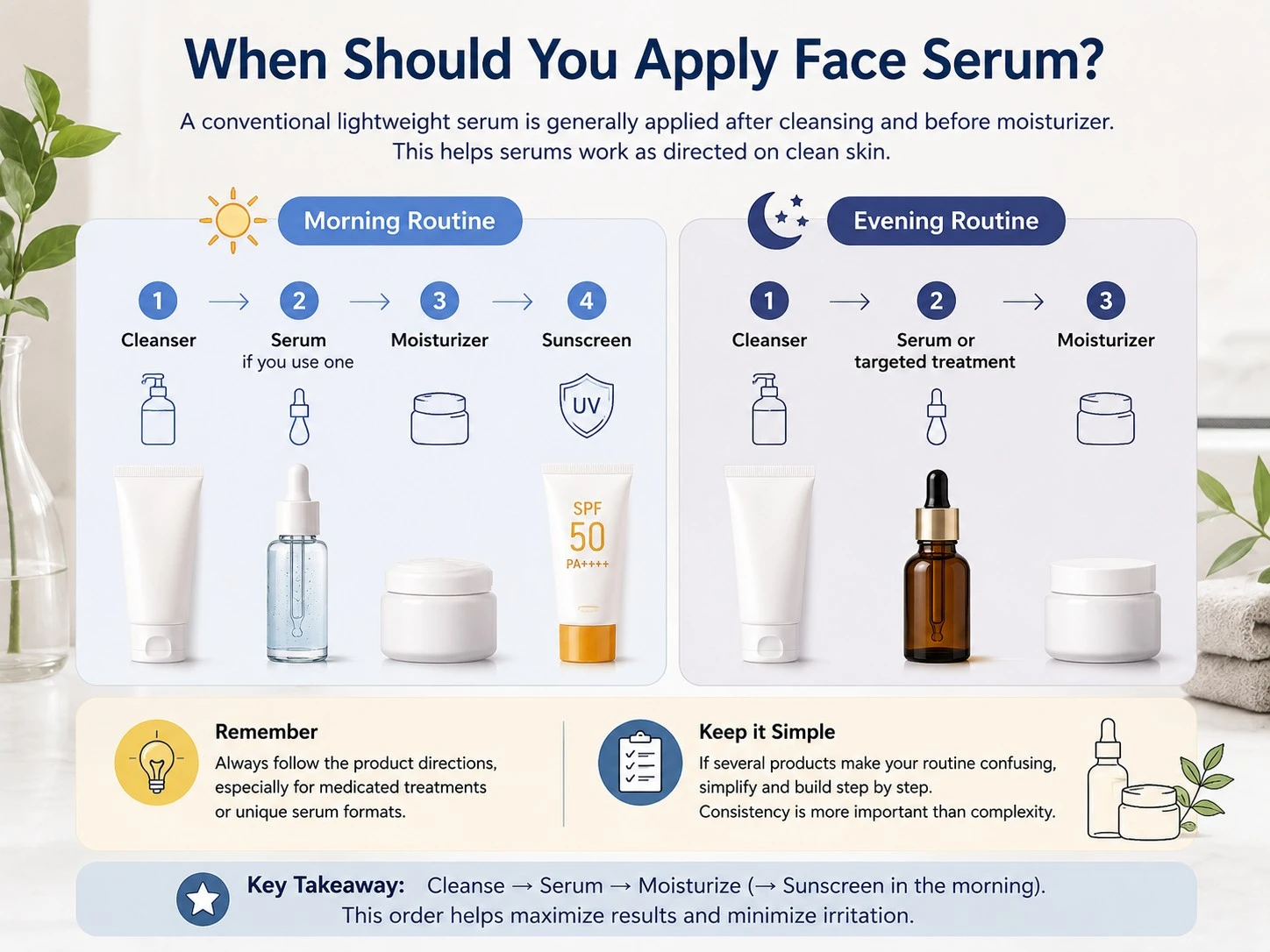
A conventional lightweight serum is generally applied after cleansing and before moisturizer. Treatment products are typically placed before the moisturizing and sunscreen steps so they can be used as directed on clean skin.[4]
A simple routine might look like:
Morning
- Cleanser
- Serum, if you use one
- Moisturizer
- Sunscreen
Evening
- Cleanser
- Serum or targeted treatment
- Moisturizer
The product directions still take priority, particularly for medicated treatments or unusual serum formats. If several products make your routine confusing, Skincare Routine Order: Morning and Night Step-by-Step explains how to organize the complete sequence.
Introduce a New Serum Without Overloading Your Skin
When possible, change one major treatment product at a time. If three new serums enter the routine together and your skin becomes irritated, it is difficult to identify which product caused the problem.
Testing a new skincare product on a small area before broader use can help identify some adverse reactions before the product is applied widely.[5] Our How to Patch Test Skincare Products Before Using Them guide provides the practical testing steps.
After introducing the serum, judge it by the outcome that matches its purpose. A hydrating serum can be assessed by comfort and hydration relatively quickly, while changes in acne, pigmentation, texture, or fine lines can require a longer and more consistent treatment period.
Signs a Face Serum May Not Be Right for You
- Persistent burning or stinging: brief sensations can occur with some actives, but repeated discomfort is not something to ignore.
- Increasing redness, scaling, or tenderness: the formula or overall active load may be too irritating.
- Repeated congestion after introduction: the finished formula may not suit your acne-prone skin.
- No clear purpose: the serum duplicates ingredients and benefits you already receive elsewhere.
- The texture makes the routine difficult: frequent pilling or an uncomfortable finish can reduce consistent use.
- You keep adding products to manage its side effects: a serum that requires several corrective steps may not be the best fit.
If irritation becomes the dominant issue, stop treating the serum as a product-selection puzzle and address the skin condition first.
Common Mistakes When Choosing a Face Serum
- Buying the trending ingredient instead of defining the skin concern.
- Choosing by skin type alone. Oily skin, for example, can still have very different concerns from one person to another.
- Assuming higher concentration means better performance.
- Choosing several serums for the same concern. More products do not necessarily produce faster improvement.
- Ignoring ingredients already present elsewhere in the routine.
- Treating “serum” as synonymous with “more powerful.” The finished formulation matters more than the category name.
- Expecting a serum to replace sunscreen or basic moisturization.
- Changing products before you can judge the original one.
- Keeping a product that repeatedly irritates your skin because the active is considered effective.
Final Thoughts
The best face serum is not the one with the highest percentage, the longest ingredient list, or the most popular active. It is the one that solves a clearly defined problem while fitting your skin type, tolerance, and existing routine.
Use a simple decision order: primary concern → suitable active direction → skin type and tolerance → whole formula → routine compatibility. If you cannot identify what a new serum adds, your routine may already contain everything it needs.
FAQs About Choosing a Face Serum
Which Face Serum Is Best for Beginners?
Choose a serum with one clear purpose and a formula that is easy for your skin to tolerate. If you do not have a treatment concern, a simple hydrating serum can be easier to integrate than starting immediately with several exfoliating or retinoid actives.
Can I Use Two Face Serums at the Same Time?
Sometimes, but two serums should have compatible purposes and ingredients. If both contain strong exfoliating or potentially irritating actives, using them together may create unnecessary irritation. A second serum should fill a real gap rather than duplicate the first.
Should I Choose a Serum Based on My Skin Type or Skin Concern?
Start with your primary concern to determine what the serum needs to accomplish, then use skin type and tolerance to refine the formula and texture. This prevents skin type from becoming an overly broad substitute for a specific treatment goal.[1]
Does a More Expensive Face Serum Work Better?
Price alone does not tell you whether a serum is appropriate or effective. Ingredient selection, formulation quality, stability, packaging, evidence, and suitability for your skin are more useful decision factors than price by itself.
Should I Use Face Serum Every Day?
It depends on the product. Some hydrating or antioxidant serums may be designed for daily use, while stronger exfoliating or retinoid treatments may need a more gradual schedule. Follow the product directions and adjust according to tolerance.
Can a Face Serum Replace Moisturizer?
Sometimes a finished product may provide enough moisturization for an individual user, but serum and moisturizer are not automatically interchangeable categories. Many targeted serums focus on a specific active or lightweight hydration, while moisturizers are designed to provide broader hydration, emolliency, and water-loss support.
Sources
[1] American Academy of Dermatology. How to Select Anti-Aging Skin Care Products
[2] American Academy of Dermatology. Acne Clinical Guideline
[3] American Academy of Dermatology. Dermatologist-Recommended Skin Care for Your 20s
[4] American Academy of Dermatology. Should I Apply My Skin Care Products in a Certain Order?
[5] American Academy of Dermatology. How to Test Skin Care Products
[6] American Academy of Dermatology. Skin Care on a Budget


