

Comparing snail mucin and hyaluronic acid can be confusing because bottles named after different ingredients may overlap in what they contain. Compare the actual formulas you would put on your skin: their ingredients, moisturizing effect, feel and fit with the rest of your routine.
Snail Mucin vs Hyaluronic Acid: Side-by-Side Comparison
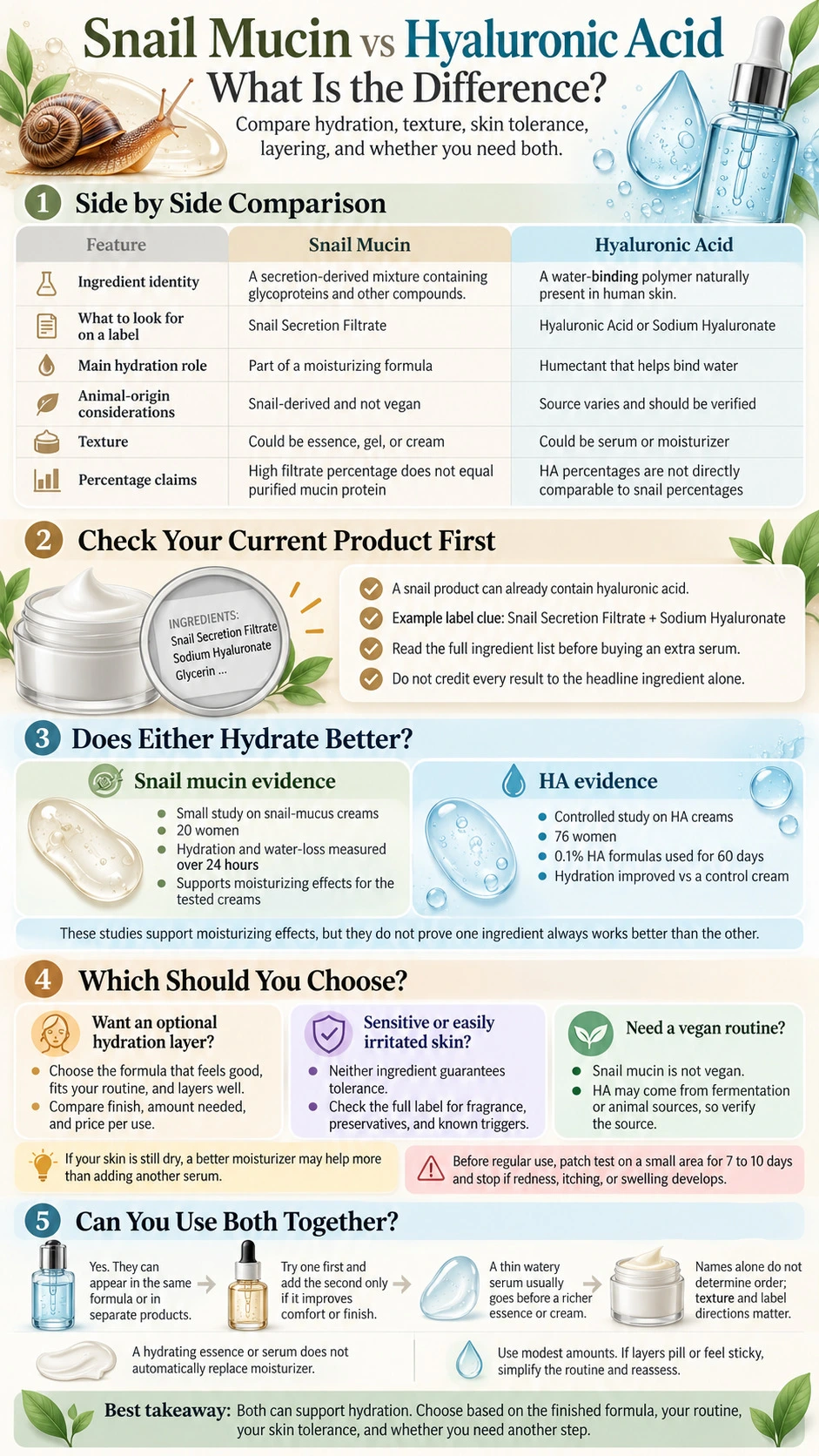
Use the table to compare the ingredient identities and label information. A product centered on HA can still have a complex formula, and either product can feel light or rich.
| What to compare | Snail mucin | Hyaluronic acid |
|---|---|---|
| Ingredient identity | A secretion-derived mixture containing substances such as glycoproteins and other compounds.[1] | A water-binding polymer also naturally present in human skin.[2] |
| What to look for on a label | Snail Secretion Filtrate. | Hyaluronic Acid or related forms such as Sodium Hyaluronate. Both ingredient types can appear in the same product.[3] |
| Main hydration role | Part of a moisturizing formula; the other ingredients also contribute. | A humectant ingredient that helps bind water. |
| Animal-origin considerations | Snail-derived, so unsuitable for a vegan routine. | Source matters: fermentation and animal-derived sources exist.[2] |
| Texture | Assess the actual essence, gel or cream; the ingredient name does not guarantee a particular finish. | Assess the actual serum or moisturizer; HA does not always mean a thin, non-sticky formula. |
| Percentage claims | A high filtrate percentage describes the amount of that mixture in the formula. | An HA percentage describes a different ingredient or declared blend; the figures are not a direct measure of comparative performance. |
Check Whether Your Snail Product Already Contains Hyaluronic Acid
A snail mucin product can already contain a form of HA. For example, one snail essence lists both Snail Secretion Filtrate and Sodium Hyaluronate, alongside ingredients including betaine and panthenol. Its label shows why a “snail versus HA” choice is not always a choice between separate formulas.[3]
Look at the full list on your current bottle before adding another serum. Seeing Sodium Hyaluronate there does not tell you the concentration, but it does show that the product already includes that ingredient. It also prevents you from attributing every effect of a blended formula to its headline ingredient.
Percentage claims need the same care. A label such as “96% snail secretion filtrate” is not a statement that the bottle contains 96% purified mucin protein. It cannot be compared directly with an HA percentage to decide which product is stronger or more hydrating.[3]
Does Either Work Better for Hydration?
The studies cited here support moisturizing effects, but do not establish a winner between the two ingredients. They tested different formulas, on different participants and over different periods.
Snail-mucus creams were evaluated in a small study involving 20 women, with hydration and skin water loss assessed over 24 hours. Those results support the tested creams as moisturizers; they do not establish how every snail essence will perform.[1]
In a separate controlled study, 76 women used creams containing 0.1% HA of different molecular weights for 60 days. The HA creams improved hydration compared with the control cream. That is evidence for those preparations, not proof that every HA serum will outperform every snail product.[4]
Which Should You Choose for Your Skin?
Start with what your routine is missing. If your skin already stays comfortable through the day, there is no need to replace a product simply because another ingredient is trending.
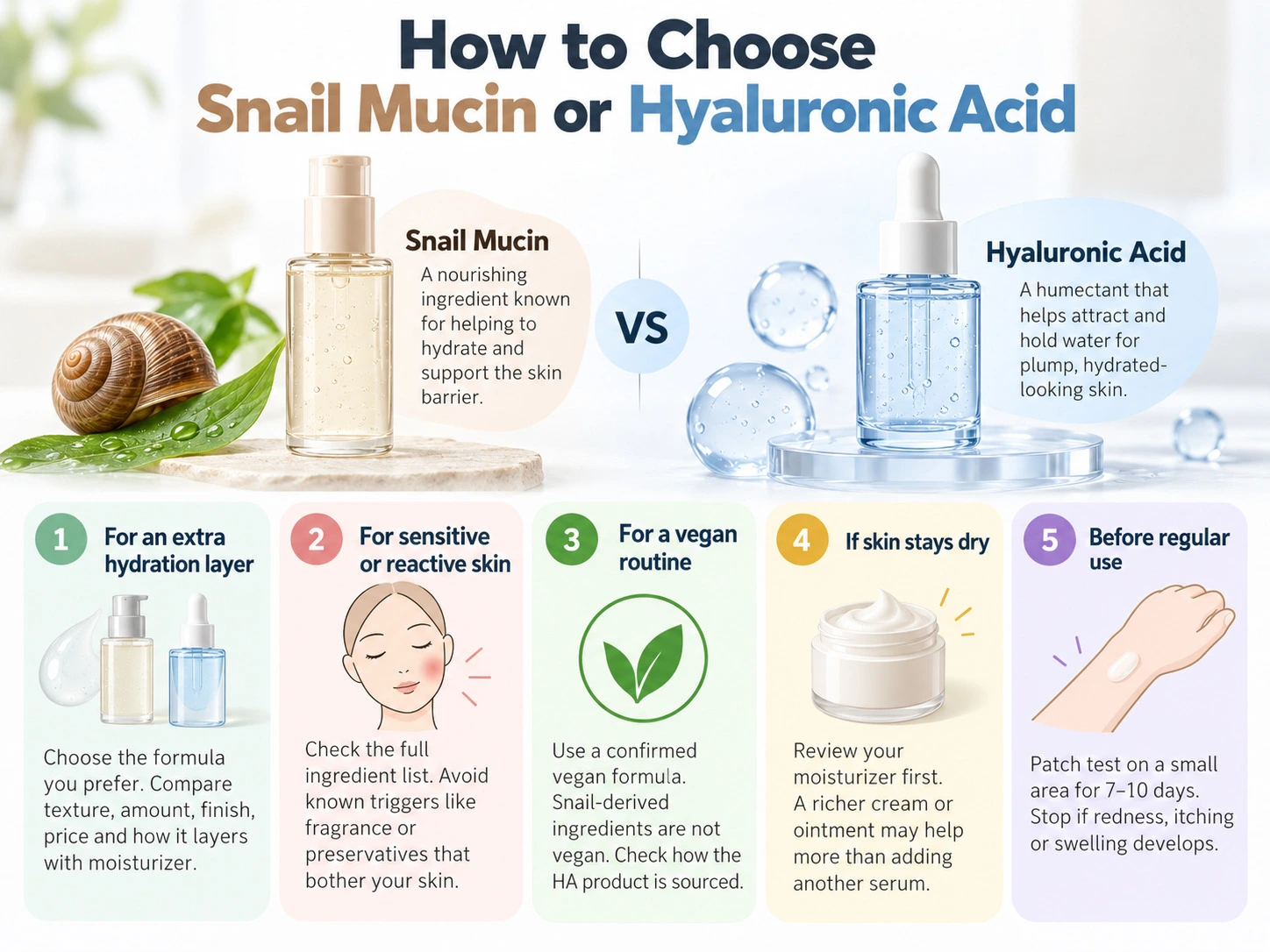
- For an optional hydration layer: an HA serum is a reasonable option to evaluate if you want a product centered on a familiar water-binding ingredient. A snail essence can serve a similar routine role if you prefer that particular formula. Compare the amount needed, finish, price per usable application and compatibility with your moisturizer.
- For sensitive or easily irritated skin: neither ingredient name guarantees tolerance. Check the full label for known triggers, including fragrance and preservatives, and avoid ingredients you have reacted to or are known to be allergic to. “Hypoallergenic” or “for sensitive skin” wording is not enough to establish that a product will suit you.[5]
- For a vegan routine: choose a product with confirmed vegan sourcing and a suitable complete formula. Snail-derived filtrate does not fit that requirement. HA can come from fermentation or animal sources, so verify the brand’s information rather than assuming the ingredient name settles the question.[2]
For persistently dry skin, check your moisturizer before adding a serum. A richer cream or ointment may be more useful than adding another lightweight serum.[6] Our barrier cream vs moisturizer comparison explains how those product roles overlap.
Before regular use, test a new product on a small area of the inner arm or elbow bend twice daily for seven to 10 days. Use the normal amount and leave it on as directed. Stop if redness, itching or swelling develops; a home check cannot guarantee that later use will be reaction-free.[7]
Can You Use Snail Mucin and Hyaluronic Acid Together?
Yes, the two ingredients can be used in the same formulation, as the combined ingredient list above demonstrates.[3] Whether you benefit from two separate products is a different question. Try one first and add the second only if it improves comfort or gives you a finish you prefer.
For separate products, let their directions and textures guide application. As a practical starting point, a thin, watery serum fits before a richer essence or cream; if the textures are reversed, the names “HA” and “snail” do not establish a mandatory order. Follow any prescribed treatment instructions ahead of a general layering suggestion.
A lightweight hydrating serum or essence should not automatically replace your moisturizer. Moisturizers also help limit water loss, which matters when skin remains dry after a serum.[6] If your snail product is itself a suitable moisturizing cream, assess it as that step rather than adding another cream by default.
Use a modest amount of each product. If the combination rolls into flakes or feels uncomfortably sticky, simplify the layers and reassess the amounts. Our guide to layering skincare without pilling covers that application problem in more detail.
FAQs About Snail Mucin and Hyaluronic Acid
Can snail mucin replace a hyaluronic acid serum?
A snail product can replace a separate HA serum in your routine if it gives you the hydration and feel you want. Check the label first: some snail formulas already contain Sodium Hyaluronate. Replacing a routine step does not make the ingredients chemically identical.[3]
Is hyaluronic acid an exfoliating acid?
No. HA is used for its water-binding properties; the word “acid” does not make it an exfoliant like glycolic acid. Do not count an HA serum as an exfoliating step or expect it to clear pores through exfoliation.[2]
Is either ingredient better for acne or acne scars?
The moisturizing studies cited here did not test which ingredient treats acne or acne scars better. Improved hydration does not establish an acne-treatment or scar-removal effect. Keep that treatment decision separate from choosing a comfortable moisturizing product.[4]
Why does skin still feel dry after either serum?
Your moisturizing routine may need a richer cream rather than another humectant layer. Check the moisturizer and whether the products feel comfortable on your skin.[6] If dryness comes with stinging, itching or a rash, stop the new product and seek advice if symptoms persist.[7]
Sources
[1] Laneri S, et al. Dosage of Bioactive Molecules in the Nutricosmeceutical Helix aspersa Muller Mucus and Formulation of New Cosmetic Cream with Moisturizing Effect
[2] Cleveland Clinic. Hyaluronic Acid
[3] COSRX. Advanced Snail 96 Mucin Power Essence
[4] Pavicic T, et al. Efficacy of cream-based novel formulations of hyaluronic acid of different molecular weights in anti-wrinkle treatment
[5] U.S. Food and Drug Administration. Allergens in Cosmetics
[6] American Academy of Dermatology Association. How to pick the right moisturizer for your skin
[7] American Academy of Dermatology Association. How to test skin care products


