

Importing skincare from China involves product development, market compliance and delivery; clearing customs does not settle every legal obligation.
This guide covers finished cosmetics for commercial sale, using the United States, European Union and Great Britain as examples. Your destination’s requirements control the order.
Start with the Destination Market and Product Classification
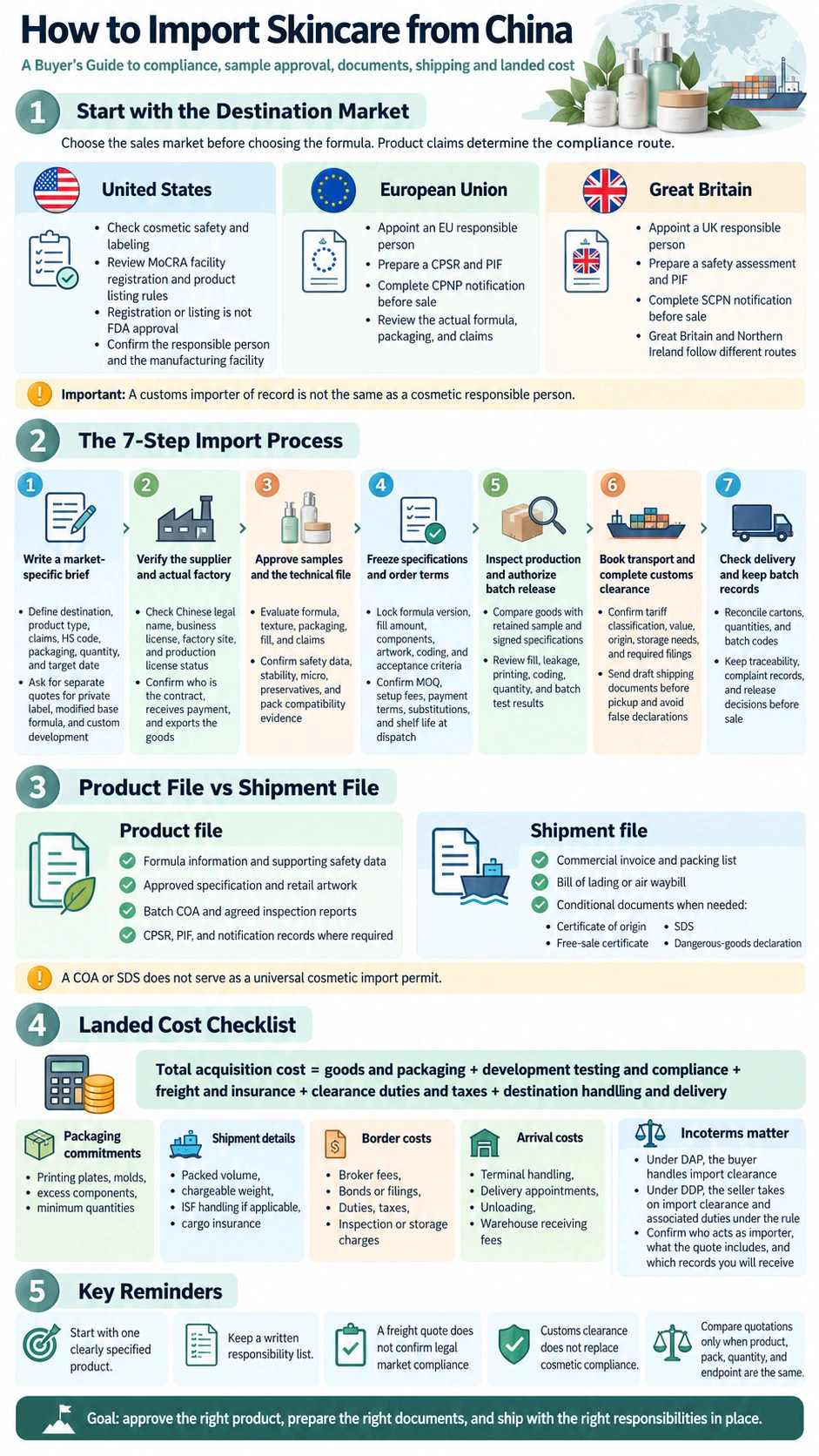
Choose the sales market before choosing the formula. In the US, intended use matters: acne-treatment claims and sun-protection claims can bring products under drug requirements. A moisturizing serum and an SPF moisturizer therefore should not follow the same cosmetic-only launch plan.[1] The US framework also includes the Modernization of Cosmetics Regulation Act of 2022 (MoCRA).
| Destination | Core cosmetic compliance checks | What to resolve before production |
|---|---|---|
| United States | Safety and labeling; applicable MoCRA facility registration and product listing, including checks for small-business exemptions and their product exclusions. Registration or listing is not FDA approval.[2] | Determine who is the label’s responsible person, which facility makes the product and who handles applicable submissions. |
| European Union | An EU-established responsible person, a Cosmetic Product Safety Report (CPSR), a Product Information File (PIF) and notification through the Cosmetic Products Notification Portal (CPNP) before placing the product on the market.[3] | Appoint the responsible person and arrange assessment of the actual formula, packaging and claims. |
| Great Britain: England, Scotland and Wales | A responsible person with a UK-established address, safety assessment, PIF and notification through the Submit Cosmetic Product Notifications (SCPN) service before making the product available. Northern Ireland follows a separate route.[4] | Confirm the responsible person and notification arrangements for GB specifically. |
In the US, ordinary cosmetics generally do not require FDA premarket approval, although color additives have separate approval requirements. Imported cosmetics must still be safe and properly labeled.[5]
Do not confuse a customs importer of record with a cosmetic responsible person. Under US MoCRA, the responsible person is the manufacturer, packer or distributor whose name appears on the product label.[7] One company may fill both roles, but their duties differ. CBP states that a US importer of record remains responsible for accurate entry documents and applicable duties, taxes and fees even when using a broker.[6]
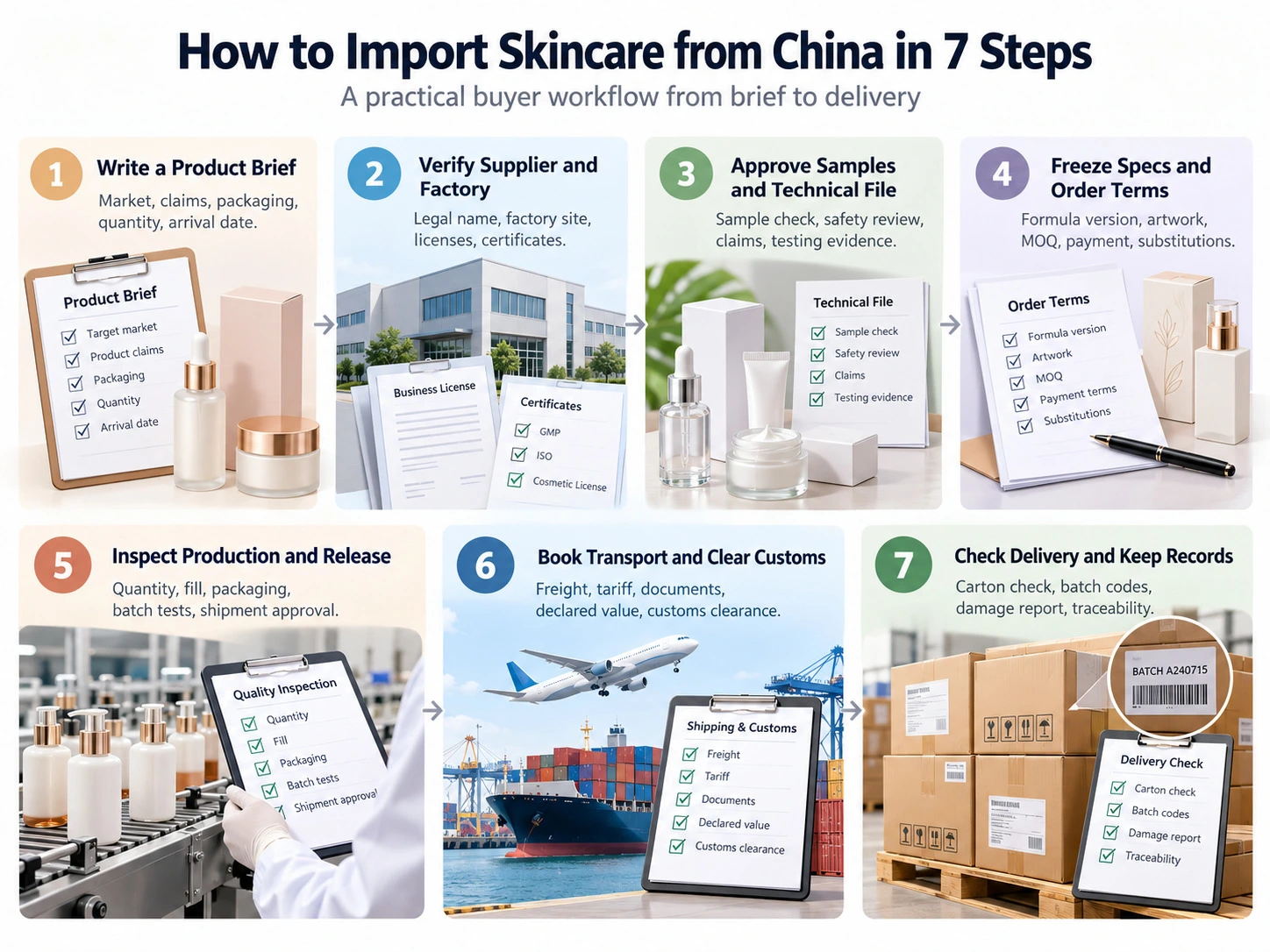
How to Import Skincare from China in 7 Steps
1. Write a Market-Specific Product Brief
Specify the destination, product type, intended claims, fill size, packaging, expected quantity and required arrival date. State whether you want an existing private-label formula, modifications to a base formula or custom development; ask the supplier to quote those routes separately.
For a private label face serum, the brief could identify a hydrating formula, a 30 mL pump bottle and one sales market. Ingredient preferences alone are insufficient: the supplier also needs your claim limits, packaging requirements and expected order size.
Work backward from warehouse arrival through clearance, transit, production and approvals. Keep your launch date separate from the factory’s promised completion date.
2. Verify the Supplier and the Actual Factory
Ask for the supplier’s Chinese legal name, business license, actual manufacturing site and relevant production-license details. Match documents to that site and check who will sign the contract, receive payment and export the goods. If a trader or export agent is involved, record the relationship rather than assuming the seller owns the factory.
Verify the scope, site, issuer and validity of any quality certificates; a certificate for another factory does not verify your production site. For a deeper factory audit and shortlist, use our guide to choosing a skincare manufacturer.
3. Approve Samples and the Technical File
Evaluate the sample against the written brief: appearance, texture, odor, dispensing, fill and packaging suitability. A lab sample in a plain container does not confirm that the final retail bottle, pump or printed carton works.
Have the appropriate reviewer assess the formula, supporting safety information and proposed claims for your market. Agree how confidential quantitative formula data will reach the responsible person or safety assessor; an ingredient list on a label is not a full technical file. In the US, MoCRA requires the responsible person to ensure and maintain adequate safety substantiation.[7]
Agree which stability, microbiological, preservative-efficacy and packaging-compatibility evidence is needed for the specific product. Check that existing reports cover the formula and pack you are ordering. Keep the approved sample and formula version; pause if information needed for review remains unavailable.
4. Freeze Specifications and Order Terms
Turn the approved sample into a signed specification covering the formula version, fill amount, packaging components, artwork, batch coding, acceptance criteria and agreed test reports. Have the market reviewer check the final ingredient declaration, net contents, required business/contact details, warnings, language and claims before printing. Ask the broker to check destination-specific country-of-origin marking.
Confirm MOQ separately for the formula, container and printed packaging. Record setup fees, ownership or permitted use of artwork and tooling, payment milestones, change approval, defect remedies and remaining shelf life at dispatch. Require written approval before substitutions.
Tie production timing to named approvals and component availability. A quote for bulk filling may exclude custom packaging preparation or the regulatory review still needed before sale.
5. Inspect Production and Authorize Batch Release
Agree the inspection plan before production finishes. Check the produced goods against the retained sample and specifications, including quantity, fill checks, packaging integrity, leakage, printing, coding and agreed quality limits. Review batch-specific test results and the certificate of analysis where included in your release plan.
Resolve failed checks before authorizing shipment or releasing any payment tied to inspection. Record the batch numbers, inspection result and person authorizing dispatch. Passing a pre-shipment inspection does not replace product safety substantiation or the destination’s regulatory process.
6. Book Transport and Complete Customs Clearance
Give the freight forwarder the product details, quantities, carton dimensions, weights and required storage conditions. Confirm whether the formulation requires special transport classification or documents; do not assume every liquid is dangerous goods or that every cosmetic can travel as ordinary cargo.
Have the customs broker confirm the tariff classification, declared value, origin, importer setup and shipment-specific filings, including any that are due before loading. Send draft shipping documents before pickup so names, descriptions, quantities and values can be reconciled. US formal-entry guidance identifies invoices, packing lists where available, shipping documents and any required special documents.[8]
Confirm who handles Chinese export clearance and who handles destination import clearance. Provide truthful descriptions and values, respond to clearance queries and keep the entry and release records. Avoid suppliers who suggest declaring commercial stock as gifts or understating its value.
7. Check the Delivery and Keep Batch Records
At receipt, reconcile cartons, quantities and batch codes with the packing list. Photograph damage, quarantine leaking or suspect goods and notify the relevant supplier or carrier within the agreed claim period. Keep transport damage separate from manufacturing defects when recording the issue.
Make stock available for sale only after the required market checks and release decisions are complete. Retain batch-to-customer traceability, complaint contacts and a process for escalating safety reports. For US cosmetics, the responsible person has serious adverse-event reporting duties under MoCRA.[7]
Which Documents Should You Request?
Keep the product file and shipment file separate. The first supports safety and lawful marketing; the second describes and clears a particular consignment. Confirm the final list with your market reviewer and broker rather than treating every certificate as universally mandatory.
| Document or record | Purpose | Owner and timing to confirm |
|---|---|---|
| Formula information and supporting safety data | Allows review of ingredients, concentrations and intended use. | Manufacturer provides data to the appropriate reviewer before approval. |
| Approved specification and retail artwork | Defines the product, pack, labels and claims authorized for production. | Buyer, manufacturer and regulatory reviewer approve before printing or filling. |
| Batch COA and agreed inspection reports | Records batch results against agreed specifications; does not establish complete market compliance. | Manufacturer and inspector provide before shipment release. |
| CPSR, PIF and notification records where required | Supports the applicable EU or GB cosmetic compliance route. | Responsible person coordinates completion and availability before market release. |
| Commercial invoice and packing list | Identifies the transaction, goods, quantities, values and packed shipment. | Seller/exporter prepares; buyer and broker reconcile before dispatch. |
| Bill of lading or air waybill | Records transport details for the consignment. | Carrier or forwarder issues; broker and consignee check against other documents. |
| Conditional certificates and transport documents | May include an origin certificate, free-sale certificate, SDS or dangerous-goods declaration when applicable. | Broker, market reviewer or carrier confirms the need before booking. |
A certificate of analysis reports specified results; an SDS communicates hazard information. Neither is a universal cosmetic import permit. Likewise, FDA says it does not issue certificates confirming cosmetic facility registration or product listing.[2]
Calculate Landed Cost and Confirm Delivery Terms
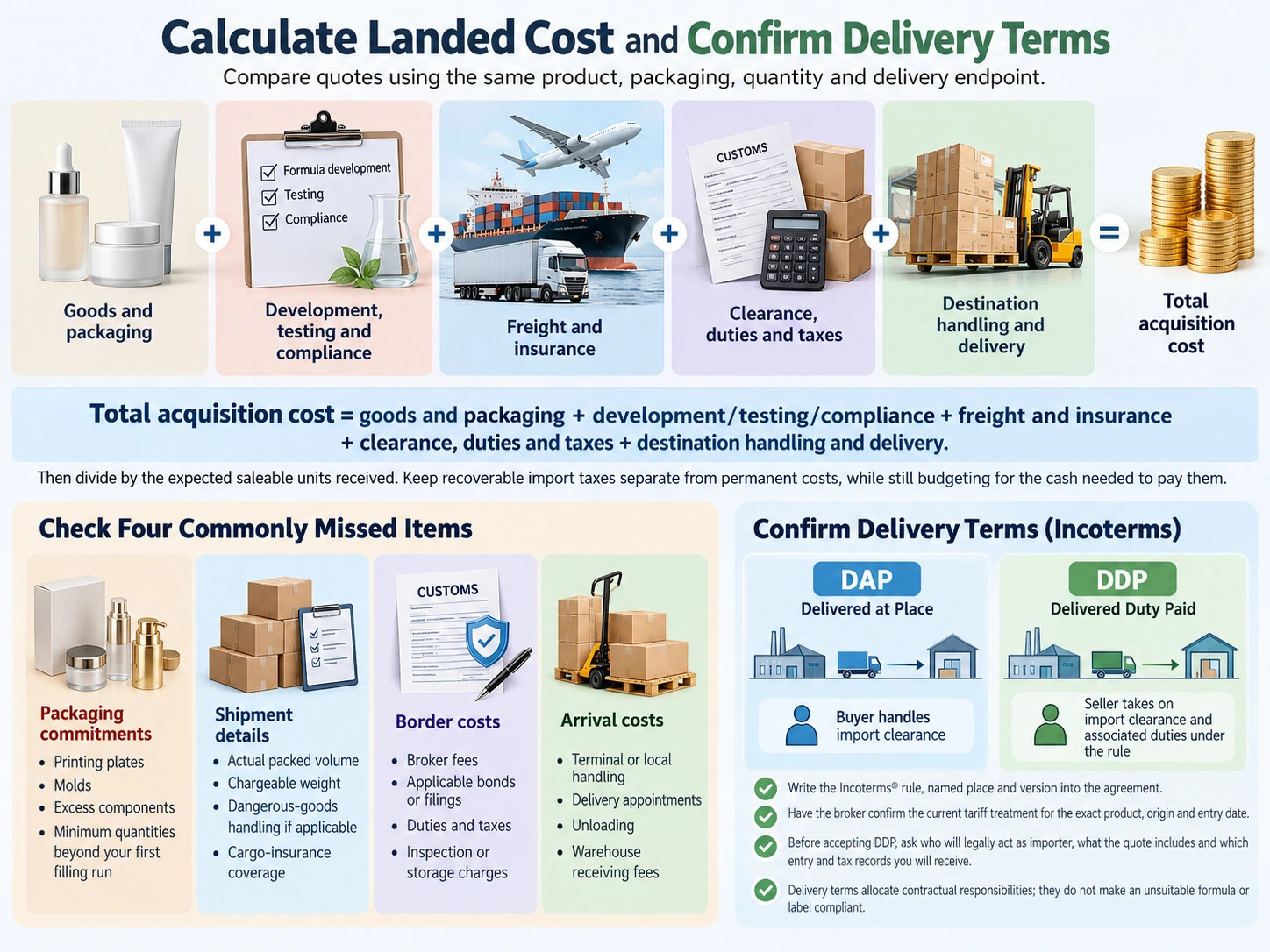
Compare quotations using the same product, packaging, quantity and delivery endpoint. For launch budgeting, include one-off development and compliance costs alongside the shipment’s landed cost:
Total acquisition cost = goods and packaging + development/testing/compliance + freight and insurance + clearance, duties and taxes + destination handling and delivery.
Then divide by the expected saleable units received. Keep recoverable import taxes separate from permanent costs, while still budgeting for the cash needed to pay them.
Check four commonly missed items:
- Packaging commitments: Printing plates, molds, excess components and minimum quantities beyond your first filling run.
- Shipment details: Actual packed volume, chargeable weight, dangerous-goods handling if applicable and cargo-insurance coverage.
- Border costs: Broker fees, applicable bonds or filings, duties, taxes and any inspection or storage charges.
- Arrival costs: Terminal or local handling, delivery appointments, unloading and warehouse receiving fees.
Have the broker confirm the current tariff treatment for the exact product, origin and entry date. There is no single duty rate or tariff code that safely covers every skincare shipment from China.
Write the Incoterms® rule, named place and version into the agreement. Under DAP, the buyer handles import clearance; under DDP, the seller takes on import clearance and associated duties under the rule.[9]
Before accepting DDP, ask who will legally act as importer, what the quote includes and which entry and tax records you will receive. Confirm the seller can perform that role in your destination. Delivery terms allocate contractual responsibilities; they do not make an unsuitable formula or label compliant.
Discuss Your China Skincare Project with ZICAIL
ZICAIL offers private-label and OEM/ODM skincare development with formula and packaging options. Send your project brief with the destination market, product type, intended claims, packaging, estimated quantity and target arrival date. Ask the team to confirm the sample scope, available technical documents, production assumptions and quotation terms for your project. Assign regulatory review and customs responsibilities alongside the manufacturing discussion so the order has a clear route from sample approval to market release.


