


What Does Retinol Do for Skin?
Retinol supports skin renewal, which is why it is used for texture, clogged pores, fine lines, dullness, and early signs of aging. [1][3] It can be useful, but it does not erase wrinkles overnight, shrink pores permanently, or cure every type of acne.
| Skin Concern | How Retinol May Help | What to Expect |
|---|---|---|
| Fine lines | Supports smoother-looking skin over time | Results take months |
| Rough texture | Helps improve uneven texture | Start slowly to avoid irritation |
| Acne-prone skin | Helps keep pores clearer | Purging or dryness can happen early |
| Visible pores | Helps improve the look of congestion and texture | Pores do not disappear |
| Dark spots / uneven tone | Supports more even-looking skin | Sunscreen is essential |
| Dullness | Helps skin look smoother and fresher | Not an overnight fix |
Retinol is most useful when you have a clear reason to use it. If your skin is already comfortable with a simple routine, you do not need to add retinol just because it is popular.
Retinol vs Retinoids: What Is the Difference?
Retinoids are a family of vitamin A-related ingredients, and retinol is one member of that family. The main differences are strength, speed, irritation potential, and whether an ingredient is sold over the counter or used as a prescription treatment. Rules vary by country, so the same ingredient may not have the same status in every market.
| Term | What It Means | Common Use |
|---|---|---|
| Retinoids | Vitamin A family of ingredients | Broad category |
| Retinol | Over-the-counter retinoid, slower and gentler | Beginner anti-aging, texture, routine support |
| Retinal / retinaldehyde | Over-the-counter retinoid, often stronger than retinol | Faster results, more irritation potential |
| Adapalene | OTC or prescription depending on market | Acne-prone skin |
| Tretinoin | Prescription retinoid in many markets | Acne, photoaging, stronger treatment |
| Retinyl palmitate / retinyl acetate | Gentler vitamin A esters | Sensitive or beginner formulas |
Retinol is often a good entry point because it is less aggressive than many prescription retinoids. Tretinoin is not simply “stronger retinol”; it is a different retinoid and is often used under medical guidance. [4]
Beginners usually do better with a lower-strength product they can use consistently than with a stronger product that causes burning, peeling, or barrier damage.
Who Should Use Retinol?
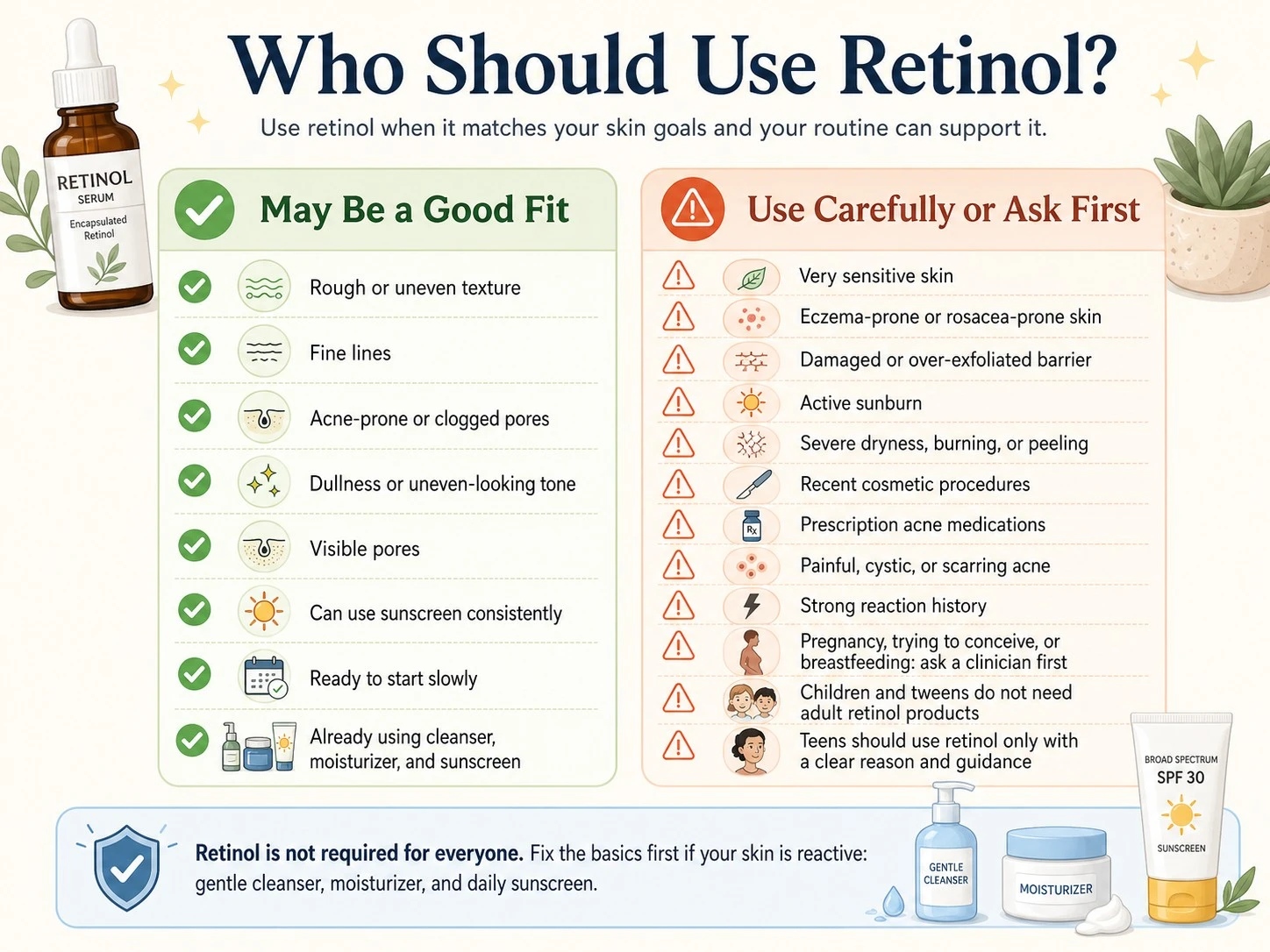
Retinol is most useful when you have a clear skin goal and a routine that can support it. It may be a good fit if you:
- Have rough or uneven texture.
- Want support for fine lines.
- Have acne-prone or clogged-pore skin.
- Notice dullness or uneven-looking tone.
- Want to improve the look of visible pores.
- Can use sunscreen consistently.
- Are ready to start slowly and watch your skin’s response.
- Already have a basic cleanser, moisturizer, and sunscreen routine.
Retinol is not required for everyone, and age alone is not a reason to start. If your skin is very reactive, your barrier is damaged, or basic products already sting, fix the basics before adding retinol.
Who Should Avoid Retinol or Use It Carefully?
Retinol is not the right choice for every skin situation. Use it carefully, or ask a dermatologist first, if you have:
- Very sensitive skin.
- Eczema-prone skin.
- Rosacea-prone skin.
- A damaged or over-exfoliated skin barrier.
- Active sunburn.
- Severe dryness, burning, or peeling.
- Recent cosmetic procedures.
- Prescription acne medications.
- Painful, cystic, or scarring acne.
- A history of strong reactions to skincare.
Retinoids, including over-the-counter retinol and adapalene, are generally avoided during pregnancy. If you are pregnant, trying to conceive, or breastfeeding, ask a clinician before using retinol or other retinoids. [2]
Children and tweens do not need adult retinol products. Teens should use retinol only with a clear reason and appropriate guidance. Most teen routines should focus on gentle cleansing, moisturizer if needed, sunscreen, and acne care when needed.
How to Start Retinol for Beginners
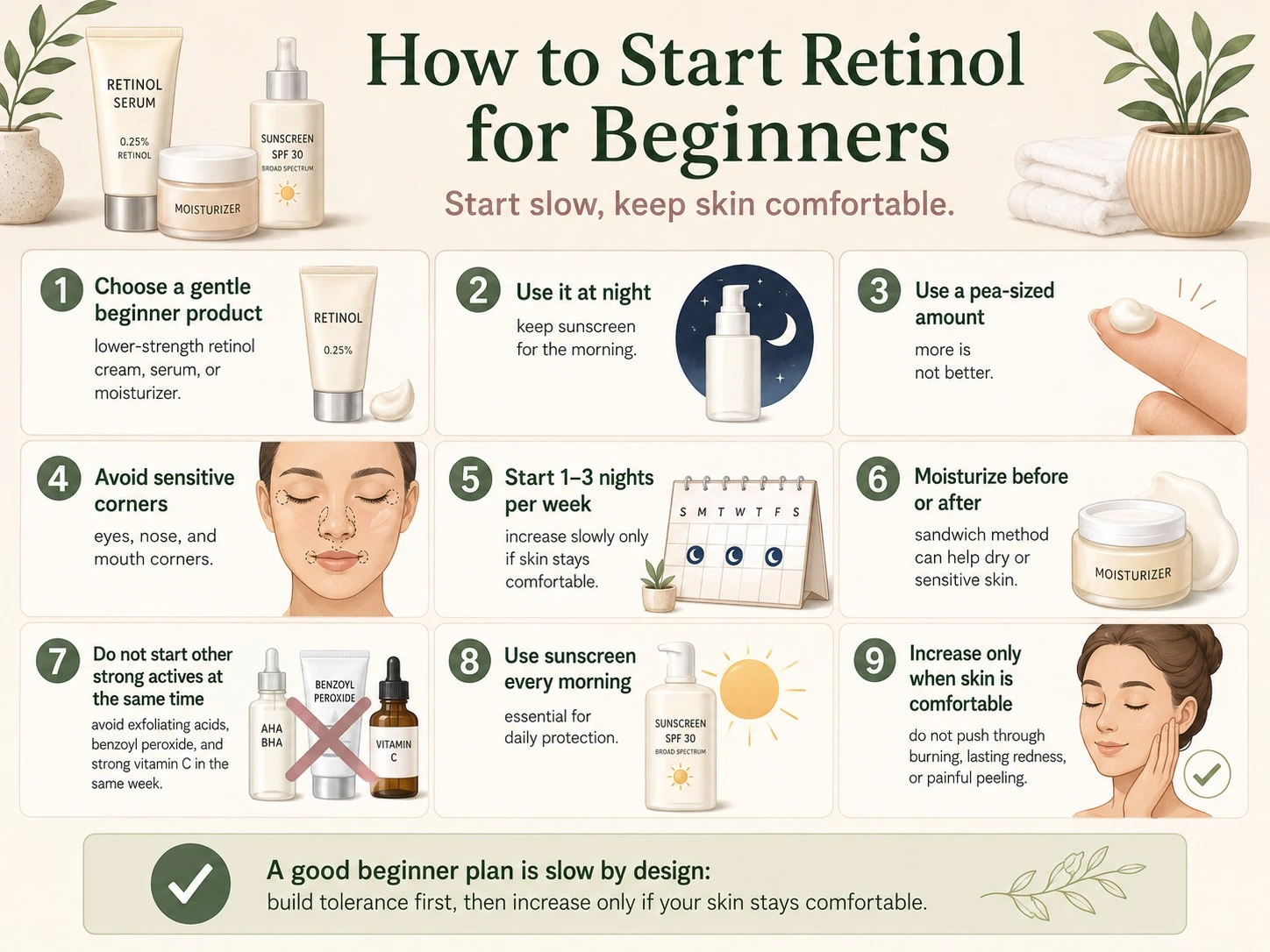
Most retinol problems start with using too much, too often, or alongside too many other active ingredients.
- Choose a gentle beginner product.
Do not start by chasing the highest strength. A lower-strength retinol cream, serum, or moisturizer can be a better first product if your skin is new to retinoids. - Use it at night.
Night use is easier for most beginners. It also keeps the routine simple: retinol at night, sunscreen in the morning. - Use a pea-sized amount.
Use a small amount for the whole face. More product does not mean faster results. It usually means more irritation. - Avoid sensitive corners.
Keep retinol away from the corners of the eyes, nose, and mouth at first. These areas often get dry and irritated more easily. - Start one to three nights per week.
A beginner can start once or twice per week. If the skin stays comfortable, increase slowly. - Moisturize before or after.
Moisturizer helps reduce dryness and makes retinol easier to tolerate. Dry or sensitive skin may benefit from the sandwich method. - Do not add other strong actives at the same time.
Avoid starting exfoliating acids, benzoyl peroxide, or strong vitamin C in the same week. Introduce one change at a time. - Use sunscreen every morning.
Sunscreen is part of a retinol routine. Without it, dark spots, uneven tone, and sun damage are harder to manage. - Increase only when your skin is comfortable.
Do not increase frequency if you still have burning, lasting redness, or painful peeling.
A good beginner plan is slow by design: build tolerance first, then increase only if your skin stays comfortable.
Where Does Retinol Fit in a Skincare Routine?
A retinol routine should stay simple. You do not need ten steps for it to work.
| Routine | Simple Order |
|---|---|
| Morning | Cleanser or rinse → moisturizer if needed → sunscreen |
| Retinol night | Cleanser → moisturizer if sandwiching → retinol → moisturizer |
| Non-retinol night | Cleanser → moisturizer / barrier support |
| Acid night | Cleanser → exfoliant if used → moisturizer, but not on the same night as retinol for beginners |
Beginners should not use retinol and AHA/BHA exfoliating acids on the same night. Alternate nights first.
Vitamin C and retinol can exist in the same overall routine, but many beginners do better with vitamin C in the morning and retinol at night. If your skin is reactive, introduce one product first and wait before adding the other.
Keep the routine easy to repeat. Consistency matters more than adding more treatment steps.
What Is the Retinol Sandwich Method?
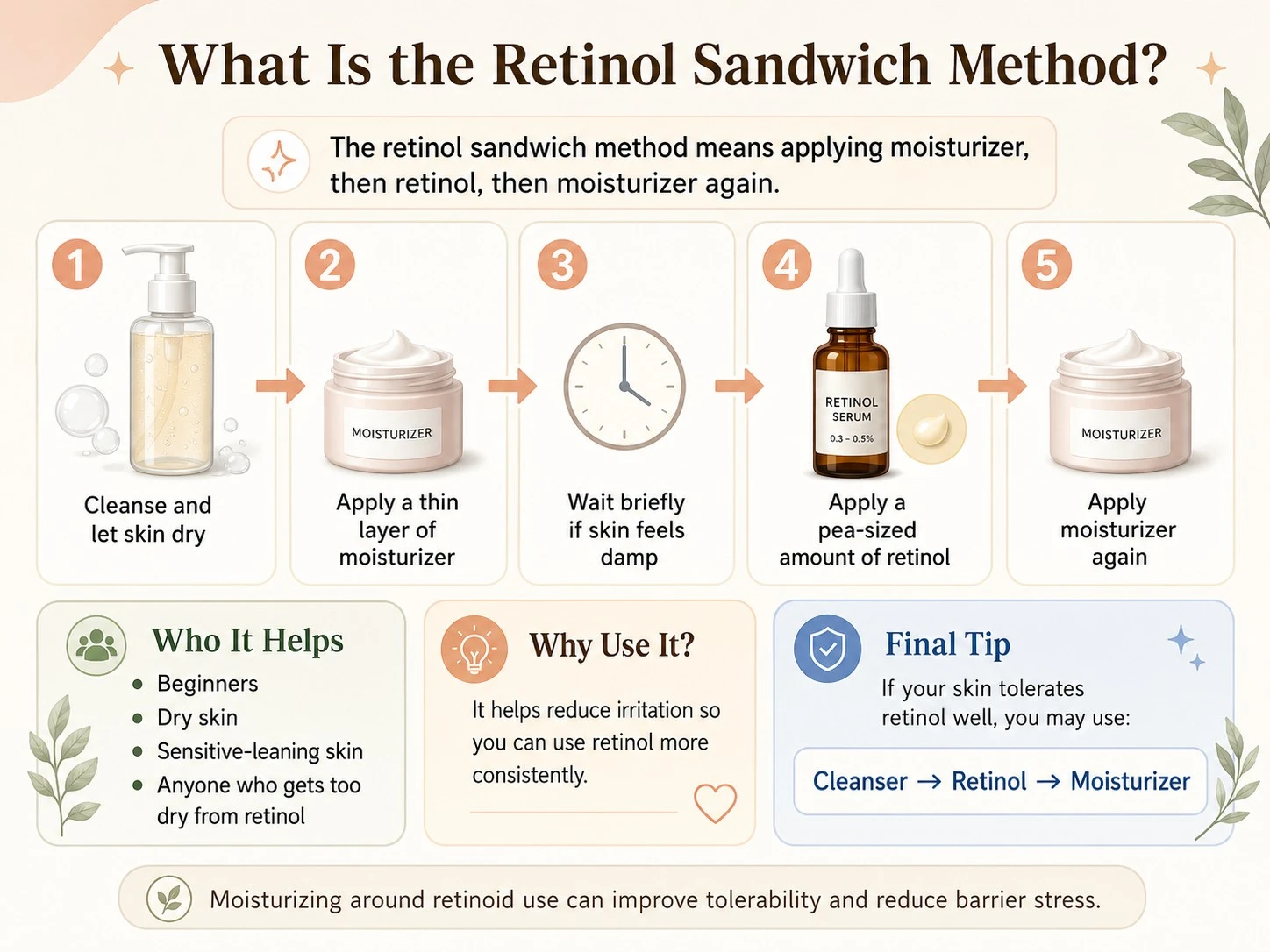
The retinol sandwich method means applying moisturizer, then retinol, then moisturizer again.
It is useful for beginners, dry skin, sensitive-leaning skin, or anyone who gets too dry from retinol. The goal is to reduce irritation so you can keep using the product consistently.
How to do it:
- Cleanse and let your skin dry.
- Apply a thin layer of moisturizer.
- Wait briefly if your skin feels damp.
- Apply a pea-sized amount of retinol.
- Apply moisturizer again.
Not everyone needs the sandwich method. If your skin tolerates retinol well, you can use cleanser → retinol → moisturizer. If your skin gets dry or tight, the sandwich method is a practical adjustment.
Moisturizing around retinoid use can improve tolerability and reduce barrier stress. [5]
Retinol Side Effects: What Is Normal and What Is Not?
Some dryness or mild flaking can happen when you start retinol. Severe burning, swelling, rash, or painful cracking is a warning sign, not a normal goal.
| Reaction | Usually Means | What to Do |
|---|---|---|
| Mild dryness | Skin is adjusting | Moisturize, reduce frequency |
| Light peeling | Too much or too fast | Use less often |
| Mild tingling | Can happen | Monitor closely |
| Burning | Irritation warning | Stop or reduce use |
| Lasting redness | Barrier stress | Pause retinol |
| Swelling or rash | Possible reaction | Stop and seek medical advice |
| Painful cracking | Barrier damage | Stop and repair barrier |
| Worsening acne in usual breakout areas | Possible purging | Monitor for a limited time |
| New rash or breakouts in unusual areas | Not typical purging | Stop and reassess |
Retinol irritation often comes from using too much, using it too often, or combining it with too many strong products. Reduce frequency for mild dryness or peeling, but do not push through severe discomfort.
If your face feels hot, painful, swollen, or cracked, pause retinol and return to a gentle cleanser, moisturizer, and sunscreen. If symptoms are severe or do not improve, see a dermatologist.
Retinol Purging vs Breakouts
Retinol can bring clogged pores to the surface faster for some people. This is often called purging. It can happen with ingredients that affect skin turnover, including retinoids, and should begin improving within a limited adjustment period. [7]
Purging should not be used as an excuse to ignore every bad reaction. Burning, rash, swelling, and painful irritation are not signs that retinol is “working.”
| Sign | More Like Purging | More Like Irritation or Breakout |
|---|---|---|
| Location | Usual breakout areas | New or unusual areas |
| Timing | Starts after adding retinol | Can happen anytime |
| Feeling | Small clogged bumps or pimples | Burning, itching, rash, swelling |
| Duration | Should improve over weeks | May worsen if you continue |
| Response | Reduce frequency and monitor | Pause product and repair barrier |
If breakouts keep getting worse after 8 to 12 weeks, or if acne is painful or scarring, stop adding more products and ask a dermatologist about a better acne plan.
What Can You Use With Retinol?
Retinol pairs best with hydration, barrier support, and sun protection. It becomes harder to tolerate when you layer too many strong actives too quickly.
| Ingredient / Product | Use With Retinol? | Practical Advice |
|---|---|---|
| Moisturizer | Yes | Helps reduce dryness |
| Sunscreen | Yes, daily | Essential in the morning |
| Niacinamide | Yes | Good barrier-support pairing |
| Hyaluronic acid / glycerin | Yes | Helps hydration |
| Ceramides | Yes | Good for barrier support |
| Vitamin C | Yes, but separate for beginners | Morning vitamin C, night retinol |
| AHAs / BHAs | Use carefully | Alternate nights first |
| Benzoyl peroxide | Use carefully | Can be drying; depends on product and acne plan |
| Scrubs / peels | Avoid at first | High irritation risk |
| Strong fragrance / alcohol-heavy products | Avoid if irritated | Can worsen sensitivity |
Retinol routines often fail from over-layering, not from retinol alone. Build your routine around what your skin can tolerate, not how many actives you can combine.
How Long Does Retinol Take to Work?
Retinol takes time. Texture may improve before you see changes in fine lines, pigmentation, or acne.
| Goal | Realistic Timeline |
|---|---|
| Skin adjustment | 2–6 weeks |
| Smoother texture | 6–12 weeks |
| Acne-prone skin | 8–12 weeks |
| Dullness | 8–12 weeks |
| Fine lines | 3–6+ months |
| Dark spots / uneven tone | 3–6+ months |
| Firmness-looking changes | 6+ months |
These timelines are not guarantees. Product strength, frequency, skin type, sunscreen use, and the cause of the concern all affect results.
If you are using retinol for acne and your skin is still worsening after a reasonable trial, it may not be the right plan. Topical retinoids and benzoyl peroxide are important acne care options, but acne type and severity should guide the choice. [3]
Retinol Strength, Product Types, and How to Choose
Retinol product choice matters because a formula that is too strong or too drying can make you stop before you get benefits.
| Product Type | Best For | Watch Out For |
|---|---|---|
| Retinol serum | People who want a targeted step | Can be stronger or drying |
| Retinol cream | Dry or beginner skin | May feel heavier |
| Retinol moisturizer | Simple routines | Lower intensity, but easier to tolerate |
| Retinol eye cream | Eye-area formulas | Do not use regular retinol too close to eyes |
| Retinal product | Users ready for a stronger OTC option | More irritation potential |
| Prescription retinoid | Acne or stronger treatment needs | Requires medical guidance in many markets |
Beginners should start with low frequency before thinking about higher strength. If a low-strength product irritates your skin every time, a stronger product will not solve the problem.
Rules and concentration limits vary by market. In the European Union, updated cosmetic rules set retinol-equivalent limits for retinol, retinyl acetate, and retinyl palmitate in certain cosmetic products. This reinforces a practical point: more vitamin A is not automatically better for daily skincare. [6]
For many people, a gentler retinol cream used two or three nights per week is more effective in real life than a strong serum used once and abandoned.
Common Retinol Mistakes
Most retinol problems come from starting too aggressively. Avoid these mistakes:
- Starting too strong.
Better: start lower and slower. - Using it every night too soon.
Better: build tolerance first. - Using too much product.
Better: use a pea-sized amount for the face. - Skipping moisturizer.
Better: support the skin barrier. - Skipping sunscreen.
Better: use daily SPF. - Mixing with acids too early.
Better: alternate nights. - Using retinol on irritated skin.
Better: pause and repair the barrier. - Expecting results in one week.
Better: think in months. - Using adult retinol on young skin without a real need.
Better: teens should focus on cleanser, moisturizer, sunscreen, and acne care if needed. - Using retinol during pregnancy without asking a clinician.
Better: stop or ask your healthcare professional.
If your skin becomes more reactive every week, simplify the routine instead of adding more products.
Retinol Alternatives for Sensitive Skin
If retinol is too irritating, you still have options. These alternatives are not identical to retinol, but they may fit certain goals better.
| Alternative | Best For | What to Know |
|---|---|---|
| Bakuchiol | People avoiding retinol irritation | Not identical to retinol |
| Azelaic acid | Redness-looking skin, acne, uneven tone | Can still irritate |
| Niacinamide | Barrier, pores, oiliness, redness | Beginner-friendly |
| Peptides | Fine-line support | More subtle results |
| Vitamin C | Dullness, uneven tone | Can irritate sensitive skin |
| AHAs / PHAs | Texture and dullness | Use carefully |
Do not assume “retinol alternative” means irritation-free. Sensitive skin can react to natural extracts, acids, fragrance, and strong vitamin C products.
If you are pregnant, trying to conceive, or breastfeeding, ask a clinician before choosing an alternative from online advice.
When to See a Dermatologist
Retinol is available over the counter, but some skin concerns need medical support. See a dermatologist if:
- Acne is painful, cystic, or scarring.
- Dark spots are spreading or look like melasma.
- You have severe burning, swelling, rash, or cracking.
- You cannot tolerate even low-frequency retinol.
- You are pregnant, trying to conceive, or breastfeeding and need acne or aging guidance.
- You are using prescription acne medications.
- You have rosacea, eczema, or a damaged skin barrier.
- You need stronger treatment such as adapalene, tretinoin, or prescription options.
Getting help does not mean your routine failed. It means your skin may need a more specific plan.
Final Thoughts
Retinol can be one of the most useful skincare ingredients, but it works best as a long-term routine, not a quick fix. Start slowly, use a small amount, keep moisturizer and sunscreen in place, and increase only when your skin stays comfortable.
The right routine is the one you can keep using without damaging your skin barrier.
FAQs About Retinol
What is retinol?
Retinol is a vitamin A derivative used in over-the-counter skincare products. It belongs to the retinoid family and is often used for rough texture, fine lines, acne-prone skin, visible pores, dullness, and uneven-looking tone.
What does retinol do for your skin?
Retinol supports skin renewal, which can improve the look of rough texture, fine lines, clogged pores, dullness, and uneven tone over time. It does not erase wrinkles, permanently shrink pores, or cure every type of acne.
Is retinol good for acne?
Retinol can help acne-prone or clogged-pore skin because retinoids support clearer pores. Inflamed, painful, or scarring acne may need a more complete acne plan, such as benzoyl peroxide, adapalene, prescription treatment, or dermatologist care.
How often should beginners use retinol?
Beginners can start one to three nights per week. If the skin stays comfortable, frequency can slowly increase. Do not increase use if you have burning, lasting redness, painful peeling, or new sensitivity.
Should retinol be used at night?
Retinol is commonly used at night because it is easier to manage irritation and keep the routine consistent. Morning sunscreen still matters because retinol routines often target concerns affected by UV exposure, such as dark spots, texture, and fine lines.
Can I use retinol every night?
Some people can use retinol every night after their skin builds tolerance. It should not be the starting point for beginners. Start low and slow, then increase only if your skin remains comfortable.
Can I use retinol with vitamin C?
Yes, retinol and vitamin C can be used in the same overall routine, but beginners should introduce them separately. A practical approach is vitamin C in the morning and retinol at night. If irritation appears, simplify the routine.
Can I use retinol with niacinamide?
Yes, niacinamide is often a good partner for retinol because it supports barrier comfort and can be used in many routines. If your skin is sensitive, introduce one product at a time so you can see how your skin responds.
What is retinol purging?
Retinol purging is a temporary breakout phase that can happen in usual breakout areas after starting a retinoid. It should improve over time. Burning, rash, swelling, painful cracking, or breakouts in unusual areas should not be treated as normal purging.
Can I use retinol while pregnant?
Retinoids, including over-the-counter retinol, are generally avoided during pregnancy. If you are pregnant, trying to conceive, or breastfeeding, ask your clinician before using retinol, adapalene, tretinoin, or any other retinoid.
Is retinol safe for sensitive skin?
Retinol can work for some sensitive skin users, but it needs a cautious approach. Start with low frequency, moisturize well, avoid mixing with acids at first, and stop if you get burning, swelling, rash, or painful peeling. If you have rosacea, eczema, or a damaged skin barrier, ask a dermatologist first.
Sources
[1] Cleveland Clinic. Retinol: Cream, Serum, What It Is, Benefits, How To Use
[2] American Academy of Dermatology. Dermatologist-approved pregnancy skin care
[3] American Academy of Dermatology / Journal of the American Academy of Dermatology. Guidelines of care for the management of acne vulgaris
[4] Baylor Scott & White Health. Tretinoin vs. retinol: Which skincare option works best for your skin goals
[5] Dermatology Times. Open Sandwich Moisturization Regimen Does Not Affect Bioactivity of Retinols and Retinoids
[6] EUR-Lex. Commission Regulation (EU) 2024/996 of 3 April 2024
[7] Dermatica. Retinoids: Why Skin Purges And How Long It Lasts


