

Why Is Stability Testing Important for Skincare Products?
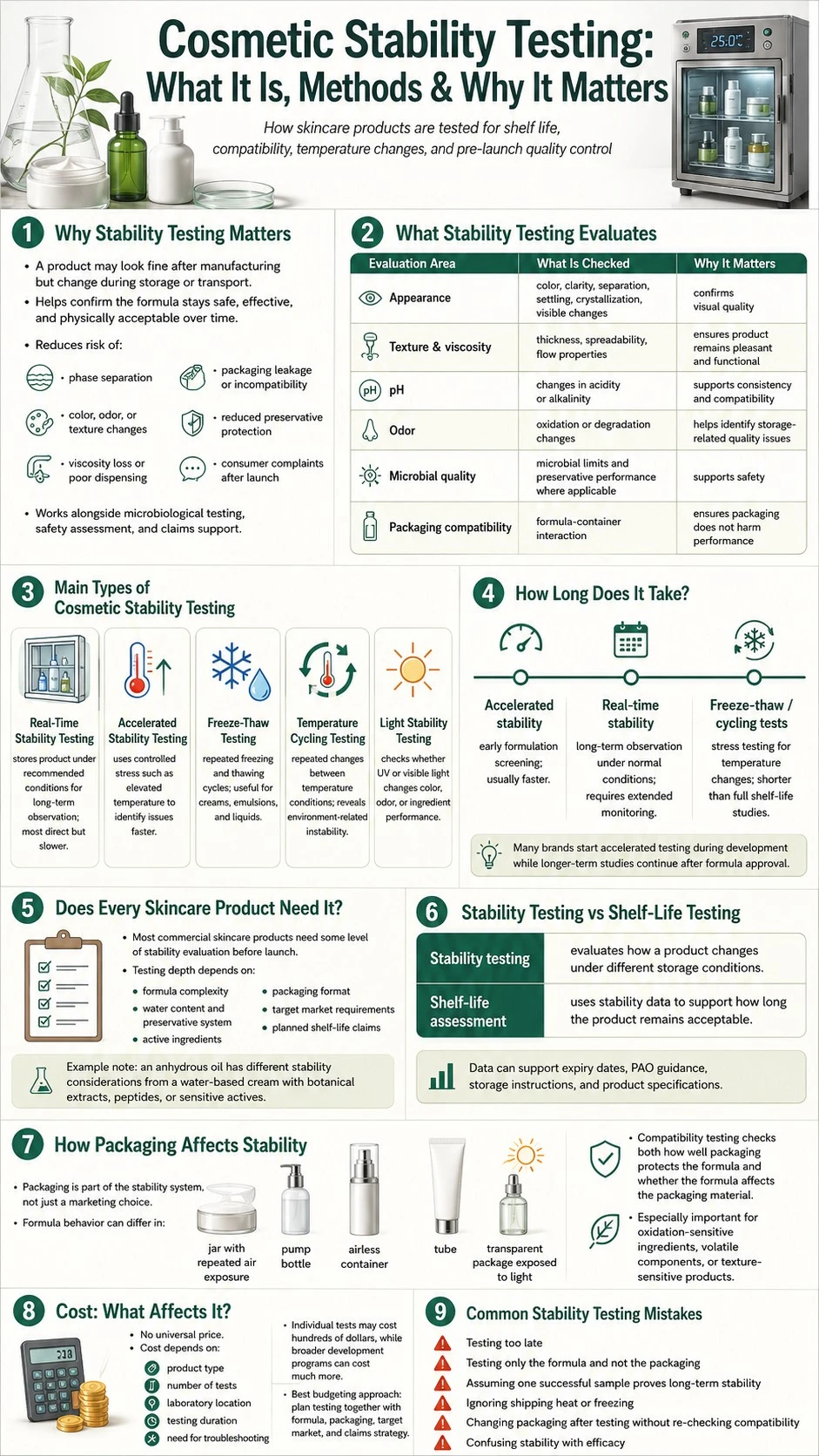
A skincare formula can look and feel acceptable immediately after manufacturing but change during months of storage or transportation. Ingredients may interact, emulsions may separate, preservatives may become less effective, or packaging may affect product quality.
Stability testing helps brands understand whether a formula can maintain its intended characteristics from production until the consumer finishes using the product.
For cosmetic manufacturers and brands, stability testing is not only a technical requirement. It is also a risk-control step that can prevent problems such as:
- phase separation in creams or emulsions;
- changes in color, odor, or texture;
- loss of viscosity or poor product dispensing;
- packaging leakage or incompatibility;
- reduced preservative protection;
- consumer complaints after launch.
Stability testing is one part of a broader product validation process. It works together with microbiological testing, safety assessment, and claims support rather than replacing them.
See Skincare Product Testing Guide: What Brands Need for a broader overview of testing requirements.
What Does Cosmetic Stability Testing Evaluate?
The exact test plan depends on the product type, ingredients, packaging, and target market. Common stability evaluations include physical, chemical, and microbiological observations.
| Evaluation Area | What Is Checked | Why It Matters |
|---|---|---|
| Appearance | Color, clarity, separation, settling, crystallization, visible changes | Confirms the product maintains expected visual quality |
| Texture and viscosity | Thickness, spreadability, flow properties | Ensures the product remains pleasant and functional |
| pH | Changes in acidity or alkalinity | Helps confirm formula consistency and ingredient compatibility |
| Odor | Changes caused by oxidation or ingredient degradation | Identifies quality issues during storage |
| Microbial quality | Microbial limits and preservative performance where applicable | Supports product safety |
| Packaging compatibility | Interaction between formula and container | Ensures packaging does not damage product performance |
What Are the Main Types of Cosmetic Stability Testing?
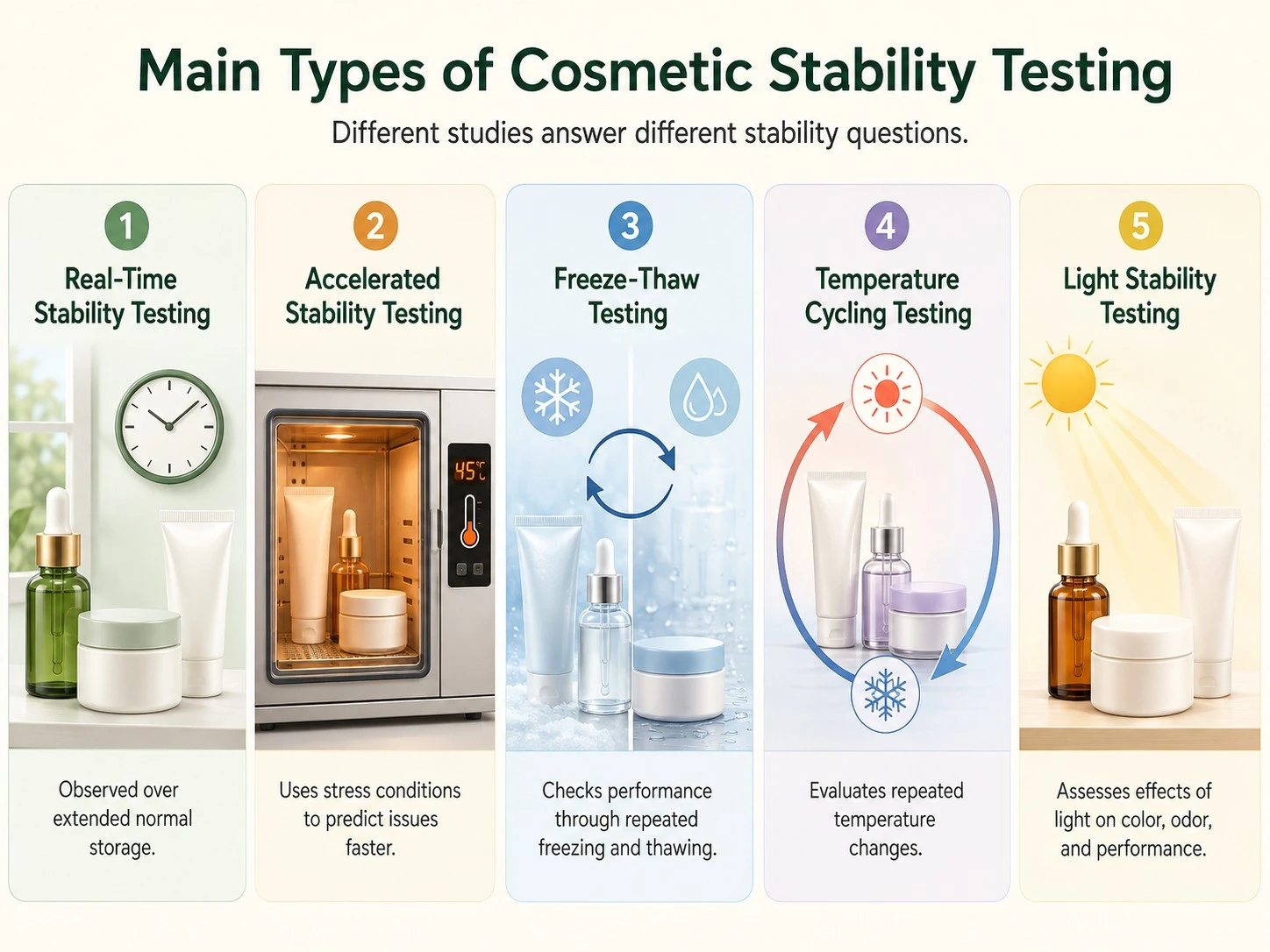
Different stability studies answer different questions. A complete development program often combines several methods rather than relying on one test condition.
Real-Time Stability Testing
Real-time stability testing stores a product under recommended conditions and observes changes over an extended period.
This provides the most direct information about how a product behaves during normal storage, but it requires more time before final shelf-life decisions can be confirmed.
Accelerated Stability Testing
Accelerated stability testing exposes products to controlled stress conditions, such as elevated temperatures, to observe potential changes more quickly.
It can help predict possible stability issues earlier during development, although accelerated conditions do not perfectly reproduce every real-world storage situation.
Freeze-Thaw Testing
Freeze-thaw testing repeatedly exposes products to freezing and thawing cycles.
This is particularly relevant for emulsions, creams, and liquid products that may experience temperature fluctuations during shipping or storage.
Temperature Cycling Testing
Temperature cycling evaluates how a product responds to repeated changes between different temperature conditions.
It helps identify formulas that appear stable under one condition but become unstable when exposed to environmental changes.
Light Stability Testing
Some ingredients are sensitive to light exposure. Light stability testing evaluates whether UV or visible light affects color, odor, or ingredient performance.
How Long Does Cosmetic Stability Testing Take?
The timeline depends on the testing approach and product requirements.
| Testing Type | Typical Purpose | Time Consideration |
|---|---|---|
| Accelerated stability | Early evaluation of potential formulation issues | Usually faster than real-time studies |
| Real-time stability | Long-term observation under normal conditions | Requires extended monitoring |
| Freeze-thaw or cycling tests | Stress evaluation during temperature changes | Shorter than full shelf-life studies |
Many brands begin accelerated testing during development while continuing longer-term studies after formula approval. The exact timeline depends on product category, claims, market requirements, and manufacturer protocols.
Does Every Skincare Product Need Stability Testing?
Most commercial skincare products require some level of stability evaluation before launch because brands need confidence that the product remains safe and acceptable throughout its intended use period.
The depth of testing depends on factors such as:
- formula complexity;
- water content and preservative system;
- active ingredients;
- packaging format;
- target market requirements;
- planned shelf-life claims.
A simple anhydrous oil product may have different stability considerations from a water-based cream containing botanical extracts, peptides, or sensitive active ingredients.
Stability Testing vs Shelf-Life Testing: What Is the Difference?
These terms are closely related but are not always identical.
| Term | Main Focus |
|---|---|
| Stability testing | Evaluates how a product changes under different storage conditions |
| Shelf-life assessment | Uses stability data to support the period during which the product remains acceptable |
Stability data can support decisions about expiry dates, period-after-opening recommendations, storage instructions, and product specifications.
How Does Packaging Affect Cosmetic Stability?
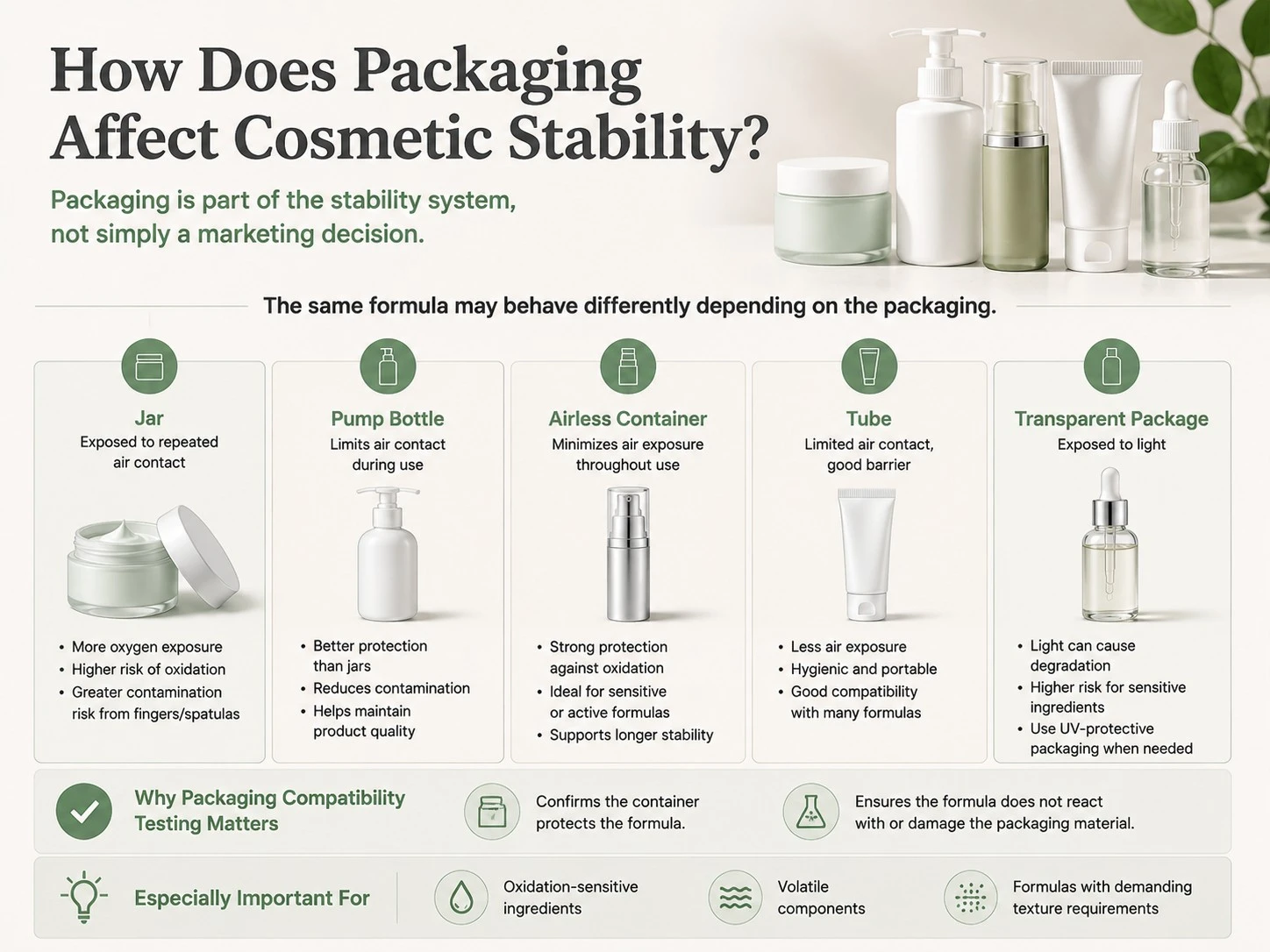
Packaging is part of the stability system, not simply a marketing decision.
The same formula may behave differently depending on whether it is stored in:
- a jar exposed to repeated air contact;
- a pump bottle;
- an airless container;
- a tube;
- a transparent package exposed to light.
Packaging compatibility testing helps identify whether the container protects the formula and whether the formula affects the packaging material.
This is especially important for products containing oxidation-sensitive ingredients, volatile components, or formulas with demanding texture requirements.
See Skincare Packaging Guide: How Brands Choose Packaging for more information about packaging decisions.
How Much Does Cosmetic Stability Testing Cost?
There is no universal stability-testing price because costs depend on the product, number of tests, laboratory location, testing duration, and whether additional troubleshooting is required.
Published laboratory examples show that individual cosmetic tests may range from hundreds of dollars, while broader development programs combining multiple tests, documentation, and project management can cost considerably more.
The most accurate budget approach is to define the testing plan together with the formula, packaging, target market, and claims strategy.
Testing should be considered during development rather than treated as an unexpected expense before launch.
Common Cosmetic Stability Testing Mistakes
- Testing too late. Discovering instability after packaging production can create expensive delays.
- Testing only the formula. Packaging interaction can also affect product quality.
- Assuming one successful sample means long-term stability. Products can change during storage.
- Ignoring transportation conditions. Products may experience heat or freezing during shipping.
- Changing packaging after testing. A new container may require compatibility evaluation.
- Confusing stability with efficacy. A stable product is not automatically proven effective.
Final Thoughts
Cosmetic stability testing is the process that connects a promising formula with a reliable commercial product. It helps brands understand whether a skincare product can maintain its quality, safety, and user experience throughout its intended lifespan.
The best time to plan stability testing is during product development, when formula, packaging, claims, and target markets are still being defined. A well-planned testing strategy reduces launch risks and creates a stronger foundation for long-term product quality.


