


Skincare product testing is not one universal lab test or a single certificate. A launch-ready testing plan usually combines formula stability, packaging compatibility, microbiological quality, preservative protection, safety evaluation, claim substantiation, and finished-batch quality control based on the product and target market.
The exact test package changes with water content, preservative system, packaging, intended users, claims, ingredients, and product classification. A simple facial oil and a water-based eye cream should not automatically follow the same test plan, and sunscreen or therapeutic-style products can require a different regulatory pathway altogether.
Stability and Packaging Compatibility Testing
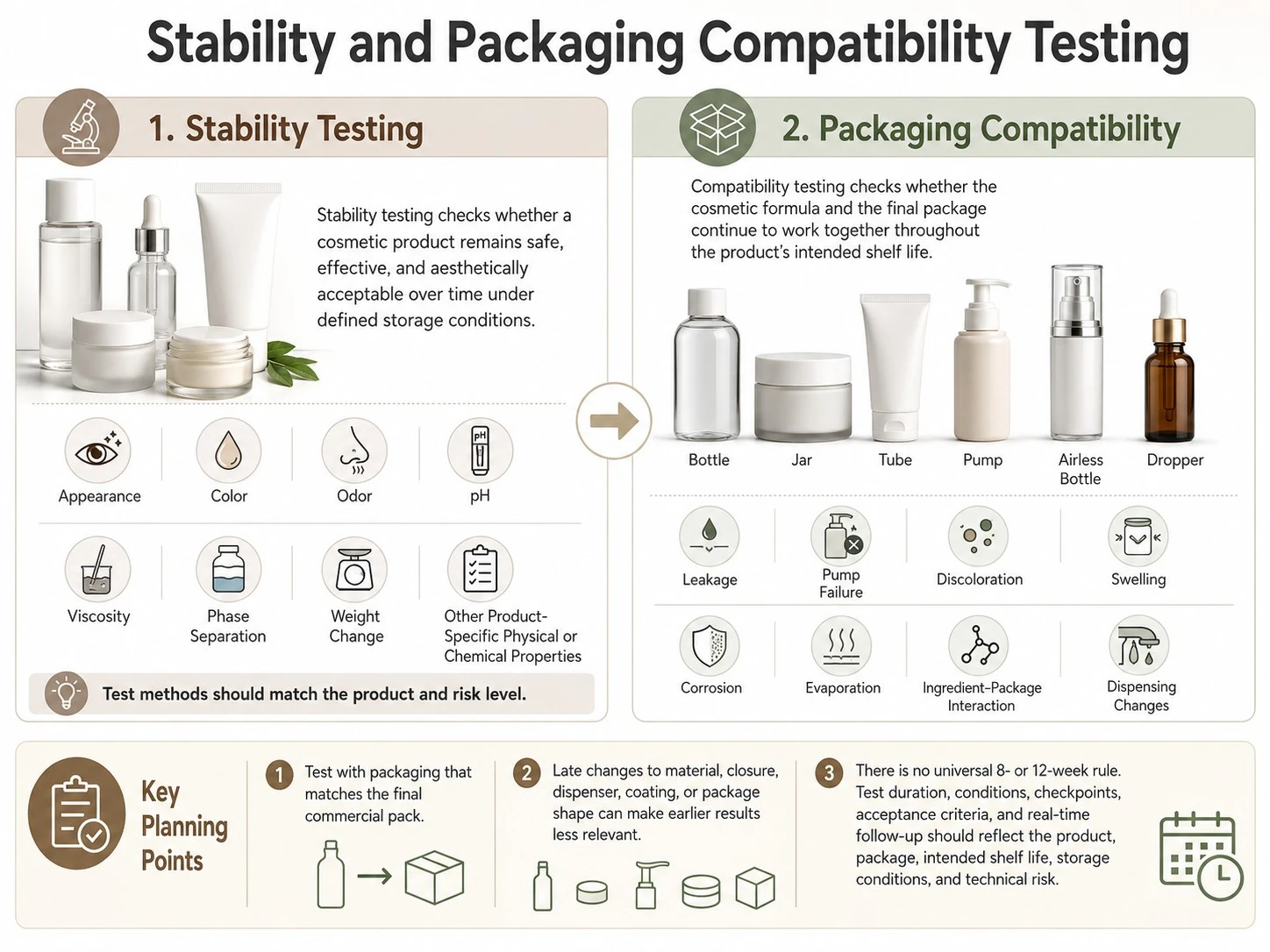
Stability testing evaluates whether a cosmetic remains suitable over time under defined storage conditions. The protocol can monitor factors such as appearance, color, odor, pH, viscosity, phase separation, weight change, and other product-specific physical or chemical properties. ISO/TR 18811 provides a technical framework for selecting appropriate stability methods rather than imposing one identical protocol on every cosmetic.[1]
Packaging compatibility answers a different question: whether the formula and its final container continue to work together. A formula can look stable in a laboratory vessel but fail in the commercial package because of leakage, pump failure, discoloration, swelling, corrosion, evaporation, ingredient-package interaction, or changes in dispensing.
Run compatibility work with packaging that is representative of the final bottle, jar, tube, pump, airless system, dropper, or other primary pack. Changing the material, closure, dispenser, coating, or package geometry late in development can make earlier compatibility evidence less relevant. Our Skincare Packaging Guide explains why packaging should be selected alongside the formula rather than after testing is complete.
There is no universal rule that every cosmetic stability programme must last exactly 8, 12, or another fixed number of weeks. Test duration, conditions, checkpoints, acceptance criteria, and real-time follow-up should reflect the product, package, intended shelf life, storage conditions, and technical risk.[1]
Microbiological Testing vs Preservative Challenge Testing
These tests are related but not interchangeable. Microbiological quality testing checks the microbial condition of a product sample. ISO 17516 provides microbiological limits used to help assess cosmetic product quality.[3]
A preservative efficacy test, often called a challenge test, evaluates how effectively the product controls introduced microorganisms over the test period. ISO 11930 describes a preservation efficacy test and a broader procedure for evaluating the antimicrobial protection of cosmetic products that are not considered microbiologically low risk.[2]
Not every cosmetic has the same microbiological risk. Products with characteristics such as low water activity, high alcohol content, or extreme pH can sometimes qualify as low risk after an appropriate assessment. ISO 29621 provides guidance for identifying such products.[4]
This means “preservative-free” does not automatically mean “no microbiology work,” and adding a preservative does not prove the finished formula is adequately protected. Product composition, manufacturing hygiene, packaging, consumer use, and the full preservation system all matter.
Safety Assessment and Skin Tolerance Testing
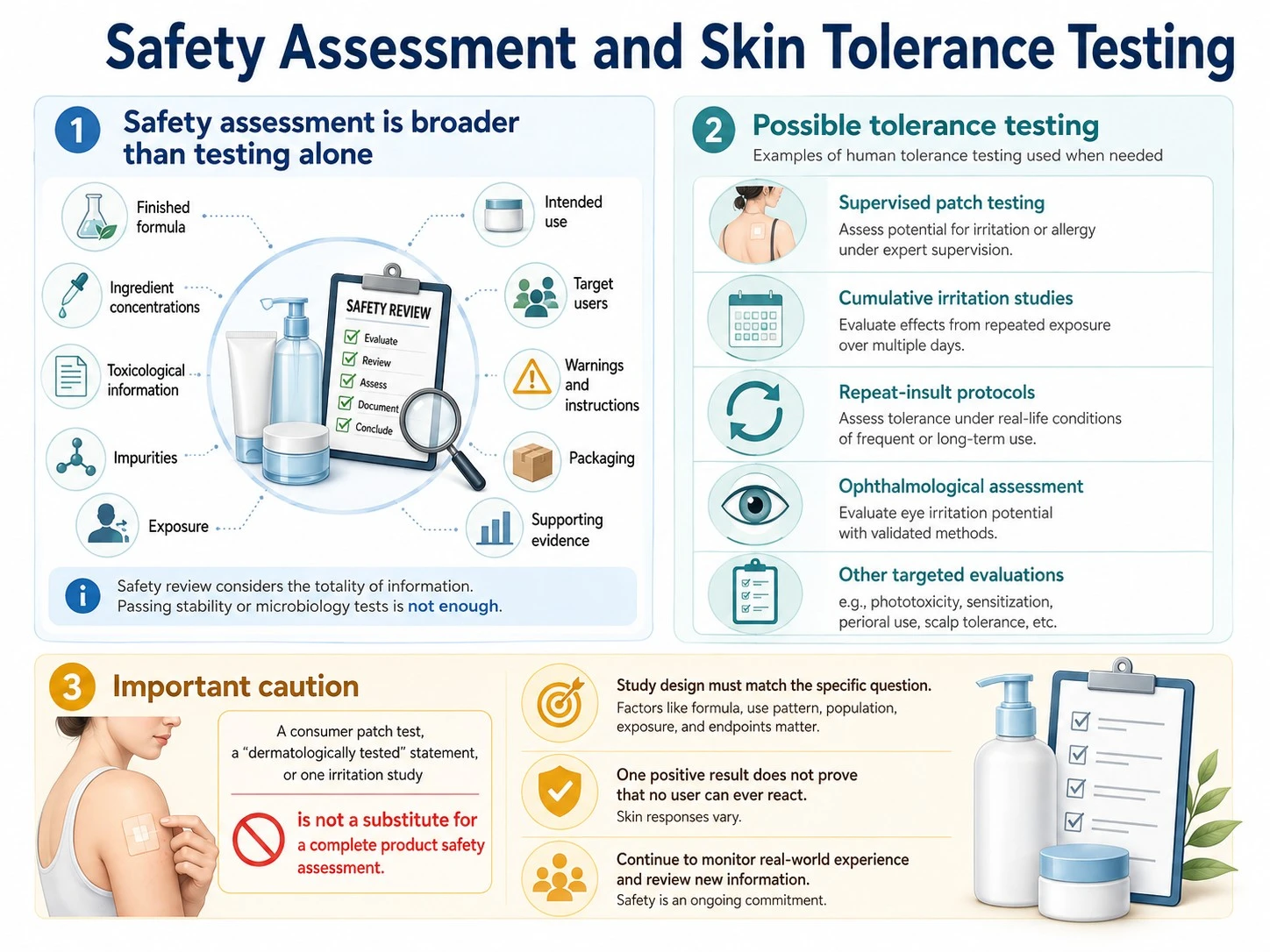
Product safety is broader than passing stability or microbiology. The safety review considers the finished formula, ingredient concentrations, toxicological information, impurities, exposure, intended use, target users, warnings, packaging, and other relevant evidence. Some markets require a formal safety report prepared by a qualified assessor; other markets use different safety-substantiation frameworks.[5][7]
Human tolerance testing can be useful when the existing safety package leaves a relevant question or when the brand wants evidence for a specific positioning. Depending on the product and study objective, this can include supervised patch testing, cumulative irritation studies, repeat-insult protocols, ophthalmological assessment, or other targeted evaluations.
Do not treat a consumer patch test, “dermatologically tested” statement, or one irritation study as a substitute for a complete product safety assessment. The study design must match the question being asked, and a test that supports tolerance in one population does not prove that no user can ever react.
Claims and Performance Testing
Safety testing asks whether the product can be used safely. Claims testing asks whether the product does what the brand says it does. These are different evidence tasks.
| Claim Type | Possible Evidence Approach | Example |
|---|---|---|
| Instrumental claim | Objective measurement using suitable equipment and a defined protocol | Improves measured skin hydration |
| Clinical / expert assessment | Grading by a qualified evaluator under controlled study conditions | Reduces the appearance of fine lines |
| Consumer perception | Structured questionnaire completed by product users | Skin feels smoother or softer |
| Comparison claim | Head-to-head or benchmark protocol designed around the exact comparison | Absorbs faster than a reference formula |
| Special functional claim | Recognized category-specific method where applicable | SPF or water-resistance performance |
The wording should be decided before commissioning the study because the claim determines what must be measured. A hydration study does not automatically support “repairs the skin barrier,” and a consumer questionnaire does not automatically prove a clinical change. In markets with explicit cosmetic-claims rules, evidence must be relevant to the effect being claimed; for example, EU rules include common criteria for the justification of cosmetic claims, while Great Britain requires brands to be able to prove marketing claims are correct.[5][6]
Avoid paying for broad “clinical testing” before the final claim set is clear. Define the exact wording, target population, test duration, controls, endpoints, statistics, and report format with the laboratory before the study starts.
Which Tests Matter Most for Different Skincare Products?
A risk-based plan is more useful than copying the same package of tests onto every SKU.
| Product Type | Testing Priorities | Extra Questions to Ask |
|---|---|---|
| Water-based serum, lotion, or cream | Stability, packaging compatibility, microbiological quality, preservation protection, safety | Does the preservative system remain effective across the final pH and package? |
| Anhydrous oil or balm | Stability, oxidation control, packaging compatibility, safety, microbiological risk assessment | Does the product qualify as microbiologically low risk, and how will oxidation be monitored? |
| Acid, retinoid, or other active-focused treatment | Stability, active-related specifications, safety, tolerance, packaging, claim support | Are pH, active level, light exposure, oxygen, or package material critical to performance? |
| Eye-area product | Standard quality and safety work plus eye-area tolerance considerations where appropriate | Does intended use justify additional ophthalmological or irritation evaluation? |
| High-claim anti-aging or brightening product | Core safety and quality testing plus well-designed efficacy substantiation | Does the study measure the exact claim the brand plans to print? |
| Sunscreen | Stability, compatibility, microbiology, safety, plus market-specific SPF/UVA/water-resistance and regulatory testing | Which sunscreen methods and product classification apply in each launch market? |
Sunscreen is a useful example of why the target market must be defined early. International standards include methods for determining SPF, but sunscreen classification, permitted filters, labeling, claim methods, and market-entry requirements differ by jurisdiction.[8] Use our separate Sunscreen Development Timeline when SPF is part of the project.
Development Testing Is Not the Same as Batch Quality Control
A brand can complete development testing and still receive a bad commercial batch if manufacturing quality is weak. Development studies help define whether the product design is viable. Batch quality control checks whether each production batch matches the approved specification.
Finished-product specifications can include appearance, color, odor, pH, viscosity, density, fill weight, microbiological criteria, or product-specific chemical and physical limits. The exact release tests depend on the formula and quality system. Good manufacturing practice also requires controls around raw materials, equipment, production, storage, traceability, and finished-product quality.[5]
Before approving a manufacturer, ask who writes the finished-product specification, which parameters are tested on every batch, which results appear on the certificate of analysis, and what happens when a result is outside specification. See How to Choose a Skincare Manufacturer for the wider supplier evaluation process.
When Should Testing Be Repeated?
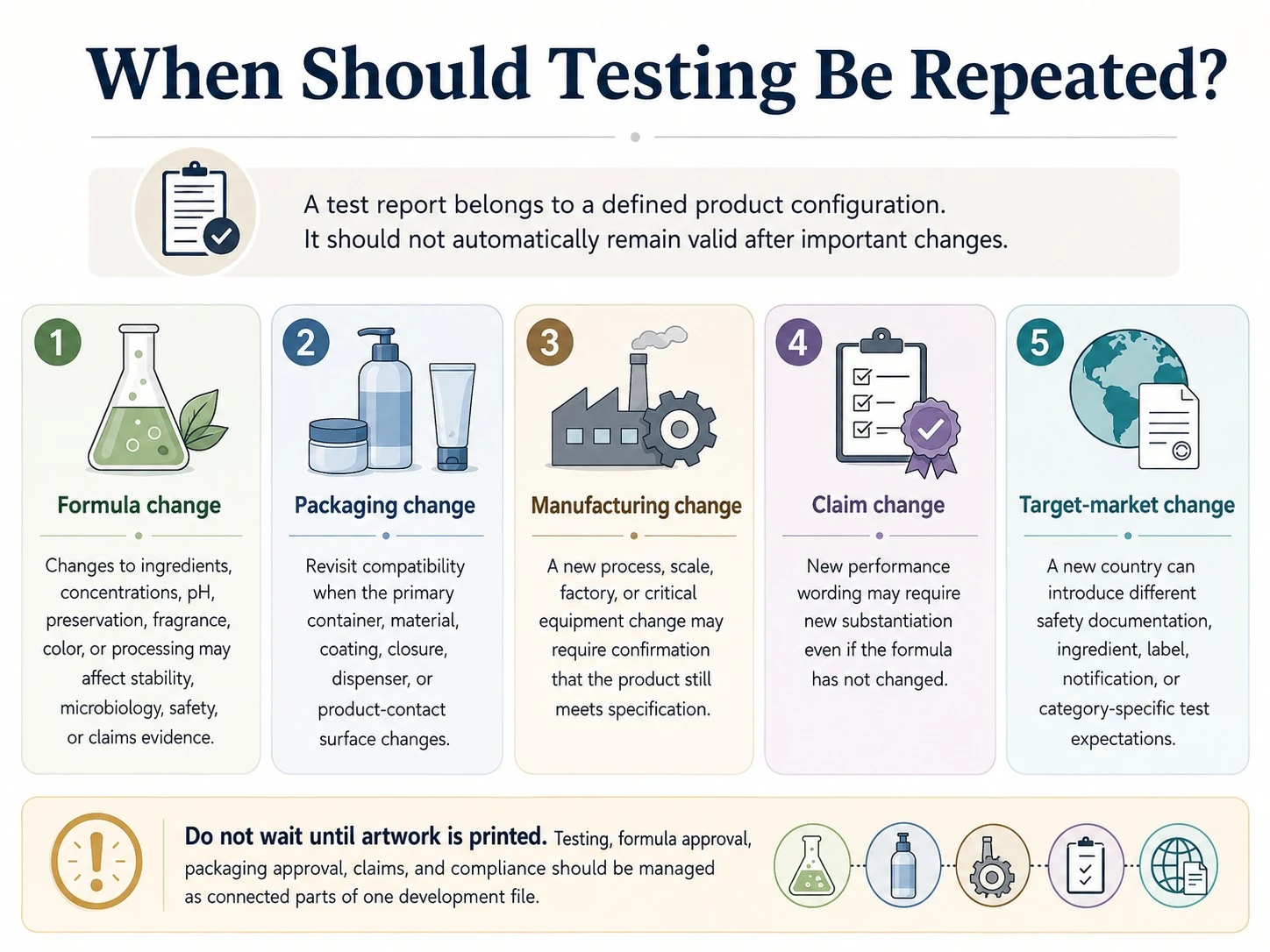
A test report belongs to a defined product configuration. It should not automatically be treated as valid forever after the formula, package, process, claims, or intended market change.
- Formula change: Reassess whether changes to ingredients, concentrations, pH, preservation, fragrance, color, or processing affect previous stability, microbiology, safety, or claims evidence.
- Packaging change: Revisit compatibility when the primary container, material, coating, closure, dispenser, or product-contact surface changes.
- Manufacturing change: A new process, scale, factory, or critical equipment change may require confirmation that the product still meets its specification.
- Claim change: New performance wording may require new substantiation even when the formula itself has not changed.
- Target-market change: A new country can introduce different safety documentation, ingredient, label, notification, or category-specific test expectations.
Do not wait until artwork is printed to identify these changes. Testing, formula approval, packaging approval, claims, and compliance should be managed as connected parts of one development file.
What Test Reports Should a Brand Request?
A manufacturer saying “the formula has passed testing” is not enough for a brand that needs to review launch risk. Ask what was tested, on which formula and package, by whom, under which method, when the work was completed, and whether the report is relevant to your exact SKU.
- Test report title, laboratory, and report date
- Exact sample or formula identification
- Packaging used during compatibility work
- Test method or protocol
- Storage or study conditions
- Acceptance criteria and results
- Conclusion and any deviations
- Whether the report is preliminary, accelerated, real-time, or final
- Whether the report supports the exact formula, claim, and target market
Private label buyers should also ask whether the supplier owns the report, can legally share it, and whether changing fragrance, active level, package, or artwork claims affects its relevance. Our Questions to Ask a Skincare Manufacturer helps turn this into a supplier-screening checklist.
How Target Market Changes the Testing Plan
There is no single global cosmetic testing checklist because safety files, claim rules, product classifications, ingredient restrictions, and special-category requirements vary by market. The same laboratory data may be useful in several countries, but the evidence package still has to be reviewed against the rules of each launch market.
For example, EU and Great Britain frameworks require formal product safety documentation and evidence supporting product effects, while the United States does not prescribe one fixed list of tests for every cosmetic but requires responsible companies to substantiate product safety.[5][7] Australia can classify products differently when therapeutic claims or certain sunscreen uses are involved.[9]
The practical approach is to define target countries and claims before the final test plan is approved. Do not run a generic package of studies first and ask a regulatory reviewer later whether those studies support the intended launch.
Final Thoughts
Skincare testing should be planned around the formula, packaging, claims, target users, and launch markets. Stability, compatibility, microbiology, safety, claims substantiation, and batch quality control serve different purposes, so the right test plan should be defined before commercial production begins.
If your brand is developing a skincare product, ZICAIL can help coordinate formulation, testing, packaging compatibility, documentation, scale-up, and manufacturing. Share your product type, development stage, target markets, and planned claims to define the appropriate testing path before final samples or production.


