


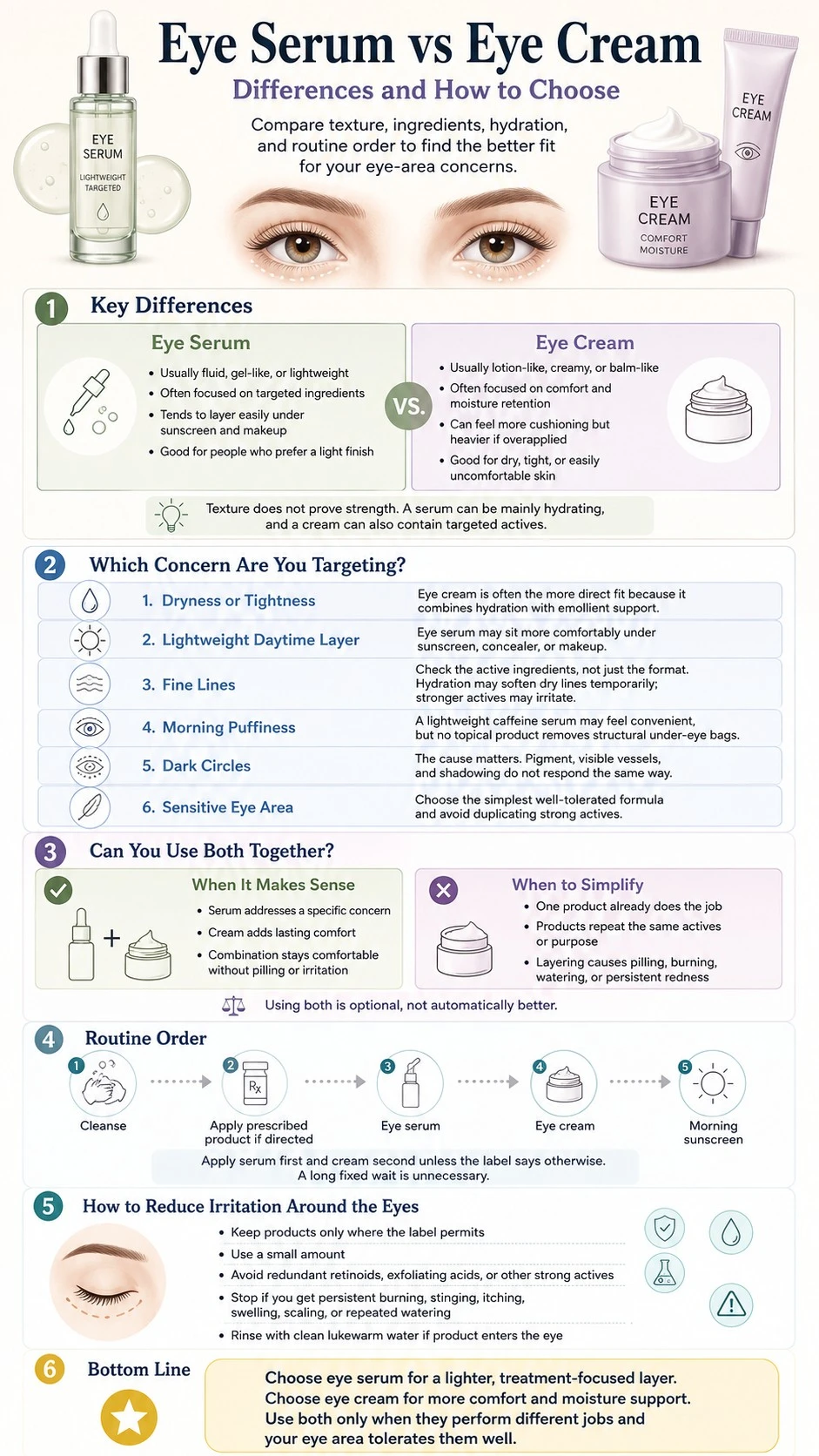
“Eye serum” and “eye cream” are product labels, not regulated definitions of ingredient concentration or performance. Serums are usually thinner and treatment-led, while creams are usually more emollient or occlusive. However, the categories overlap: a serum can be primarily hydrating, and a cream can contain retinoids, peptides, caffeine, niacinamide, or other targeted ingredients.
That overlap is why the better question is not simply which category wins. It is which finished formula does the job you need with the least irritation and the most usable texture.
Eye Serum vs Eye Cream: Key Differences
The following comparison describes common patterns, not rules that every product must follow.
| Comparison point | Eye serum | Eye cream |
|---|---|---|
| Texture | Usually fluid, gel-like, or lightweight | Usually lotion-like, creamy, or balm-like |
| Main routine role | Often delivers targeted ingredients in a thin layer | Often adds comfort, softness, and moisture retention |
| Common ingredients | Humectants, caffeine, peptides, antioxidants, niacinamide, or retinoids | Humectants plus emollients or occlusives; may contain the same targeted ingredients as a serum |
| Finish and layering | Tends to absorb or set with less residue and can suit daytime layering | Provides more cushioning but may feel heavy or pill if too much is used |
| Most likely fit | People who prefer light textures or want a separate treatment step | People whose eye area feels dry, tight, or easily uncomfortable |
| Main caution | “Concentrated” marketing does not prove that it is stronger or more effective | A richer texture does not prove that it treats wrinkles, puffiness, or dark circles |
The ingredient list also cannot reveal everything about performance. Concentration, ingredient form, delivery system, stability, packaging, and the way the ingredients work together all affect the finished product. A 2024 review found potential benefits from ingredients commonly used around the eyes, including retinoids, vitamins C and E, peptides, ceramides, hyaluronic acid, caffeine, and niacinamide, but also noted limited eye-formula trials and wide variation among studies.[1]
This means a cream can be more treatment-focused than a serum, while a serum can function mainly as lightweight hydration. Compare the stated purpose and directions before using texture as a shortcut.
Which One Fits Your Main Eye-Area Concern?

Start with the concern you can realistically change. Then decide whether a light or rich texture makes that formula easier to use consistently.
- Dryness or tightness: An eye cream is usually the more direct choice because it can combine water-binding ingredients with emollients and ingredients that slow evaporation. Hyaluronic acid and ceramides are commonly used to support hydration and comfort around this thin, easily irritated area.[2]
- A lightweight daytime layer: An eye serum may sit more comfortably under sunscreen, concealer, or makeup. It can also suit people who already use a facial moisturizer and do not want another rich layer.
- Fine lines: Look at the actives and the evidence rather than choosing by format. Hydration may temporarily make dry lines less visible; retinoids have stronger support for photoaging changes but can irritate, and peptide evidence varies by formula. A cream is not automatically better for lines, and a serum is not automatically more potent. The ZICAIL retinol guide explains the benefits and tolerance limits of this ingredient family.
- Morning puffiness: A lightweight caffeine serum may feel convenient, and caffeine may temporarily improve the appearance of some puffiness. Cooling and hydration can also change how the area looks for a short time. Neither a serum nor a cream can remove persistent bags caused by fat-pad prominence, bone structure, or skin laxity.[3]
- Dark circles: First consider why the area looks dark. Surface pigment, visible vessels, irritation, shadows from hollows, and lifestyle factors do not respond to the same ingredient. Brightening ingredients may help some pigment-related discoloration, but a topical product will not fill a tear trough or permanently correct every genetic or structural cause.[1]
- Sensitive or reactive skin: Prioritize a simple, well-tolerated formula and avoid duplicating strong actives. Texture is secondary. A rich cream can still sting, while a simple serum can still contain fragrance or an irritating active.
If you are deciding whether a separate eye product is worthwhile at all, does eye cream work examines the benefits, limits, and situations in which a facial moisturizer may already be enough.
Can You Use Eye Serum and Eye Cream Together?

Yes, but using both is optional. Layering makes sense when the products do different jobs and remain comfortable together. For example, a light serum may supply a targeted active while a cream reduces dryness. Two products that repeat the same humectants, peptides, or retinoid may add cost and irritation without adding a clear benefit.
When using both makes sense
- The serum addresses a specific concern, while the cream supplies lasting comfort.
- A treatment serum feels drying when used alone, but the compatible cream improves tolerance.
- The serum works well in a thin layer, while the cream is needed only on dry areas or at night.
Skip the second product if one formula already gives adequate hydration and contains the ingredients you want. Also simplify if the combination causes pilling, watering, burning, or persistent redness. The American Academy of Dermatology notes that using too many products—especially multiple anti-aging products—can irritate skin.[4]
Which one goes first
Unless the labels give different instructions, use this order:
- Cleanse and apply any prescribed product as directed. Do not change the placement of medication based on a general cosmetic routine.
- Apply eye serum. Use a thin, even amount only on the area permitted by the label.
- Apply eye cream. Pat on a small amount after the serum is no longer wet or pooling; a long fixed wait is unnecessary.
- Finish the morning routine with sunscreen. Apply it over exposed facial skin without rubbing the eye products back and forth.
This follows the practical principle of treatment before moisturizer and sunscreen.[4] For placement and amount around the eyes, see how to apply eye cream. The full skincare routine order can help when several facial products are involved.
How to Reduce Irritation Around the Eyes
The eye area is less forgiving than much of the face, so label directions matter more than a universal “lightest to heaviest” rule.
- Keep products where the label permits: Do not assume that “eye product” means safe on the mobile eyelid, lash line, or inner corners. Products can migrate after application.
- Use a small amount: More product increases the chance of pilling or movement into the eyes; it does not make an active work faster.
- Avoid redundant actives: Do not automatically layer an eye serum and eye cream that both contain retinoids, exfoliating acids, or other potentially irritating treatments.
- Stop at persistent symptoms: Burning, ongoing stinging, itching, swelling, scaling, or repeated watering is a reason to remove the product and stop using it. Thin eyelid skin is a common location for contact dermatitis.[5]
If a cosmetic enters the eye, rinse with clean lukewarm water and follow the label’s first-aid directions. Seek prompt care for severe pain, marked swelling, light sensitivity, vision changes, or symptoms that do not settle.
FAQs About Eye Serums and Eye Creams
Can eye serum replace eye cream?
Yes, if the serum gives enough hydration and comfort on its own. If the area still feels tight or dry, add a compatible cream or choose one more balanced product instead of assuming every routine needs two eye products.
Can you use face serum under your eyes?
Only when the product directions permit use near the eyes and the formula is comfortable there. A facial serum may be stronger, more fragranced, or tested for a different application area. Keep it away from the lash line and mobile eyelids unless the label specifically allows those areas.
Can you use moisturizer instead of eye cream?
Often, yes. A gentle facial moisturizer may provide all the hydration the eye area needs. A separate eye cream is more useful when you prefer its texture, tolerate it better near the eyes, or want an eye-specific formula and directions.
Should you use eye serum in the morning or at night?
Follow the label and the ingredients. Hydrating, peptide, caffeine, and antioxidant serums may be designed for morning, night, or both. Retinoid formulas are commonly used at night, while daytime routines still need sunscreen. Frequency should be reduced if the area becomes dry or irritated.
Which is better for mature skin: eye serum or eye cream?
Neither format is universally better. Drier mature skin may prefer a cream, while a light serum can deliver a targeted ingredient without heaviness. If using both, choose complementary formulas rather than duplicating strong actives, and judge results by comfort and the specific concern—not age alone.
Sources
[1] Hamie H, Yassine R, Shoukfeh R, Moossavi M. A Review of the Efficacy of Popular Eye Cream Ingredients
[2] Cleveland Clinic. How To Choose the Right Eye Cream
[3] Cleveland Clinic. Dark Circles or Bags Under Your Eyes? How To Get Rid of Them
[4] American Academy of Dermatology Association. Should I Apply My Skin Care Products in a Certain Order?
[5] American Academy of Dermatology Association. Eczema Types: Contact Dermatitis Signs and Symptoms


