


Under-eye masks, eye patches, and under-eye gels are small sheet or hydrogel products designed to sit beneath the lower eyelids. Most are saturated with a water-based serum; reusable silicone versions instead hold a separate skincare product against the skin.
Their value depends on what you want changed. A patch can improve how the skin surface looks for a while, but “brighter,” “de-puffed,” and “anti-aging” are not interchangeable outcomes. The cause of the concern matters more than the marketing claim on the jar.
What Under-Eye Masks Actually Do
An under-eye mask mainly combines three things: a liquid formula, close contact with the skin, and time. The patch keeps the formula in place and slows evaporation while it is worn. Humectants in the serum attract water, while emollient ingredients can soften the surface. This can make dry skin and shallow dehydration lines look smoother after removal.
Hydrogel, fabric, and biocellulose are delivery formats, not active ingredients by themselves. A reusable silicone patch is different again: it contains no serum unless the manufacturer preloads it, so its main job is to create a temporary covering over a compatible product you apply first. The same general contact-and-hydration principle helps explain many sheet mask benefits.
Cooling adds a separate effect. A chilled patch can act like a brief cool compress, which can restrict blood vessels and reduce temporary swelling.[3] That does not mean refrigeration turns the formula into a stronger treatment; much of the immediate de-puffing may come from temperature.
Evidence also needs to be interpreted carefully. Research on ingredients used around the eyes suggests potential benefits for hydration, elasticity, pigmentation, and fine lines, but studies vary in formula, concentration, application schedule, and measured outcome. Much of that evidence concerns individual ingredients or leave-on formulas rather than the single-use under-eye patch category.[1] Ingredient evidence therefore cannot prove that every patch containing hyaluronic acid, caffeine, peptides, or retinol will deliver the advertised result.
What Results Can You Expect From Under-Eye Masks?
The most realistic benefits occur at the skin surface or involve temporary fluid-related puffiness. Concerns driven by pigment, anatomy, or long-term tissue change need different expectations.
| Under-eye concern | What a mask may do | What it is unlikely to do | Best reason to use one |
|---|---|---|---|
| Dryness or tightness | Add temporary water and softness to the surface | Repair every cause of persistent dryness after one use | Quick comfort before makeup or when the area feels dry |
| Fine dehydration lines | Plump the outer skin layer so shallow lines look less visible | Permanently erase expression lines or established wrinkles | A smoother-looking finish for several hours |
| Mild morning puffiness | Provide a cooling effect that briefly reduces a swollen appearance | Remove prominent fat pads or permanently tighten loose skin | Short-term de-puffing after sleep, crying, or a salty meal |
| Dark circles | Make the area look fresher when dryness, temporary swelling, or visible surface dullness contributes | Remove genetic pigment, deep shadowing, thin-skin visibility, or prominent vessels | A temporary cosmetic refresh when the cause is partly surface-level |
| Tear troughs or structural bags | Hydrate the skin over the area and soften surface texture | Replace lost volume or change bone, fat, ligaments, or skin laxity | Surface conditioning only, with modest expectations |
Dark circles are especially easy to overpromise because the same visible darkness can have different causes. Pigmentation, thin translucent skin, blood vessels, soft-tissue changes, and shadows from facial anatomy can all contribute, often at the same time.[2] A patch cannot correct all of those mechanisms.
If the area looks less dark immediately after a chilled mask, the change may come from smoother skin, less swelling, altered light reflection, or temporary vessel constriction. That is still a useful cosmetic result, but it should not be described as permanent pigment removal.
Likewise, “under-eye bags” can mean temporary fluid buildup or a lasting structural bulge. Cooling may help the first type for a while. Bags related to genetics, prominent fat pads, bone structure, or skin laxity are harder to change with topical skincare.[3]
Which Under-Eye Mask Ingredients Are Worth Considering?
Choose ingredients by the short-term result you want, then judge the complete formula and your tolerance. A familiar ingredient name is not a guarantee of concentration, stability, delivery, or finished-product performance.
- For hydration: Glycerin, hyaluronic acid, and other humectants help hold water at the skin surface. Ceramides and emollients can support a softer finish. These are the most logical choices for dry-looking skin and dehydration lines.
- For temporary puffiness: Caffeine is common in eye products and has plausible cosmetic value, but the cooling temperature and close contact of the patch may be responsible for much of an immediate change. Do not assume a caffeine patch will alter structural bags.
- For a calmer feel: Simple fragrance-free formulas are often easier to tolerate than patches loaded with perfume or many botanical extracts. Soothing ingredients can improve comfort, but “natural” does not mean non-irritating.
- For longer-term fine-line or tone goals: Retinoids, vitamin C, niacinamide, peptides, and similar actives have varying levels of topical evidence around the eyes.[1] Meaningful changes generally require a suitable formulation and repeated use, not one 15-minute patch. Retinoids and acidic formulas can also irritate sensitive eye-area skin.
If your goal is one calm, hydrated application, a short ingredient list may be more useful than the patch with the largest collection of actives. Fragrance-free is particularly worth considering if your eyelids or under-eye area react easily.
How to Use Under-Eye Masks Safely
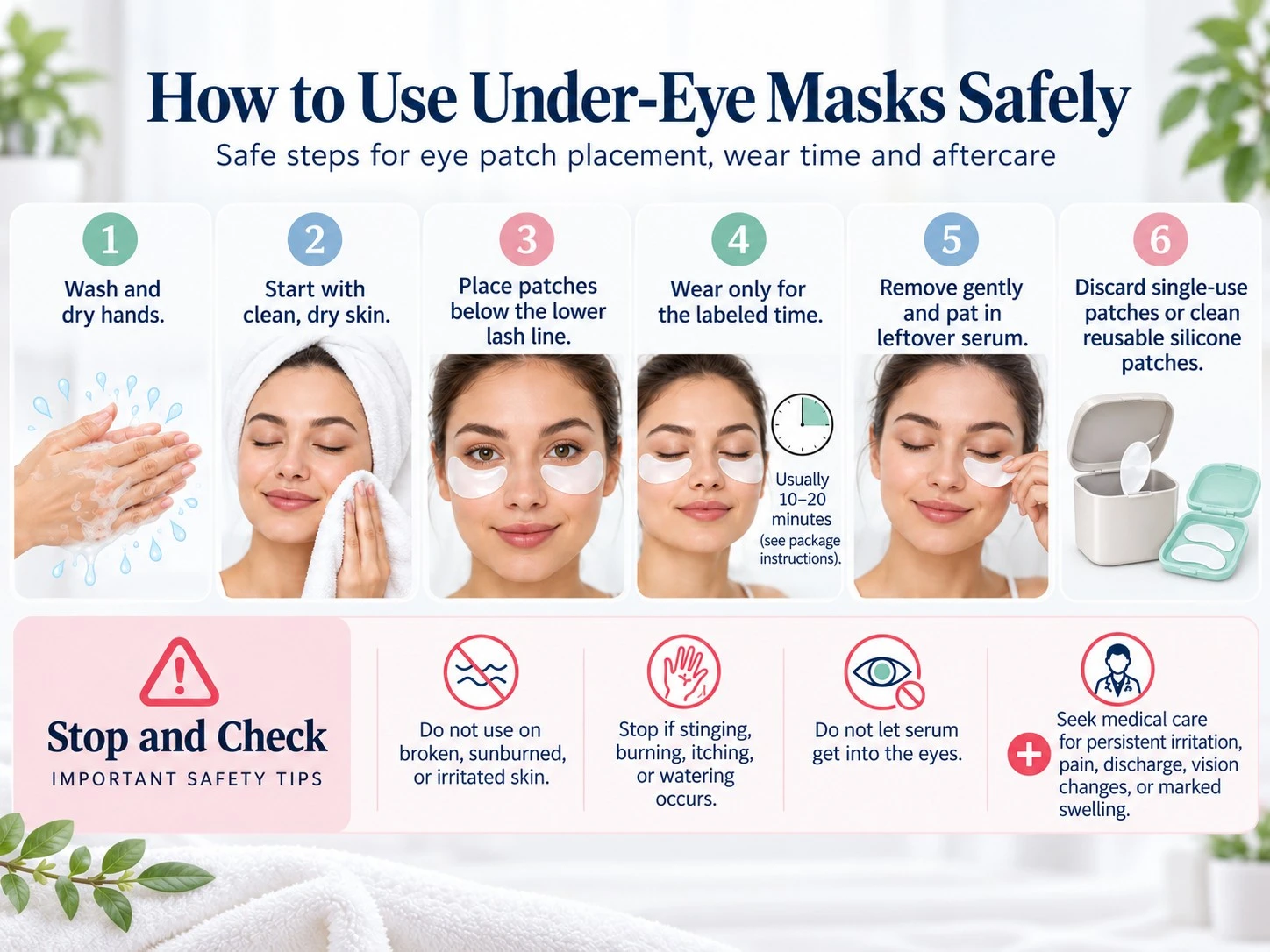
Follow the product label first because placement, wear time, storage, and frequency vary. A patch designed for the cheek or forehead is not automatically appropriate close to the eyes.
- Wash and dry your hands. Clean hands reduce the chance of moving dirt or microbes toward the eye area.[4]
- Start with clean, dry skin. Remove makeup and skincare residue so the patches can sit evenly. Do not apply over broken, sunburned, inflamed, or actively irritated skin.
- Place each patch below the lower lash line. Leave enough space to prevent serum from sliding into the eye, and do not place the patch on the moving eyelid unless its directions specifically allow that use.
- Wear it for the labeled time. Longer is not automatically better. Remove the mask if it begins to sting, burn, itch, or cause watering.
- Lift it off gently. Do not pull the skin sharply. Pat in a comfortable amount of remaining serum or remove excess if the label directs rinsing or the residue irritates you.
- Discard or clean it correctly. Throw away a single-use patch after one application. Wash and dry a reusable silicone mask according to its instructions before storing it.
Stop using any eye-area cosmetic that causes irritation, and do not use one while you have an eye infection or inflamed skin around the eye.[4] The eyelid and surrounding skin are thin and are common sites for contact dermatitis; warning signs include itching, burning, swelling, rash, excessive dryness, and blisters.[5]
If serum gets into the eye, remove the patches and rinse as directed on the product label. Seek medical care for persistent irritation, pain, discharge, vision changes, marked one-sided swelling, or swelling that lasts longer than expected rather than repeatedly masking the symptom.
Under-Eye Masks vs Eye Cream: Which Should You Use?
Use an under-eye mask when you want a short, concentrated hydration or cooling step. Use an eye cream—or a face moisturizer that your eye area tolerates—when you want a consistent leave-on routine. Neither category is mandatory, and neither is automatically more effective just because it is labeled for the eyes.
- Choose an under-eye mask: for a temporary smoother look, a cooling session, travel, or preparation before makeup and an event.
- Choose a leave-on product: for daily dryness support or when an active ingredient requires consistent use over weeks rather than occasional contact.
- Use both only when they have separate jobs: for example, a hydrating patch occasionally and a simple moisturizer routinely. Layering both every time is unnecessary if it feels heavy or irritates the area.
The broader guide to whether eye cream works explains how daily formulas compare with ordinary facial moisturizer. Whichever format you choose, judge it by a specific concern, a realistic time frame, and the result you can actually observe.
FAQs About Under-Eye Masks
How long do under-eye mask results last?
The smoother, more hydrated look is temporary and often fades within the same day, but there is no universal duration. Formula, skin dryness, climate, makeup, and the cause of puffiness all affect how long the change remains visible. If a brand claims a precise duration, look for finished-product testing that supports that specific claim.
Can you use under-eye masks every day?
You can use some under-eye masks daily if the label allows it and your skin remains comfortable, but daily use is not necessary for everyone. More frequent application does not guarantee a larger or permanent result. Reduce frequency or stop if you develop stinging, itching, redness, swelling, or persistent dryness.
Should you refrigerate under-eye masks?
Refrigeration is optional unless the label requires it. A cool patch may feel refreshing and temporarily reduce puffiness, but a frozen or extremely cold patch can be uncomfortable and may irritate the skin. Follow the stated storage range, keep the container clean and closed, and never use a patch that has changed unexpectedly in smell, color, or texture.
Can you reuse under-eye masks?
Do not reuse disposable hydrogel or fabric patches. After wear, they have lost part of their serum and have contacted skin, hands, and the surrounding environment. Reusable silicone patches are designed differently and can be used again only when cleaned, dried, and stored according to their instructions. Do not put used disposable patches back into the jar.
Sources
[1] Hamie H, Yassine R, Shoukfeh R, et al. A Review of the Efficacy of Popular Eye Cream Ingredients
[2] Vrcek I, Ozgur O, Nakra T. Infraorbital Dark Circles: A Review of the Pathogenesis, Evaluation and Treatment
[3] Cleveland Clinic. Dark Circles or Bags Under Your Eyes? How To Get Rid of Them
[4] U.S. Food and Drug Administration. Cosmetics Safety Q&A: Eye Cosmetic Safety
[5] American Academy of Dermatology Association. Eczema Types: Contact Dermatitis Signs and Symptoms


