


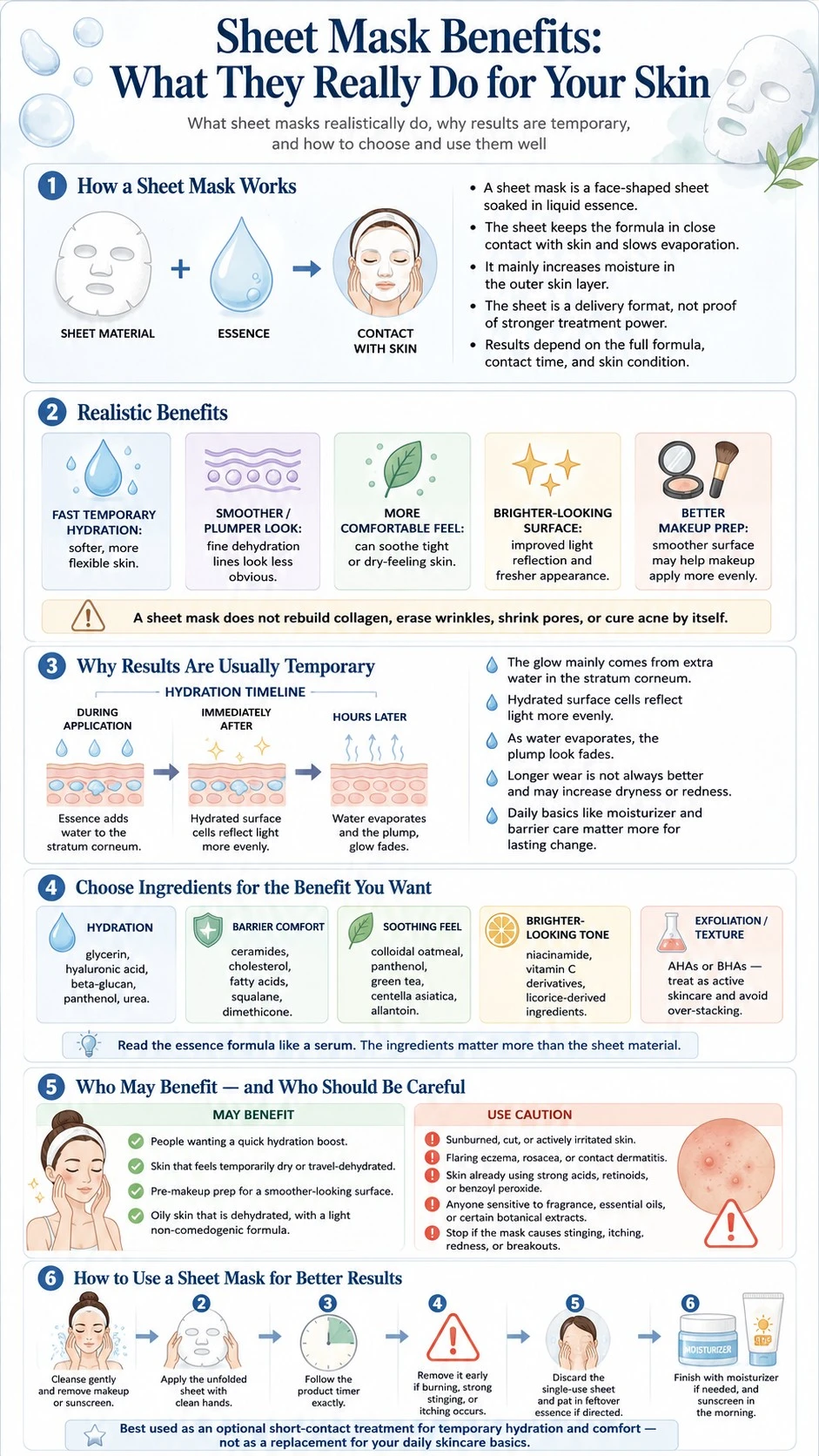
A sheet mask is most useful as an optional short-contact treatment when you want a temporary hydration boost or a more comfortable, smoother-looking surface. It is not automatically more effective than a well-formulated serum or moisturizer, and the visible result may fade as the added water is lost from the outer skin layer.
The meaningful question is therefore not whether sheet masks “work” as a category. It is whether the essence contains ingredients suited to your skin, whether the sheet maintains even contact, and whether the expected benefit matches what a rinse-free cosmetic can realistically provide.
How a Sheet Mask Works
A sheet mask combines two parts: a face-shaped substrate made from material such as cotton, plant cellulose, bio-cellulose, or hydrogel, and a liquid essence held within it. The wet sheet acts as a temporary reservoir. It keeps the formula in contact with a large area of skin and slows immediate evaporation while the mask is in place.
That contact can increase moisture in the stratum corneum, the outermost skin layer. In a small controlled study, one bacterial-cellulose mask increased measured facial moisture more than a wet towel after a single application, but it did not produce obvious changes in the other tested characteristics, including elasticity, texture, dullness, or shedding.[2] This is a useful boundary: a sheet can improve short-term water delivery without proving every claim printed on its pouch.
The format also does not make all ingredients penetrate deeply. Delivery depends on the full formula, including ingredient concentration, molecular properties, solvent system, contact time, and the condition of the skin barrier. Better fit may create more even contact and reduce dry gaps, but a tighter or wetter sheet is not evidence of stronger anti-aging or treatment effects.
In many cases, the same humectants or soothing ingredients could be delivered through a leave-on serum. The sheet mainly changes how the formula is held against the face and how the experience feels. That can be convenient before an event or when the skin feels temporarily dry, but it does not make the daily basics optional.
Which Sheet Mask Benefits Are Realistic?
The most credible benefits are surface-level and formula-dependent. Use the product’s ingredient list and claims to decide which row is relevant rather than expecting one mask to deliver every result.
| Potential benefit | What may create it | Realistic expectation | Important limit |
|---|---|---|---|
| More hydrated skin | Water, humectants, and reduced evaporation during wear | Softer, more flexible skin soon after removal | The boost can fade and does not replace ongoing moisturizing |
| Smoother or plumper appearance | Temporary hydration of dry surface cells | Fine dehydration lines and rough texture may look less obvious | This is not permanent wrinkle correction or new collagen |
| Calmer, more comfortable feel | A cooling wet format plus tolerated ingredients such as glycerin, panthenol, colloidal oatmeal, or centella | Temporary comfort for skin that feels dry or tight | Fragrance, botanicals, or active ingredients can produce the opposite response |
| Brighter-looking surface | Improved hydration and smoother light reflection; sometimes niacinamide or vitamin C derivatives | A fresher or more even-looking finish | Immediate glow is not proof that pigmentation has changed |
| A smoother makeup base | Less visible flaking and a more hydrated surface | Makeup may spread more evenly for the next few hours | Too much leftover essence can make makeup or sunscreen pill |
Sheet masks can also deliver exfoliating acids, retinoids, or acne-related ingredients, but the benefits and risks then come from those actives rather than from the sheet itself. Occluding an active formula against the face may increase exposure and irritation. Count it as an active treatment within the complete routine instead of treating it as a harmless hydration step.[1]
Why Sheet Mask Results Are Usually Temporary
Most of the immediate “glass skin” effect comes from water in the outer skin layer. Hydrated surface cells swell slightly and lie more evenly, so the skin can look smoother and reflect light more uniformly. As that water evaporates and the routine continues, the visual effect becomes less noticeable.
A randomized study comparing three sheet-mask liquids and several wear times found that applications under 25 minutes improved hydration in the short term. Longer wear was linked with more dryness and redness, especially in the 40-minute condition; the study included only 28 participants, so it does not establish one timer for every product.[3] It does show why an immediate wet, plump appearance should not be confused with unlimited or lasting benefit.
Longer-term changes require the right active ingredient, a suitable concentration and vehicle, repeated use, sun protection, and enough time. A mask labeled “collagen,” for example, may hydrate and temporarily make lines look softer, but that result alone does not show that the product created new collagen in the dermis. Likewise, a brightening essence may support a longer routine, but one application cannot be judged by the same standard as months of consistent pigment care.
If lasting dryness is the main problem, first distinguish dehydrated vs dry skin and build a daily routine that supports the skin barrier. A sheet mask can supplement that routine; it should not be the only time the skin receives hydration or lipids.
Choose Ingredients for the Benefit You Want
Read the essence formula as you would a serum. The sheet material affects fit and contact, but the ingredient system determines the main skin effect.
- For hydration: Look for humectants such as glycerin, hyaluronic acid, beta-glucan, panthenol, or urea. Humectants bind water, but very dry skin may still need emollient and occlusive support afterward. The comparison of humectants, emollients, and occlusives explains their different jobs.
- For barrier comfort: Ceramides, cholesterol, fatty acids, squalane, dimethicone, and other emollient or barrier-supporting ingredients may help the surface feel softer. The finished formula matters more than one highlighted ingredient.
- For a soothing feel: Colloidal oatmeal, panthenol, green tea, centella asiatica, and allantoin may suit some users, but plant extracts are not automatically gentle. A cooling sensation also does not prove that inflammation or a skin condition has been treated.
- For a brighter-looking tone: Niacinamide, vitamin C derivatives, licorice-derived ingredients, or mild exfoliants may support a broader routine. Expect an immediate glow mainly from hydration; judge pigment-related change only after consistent use over time.
- For exfoliation or texture: Treat a sheet mask as an exfoliating product when it is marketed for exfoliation or its directions present an AHA or BHA as an active treatment. Do not combine it automatically with an acid toner, scrub, retinoid, or another peel. An acid listed only as a pH adjuster does not establish exfoliating strength. This guide to how often to exfoliate helps set the total schedule. AHA cosmetics may also increase sun sensitivity, so follow the label warning and use sun protection.[4]
If your skin reacts easily, “fragrance-free” is generally a more useful starting label than “unscented,” which can still describe a formula containing ingredients that mask odor. The distinction is covered in fragrance-free vs unscented skincare.
Who May Benefit—and Who Should Be Careful

Sheet masks are most likely to earn their place when the goal is modest and immediate. They may be useful before makeup, after travel in a dry environment, or whenever a well-tolerated hydrating formula makes the skin feel more comfortable. Oily skin can also be dehydrated, so the format is not limited to dry skin; choose a light, non-comedogenic essence if residue or congestion is a concern.
Use more caution when:
- the skin is actively sunburned, cut, swollen, or already burning;
- eczema, rosacea, or contact dermatitis is flaring;
- the formula duplicates acids, retinoids, benzoyl peroxide, or other irritating treatments;
- fragrance, essential oils, or botanical extracts have caused reactions before;
- the mask repeatedly causes stinging, itching, redness, or breakouts; or
- the fit pushes serum into the eyes, lips, or nostrils.
Test a new formula on a small area first when the product format makes that practical. Use the normal amount and contact time, and do not continue if the area becomes red, itchy, or swollen.[5] Do not keep an opened single-use pouch for several days to perform a test; once opened, use or discard it as directed.
A cosmetic sheet mask cannot diagnose or treat persistent acne, eczema, rosacea, infection, or an allergic rash. Stop the product and seek medical care for severe swelling, hives with breathing symptoms, blistering, eye involvement, or a reaction that continues to worsen.
How to Use a Sheet Mask for Better Results
- Cleanse gently. Remove makeup, sunscreen, and surface soil without scrubbing. Pat off excess water and follow the mask directions on whether skin should be fully dry.
- Open and unfold it with clean hands. Apply the sheet immediately, smooth out large folds, and keep the serum away from the eyes and mouth.
- Follow the stated contact time. Do not extend the session because the sheet is still wet. Research has found that mask material, contact area, and wear time all change how much formula reaches the skin, with exposure rising as contact continues.[6]
- Remove it if the skin objects. Burning, strong stinging, itching, swelling, or rapidly increasing redness is a reason to take the mask off and rinse rather than wait for the timer.
- Discard the single-use sheet. Pat in the remaining essence if the label says to leave it on; rinse only when directed. If the surface feels heavily coated, use less of the remaining liquid rather than forcing the whole pouch onto the face.
- Finish the routine. Apply a suitable moisturizer if more lasting comfort is needed. In the morning, finish with sunscreen and let wet layers settle before makeup.
Sheet-mask frequency depends on the complete formula and the rest of the routine. A simple hydrating mask and an exfoliating acid mask should not share the same default schedule; the guide to how often to use a face mask provides the full decision framework. For placement among other products, use the skincare routine order rather than assuming every sheet mask belongs at the same step.
The best reason to use a sheet mask is that a suitable formula gives a short-term result you value without irritation. If the effect is no better than your usual serum and moisturizer, the sheet is optional—not a missing requirement in the routine.
Sources
[1] American Academy of Dermatology Association. Do Facial Masks Work, and Should I Add One to My Skin Care Routine?
[2] Amnuaikit T, Chusuit T, Raknam P, Boonme P. Effects of a Cellulose Mask Synthesized by a Bacterium on Facial Skin Characteristics and User Satisfaction
[3] Wang Y, Cao Y, Huang X, et al. Short-Term Skin Reactions and Changes in Stratum Corneum Following Different Ways of Facial Sheet Mask Usage
[4] U.S. Food and Drug Administration. Alpha Hydroxy Acids
[5] American Academy of Dermatology Association. How to Test Skin Care Products
[6] Zhou L, Chen J, Chen T, et al. Investigation of Actual Exposure to Facial Sheet Mask Preceding Its Risk Assessment


