


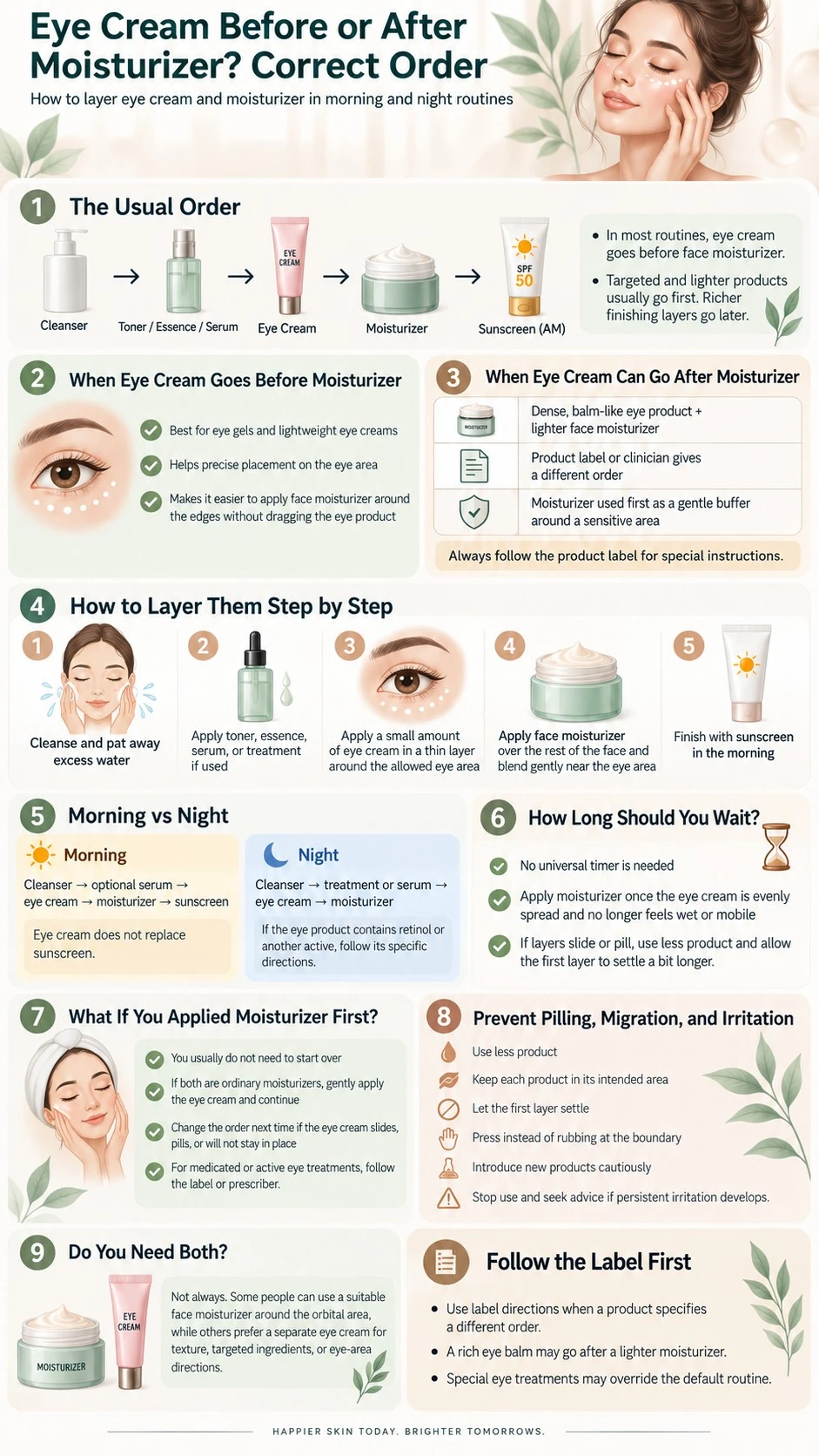
The order is simple in most routines: serum, eye cream, moisturizer. That sequence makes it easier to place a small amount around the eye area before a face cream changes the slip of the skin. It also keeps moisturizer and sunscreen in their usual finishing positions.
Order is not a test you fail if two products are reversed. Texture, ingredients, and directions matter more than the words on the front of the jar. A lightweight eye gel behaves differently from a waxy overnight balm, and an active eye treatment may carry instructions that override a general layering rule.
Should Eye Cream Go Before Moisturizer?
Yes, in the usual routine. Apply cleanser first, then prescribed medication or leave-on treatment as directed, followed by eye cream and moisturizer. General dermatology guidance places treatments after cleansing and moisturizer or sunscreen afterward.[1] A more detailed routine guide likewise places eye cream after serum and before moisturizer.[2]
This order is useful because eye cream is applied to a small, specific area. Putting it on first lets you control placement. You can then apply face moisturizer around it and gently blend the edges without dragging the eye product toward the lash line.
The same logic fits the broader skincare routine order: cleanse first, use targeted leave-on products next, moisturize, and finish the morning routine with sunscreen. The popular “thinnest to thickest” rule is a helpful default, not a substitute for label directions.[2]
When Should Eye Cream Go After Moisturizer?
Eye cream can go after moisturizer when the eye product is clearly richer or more occlusive than the face moisturizer, or when a clinician or product label gives a different sequence. A moisturizer-first order can also be used as a buffer around a sensitive area, but this should not be improvised with prescription products or irritating actives.
| Situation | Best default order | Why |
|---|---|---|
| Lightweight eye gel or lotion | Serum → eye cream → moisturizer | The targeted, lighter layer is placed before the broader cream. |
| Standard eye cream and standard face cream | Eye cream → moisturizer | This is the usual order and makes precise eye-area placement easier. |
| Dense eye balm with a light gel moisturizer | Moisturizer → eye balm | The heavier balm can sit last instead of interfering with the lighter layer. |
| Eye treatment with specific directions | Follow the label | Clean, dry skin, nighttime-only use, or limited frequency can matter more than texture. |
| Morning routine | Eye cream → moisturizer → sunscreen | Sunscreen remains the final skincare layer before makeup.[2] |
If two products have similar textures and are simple moisturizers, the practical difference may be small. Choose one consistent order that spreads comfortably and does not pill. Do not mix the products in your palm unless their directions say to do so; separate layers make the amount and placement easier to control.
How to Layer Eye Cream and Moisturizer Step by Step

Use this sequence when neither product has special directions:
- Cleanse your face. Remove makeup and cleanser residue, then pat away excess water. If a treatment requires fully dry skin, wait until the area is dry.
- Apply toner, essence, serum, or treatment if used. Keep facial actives out of the immediate eye area unless they are intended for that location.
- Apply eye cream. Use a small amount and spread a thin layer over the area named on the label. Keep it out of the eye opening and away from the lash line unless closer placement is specifically permitted.[3]
- Apply face moisturizer. Smooth or press it over the rest of the face. At the eye-area boundary, use light pressure so you do not move the eye cream.
- Finish with sunscreen in the morning. Sunscreen is the last skincare step before makeup.[2]
For more detail on amount, placement, and technique, see how to apply eye cream. Those application details belong to the product and the permitted area; the order above simply shows where the step fits.
Morning order
A practical morning sequence is cleanser, optional hydrating toner or serum, eye cream, moisturizer, and sunscreen. Eye cream does not replace sunscreen. Apply sunscreen around the eyes only as its own label permits, and avoid mixing it into the eye cream because that can make coverage less predictable.
Night order
A practical night sequence is cleanser, treatment or serum if used, eye cream, and moisturizer. If the eye product is a retinol or another active treatment, follow its frequency and dry-skin directions. More frequent use is not automatically more effective, especially around a sensitive area.
How Long Should You Wait Between Eye Cream and Moisturizer?
There is no universal waiting time. Move to moisturizer once the eye cream has formed an even layer and no longer feels wet or mobile. That may take only a short moment for a gel and longer for a richer cream.
Use the surface as your guide. If moisturizer makes the eye cream slide, give the first layer more time or use less product. If the layers pill, reduce the amount, press rather than rub, and check whether the formulas are compatible. A long timer cannot fix excess product or incompatible textures.
What If You Applied Moisturizer First?
You do not need to wash your face and start again. If both products are ordinary moisturizers and the eye area feels comfortable, gently apply the eye cream and continue. The likely downside is practical: a rich face cream can make it harder to place a lighter eye product evenly.
Adjust the order next time if the eye cream slides, pills, or no longer stays where intended. If it is a medicated or active eye treatment, follow the label or prescriber’s instructions rather than assuming it can go over any moisturizer. A single reversed application is not a reason to add extra product.
How to Prevent Pilling, Migration, and Irritation
- Use less product. A thick layer is more likely to roll up, stay tacky, or move toward the eyes.
- Keep each product in its intended area. A face serum that feels gentle on the cheeks is not automatically suitable for the eyelids or lash line.[3]
- Let the first layer settle. Continue when it is evenly spread rather than following a fixed stopwatch rule.
- Press at the boundary. Rubbing face moisturizer across freshly applied eye cream can shift both layers.
- Introduce new products cautiously. Test a new leave-on product before regular use and stop if it causes a reaction.[4]
- Stop for persistent irritation. Burning, swelling, itching, scaling, or repeated watering is a reason to discontinue the cosmetic and seek medical advice if symptoms persist.[3]
These adjustments are more useful than forcing one order that does not suit the formulas. If pilling happens only after sunscreen or concealer, change one variable at a time and never reduce sunscreen below its labeled amount just to improve the finish.
Do You Need Both Eye Cream and Moisturizer?
Not necessarily. Eye cream is optional, and some people can comfortably use a suitable face moisturizer around the orbital area. Others prefer a separate product because it has a lighter texture, a more targeted ingredient profile, or directions designed for the eye area.
The choice is different from the order question. Eye cream vs moisturizer explains how their roles overlap, while whether you can use face moisturizer under the eyes depends on the formula, permitted area, and your tolerance. If you are deciding whether the extra step is worthwhile at all, review what eye cream can realistically do before adding another product.
FAQs About Eye Cream and Moisturizer Order
Can you put moisturizer over eye cream?
Yes. That is the usual order: apply eye cream to its targeted area, then apply face moisturizer. Use light pressure where the layers meet so the eye cream does not migrate.
Does eye cream go before or after serum?
Eye cream usually goes after a lightweight face serum and before moisturizer. Keep the serum away from the immediate eye area unless it is intended for use there, and follow any special directions for active eye treatments.
Does eye cream go before sunscreen?
Yes. Apply eye cream and moisturizer before sunscreen. Sunscreen is the final morning skincare layer, followed by makeup if used.[2]
Should retinol eye cream go before or after moisturizer?
Follow the retinol eye cream’s directions. Many treatment eye creams are applied before moisturizer, but a label or clinician may recommend a different frequency, dry-skin application, or buffering method. Do not assume the routine for a plain hydrating eye cream applies to an active treatment.
Can moisturizer be used as an eye cream?
Sometimes. A gentle face moisturizer may be suitable around the orbital area if its label does not exclude that use and it does not irritate or migrate into the eyes. Avoid placing an ordinary face product on the movable eyelid, lash line, or in the eye unless it is specifically intended for that area.[3]
Sources
[1] American Academy of Dermatology Association. Should I apply my skin care products in a certain order?
[2] Cleveland Clinic. How To Order Your Skin Care Routine
[3] U.S. Food and Drug Administration. Eye Cosmetic Safety
[4] American Academy of Dermatology Association. How to test skin care products


