

A separate eye cream is not automatically necessary for hydration. A well-tolerated face moisturizer may perform the same basic job under the eyes: adding water-binding ingredients and reducing moisture loss. The important question is not what the jar is called, but whether the formula is suitable for this sensitive location.
“Under the eyes” also has a boundary. It means the skin below and around the eye, not the eyeball, inner rim, lash line, or mobile upper eyelid unless the product specifically permits that placement.
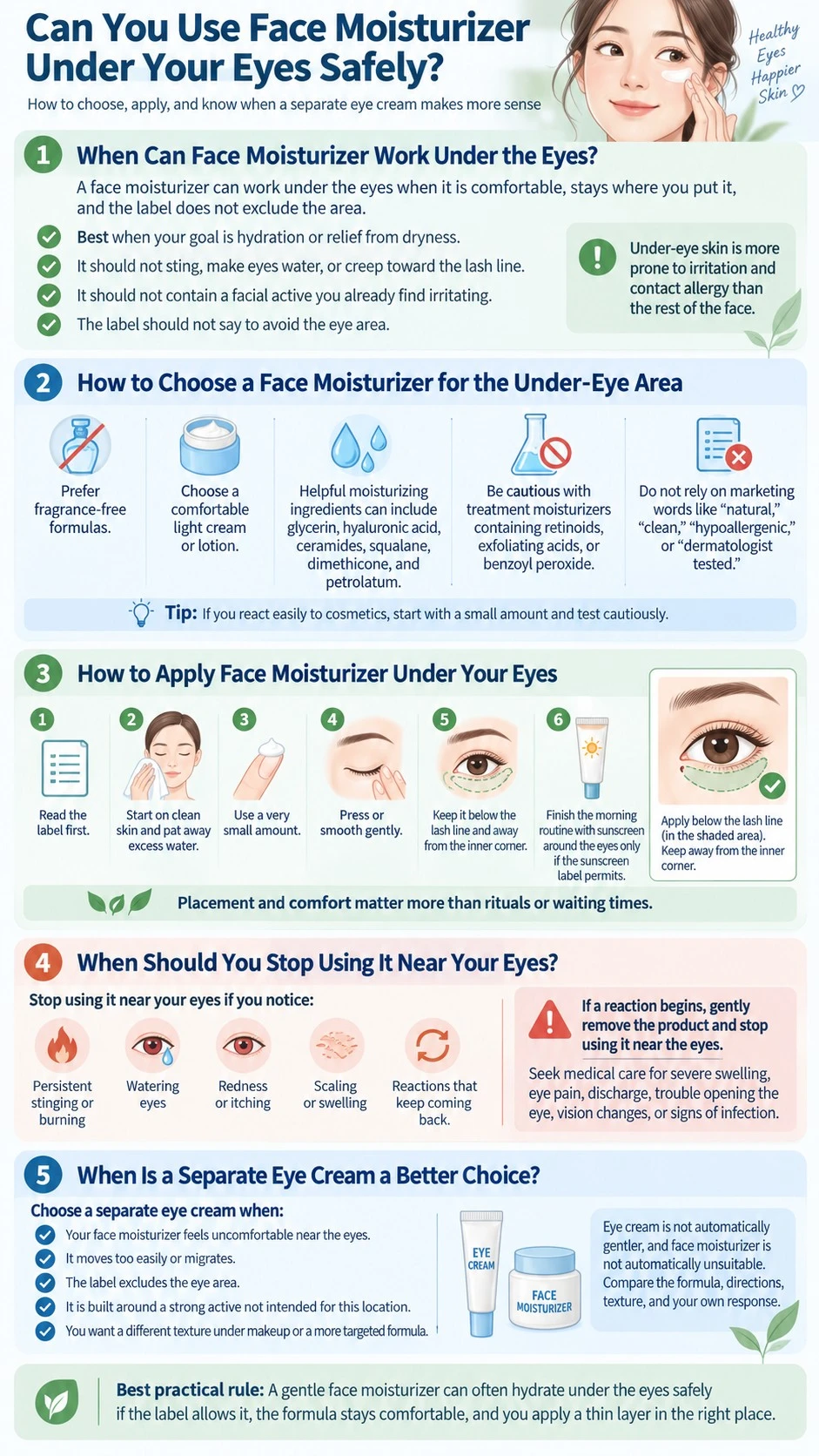
When Can Face Moisturizer Work Under the Eyes?
A face moisturizer is a reasonable under-eye option when it is comfortable, stays where you put it, and has no directions excluding the area. Moisturizers can soften dry surface skin by combining humectants that hold water with emollient or occlusive ingredients that reduce water loss.[1]
Use the same moisturizer under your eyes when all of these are true:
- Your main goal is hydration or relief from a dry, tight feel.
- The product does not sting your skin or make your eyes water.
- It spreads in a thin layer without creeping toward the lash line.
- It does not contain a facial active that you already find irritating.
- The label does not restrict use near the eyes.
Being safe on the cheeks does not prove that a product will feel comfortable under the eyes. Eyelid and periorbital skin is especially vulnerable to irritation and contact allergy, and a reaction may appear there even when the rest of the face looks normal.[2]
How to Choose a Face Moisturizer for the Under-Eye Area
Start with a bland, hydrating formula and a short decision checklist rather than looking for one “best” ingredient.
- Prefer fragrance-free. Fragrance and preservatives are frequent allergen groups in people evaluated for eyelid dermatitis.[2] “Unscented” is not the same as fragrance-free because a product may contain fragrance-related ingredients that mask odor.
- Favor a comfortable texture. A light cream or lotion is easier to apply in a thin layer. A very rich balm is not automatically unsafe, but it may migrate or feel heavy.
- Look for familiar moisturizing components. Glycerin, hyaluronic acid, ceramides, squalane, dimethicone, and petrolatum can all support hydration in different formula types. The full formula and your tolerance matter more than any single highlighted ingredient.
- Be cautious with treatment moisturizers. Retinoids, exfoliating acids, benzoyl peroxide, or other strong actives should not be moved closer to the eyes unless the product directions allow it. A face cream with an active is not interchangeable with an eye product merely because both are creams.
- Do not rely on marketing words alone. “Natural,” “clean,” “hypoallergenic,” and “dermatologist tested” do not guarantee that a formula will suit your eye area.
If you already react easily to cosmetics, test the product before regular use. The fuller guide to patch testing skincare products explains how to screen for delayed redness, itching, or swelling. Even a successful arm test cannot guarantee that the more sensitive under-eye area will tolerate the product, so begin with a small amount.
How to Apply Face Moisturizer Under Your Eyes
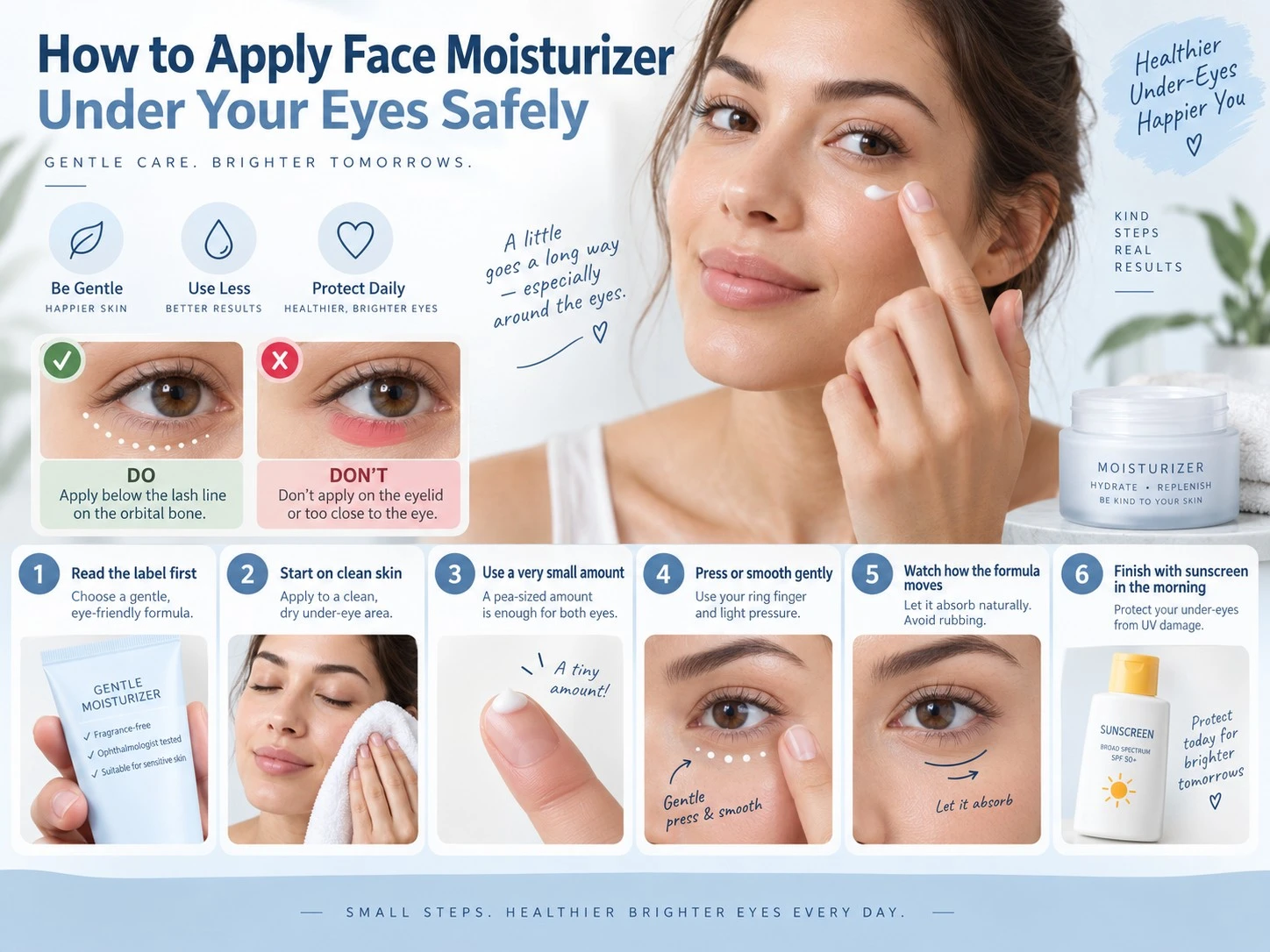
Use a controlled, thin application rather than treating the under-eye area like the cheeks.
- Read the label first. Do not use the product near the eyes if its directions or warnings exclude that area.
- Start on clean skin. Pat away excess water so the product does not slide. If another eye-area treatment requires dry skin, follow its directions.
- Use a very small amount. Spread a thin film between the lower orbital area and the top of the cheek. A thin layer is easier to control and less likely to migrate toward the eye.
- Press or smooth gently. Use light pressure and avoid repeated rubbing or pulling. Keep the moisturizer below the lash line and out of the inner corner of the eye.
- Watch how the formula moves. If it travels toward the eye, use less, place it farther from the lash line, or choose a lighter texture.
- Finish the morning routine with sunscreen. Apply sunscreen around the eyes only as that sunscreen’s label permits.
You do not need to use a particular finger, wait a fixed number of minutes, or pat until the product disappears. Accurate placement and comfort matter more than a ritual. FDA eye-cosmetic guidance also supports stopping immediately when a product causes irritation and avoiding cosmetics near the eyes when the surrounding skin is inflamed.[3]
When Should You Stop Using It Near Your Eyes?
Stop using the moisturizer in this area if you develop persistent stinging, burning, watering, redness, itching, scaling, or swelling. These signs can reflect irritation or contact allergy; continuing to apply the product can make it harder to identify the trigger.
Gently remove the product if a reaction begins. Do not keep testing it closer to the eye, cover the reaction with more new skincare, or assume discomfort means the product is “working.” A home-use test can help screen a new product, but a clinician may need to perform formal patch testing when reactions recur or the trigger is unclear.[4]
Seek prompt medical care for severe swelling, eye pain, discharge, trouble opening the eye, vision changes, signs of infection, or symptoms that persist after you stop the product. A recurring scaly or itchy eyelid rash also deserves evaluation rather than repeated cosmetic experiments.
When Is a Separate Eye Cream a Better Choice?
Choose a separate eye cream when your face moisturizer is uncomfortable, too mobile, excluded by its label, or built around an active that is not intended for the eye area. An eye cream can also make sense when you want a different texture under makeup or a targeted formula for a specific cosmetic concern.
“Eye cream” does not guarantee a gentler formula, and “face moisturizer” does not make a product unsuitable by definition. Compare the ingredient lists, directions, texture, and your response. The guide to eye cream vs moisturizer explains where their functions overlap and when buying both adds real value.
Targeted eye products also have limits. They may hydrate, temporarily soften dehydration lines, or modestly improve certain appearance concerns, but results depend on the active, formula, cause, and consistent use.[5] Before buying a treatment product, review what eye cream can realistically do so the product matches the problem.
FAQs About Face Moisturizer Under the Eyes
Can you put face moisturizer on your upper eyelids?
Only if the product directions permit that use. Otherwise, keep an ordinary face moisturizer off the mobile upper eyelid and away from the lash line because the formula can migrate into the eye. A clinician may recommend a particular bland product for eyelid dryness, but that is different from assuming every face cream is suitable.
Can you use face moisturizer under your eyes every day?
Yes, if the product remains comfortable and its label does not exclude the area. Daily use is reasonable for hydration, but stop if repeated application causes itching, scaling, watering, redness, or swelling.
Can face moisturizer reduce dark circles?
Moisturizer can make dry skin look smoother and may reduce the shadowing created by dehydration lines. It will not correct every cause of dark circles, such as deeper pigmentation, visible vessels, allergies, or anatomical hollows. A targeted product still needs to match the actual cause.
Can you use night cream under your eyes?
Sometimes. A plain night moisturizer may be suitable, but many night creams contain retinoids, exfoliating acids, fragrance, or rich textures that can irritate or migrate. Check the directions and formula instead of assuming that “night cream” describes one standard product type.
Sources
[1] Zirwas MJ, Stechschulte SA. Moisturizer Allergy: Diagnosis and Management
[2] Borzova E, et al. Eyelid dermatitis in patch-tested adult patients
[3] U.S. Food and Drug Administration. Eye Cosmetic Safety
[4] American Academy of Dermatology Association. How to test skin care products
[5] Hamie H, et al. A review of the efficacy of popular eye cream ingredients


