


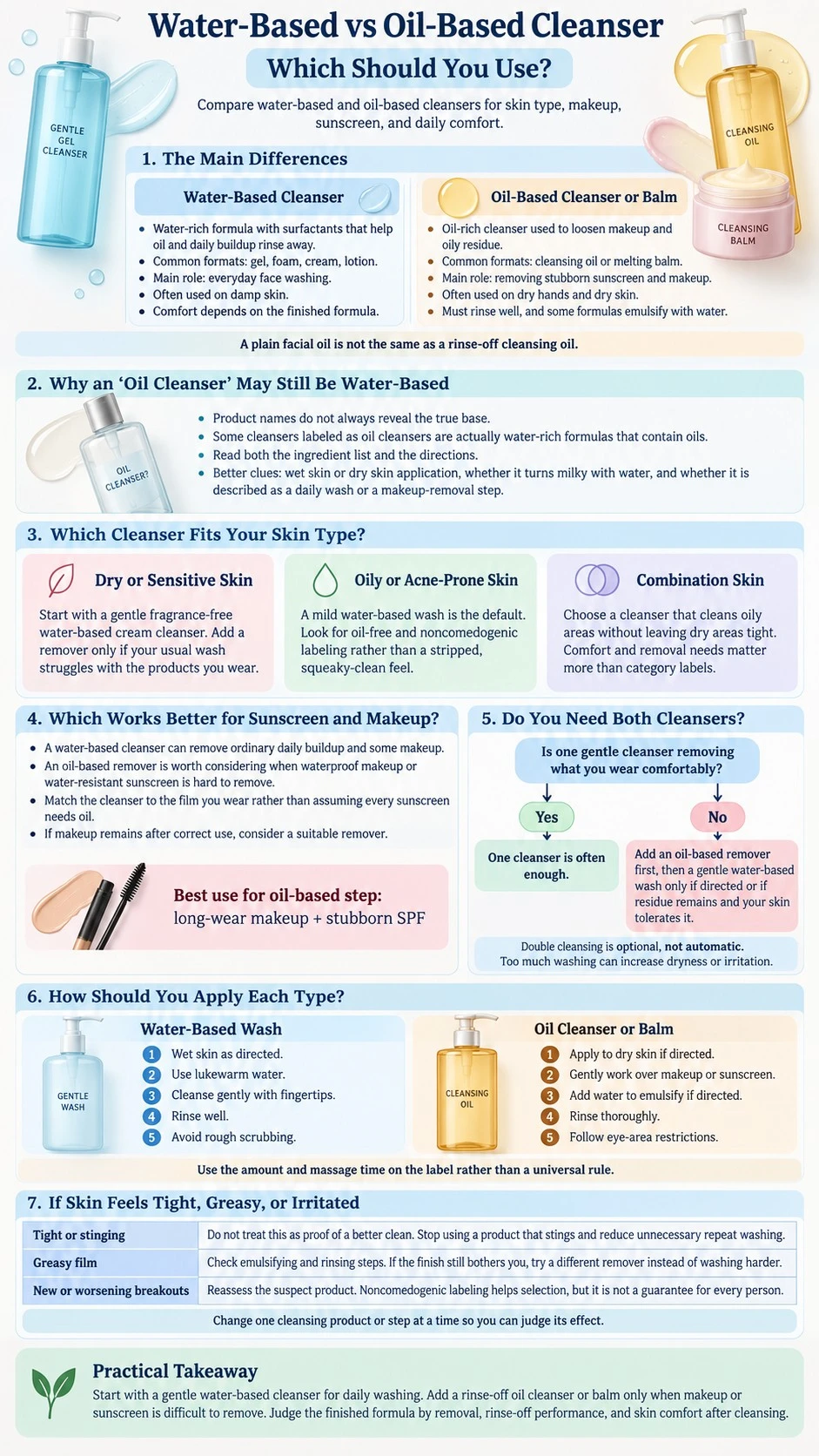
Choose your cleanser around what needs removing and how your skin feels afterward. Water-based and oil-based formulas have overlapping abilities, and either can be a poor fit if it requires vigorous rubbing or leaves your skin uncomfortable.
Water-Based vs Oil-Based Cleanser: The Main Differences
Water-based cleanser: A water-rich formula containing cleansing ingredients called surfactants. Their oil-attracting and water-attracting parts loosen oily dirt so it can rinse away. A water-based cleanser therefore removes surface oil as well as other daily buildup; it is different from washing with plain water.[1]
Classic oil-based cleanser: An oil-rich liquid or balm used to loosen makeup and oily residue. Rinse-off formulas include ingredients that help the oil mix with water during removal. For example, one oil-cleanser label lists oils alongside an emulsifying ingredient and directs users to add water until the cleanser turns milky.[2]
| What to compare | Water-based cleanser | Classic oil-based cleanser or balm |
|---|---|---|
| Common formats | Gel, foam, cream or lotion | Liquid oil or a solid balm that melts during use |
| Main practical role | Everyday face washing; removal performance varies by formula | Loosening makeup and stubborn oily films before rinsing |
| Can it remove surface oil? | Yes; surfactants help oil rinse away | Yes; an oil-rich formula can loosen oily residue |
| Starting application | Often damp skin; check the label | Often dry hands and dry skin; check the label |
| What matters for rinsing | Correct amount, gentle application and a thorough rinse | Adding water to emulsify when directed, then rinsing thoroughly |
| Skin comfort | A creamy water-based wash can suit dry skin; a stronger wash may feel drying | An oil-rich texture is not a guarantee against irritation or breakouts |
| Need for another cleanser | Usually used as the main wash | May be a first cleanse; a second wash depends on directions and need |
For the oil-based option, choose a cleanser formulated to rinse off. A plain facial oil is not interchangeable with an emulsifying cleansing oil.
Why an “Oil Cleanser” May Still Be Water-Based
Names do not reliably identify a cleanser’s base or application method. One US product sold as a foaming oil cleanser lists water first, contains squalane and other lipids, and directs application to wet skin.[3]
This is different from a classic dry-applied cleansing oil. A water-rich formula can contain oils, while an oil-rich remover can contain emulsifiers. Creamy texture and foam level are not reliable shortcuts for classifying every product.
Read the ingredient list together with the directions: does it start on wet or dry skin, does it need added water to turn milky, and is it presented as a daily wash or a makeup-removal step? These clues are more useful than treating every bottle labeled “oil” as interchangeable.
Which Cleanser Fits Your Skin Type?
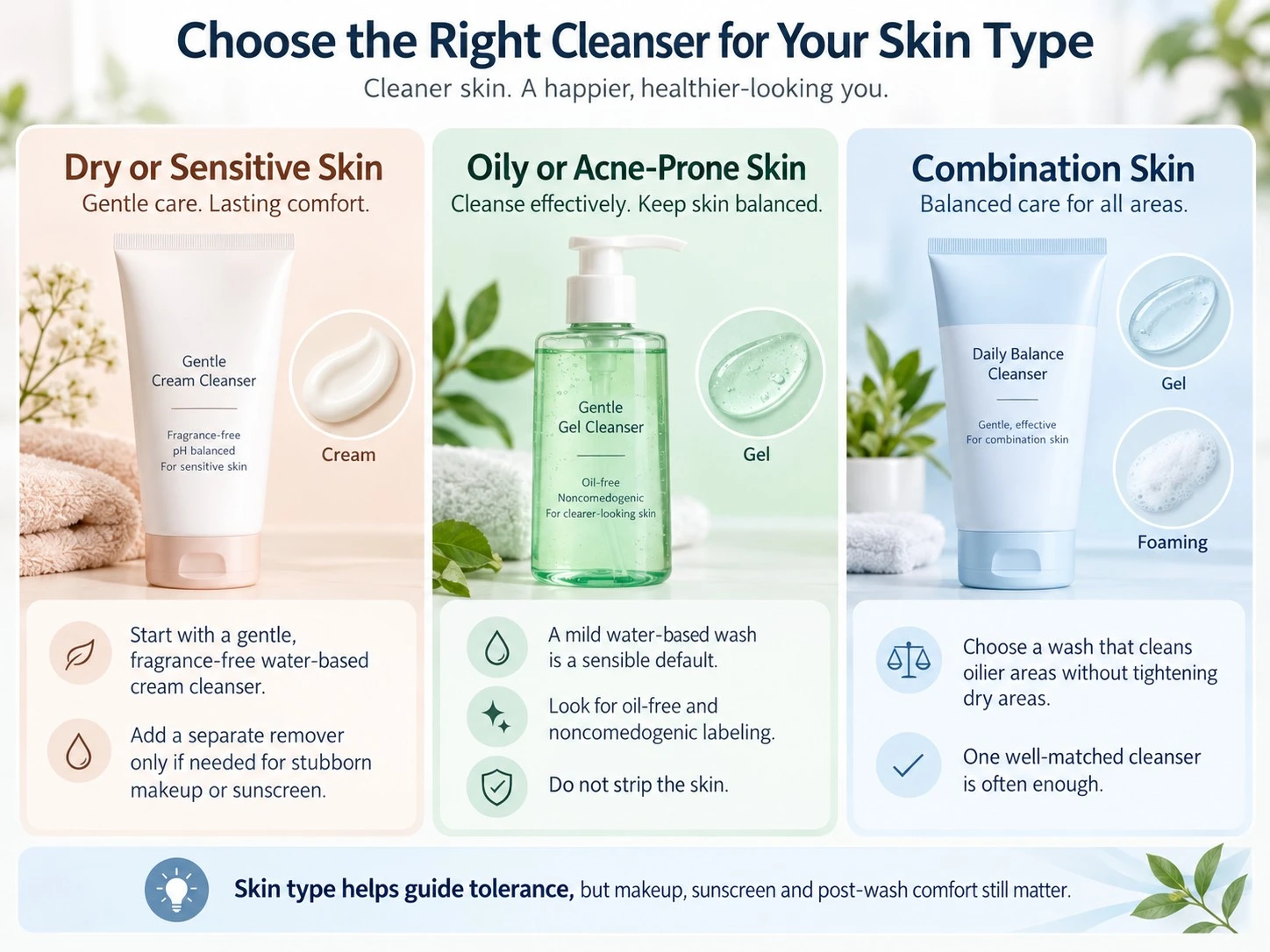
Skin type helps you choose a tolerable formula; it does not tell you how much makeup needs removing.
- Dry or sensitive skin: A gentle, fragrance-free water-based cream cleanser is a reasonable starting point.[4] Oil is not required just because your skin is dry. Add a separate remover only if your usual wash struggles with the products you wear.
- Oily or acne-prone skin: A mild water-based wash is a sensible default. Look for oil-free and noncomedogenic labeling rather than trying to make your face feel completely stripped. Oil cleansers are not a necessary way to “balance” oily skin.[5]
- Combination skin: Choose a wash that cleans the oilier areas without leaving dry areas tight. You do not need two different cleanser bases for two zones; removal needs and comfort still guide the choice.
Texture can help narrow the choice among gel, cream and foaming cleansers, but assess the actual formula after rinsing. A product that leaves your dry areas tight is not a good fit simply because its category is recommended for your skin type.
Which Works Better for Sunscreen and Makeup?
An oil-based remover is worth considering when waterproof makeup or water-resistant sunscreen is hard to remove with your usual wash. That does not mean every sunscreen requires oil, or that a water-based cleanser cannot remove makeup.
In a small study involving 20 participants, both the tested foaming cleanser and cleansing oil removed the tested non-waterproof sunscreen effectively. The oil performed better for the tested waterproof sunscreen. The findings support matching removal to the film you wear; they do not establish that every oil cleanser outperforms every water-based cleanser.[6]
Start with your cleanser’s removal claims and directions. Visible makeup remaining after correct use is a reason to consider a suitable remover. For sunscreen removal, follow the specific product guidance; skin feeling clean cannot prove that all SPF has been removed.
Do You Need Both Cleansers?
Double cleansing: An optional two-product approach. One thorough wash with a gentle cleanser is often sufficient; unnecessary repeat washing can add dryness or irritation.[4]
Use two products when the first serves a specific removal job and a follow-up wash is directed or useful for remaining residue. If double cleansing, the usual order is oil-based remover first, then water-based cleanser. Keep skin damp for the second wash and pat dry after the final rinse.[4]
An oil cleanser may be enough on its own if its directions allow that use and it removes what you wear comfortably. Follow a labeled two-step routine when using a product designed for that routine; if it feels too drying, choose a simpler alternative instead of forcing the extra wash.
How Should You Apply Each Type?
For a conventional water-based wash: Follow its wet-skin directions, use lukewarm water and gentle fingertips, and rinse well. Scrubbing with rough tools is unnecessary and can irritate skin.[7]
For a classic rinse-off oil or balm: Follow its dry-skin directions. Gently work the product over makeup, add water to emulsify if directed, then rinse thoroughly.[2] A balm’s solid starting texture does not mean it should be scrubbed in; the guide to using cleansing balm covers its application and common mistakes.
Use the amount on your label rather than a universal pump count or massage time. Follow any eye-area restrictions: a facial cleanser is not automatically suitable for removing eye makeup.
What If Your Skin Feels Tight, Greasy or Irritated?
Use the problem after cleansing to decide what to change:
- Tightness or stinging: Do not take this as evidence of a better clean. Stop using a product that stings and reduce unnecessary repeat washing. Drying and irritating acne-prone skin can worsen breakouts.[8]
- A persistent oily film: Check that you added water to emulsify when directed and rinsed thoroughly before adding another product. If the finish still bothers you, a different remover may suit you better.
- New or worsening breakouts: Do not assume they are a beneficial “purge.” Reassess the suspect product; noncomedogenic labeling is a useful selection aid, not a guarantee for every individual.[8]
Change one product or cleansing step at a time so you can judge its effect. If irritation or breakouts persist, seek advice from a dermatologist rather than escalating to harsher washing.
FAQs About Water-Based and Oil-Based Cleansers
Is micellar water a water-based cleanser?
Yes, it is generally an aqueous cleansing formula containing surfactants.[9] Its wipe-on application differs from a conventional rinse-off face wash, so follow that product’s removal and rinsing directions rather than treating the two formats as identical.
Does oily skin need an oil cleanser?
No. A gentle water-based wash is a practical default. Oily skin does not require an oil cleanser to balance oil production; choose a product that removes what you wear without irritation.
Should you use an oil cleanser every morning?
Not automatically. Choose morning cleansing around your skin’s needs and product directions. If there is no stubborn makeup or sunscreen to remove, that removal task alone does not justify adding an oil step.
Will an oil cleanser remove blackheads?
An ordinary oil cleanser is not a blackhead treatment. Avoid trying to scrub acne away; persistent blackheads may need an appropriate acne treatment.[8]
Sources
[1] DermNet. Soaps and cleansers
[2] DHC. Deep Cleansing Oil®
[3] CeraVe. Hydrating Foaming Oil Cleanser
[4] Cleveland Clinic. Double Cleansing Method Explained: Should You Try It?
[5] American Academy of Dermatology. How to control oily skin
[6] West China Hospital, Sichuan University; The Second People’s Hospital of Chengdu. The optimal cleansing method for the removal of sunscreen:Water, cleanser or cleansing oil?
[7] American Academy of Dermatology. Face washing 101
[8] American Academy of Dermatology. 10 skin care habits that can worsen acne
[9] Cleveland Clinic. Micellar Water: What It Is and How To Use It in Your Skin Care Routine


