
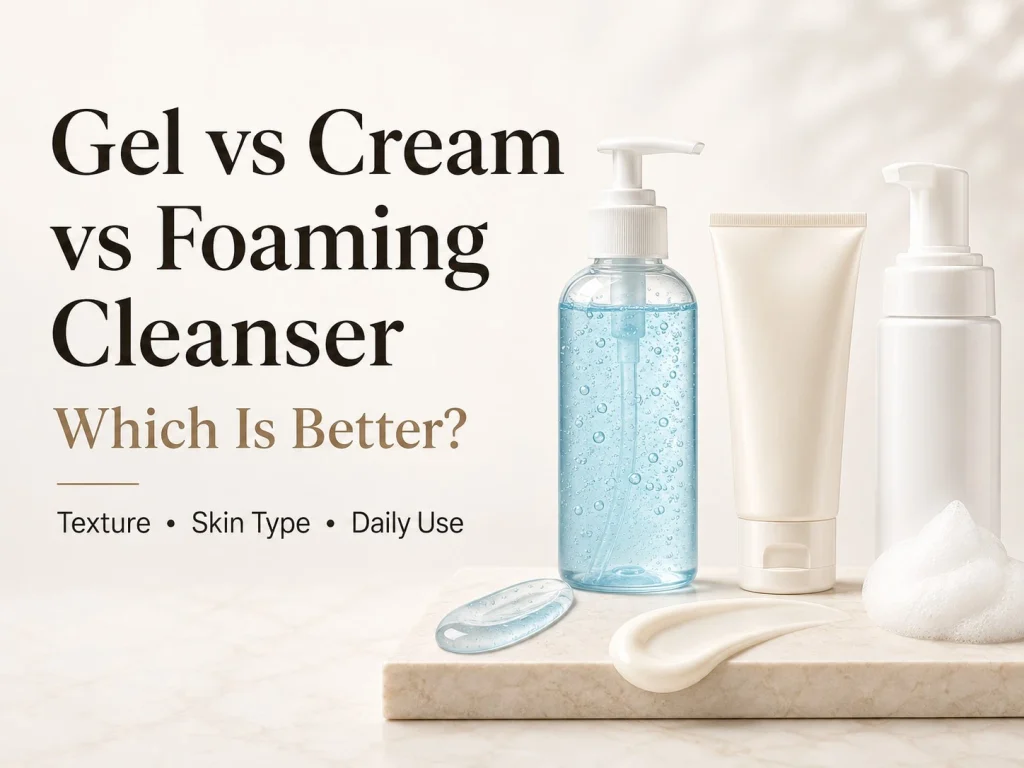

Gel, cream, and foaming cleansers can all remove sweat, excess oil, sunscreen, and daily buildup, but they differ in texture, lather, rinse feel, and how easily they fit different skin conditions. The label offers a useful starting point, not a guarantee of cleansing strength or gentleness.
The most important distinction is often missed: gel and cream mainly describe the starting texture, while foaming describes what the cleanser does when mixed with water. A gel cleanser can foam, and a cream cleanser can produce a light lather.
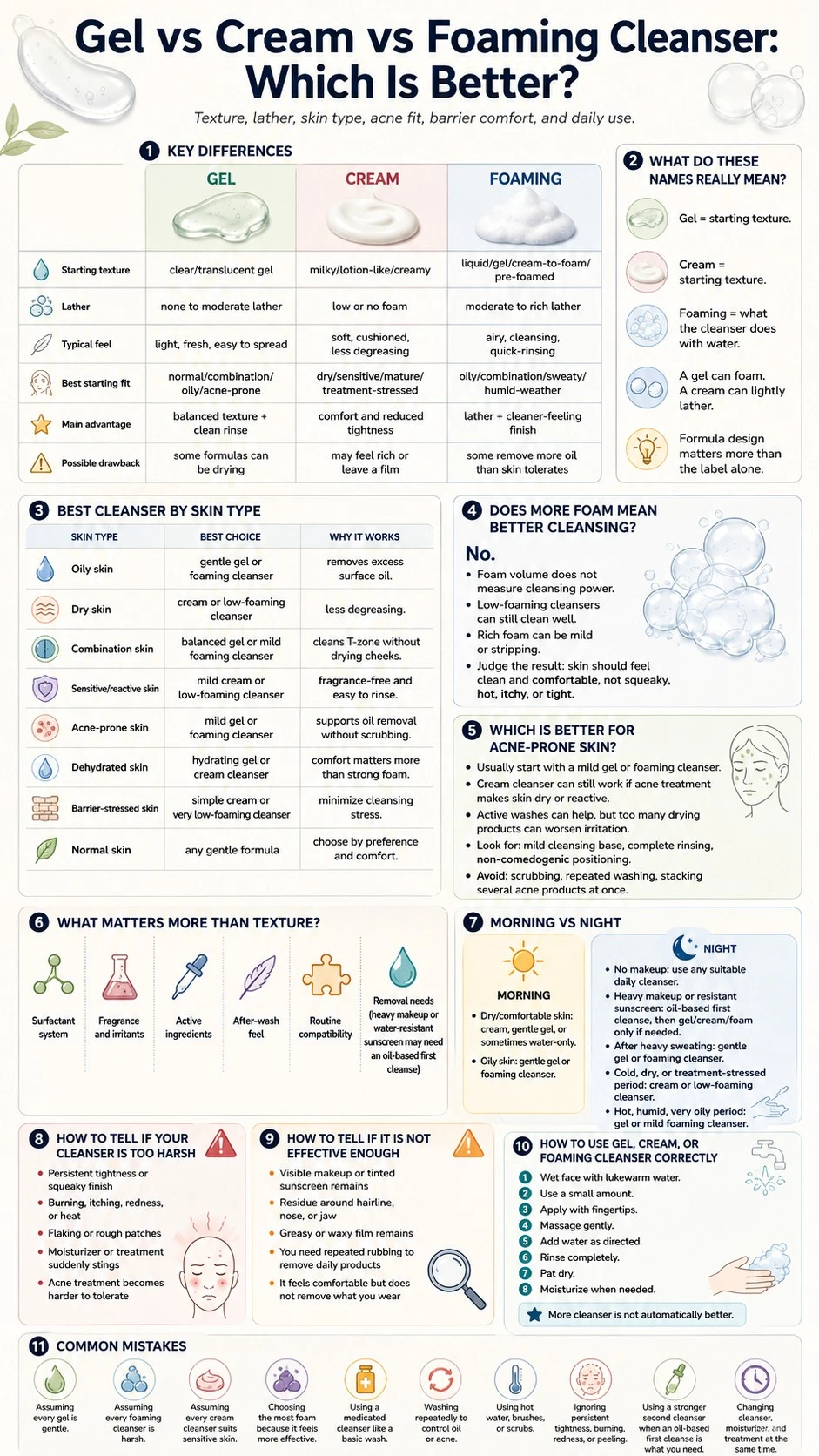
Gel vs Cream vs Foaming Cleanser: Key Differences
The table below compares the typical experience of each format. Individual products can behave differently, so use these patterns as a starting point rather than a fixed rule.
| Feature | Gel Cleanser | Cream Cleanser | Foaming Cleanser |
|---|---|---|---|
| Starting texture | Clear or translucent gel | Milky, lotion-like, or creamy | Liquid, gel, cream-to-foam, or pre-foamed |
| Lather | None to moderate | Usually low or none | Moderate to rich |
| Typical feel | Light, fresh, and easy to spread | Soft, cushioned, and less degreasing | Airy, cleansing, and quick-rinsing |
| After-wash finish | Clean with relatively little residue | Comfortable or slightly conditioned | Fresh to very clean, depending on the formula |
| Oil-removal tendency | Usually moderate | Usually mild to moderate | Often moderate to higher |
| Common starting fit | Normal, combination, oily, or acne-prone skin | Dry, sensitive, mature, or treatment-stressed skin | Oily, combination, sweaty, or humid-weather skin |
| Main advantage | Balanced texture and clean rinse | Lower-foam comfort | Visible lather and efficient spread |
| Possible drawback | Some gels contain strong surfactants or drying actives | Some feel too rich or leave a film | Some remove more oil than the skin tolerates |
| Best reason to choose it | You want light cleansing without necessarily wanting rich foam | You prioritize comfort and reduced post-wash tightness | You prefer lather and a cleaner-feeling finish |
What Do Gel, Cream, and Foaming Actually Mean?
Facial cleansers use surfactants to surround oil-based material so it can mix with water and be rinsed away. How strongly a cleanser interacts with the skin depends on the complete surfactant system and supporting formula, not simply whether the product looks clear, creamy, or bubbly.[3][4]
Gel Cleanser
A gel cleanser begins with a light, water-based gel texture. It normally spreads quickly and rinses without the richer after-feel associated with cream formulas. Some gel cleansers barely lather, while others are marketed as foaming gels and produce abundant bubbles.
Gel cleansers are often selected for oily, combination, or acne-prone skin because they can remove surface oil without the weight of a cream. However, a gel containing a strong cleansing base, fragrance, alcohol, exfoliating acids, or an acne active may feel more drying than a mild foaming or cream cleanser.
Cream Cleanser
A cream cleanser is an emulsion with a milky, lotion-like, or creamy texture. It usually produces little foam and often contains emollients or humectants that create a softer washing experience. This makes cream cleansers a common starting option for dry, reactive, mature, or barrier-stressed skin.
A conditioned after-feel is not automatically residue, but the product should still rinse evenly. A cream cleanser may be a poor match when it leaves a persistent waxy film, fails to remove the day’s products, or feels uncomfortably heavy on oily skin.
Foaming Cleanser
A foaming cleanser produces bubbles when dispensed or mixed with water. It may begin as a gel, liquid, powder, or cream-to-foam formula, which is why “foaming” is not a completely separate texture category.
Foaming cleansers commonly suit people who want more noticeable oil, sweat, and debris removal. The American Academy of Dermatology recommends a gentle foaming face wash as one option for oily skin, while also warning against irritating cleansers and aggressive oil removal.[2] Modern foaming formulas can be mild, so foam itself should not be treated as proof that a cleanser damages the barrier.
Which Cleanser Is Best for Your Skin Type?
Skin type helps identify a sensible first option, but current skin condition can override it. Oily skin can also be dehydrated, and normally resilient skin can become sensitive after retinoids, exfoliating acids, benzoyl peroxide, dry weather, or over-cleansing.
| Skin Type or Condition | Better Starting Option | Why | What to Check |
|---|---|---|---|
| Oily skin | Gentle gel or foaming cleanser | Can remove excess surface oil with a lighter finish | No squeaky tightness, burning, or rebound discomfort |
| Dry skin | Cream or low-foaming cleanser | Usually provides a less degreasing wash | Fragrance-free formula and no post-wash tightness |
| Combination skin | Balanced gel or mild foaming cleanser | Can clean the T-zone without heavily coating the cheeks | Cheeks remain comfortable after rinsing |
| Sensitive or reactive skin | Mild cream or low-foaming cleanser | Reduces unnecessary lather and active ingredients | Fragrance-free, soap-free, and easy to rinse |
| Acne-prone skin | Mild gel or foaming cleanser | Supports oil and residue removal without scrubbing | Non-comedogenic positioning and compatibility with acne treatment |
| Dehydrated skin | Hydrating gel or cream cleanser | Balances cleansing with a more comfortable finish | Avoid choosing strong foam only because the face looks shiny |
| Barrier-stressed skin | Simple cream or very low-foaming cleanser | Minimizes avoidable cleansing stress | No exfoliating actives, fragrance, or persistent stinging |
| Normal skin | Any gentle formula | Texture preference can guide the choice | Complete removal without tightness or residue |
Use our Skin Type Guide if you are unsure where to begin. Skin that feels tight yet becomes shiny may be dehydrated rather than naturally dry; our Dehydrated vs Dry Skin guide explains the distinction.
Does More Foam Mean Better Cleansing?

No. Foam can improve spread, rinsing perception, and the feeling of freshness, but bubble volume does not directly measure how much oil, sunscreen, or debris a formula removes. A low-foaming gel may cleanse effectively, while a rich foam can be either mild or overly degreasing.
Cleansing performance and irritation potential depend on factors such as surfactant type, concentration, micelle behavior, contact time, pH, polymers, humectants, and emollients. Stronger surfactant interactions can remove skin lipids and affect proteins in the outer barrier, while well-designed systems can reduce those effects.[3][4]
Judge the result after rinsing. Skin should feel clean and comfortable, not squeaky, hot, itchy, or increasingly tight over the next several minutes. If the richest foam causes repeated discomfort, moving to a milder gel, cream, or low-foaming formula is more useful than trying to make the skin “adjust.”
Which Is Better for Acne-Prone Skin?
Acne-prone skin does not automatically need the strongest foaming cleanser. A mild gel or foaming formula is often a practical starting point because it can remove excess oil and daily buildup without leaving a heavy finish. Cream cleanser can still be appropriate when acne treatment has made the skin dry or reactive.
The cleanser must also fit the rest of the routine. Salicylic acid or benzoyl peroxide washes can be useful, but combining an active cleanser with several drying leave-on treatments may increase redness, peeling, and poor treatment tolerance. Dermatologists advise gentle cleansing and warn that scrubbing and repeated washing can worsen acne irritation.[5]
- Look for: A mild cleansing base, complete rinsing, and non-comedogenic positioning when available.
- Consider an active wash: Only when the active addresses a defined acne concern and fits your treatment plan.
- Avoid: Washing until the skin feels stripped, using a scrub with an active cleanser, or adding several acne products at once.
- Reassess: If the cleanser causes persistent burning, tightness, flaking, or makes prescribed treatment harder to tolerate.
Keep proven treatment at the center of an Acne-Prone Skincare Routine rather than expecting cleanser texture alone to control breakouts.
What Matters More Than Cleanser Texture?
- Surfactant system: The complete blend affects cleansing strength and skin interaction more than one highlighted ingredient.
- Fragrance and irritants: Dry, sensitive, and rosacea-prone skin often benefits from fragrance-free products. Dermatologists also recommend mild, non-soap cleansing for rosacea-prone skin.[6][7]
- Active ingredients: Salicylic acid, benzoyl peroxide, glycolic acid, and other actives change a cleanser from a basic wash into a treatment-support product.
- After-wash feel: Persistent tightness, burning, itching, or rawness is more informative than how luxurious the foam feels.
- Routine compatibility: A cleanser that is tolerable alone may become too much when paired with retinoids, acids, scrubs, or prescription treatment.
- Removal needs: Heavy makeup and water-resistant sunscreen may require an oil-based first cleanse rather than a stronger water-based cleanser.
For oil-based first cleansers, compare the texture and rinsing differences in Cleansing Balm vs Cleansing Oil.
Which Cleanser Should You Use in the Morning and at Night?
You do not need to use the same cleanser at every wash. The best format can change with oil production, weather, exercise, makeup, sunscreen, and treatment-related dryness.
| Situation | Practical Starting Option | Reason |
|---|---|---|
| Dry or comfortable skin in the morning | Cream cleanser, gentle gel, or water-only when appropriate | A heavy cleanse may be unnecessary |
| Oily skin in the morning | Gentle gel or foaming cleanser | Removes overnight oil without aggressive scrubbing |
| Evening without makeup | Any suitable daily cleanser | Match strength to sweat, oil, and sunscreen residue |
| Evening with heavy makeup or resistant sunscreen | Oil-based first cleanse, then gel, cream, or foam only if needed | Improves removal without forcing one harsh wash |
| After heavy sweating | Gentle gel or foaming cleanser | Rinses sweat, oil, and surface debris efficiently |
| Cold, dry, or treatment-stressed period | Cream or low-foaming cleanser | Prioritizes barrier comfort |
| Hot, humid, or very oily period | Gel or mild foaming cleanser | Provides a lighter rinse feel |
Most people do not benefit from washing repeatedly throughout the day. See How Often Should You Wash Your Face? for frequency guidance by skin type and situation.
How to Tell If Your Cleanser Is Too Harsh or Not Effective Enough
Signs It May Be Too Harsh
- Persistent tightness or a squeaky finish
- Burning, itching, redness, or heat after rinsing
- New flaking or rough patches
- Your usual moisturizer or treatment suddenly stings
- Acne medication becomes harder to tolerate
Signs It May Not Remove Enough
- Visible makeup or tinted sunscreen remains
- Residue collects around the hairline, nose, or jaw
- A persistent greasy or waxy film remains after rinsing
- You need repeated rubbing to remove daily products
- The cleanser is comfortable but consistently fails your actual removal needs
A new breakout does not prove that a cleanser was too gentle. Breakouts can also relate to irritation, residue, another product, treatment changes, hormones, or the acne condition itself. Change one variable at a time. If cleansing causes persistent burning, peeling, or sensitivity, review the signs of a Damaged Skin Barrier.
How to Use Gel, Cream, or Foaming Cleanser Correctly

- Wet the face with lukewarm water: Very hot water can increase dryness and discomfort.
- Use a small amount: More cleanser does not automatically improve removal.
- Apply with fingertips: Avoid brushes, rough cloths, and abrasive tools for routine washing.
- Massage gently: Spread the cleanser over the face without prolonged scrubbing.
- Add water as directed: Foaming formulas may need gradual water to build and distribute lather.
- Rinse completely: Check the hairline, sides of the nose, and jaw.
- Pat dry: Do not rub the face with a towel.
- Moisturize when needed: Especially when the skin is dry, sensitive, or using active treatment.
Dermatologists recommend a gentle, non-abrasive cleanser, lukewarm water, fingertip application, complete rinsing, and gentle drying.[1] Cleansing normally comes first; our Skincare Routine Order guide explains where treatment, moisturizer, and sunscreen follow.
Common Gel, Cream, and Foaming Cleanser Mistakes
- Assuming every gel cleanser is light and gentle.
- Assuming every foaming cleanser is harsh.
- Assuming every cream cleanser is suitable for sensitive skin.
- Choosing the most foam because it feels more effective.
- Using a medicated cleanser like a basic daily wash without checking the directions.
- Washing repeatedly to control oil or acne.
- Using hot water, a cleansing brush, or a scrub to increase the feeling of cleanliness.
- Ignoring persistent tightness, burning, redness, or peeling.
- Using a stronger second cleanser when makeup or sunscreen really needs an oil-based first cleanse.
- Changing cleanser, moisturizer, and treatment at the same time.
Final Thoughts
Gel, cream, and foaming cleansers are not ranked from best to worst. Gel cleansers usually offer a light, clean-rinsing experience. Cream cleansers usually prioritize a softer, lower-foam finish. Foaming cleansers provide more lather and often stronger oil-removal perception, but they can range from mild to stripping.
Start with your skin type, then adjust for your current barrier condition, climate, treatment routine, and removal needs. The right cleanser removes the day without leaving your skin persistently tight, irritated, or coated.
FAQs About Gel vs Cream vs Foaming Cleanser
Can a gel cleanser also be a foaming cleanser?
Yes. Gel describes the product’s starting texture, while foaming describes how it behaves with water and agitation. Many products are correctly described as foaming gel cleansers.
Is foaming cleanser bad for dry or sensitive skin?
Not automatically. A mild, fragrance-free, low-foaming formula may be comfortable, but dry or reactive skin often prefers cream or very gentle low-lather cleansers. Stop if the product repeatedly causes tightness, burning, or flaking.
Can oily skin use a cream cleanser?
Yes. A cream cleanser can suit oily skin that is dehydrated, treatment-stressed, or temporarily sensitive. It is a poor fit only when it leaves uncomfortable residue or does not remove the user’s normal buildup.
Is gel or foaming cleanser better for acne?
Neither format is universally better. Choose a mild, non-comedogenic formula that removes excess oil without stripping the skin. An active cleanser may help when salicylic acid or benzoyl peroxide fits the acne treatment plan.
Which cleanser is best for removing sunscreen?
A gel, cream, or foaming cleanser may remove light daily sunscreen when the formula and application are effective. Heavy, tinted, or water-resistant sunscreen may be easier to remove with a cleansing balm or oil first.
Can I use different cleansers in the morning and at night?
Yes. You might use a cream or gentle gel in the morning and a gel or foaming cleanser at night, or switch to a cream cleanser during dry weather. The routine should reflect what needs removal and how the skin feels.
Sources
[1] American Academy of Dermatology. Face Washing 101
[2] American Academy of Dermatology. How to Control Oily Skin
[3] Walters RM, et al. Cleansing Formulations That Respect Skin Barrier Integrity
[4] Draelos ZD. The Science Behind Skin Care: Cleansers
[5] American Academy of Dermatology. 10 Skin Care Habits That Can Worsen Acne
[6] American Academy of Dermatology. 7 Rosacea Skin Care Tips Dermatologists Recommend
[7] American Academy of Dermatology. Dermatologists’ Top Tips for Relieving Dry Skin


