
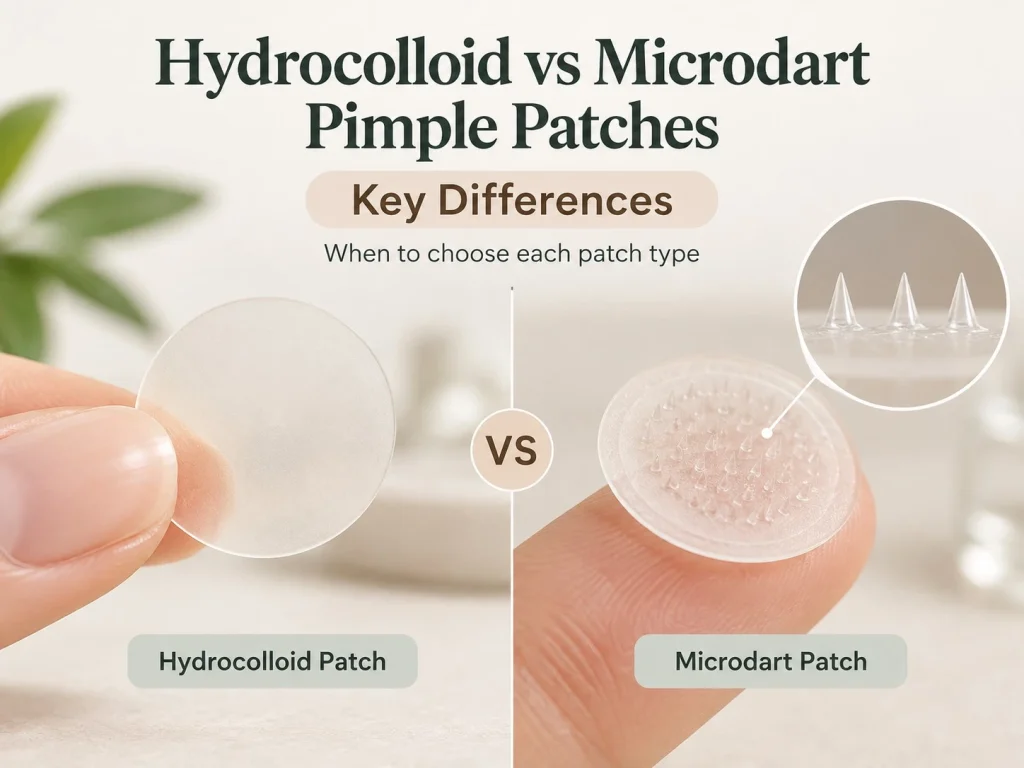

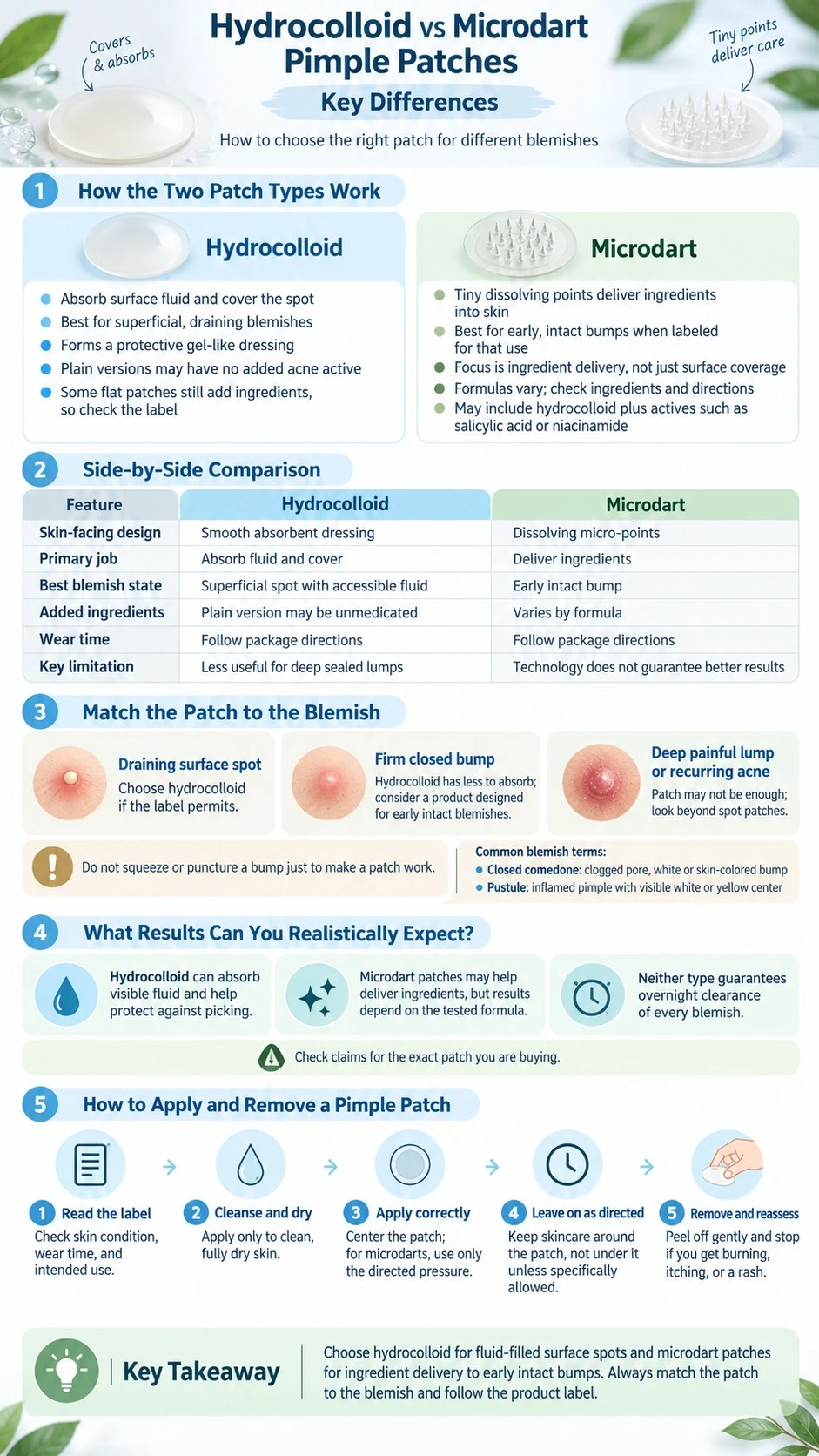
Choosing between hydrocolloid and microdart pimple patches starts with three checks: the skin-facing design, the blemish’s condition and the product directions. Use those checks to decide whether a simple dressing or an ingredient-delivery patch fits.
How the Two Patch Types Work
Hydrocolloid: Absorb Fluid and Cover the Spot
A plain hydrocolloid patch acts as a small absorbent dressing. It takes up fluid and forms a gel while covering the area. This makes its mechanism a better fit for a superficial, draining spot than a sealed bump with no accessible fluid.[1]
The material’s ability to form a protective, moisture-retaining layer comes from its gel-forming polymers. It does not need an added acne ingredient to perform that physical job.[1] A useful way to read the box is to ask whether it describes absorption, ingredient delivery, or both.
“Hydrocolloid” does not automatically mean “unmedicated.” Flat patches can also contain ingredients such as salicylic acid, which changes their tolerance considerations. Check the ingredient list instead of assuming every smooth sticker is the plain version.[2]
Microdarts: Deliver Ingredients Through Dissolving Points
Microdart, micropoint and some microneedle patches use small projections made from dissolvable material. The points are designed to cross the skin’s outer barrier and release what they contain as they dissolve. This is an ingredient-delivery approach, rather than simply placing an absorbent layer on the surface.[3]
Some microdart products combine hydrocolloid with ingredients such as sodium hyaluronate, niacinamide and salicylic acid, so the categories overlap.[4] The added point structure is the distinguishing feature.
Keep two separate questions in mind: Does it have dissolving points? and What ingredients does it contain? Neither “microdart” nor “medicated” tells you the full formula, delivered amount or likely result. If a patch contains it, understand how salicylic acid fits your existing products before adding more of the same active.
Hydrocolloid vs Microdart Patches: Side-by-Side Comparison
Use this table to compare formats. Individual directions take priority over category-level expectations.
| Decision factor | Plain hydrocolloid patches | Microdart pimple patches |
|---|---|---|
| Skin-facing design | Smooth absorbent dressing | Small dissolving projections, sometimes combined with hydrocolloid |
| Primary job | Take up fluid and cover the spot | Deliver the ingredients built into the points |
| Relevant blemish state | Superficial spot with accessible fluid | Early, intact bump if that use is specified on the label |
| Added ingredients | No added acne active in the plain version | Formula varies; check the complete ingredient list |
| Wear time | Follow the package’s removal or replacement directions | Follow the package; point dissolution and total wear time can differ |
| Key limitation | Absorption cannot reliably address a deep, sealed lump | Delivery technology alone does not establish effectiveness for deep acne |
| Buying check | Fit, adhesion, ingredients and patch count | Intended use, ingredients, directions and patch count |
Compare cost per patch rather than box price, and consider how many spots you actually need to cover. A large multipack and a small treatment pack are not equivalent purchases. More points or more ingredients should not be treated as a quality score without relevant finished-product evidence.
Match the Patch to the Blemish, Not Just the Word Whitehead
The word “whitehead” is often used loosely. A closed comedone is a clogged pore that creates a small white or skin-colored bump. A pustule is an inflamed pimple with a visible white or yellow pus-filled center. These are different lesion types, even when both look pale on top.[5]
That matters because a visible pale center does not automatically mean fluid is available for absorption. For a spot that has already begun draining, a plain hydrocolloid product can serve as a protective, absorbent cover if its directions allow that use. A firm, closed bump is a less suitable target for the same physical mechanism. Do not squeeze it to create an opening.[2]
For an early bump with intact skin, consider a microdart product labeled for early blemishes after checking its ingredients and directions.[6] An intact bump should not automatically be called a cyst or treated as one based on a product’s “deep blemish” wording.
Sometimes the better choice is an acne treatment rather than either patch. The comparison of pimple patches and spot treatments explains that separate decision. A patch choice should follow the kind of lesion and the job you need done, rather than the idea that every breakout needs a sticker.
What Results Can You Realistically Expect?
Expect a spot-level aid, not guaranteed overnight clearance. A small randomized trial involving 20 people found improvements in acne severity and inflammation with one hydrocolloid dressing compared with skin tape. It lasted only one week, so it cannot establish how every patch performs over longer periods.[7]
Dissolving acne patches also have human research. One trial followed 30 people using a specific anti-acne microneedle formulation for 28 days and reported reduced acne volume and pigmentation. Those findings support further interest in that tested formulation; they do not prove that every retail microdart patch gives the same results.[8]
The studies cited here did not directly compare a retail microdart patch with a plain hydrocolloid patch. They cannot establish that one category is universally better. Check whether a claim concerns the actual patch you are buying, and whether “results” means a measured change or a consumer’s impression.
Deep nodules and cysts develop below the surface and can scar. Persistent painful lumps, multiple deep lesions or scarring deserve dermatology care rather than repeated patch experiments.[9] Do not use a disappointing patch result as a reason to press harder, puncture the spot or keep adding treatments.
How to Apply and Remove a Pimple Patch
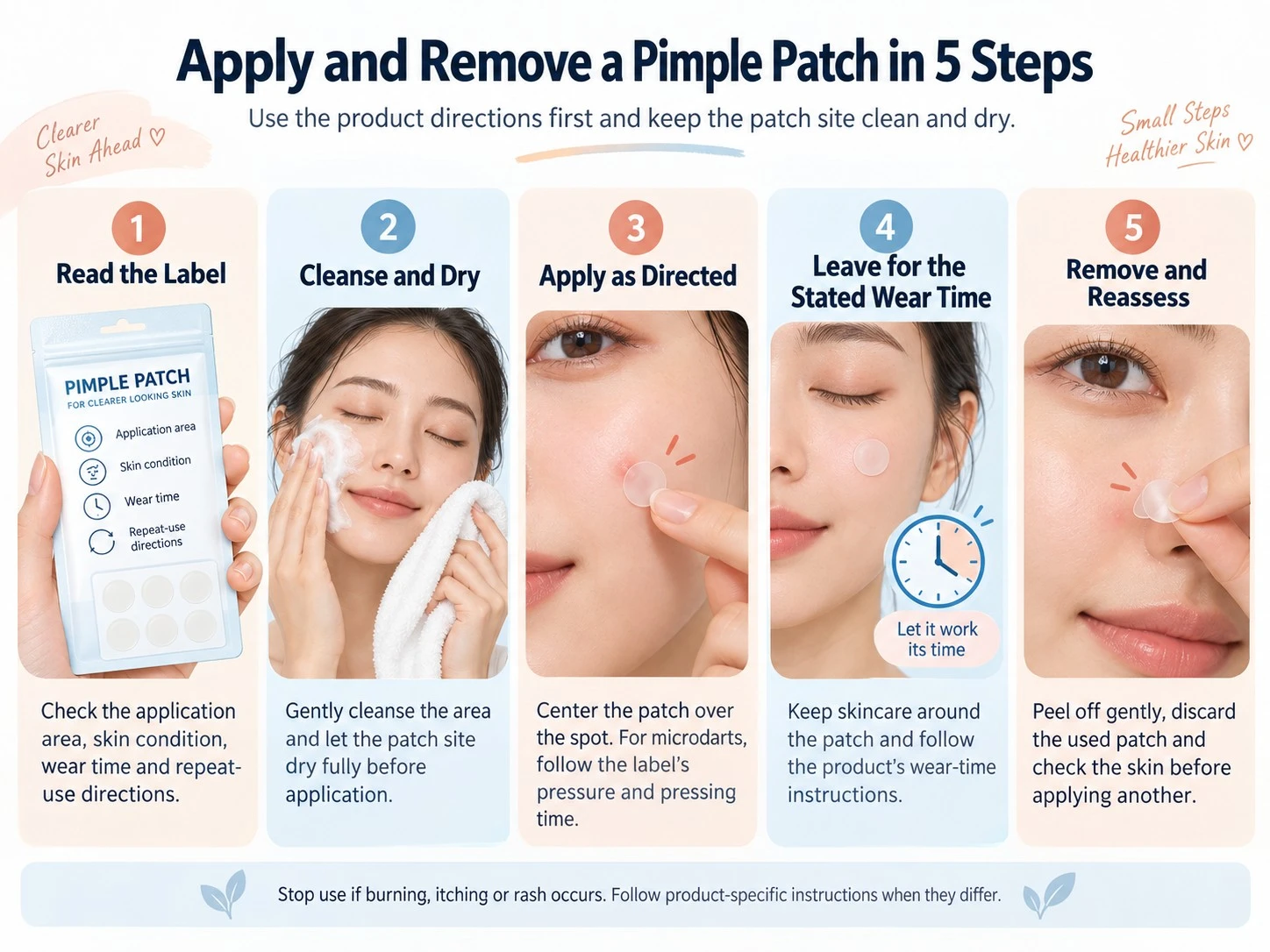
For patches whose directions call for clean, dry skin, use this sequence. Follow any product-specific preparation instructions instead when they differ.
- Read the label: confirm the intended application area, skin condition, wear time and repeat-use directions. If the skin is broken, check that the product explicitly permits use there.
- Cleanse and dry: gently clean the area and let the patch site dry fully. Leave moisturizer, oils and separate spot treatments off that site unless the directions specifically support using them underneath.
- Apply as directed: center the patch over the spot. For microdarts, use the pressure and pressing time specified on the label; extra force is not a shortcut to better delivery.[6] Avoid touching the skin-facing surface.
- Leave it for the stated wear time: keep other skincare around the patch. A claim that points dissolve after two hours does not necessarily mean the patch should be removed then.[4]
- Remove and reassess: peel gently, discard the used patch and check the skin before applying another. Stop if it causes burning, itching or a rash; adhesive and added ingredients can irritate sensitive skin.[2]
For help fitting the patch around toner, moisturizer or makeup, see when to apply a pimple patch in your skincare routine.
FAQs About Hydrocolloid and Microdart Pimple Patches
Do microdart pimple patches hurt?
Some users report a prickly feeling during application, and sensation varies by product and person.[4] Do not press harder to chase a stronger effect. Remove the patch if discomfort persists or the skin develops burning, swelling or a rash.
Why does a hydrocolloid patch turn white?
The absorbent material swells as it takes up moisture and forms a gel. A cloudy center does not measure how much acne remains, or prove that the entire blemish has cleared.[1]
Should you pop a pimple before applying a patch?
No. Squeezing can worsen a deep pimple and increase the risk of infection, discoloration and scarring. If a spot has already opened, stop manipulating it and check whether the patch is labeled for that skin condition.[9]
Can you use hydrocolloid and microdart patches on the same pimple?
Do not stack them. Each needs the skin contact specified by its directions. If the spot’s condition changes, reassess whether a different format fits; switching products is a practical choice, not a proven two-step treatment that everyone needs.
Sources
[1] Nguyen N, et al. Narrative Review of the Use of Hydrocolloids in Dermatology: Applications and Benefits
[2] Cleveland Clinic. How Do Pimple Patches Work?
[3] Lee JW, Park JH, Prausnitz MR. Dissolving microneedles for transdermal drug delivery
[4] Peach Slices. Deep Blemish Microdarts
[5] American Academy of Dermatology Association. How to treat different types of acne
[6] ZitSticka. KILLA Kit
[7] Chao CM, et al. A pilot study on efficacy treatment of acne vulgaris using a new method: results of a randomized double-blind trial with Acne Dressing
[8] Tai M, et al. Acne and its post-inflammatory hyperpigmentation treatment by applying anti-acne dissolving microneedle patches
[9] American Academy of Dermatology Association. Tips to treat a deep, painful pimple


