

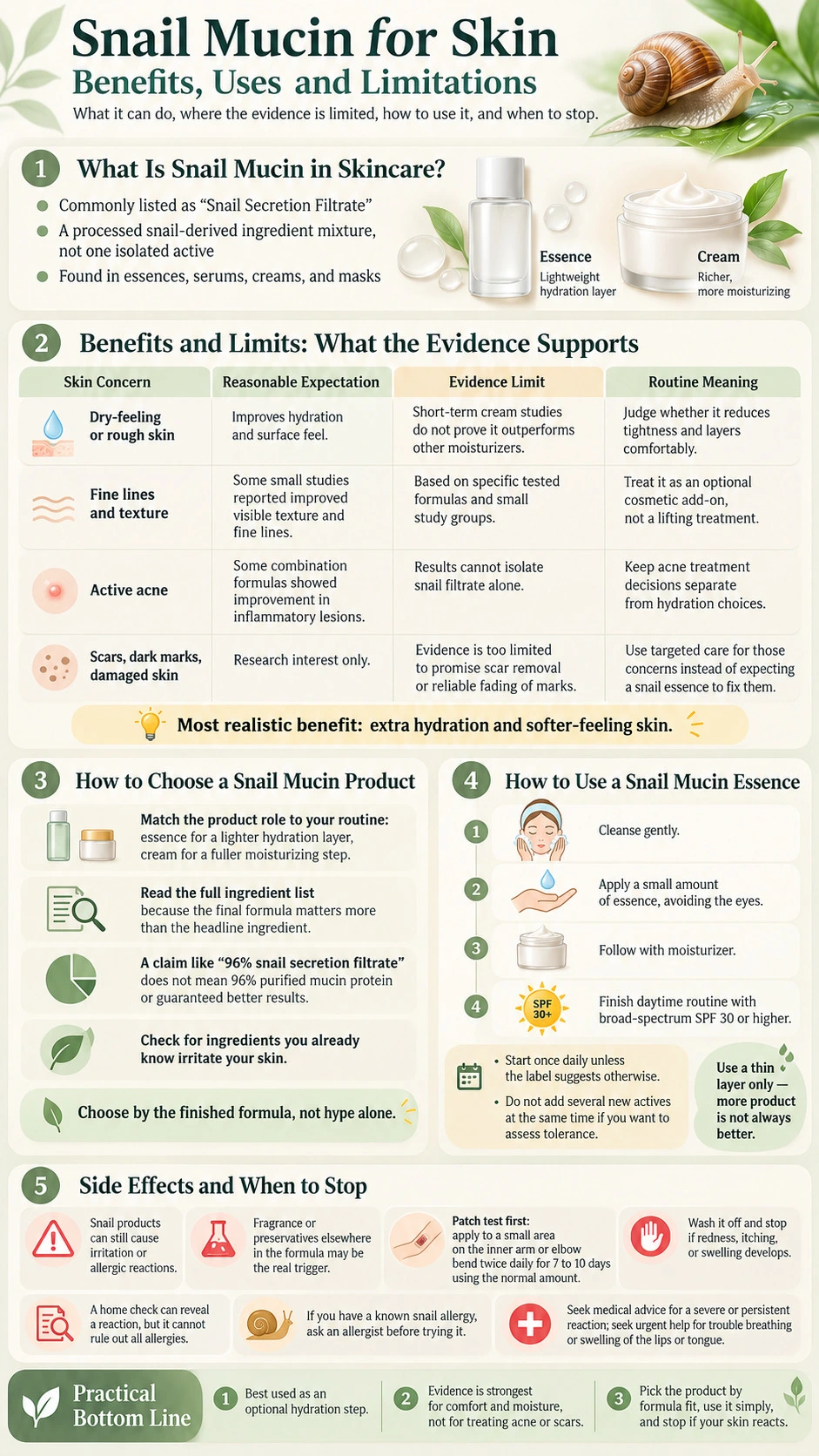
Snail mucin for skin makes most sense as an optional hydration step. Whether it is worth adding depends on the finished product, how it fits your routine and the result you want. Acne, scars and visible aging need more careful expectations than the promise of softer-feeling skin.
What Is Snail Mucin in Skincare?
Snail mucin comes from the mucus produced by snails. In skincare, the ingredient is commonly listed as Snail Secretion Filtrate. It is a processed mixture containing substances such as glycoproteins, which are proteins attached to sugar chains, rather than one isolated active ingredient.[2]
It appears in essences, serums, creams and masks. These product names matter because they describe different formulas: a thin essence adds a layer, while a cream can also supply the richer moisturizing ingredients your skin needs.
Benefits and Limits: What the Evidence Supports
Hydration is the most reasonable starting expectation. A small human study tested snail-mucus creams on 20 women and measured skin hydration and water loss over 24 hours. It supports a moisturizing role for those preparations, but does not establish long-term results for every essence or cream.[1]
| Skin concern | Reasonable expectation | Important evidence limit | What that means for your routine |
|---|---|---|---|
| Dry-feeling or rough skin | A moisturizing formula can improve hydration and surface feel. | Short-term cream results do not establish that snail filtrate outperforms other moisturizers.[1] | Judge whether it reduces tightness and layers comfortably. |
| Fine lines and texture | Some snail-containing products have improved visible wrinkles and texture. | A controlled study involved only 25 people and specific serum/emulsion formulas used for 12 weeks.[3] | Consider it an optional cosmetic addition; do not expect a lifting effect. |
| Active acne | A combination serum improved inflammatory lesions in mask-related acne. | The serum also contained calendula and licorice extracts; the result cannot isolate snail filtrate’s contribution.[4] | Keep acne treatment separate from the decision to add hydration. |
| Acne scars, dark marks or damaged skin | Laboratory findings provide reasons for further research. | They do not establish that an ordinary snail essence removes scars, reliably fades marks or treats open wounds.[2] | Seek care directed at the specific concern rather than escalating a cosmetic essence. |
Much of the wider research is preclinical or consists of small human studies. Results involving cells, animals, specialized wound preparations or supplements cannot be transferred directly to a bottled facial product.[2]
This distinction also matters when skin looks temporarily plumper: an improvement in surface hydration does not, by itself, demonstrate that a product has rebuilt deeper skin structures.
How to Choose a Snail Mucin Product
Start with the product’s role in your routine. If you already like your moisturizer but want a lighter hydration layer beneath it, an essence may fit. If you want fewer steps, assess a cream as a complete moisturizer rather than buying several products with the same featured ingredient.
Check these details before choosing:
- The full ingredient list: a snail product may also include sodium hyaluronate, panthenol, betaine or other ingredients. Any benefit comes from the finished formula, so the headline ingredient should not receive all the credit.[5]
- What the percentage measures: a claim such as “96% snail secretion filtrate” describes the filtrate ingredient. It does not state that 96% of the bottle is purified mucin protein or prove that it works better than a lower-percentage formula.[5]
- Your existing sensitivities: check for ingredients you already know you react to. A “natural” or “hypoallergenic” label is not a guarantee that your skin will tolerate the product.[6]
If you are choosing between a snail product and a hyaluronic acid serum, compare snail mucin and hyaluronic acid before buying both. The ingredient names describe different things, even though they can appear in the same formula.
How to Use a Snail Mucin Essence
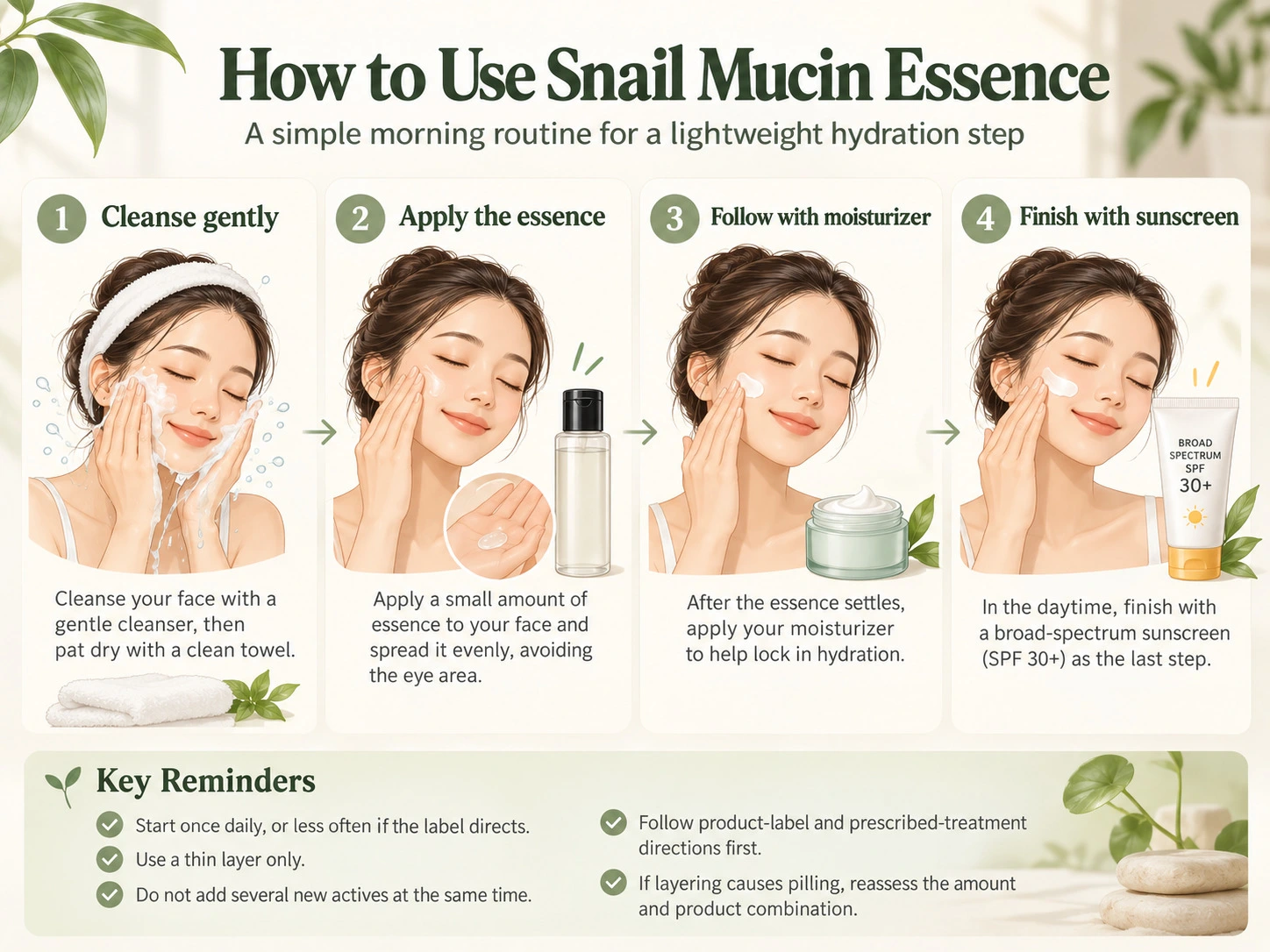
For a lightweight leave-on essence, use this morning sequence after checking tolerance on a small area. Follow the product label and any instructions for prescribed treatments; those directions take priority over a general layering guide.[7]
- Cleanse gently. Wash your face and gently pat it dry.
- Apply the essence. Spread a small amount over the face, keeping it away from your eyes. Follow the label’s directions for the amount and application method.[5]
- Follow with moisturizer. Apply your usual moisturizer after the essence has settled. A lightweight essence does not automatically replace a cream.[5]
- Finish daytime skincare with sunscreen. Use broad-spectrum SPF 30 or higher, and choose a water-resistant formula for outdoor use. Follow the sunscreen’s application and reapplication instructions.[8]
Start with one application a day, or less often if the label directs. Increase only if the product is comfortable and there is a useful reason to do so. Twice daily is not a requirement for getting value from an optional hydration step.
You do not need to introduce vitamin C, retinol or exfoliating acids at the same time. If those products already suit you, keep their directions unchanged while you assess the new essence. Adding several new products makes irritation harder to trace.[7]
Use only enough to spread a thin layer. If products roll into little flakes as you layer them, reassess the amount and the combination using our guide to why face serum pills. Pilling alone does not tell you whether the snail ingredient is effective.
Side Effects and When to Stop
A snail-containing product can cause irritation or an allergic reaction. Fragrance or preservatives elsewhere in the formula can also cause reactions. Check the whole ingredient list rather than assuming the snail filtrate is responsible.[6]
Before widespread use, apply the product to a small, coin-sized area on the inner arm or elbow bend twice daily for seven to 10 days. Use the normal amount and leave it on for the time directed on the label. If redness, itching or swelling develops, wash it off and stop using it.[9]
This home check can help reveal a reaction, but it cannot guarantee tolerance or identify a specific allergy. Medical patch testing is a different process used to investigate contact allergies.[9]
If you have a known snail allergy, ask an allergist before trying snail skincare. A home product test is not a way to rule out a serious allergy.[2]
Do not assume new bumps mean a snail product is “purging” your skin. Pause the new product and review what changed instead of continuing through an itchy rash or worsening breakouts. Get medical advice for a severe or persistent reaction. Seek urgent help for trouble breathing or swelling of the lips or tongue.[6]
FAQs About Snail Mucin for Skin
Can snail mucin replace moisturizer?
That depends on the product. A snail-containing cream may serve as your moisturizer if it keeps your skin comfortable. A thin essence is usually an additional layer; if your skin still feels tight or dry, follow it with moisturizer.[5]
How long does snail mucin take to work?
Separate hydration from slower cosmetic claims. Hydration has been measured within a day in a small cream study.[1] One wrinkle study assessed specific products over 12 weeks.[3] Neither result guarantees a timeline for your product, and irritation is a reason to stop sooner.
Is snail mucin vegan or cruelty-free?
Snail-derived mucin is animal-derived and is not vegan. Cruelty-free claims address a different question. Collection methods vary, so assess the brand’s specific sourcing and welfare information rather than assuming every snail product uses the same process.[2]
Is snail mucin an exfoliant?
Do not treat a snail essence as a measured exfoliating-acid product. Detecting glycolic acid in snail mucus does not establish the acid concentration or exfoliating strength of a finished essence. Check whether the product contains a separately formulated exfoliating ingredient.[1]
Sources
[1] Laneri S, et al. Dosage of Bioactive Molecules in the Nutricosmeceutical Helix aspersa Muller Mucus and Formulation of New Cosmetic Cream with Moisturizing Effect
[2] Singh N, Brown AN, Gold MH. Snail extract for skin: A review of uses, projections, and limitations
[3] Fabi SG, et al. The Effects of Filtrate of the Secretion of the Cryptomphalus Aspersa on Photoaged Skin
[4] Puaratanaarunkon T, et al. Efficacy and safety of a facial serum containing snail secretion filtrate, Calendula officinalis, and Glycyrrhiza glaba root extract in the treatment of maskne: A randomized placebo-controlled study
[5] COSRX. Advanced Snail 96 Mucin Power Essence
[6] U.S. Food and Drug Administration. Allergens in Cosmetics
[7] American Academy of Dermatology Association. Should I apply my skin care products in a certain order?
[8] American Academy of Dermatology Association. How to select a sunscreen
[9] American Academy of Dermatology Association. How to test skin care products


