


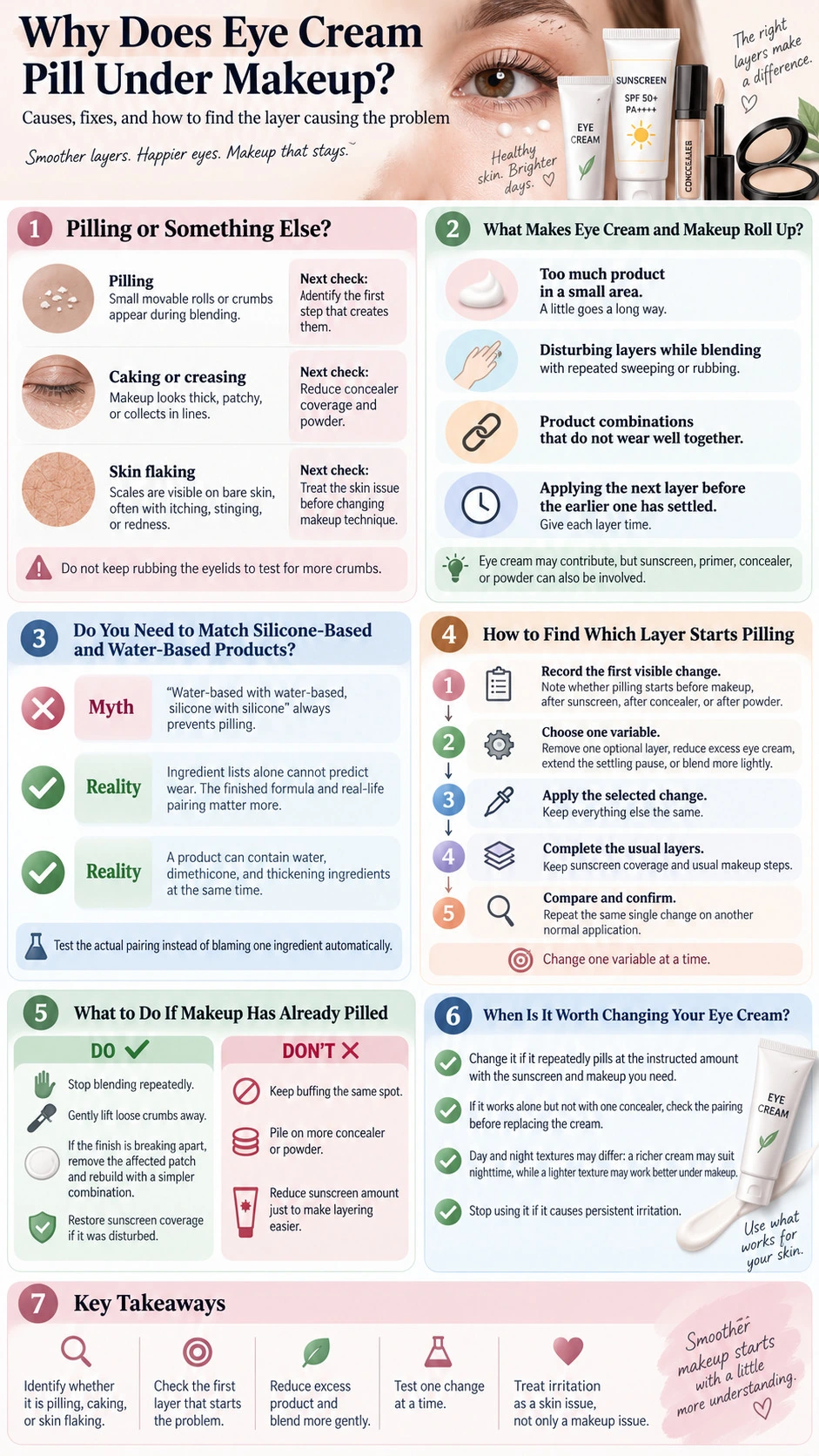
Before replacing an eye cream, identify what is rolling up and the step at which it starts. A product-layering problem and irritated, scaly skin need different responses.
Is It Pilling, Caking or Skin Flaking?
Pilling means that applied products gather into visible rolls or crumbs. Caking and creasing describe makeup that looks thick, patchy or collected in lines. Skin flaking may remain visible before makeup is applied. These patterns can overlap, so use them as observation clues, not a diagnosis.
| Pattern | What you see | Useful next check |
|---|---|---|
| Pilling | Small movable rolls appear during product blending | Identify the first application step that creates them |
| Caking or creasing | Makeup sits thickly, looks patchy or collects in lines without forming rolls | Check concealer coverage and powder amount |
| Skin flaking | Scales are visible on bare skin, sometimes with itching, stinging or redness.[2] | Address the skin symptoms before changing makeup technique |
Check the area during your usual gentle cleanse and application. Do not keep rubbing your eyelids to see whether more crumbs appear. Thin eyelid skin is vulnerable to irritation, and rubbing or scratching can be a trigger.[2]
If your eyelids are inflamed or a cosmetic causes irritation, pause eye makeup rather than covering the symptoms with more concealer. Stop the offending cosmetic and seek medical advice if irritation persists.[3]
What Makes Eye Cream and Makeup Roll Up?
Several variables are worth checking before assuming that one ingredient is to blame:
- More product than the area needs: excess skincare can remain on the surface and collect during layering.[1] Eye serum, eye cream and face moisturizer, and primer may overlap beneath concealer. You may not need every optional moisturizing layer in the same small area.
- Disturbing the layers while blending: repeated sweeping, circular rubbing or repeated attempts to smooth the same spot can move the products beneath makeup. Rubbing methods were associated with more pilling in facial product-layering observations; this does not prove that rubbing causes every case.[4]
- A combination that does not wear well together: a cream may look smooth alone and roll only after another formula is added. Applying the next product before the earlier layer has settled is another practical variable to test.[1]
Human research on pilling used selected facial formulas, sunscreen and foundation rather than eye-cream/concealer trials. Application methods were self-selected. These observations support checking combinations and technique; they do not prove which change will fix your under-eye routine.[4]
Treat waiting as a wearability check, not a test of whether an ingredient has reached the skin. There is no universal eye-cream waiting time that guarantees a smooth result. If a pause changes the outcome, keep that observation; if it does not, test another variable. The broader guide to waiting between skincare steps explains the timing distinction.
Do You Need to Match Silicone-Based and Water-Based Products?
Not as a reliable rule. An eye cream can contain water, dimethicone and thickening ingredients in the same finished formula.[5] Seeing water first on an ingredient list does not mean the product is silicone-free, and seeing a silicone does not establish that it will pill under your concealer.
Polymers can contribute to clumping in some formulas.[1] An ingredient list alone cannot establish how the whole product will wear under makeup. Test the actual pairing at its intended amounts instead of automatically excluding silicone, hyaluronic acid or another ingredient.
How to Find Which Layer Starts Pilling
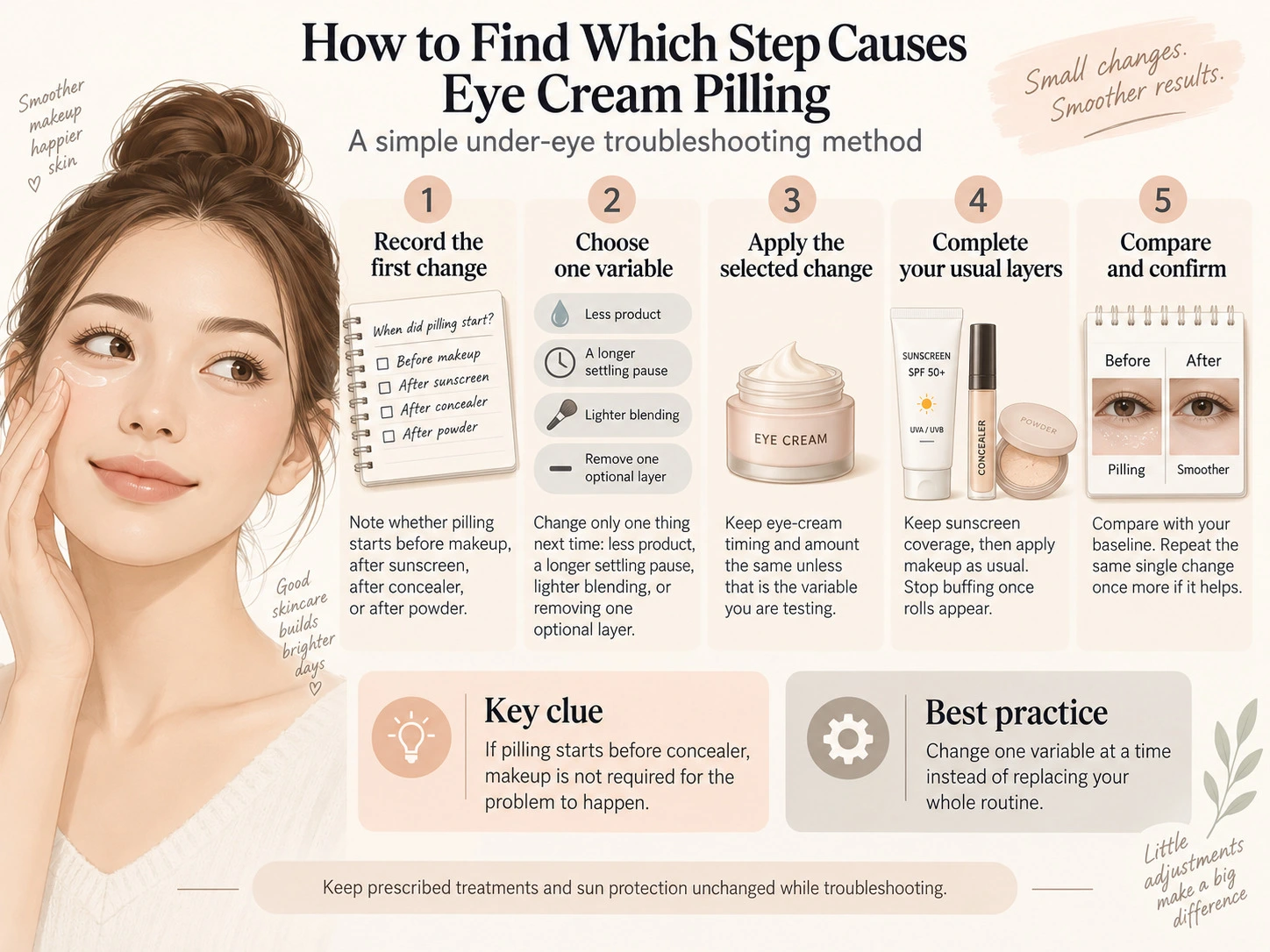
Use normal applications rather than repeated rubbing tests. Keep prescribed treatments and required sun protection as directed; simplify optional products first. Clean hands and applicators matter around the eyes.[3]
- Record the first visible change: during one normal application, note whether crumbs begin before makeup, after sunscreen, after concealer or only after powder. Record the products, amount and blending method you used rather than changing them all immediately.
- Choose one variable: select one change for the next application: remove an optional overlapping layer, correct an excessive eye-cream amount, extend the settling pause, or try lighter blending. Do not make all four changes at once. Keep prescribed treatments and sunscreen directions unchanged.
- Apply the selected change: keep eye-cream amount and timing consistent unless one is your chosen variable. If adjusting the amount, follow its directions; some eye creams specify small dots rather than a universal dose.[5] See how to apply eye cream for the application details.
- Complete the usual layers: preserve sunscreen coverage, then add your usual makeup. Keep blending consistent unless lighter tapping is the chosen change. Note whether rolls first appear with sunscreen, concealer or powder, and stop buffing when they do.
- Compare and confirm: compare the first-onset step with your baseline. Repeat the same single change at another normal application if your skin remains comfortable. If it does not help, test a different variable next time. A repeatable result suggests a useful adjustment, not a proven offending ingredient.
If pilling begins before concealer, makeup is not necessary to produce that result. If it begins only after concealer, the full stack needs checking; it does not prove that concealer or eye cream alone is defective. If the first problem appears with SPF, the guide to sunscreen pilling addresses that layer more specifically.
For a routine with several facial products, layering skincare without pilling provides the wider troubleshooting process. Avoid turning a local under-eye problem into an unnecessary replacement of your entire routine.
What Can You Do After Makeup Has Already Pilled?
Stop blending the same spot repeatedly. Adding more concealer or powder over rolled residue can leave you with a thicker, patchier finish instead of repairing the layer underneath.
For a few loose crumbs on comfortable skin, try lifting them away gently with a clean fingertip or suitable soft applicator. If the finish is breaking apart, gently remove the affected patch and rebuild it with the simplified combination. Use products intended for the eye area and avoid scratching or getting product into the eye.[3]
If removing or rubbing the patch disturbed your sunscreen, restore the intended coverage before reapplying makeup. Sunscreen needs generous, even application; reducing its amount is not a suitable pilling fix.[6] Visible pilling does not tell you how much protection remains, so do not assume that brushing away crumbs preserved the original sunscreen layer.
When Is It Worth Changing Your Eye Cream?
Consider a replacement when the cream repeatedly pills at its instructed amount with the sunscreen and makeup you need, despite simpler optional layering and gentler application. If the same cream works alone but fails with one concealer, changing the pairing may be more useful than rejecting every similar eye cream.
A well-tolerated richer cream might fit your nighttime routine if its directions permit, while another texture may be easier under daytime makeup. That is a practical wear preference, not proof that rich creams always pill or lightweight gels never do. Check a replacement with your actual concealer before committing to a larger purchase.
Irritation is a separate reason to stop. Do not keep using a product that causes persistent eye-area irritation merely because its makeup finish looks smooth.[3]
FAQs About Eye Cream Pilling Under Makeup
How long should you wait after eye cream before concealer?
Follow any product-specific instruction and give the layer a chance to settle. There is no universal number of minutes that guarantees compatibility. If waiting longer does not change pilling, check amount, blending and the product combination.
Does pilling mean the eye cream is not working?
Pilling alone cannot establish whether an eye cream’s ingredients are effective. Visible-pilling research did not measure eye-cream treatment results or ingredient absorption. It identifies a wear problem to troubleshoot, not a clinical efficacy test.[4]
Does under-eye pilling prove that your skin is dehydrated?
No. Rolling residue is not a hydration measurement. Observe whether bare skin is also flaky or uncomfortable, but do not diagnose dehydration from how your concealer behaves.
Should you exfoliate your eyelids to stop pilling?
No. Do not add a scrub or exfoliating acid to eyelids as a pilling fix. Eyelid skin is sensitive, and acids, rubbing and scratching can cause irritation. Persistent scales or discomfort need appropriate skin assessment.[2]
Sources
[1] The Ordinary. How to Prevent and Solve for Product Pilling
[2] DermNet. Eyelid contact dermatitis
[3] U.S. Food and Drug Administration. Eye Cosmetic Safety
[4] Lua BL et al. Understanding the causes of skincare product pilling
[5] CeraVe. Eye Repair Cream
[6] U.S. Food and Drug Administration. Sunscreen: How to Help Protect Your Skin from the Sun


