
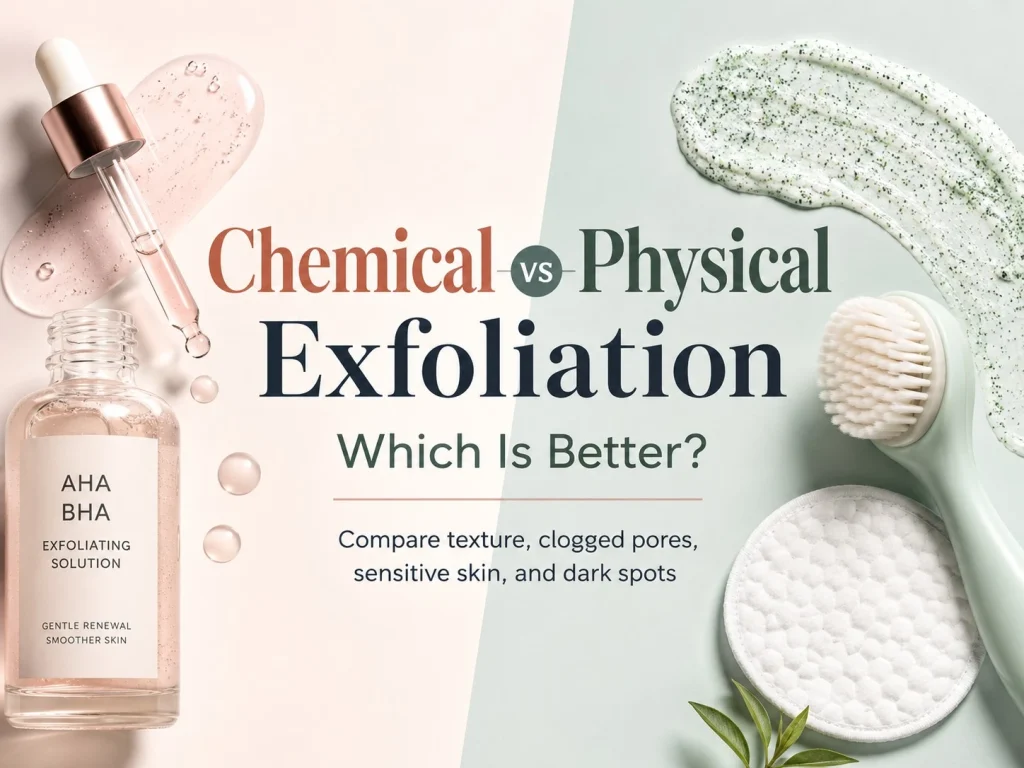

The chemical-versus-physical exfoliation debate is often reduced to “acids are good, scrubs are bad.” That is too simple. A mild washcloth used with light pressure can be less irritating than a strong acid peel, while an appropriately formulated chemical exfoliant can target problems that surface rubbing does not address as effectively.
The more useful comparison is therefore not which category wins. It is how each method works, what problem you are trying to solve, how strong the product is, and how much exfoliation your skin can tolerate.
What Is Chemical Exfoliation?

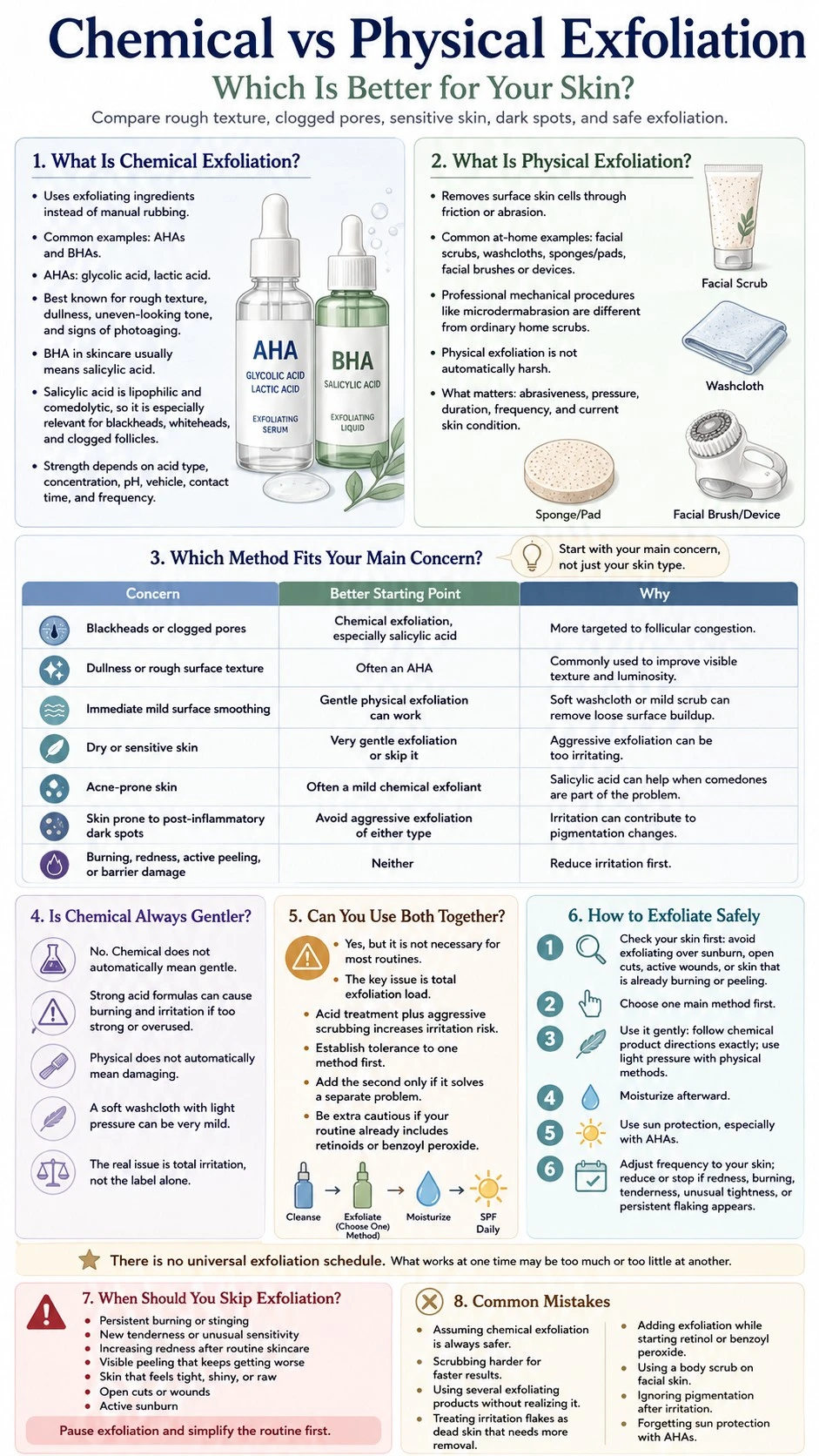
Chemical exfoliation uses ingredients that promote shedding or loosening of cells at the skin surface rather than relying primarily on manual abrasion. Common skincare examples include alpha hydroxy acids (AHAs) and beta hydroxy acids (BHAs).[1]
AHAs include ingredients such as glycolic acid and lactic acid. They are widely used to improve the appearance of rough texture, dullness, uneven tone, and signs of photoaging.[3]
BHA in everyday skincare usually refers to salicylic acid. Salicylic acid is lipophilic and has exfoliating and comedolytic properties, making it particularly relevant when blackheads, whiteheads, and clogged follicles are the main concern.[4] See our Salicylic Acid for Skin guide for a deeper look at how it is used.
Chemical exfoliation covers a wide intensity range. A mild leave-on skincare product is not equivalent to a high-strength professional chemical peel. Acid type, concentration, pH, vehicle, contact time, and how frequently the product is used all influence its effect and irritation potential.[3]
What Is Physical Exfoliation?

Physical exfoliation, also called mechanical exfoliation, removes surface skin cells through friction or abrasion. Scrubs and tools such as brushes, pads, and sponges are forms of mechanical exfoliation.[1]
Common at-home examples include:
- Facial scrubs: Formulas containing particles that move across the skin during massage.
- Washcloths: Soft cloths that provide mild mechanical exfoliation when used gently.
- Sponges and pads: Their exfoliating intensity depends on material, texture, and pressure.
- Facial brushes or devices: These can create substantially more friction when used aggressively or too frequently.
Professional procedures such as microdermabrasion also use mechanical exfoliation, but they should not be treated as equivalent to an ordinary home face scrub because the equipment, intensity, indications, and supervision are different.
Physical exfoliation is therefore not automatically harsh. What matters is the abrasiveness of the material, the amount of pressure, how long you use it, how often you repeat it, and the condition of your skin at the time.
Which Exfoliation Method Is Better for Your Skin?
Start with your main concern rather than choosing solely from labels such as dry, oily, or combination skin. The same person can have dry cheeks, clogged pores around the nose, and easily irritated skin at the same time.
| Main Concern or Situation | Better Starting Point | Why |
|---|---|---|
| Blackheads or clogged pores | Chemical exfoliation, especially salicylic acid | Salicylic acid is lipophilic and comedolytic, making it more targeted to follicular congestion.[4] |
| Dullness or rough surface texture | Often an AHA | AHAs such as glycolic and lactic acid are commonly used to improve visible texture and luminosity.[3] |
| Immediate mild surface smoothing | Gentle physical exfoliation can work | A soft washcloth or mild scrub can mechanically remove loose surface buildup without requiring an acid. |
| Dry or sensitive skin | Use very gentle exfoliation or skip it | Aggressive mechanical exfoliation can be too irritating for dry or sensitive skin.[1] |
| Acne-prone skin | Often a mild chemical exfoliant | Mechanical rubbing may irritate inflamed skin, while salicylic acid can be useful when comedones are part of the problem.[1][4] |
| Skin prone to post-inflammatory dark spots | Avoid aggressive exfoliation of either type | Irritation itself can contribute to pigmentation changes, particularly in skin that develops dark marks after inflammation or injury.[1] |
| Burning, redness, active peeling, or barrier damage | Neither | The immediate priority is reducing irritation rather than increasing exfoliation. |
If your skin is already unusually reactive, first determine whether you are dealing with a stable skin tendency or temporary irritation. Our Sensitive vs Sensitized Skin guide explains that distinction.
Is Chemical Exfoliation Always Gentler Than Physical Exfoliation?
No. “Chemical” does not mean gentle, and “physical” does not mean damaging.
A strong acid formula can cause substantial irritation if the concentration, pH, application time, or frequency exceeds what your skin can tolerate. AHAs can cause burning, swelling, itching, and other irritation when used inappropriately, and stronger chemical peels belong in a different risk category from ordinary home skincare.[2][3]
Conversely, a soft washcloth used briefly with minimal pressure may provide very mild mechanical exfoliation. The problem with physical exfoliation usually comes from excessive abrasiveness, pressure, duration, or repetition—not from the fact that the method is physical.
This is why broad claims that all facial scrubs create damage or that every chemical exfoliant is automatically safer are not useful decision rules.
Can You Use Chemical and Physical Exfoliation Together?
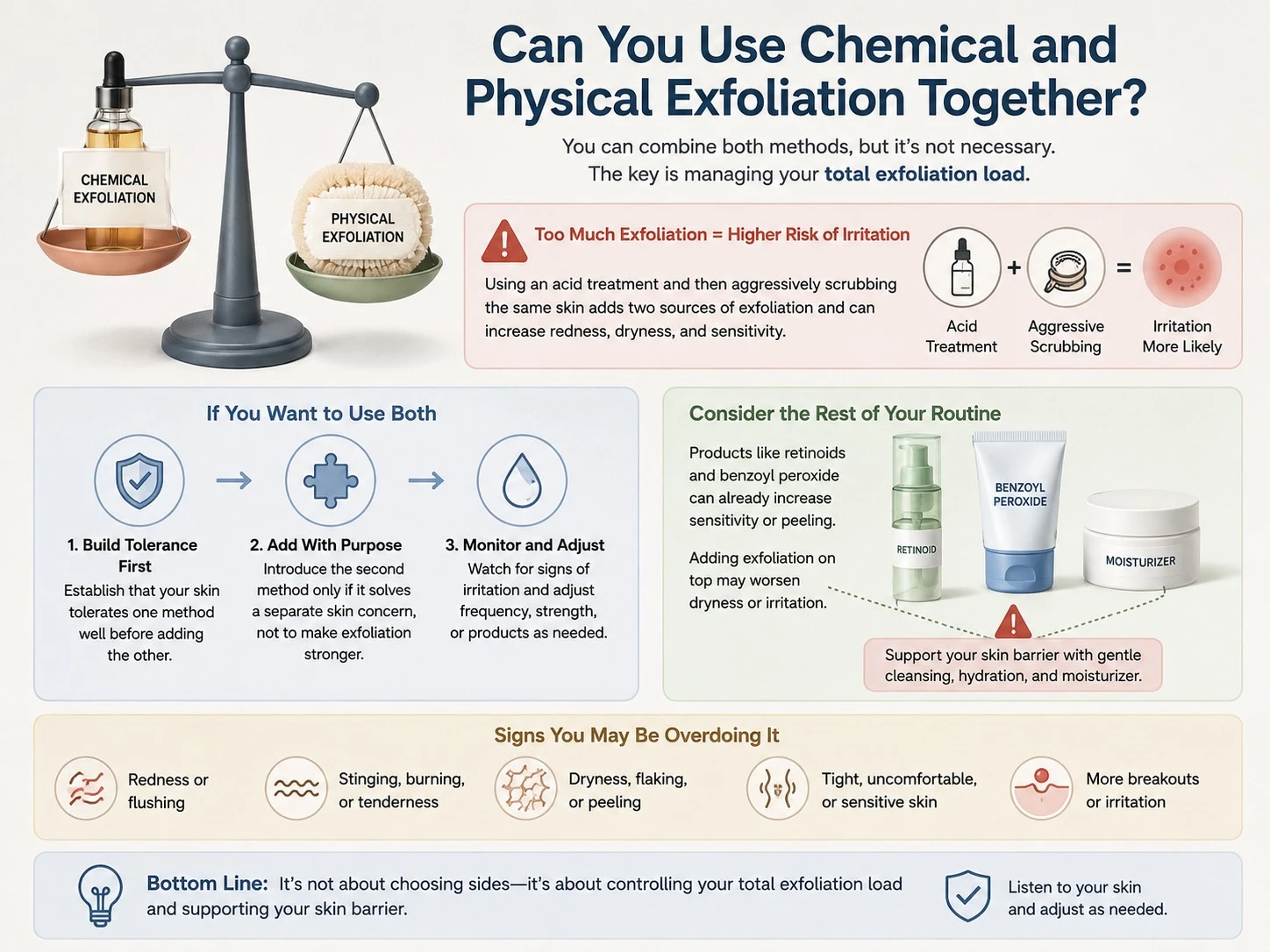
You can encounter products and routines that combine both methods, but using both is not necessary for effective skincare. The important issue is the total exfoliation load.
For example, using an acid treatment and then aggressively scrubbing the same skin adds two sources of exfoliation and makes irritation more likely. If you want to use both methods, first establish that your skin tolerates one of them. Then add the second only when it solves a separate problem rather than simply trying to make exfoliation stronger.
Also consider the rest of your routine. Products such as retinoids and benzoyl peroxide can already make skin more sensitive or prone to peeling, so adding exfoliation may worsen dryness or irritation.[1] If you use vitamin A skincare, review our Retinol Guide before increasing exfoliation.
How to Exfoliate Your Face Safely

Safe exfoliation is less about finding the strongest method and more about controlling the total amount of irritation your routine creates.
- Check your current skin condition: Do not intentionally exfoliate over sunburn, open cuts, active wounds, or skin that is already burning or peeling.[1]
- Choose one main exfoliation method: Start with either a chemical or physical exfoliant rather than introducing several exfoliating products at the same time.
- Use the method gently: Follow chemical-exfoliant directions exactly. With a scrub, washcloth, or other physical method, use light pressure and avoid prolonged rubbing.
- Moisturize afterward: Exfoliation can increase dryness, so follow with a moisturizer appropriate for your skin.[1]
- Use sun protection: This is particularly important with AHAs because they can increase sensitivity to ultraviolet radiation and the possibility of sunburn.[2]
- Adjust frequency to your skin: More aggressive exfoliation generally requires less frequent use. Reduce or stop when redness, burning, tenderness, unusual tightness, or persistent flaking appears.[1]
There is no universal schedule that works for every scrub, acid, cleanser, toner, serum, or peel. For a dedicated frequency framework, see How Often Should You Exfoliate Your Face.
When Should You Skip Exfoliation?
Sometimes the correct choice is neither chemical nor physical exfoliation. Adding another exfoliant to already irritated skin can make it harder to return to a comfortable baseline.
Pause exfoliation when you have:
- Persistent burning or stinging
- New tenderness or unusual sensitivity
- Increasing redness after routine skincare
- Visible peeling that is getting worse rather than better
- Skin that feels unusually tight, shiny, or raw
- Open cuts or wounds
- Active sunburn[1]
These symptoms do not prove that your skin barrier is permanently damaged, but they are a reason to reduce unnecessary irritation. If you have already gone too far, use our Over-Exfoliated Skin guide and Skin Barrier guide before restarting an exfoliant.
Common Chemical and Physical Exfoliation Mistakes
- Assuming chemical exfoliation is always safer: Strong acids can irritate skin just as an aggressive scrub can.
- Scrubbing harder for faster results: More pressure increases friction without making the routine smarter.
- Using several exfoliating products unknowingly: An acid cleanser, toner, serum, peeling mask, and scrub can create a much higher total exposure than expected.
- Treating irritation-related flakes as dead skin that needs removal: More exfoliation can worsen the underlying irritation.
- Adding exfoliation while starting retinol or benzoyl peroxide: Introduce changes carefully so you can identify what your skin tolerates.[1]
- Using a body scrub on facial skin: Products designed for thicker body areas may be unnecessarily abrasive on the face.
- Ignoring pigmentation after irritation: If your skin develops dark spots easily after inflammation, aggressive exfoliation can be counterproductive.[1]
- Forgetting sun protection with AHAs: AHA use can increase sun sensitivity.[2]
Final Thoughts
Chemical and physical exfoliation are two ways of addressing surface buildup, but they are not interchangeable in every situation. Chemical exfoliants can offer more targeted options for concerns such as rough texture, uneven-looking tone, blackheads, and clogged pores, depending on the ingredient used. Physical exfoliation can still be useful when it is gentle, controlled, and appropriate for the skin.
The best method is therefore not automatically the newest, strongest, or most popular one. Choose the least aggressive approach that addresses your actual concern, keep the rest of the routine simple enough to judge your response, and reduce exfoliation when discomfort begins.
FAQs About Chemical vs Physical Exfoliation
Is chemical or physical exfoliation better for sensitive skin?
Sensitive skin usually benefits from a conservative approach. Mechanical exfoliation may be too irritating for some dry, sensitive, or acne-prone skin, while a mild chemical exfoliator or gentle washcloth may be better tolerated.[1] If even basic skincare stings, skip exfoliation until the skin is comfortable again.
Is chemical or physical exfoliation better for acne?
For blackheads, whiteheads, and clogged pores, a chemical exfoliant containing salicylic acid is often more targeted because salicylic acid is lipophilic and comedolytic.[4] Inflamed, painful, or persistent acne may require treatment beyond exfoliation.
Are physical face scrubs bad for your skin?
Not automatically. A scrub can become irritating when its particles are very abrasive or when it is used with excessive pressure or frequency. Gentle mechanical exfoliation can be tolerated by some people, while others do better with chemical exfoliation or no intentional exfoliation.
Can I use chemical and physical exfoliation on the same day?
It is possible, but most routines do not need both on the same day. Combining methods increases the total exfoliation load and can make irritation harder to predict. If you use both, introduce them separately and follow the directions for each product.
Should I exfoliate if I use retinol?
Use caution. Retinol can already cause dryness, peeling, or increased sensitivity, and adding exfoliation may worsen irritation.[1] You may need less frequent exfoliation or none at all while your skin adjusts.
Do you have to exfoliate your face?
No. Intentional exfoliation is optional skincare. If your skin is comfortable and you do not have a concern that exfoliation meaningfully improves, you do not need to add an acid, scrub, brush, or exfoliating tool simply because exfoliation is popular.
Sources
[1] American Academy of Dermatology. How to Safely Exfoliate at Home
[2] U.S. Food and Drug Administration. Alpha Hydroxy Acids
[3] Almeman AA. Evaluating the Efficacy and Safety of Alpha-Hydroxy Acids in Dermatological Practice: A Comprehensive Clinical and Legal Review
[4] Arif T. Salicylic Acid as a Peeling Agent: A Comprehensive Review


