
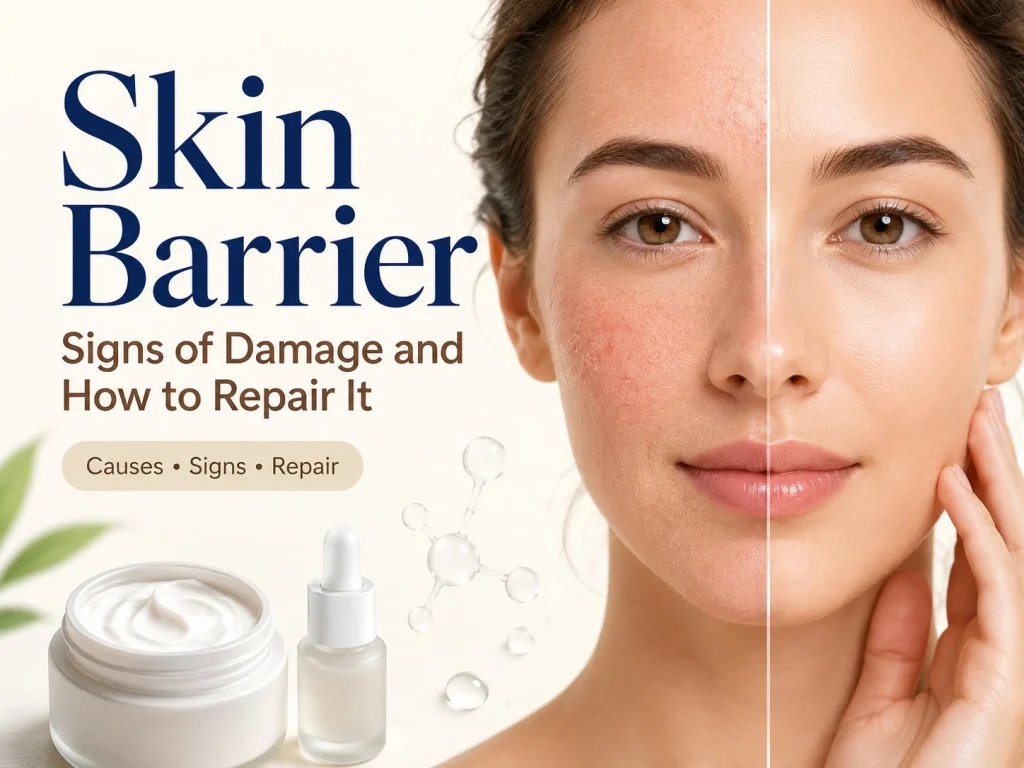


Skin Barrier Problems at a Glance
Use this table as a quick first check. It cannot diagnose your skin, but it can help you decide what to adjust before buying more products or changing your whole routine.
| What You Notice | What It May Mean | What to Try First |
|---|---|---|
| Products suddenly sting | Skin may be irritated or overworked | Pause strong actives and simplify |
| Skin feels tight after moisturizing | Moisturizer may be too light, or cleansing may be too harsh | Use a gentler cleanser and more comforting moisturizer |
| Dry, flaky, or rough patches | Skin may be dry, over-cleansed, or irritated | Moisturize consistently and stop frequent exfoliation |
| Redness or heat | Skin may be reacting to friction, actives, or irritation | Avoid scrubs, hot water, and new strong products |
| Breakouts with burning or irritation | Irritation may be involved, not only acne | Stop the newest product and simplify |
| Skin feels worse after acids or retinoids | Active use may be too frequent or too strong | Reduce frequency or pause until skin calms |
| Cleansing leaves skin hot or tight | Cleanser may be stripping | Switch to a gentle cleanser |
| Moisturizer no longer feels enough | Skin may be losing moisture faster than usual | Use a richer moisturizer or apply moisturizer more consistently |
Do not assume every breakout, rash, or flare is only a skin barrier problem. Acne, eczema, rosacea, allergy, infection, and product reactions can overlap. If symptoms are severe or persistent, get professional advice.
What Does the Skin Barrier Do?
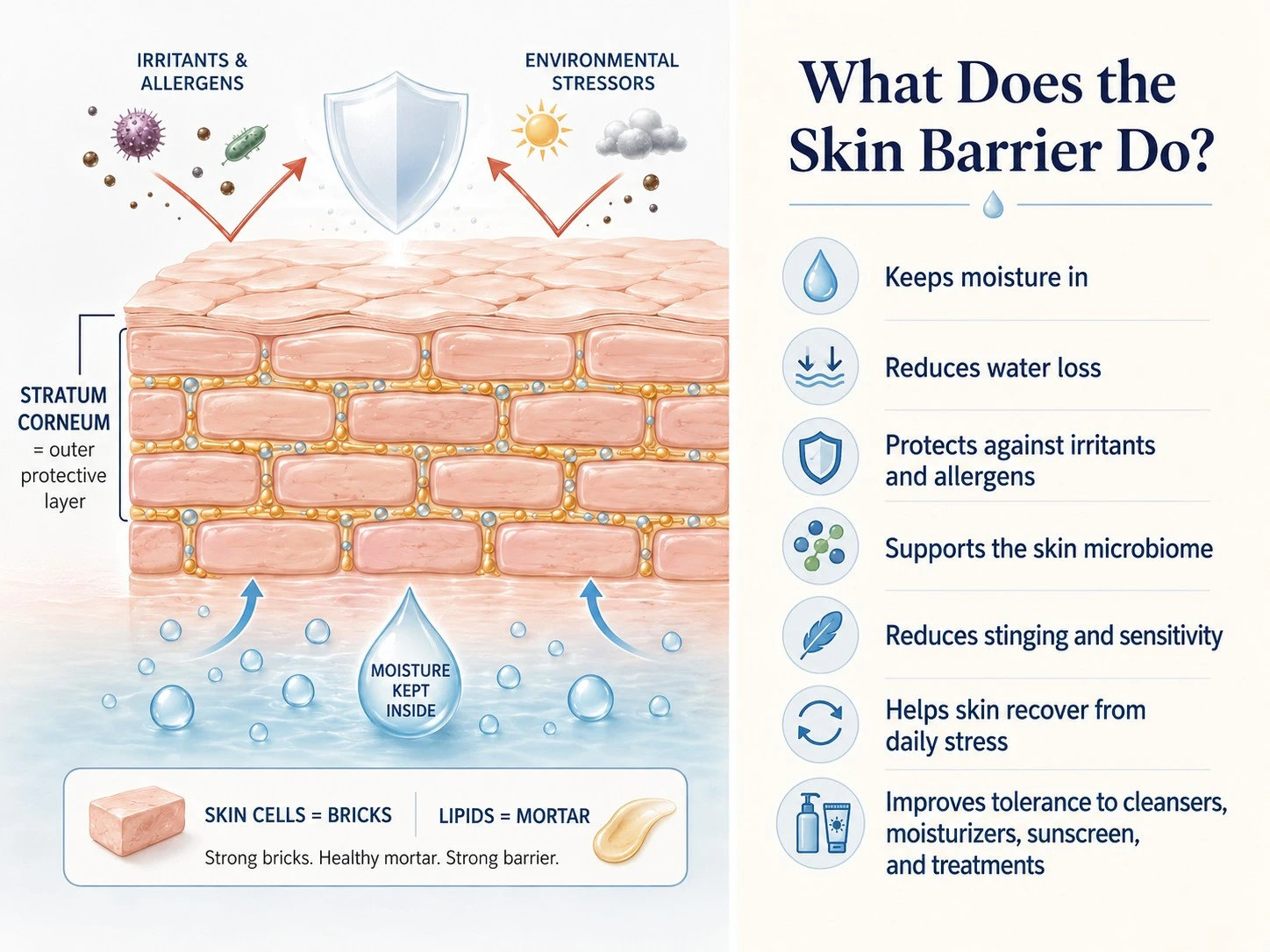
The skin barrier is part of the skin’s outer defense system. In simple terms, it works like a protective wall. Skin cells are like bricks, and natural lipids are like mortar between those bricks. When this layer works well, moisture stays in and irritants have a harder time getting through.
The skin barrier helps:
- Keep moisture inside the skin
- Reduce water loss through the skin
- Protect against irritants and allergens
- Support the skin’s natural microbiome
- Reduce stinging and sensitivity
- Help skin recover from daily stress
- Improve tolerance to cleansers, moisturizers, sunscreens, and treatment products
The outermost part of the skin, called the stratum corneum, plays a major role in barrier function, hydration, and self-repair. Barrier problems are also linked with several skin conditions, but that does not mean every skin issue is only a barrier issue. [2]
A good skincare routine should support this layer instead of constantly stressing it. That means gentle cleansing, enough moisturizer, daily sun protection, and careful use of stronger ingredients.
Signs Your Skin Barrier May Be Damaged
Skin barrier problems often show up as discomfort before they show up as obvious visible damage. Your skin may look mostly normal but still feel tight, hot, stingy, or unusually reactive.
| Sign | What It Feels or Looks Like | What Else It Could Be |
|---|---|---|
| Tightness | Skin feels pulled, even after moisturizer | Dry skin, harsh cleanser, low humidity |
| Stinging or burning | Products sting that used to feel fine | Allergy, active irritation, over-exfoliation |
| Dryness or flaking | Skin looks scaly, flaky, or uneven | Dry climate, eczema, over-cleansing |
| Rough texture | Skin feels bumpy or less smooth | Dehydration, buildup, irritation |
| Redness or heat | Skin looks flushed or feels warm | Rosacea, irritation, product reaction |
| Itching | Skin feels uncomfortable or scratchy | Eczema, allergy, dryness |
| Increased sensitivity | More products feel harsh than before | Overuse of actives, skin condition flare |
| Breakouts with irritation | Acne appears with burning or redness | Acne flare, product reaction, over-exfoliation |
| Products suddenly feel harsh | Normal routine becomes uncomfortable | Reduced tolerance, weather change, irritation |
Common signs of a damaged skin barrier include dry or flaky skin, inflammation, itchiness, rough patches, stinging, tenderness, sensitivity, acne, and infection. [1]
Still, do not self-diagnose every skin problem as barrier damage. Swelling, oozing, severe rash, signs of infection, painful acne, or symptoms that keep worsening should be checked by a dermatologist.
What Can Damage Your Skin Barrier?
Skin barrier problems often come from repeated stress. One product may trigger the issue, but the full cause is often a mix of over-cleansing, over-exfoliation, weather, friction, and too many strong ingredients.
| Cause | How It Affects Skin | Common Example |
|---|---|---|
| Over-exfoliation | Removes surface buildup too aggressively | Daily acids or frequent exfoliating pads |
| Harsh cleanser | Strips skin and leaves it tight | Strong foaming cleanser used too often |
| Too many active ingredients | Raises the chance of irritation | Retinoid, acid, and vitamin C layered together |
| Retinoid or acid overuse | Can cause peeling, burning, or dryness | Starting too often too soon |
| Fragrance or irritating products | Can bother reactive skin | Scented products on sensitive skin |
| Cold, dry, or windy weather | Increases dryness and tightness | Winter air or strong indoor heating |
| UV exposure | Adds environmental stress to skin | Skipping sunscreen outdoors |
| Hot water | Can worsen dryness | Long hot showers or face washing |
| Scrubbing or friction | Physically irritates skin | Harsh towels, scrubs, cleansing brushes |
| Under-moisturizing | Leaves skin less supported | Using treatment products without enough moisturizer |
| Existing skin conditions | Can weaken comfort and tolerance | Eczema, rosacea, acne flares, allergy |
The main problem is often not one “bad” ingredient. A high-quality routine can still be too strong for your skin at the wrong time. If your skin feels tight, stingy, or reactive, reduce stress before adding more products.
How to Repair Your Skin Barrier Safely

Skin barrier repair should be simple. The goal is to reduce irritation, support moisture, and stop the cycle of adding more products to fix problems caused by too many products.
- Pause strong actives
Stop or reduce exfoliating acids, retinoids, strong vitamin C, peel-like products, and harsh acne treatments until your skin feels calmer. This is temporary, not a permanent ban. - Switch to a gentle cleanser
Your cleanser should leave skin clean but not tight, hot, or squeaky. If cleansing burns or leaves your skin pulled, the cleanser is too harsh for your current skin condition. - Moisturize consistently
Use a moisturizer that makes your skin feel comfortable. Dry skin may need a richer cream. Oily skin may prefer a light lotion or gel cream. The right texture is the one you can use daily without irritation or heavy buildup. - Use sunscreen in the morning
Sun exposure is one more stress your skin has to handle. Choose a broad-spectrum sunscreen with SPF 30 or higher, and choose water resistance when sweat or swimming is involved. [6] - Avoid scrubs and frequent exfoliation
When your skin is irritated, more exfoliation usually makes the problem worse. Wait until your skin feels stable before adding exfoliation back. - Keep the routine simple for 1–2 weeks
Use cleanser, moisturizer, and sunscreen in the morning. Avoid testing several new products at once. Simplicity helps you see whether your skin is improving. - Reintroduce one product at a time
When your skin is calm, add one product back slowly. Watch for stinging, redness, dryness, peeling, and breakouts. If symptoms return, that product or frequency may be too much.
Do not try to repair your barrier with a complicated 10-step routine. Irritated skin needs less stress, not more layers.
Best Ingredients for Supporting the Skin Barrier
Barrier-supporting ingredients can help, but ingredients are not the whole solution. A good moisturizer in a simple routine often does more than a long ingredient list used with harsh cleansing and daily exfoliation.
| Ingredient Type | Examples | Why It Helps | Best For |
|---|---|---|---|
| Humectants | Glycerin, hyaluronic acid | Attract water to the skin | Dry, tight, or dehydrated-feeling skin |
| Barrier lipids | Ceramides, cholesterol, fatty acids | Support the lipid structure of the barrier | Dry, sensitive, or weakened skin |
| Emollients | Squalane, dimethicone, plant oils, shea butter | Smooth and soften the skin surface | Rough or flaky texture |
| Occlusives | Petrolatum, mineral oil, thicker ointments | Help reduce water loss | Very dry or cracked areas |
| Soothing ingredients | Colloidal oatmeal, panthenol, allantoin | Help calm discomfort and dryness | Reactive or irritated-feeling skin |
| Supportive actives | Niacinamide, if tolerated | Can support barrier comfort and uneven tone | Skin that tolerates it well |
Moisturizer guidance commonly recommends ingredients such as dimethicone, glycerin, hyaluronic acid, mineral oil, petrolatum, and shea butter. [3] Moisturizers are also used to increase skin hydration and support the skin’s protective function. [5]
Do not assume every barrier ingredient fits every person. Heavy ointments can feel too greasy for some acne-prone skin. Niacinamide can be useful, but high-strength or poorly tolerated formulas may sting. Choose products by skin comfort, not ingredient popularity alone.
What to Avoid While Your Skin Barrier Is Irritated
When your skin barrier feels irritated, your temporary “avoid” list matters as much as your product choices. This does not mean these products are always bad. It means your skin may not tolerate them while it is already stressed.
Avoid temporarily:
- Scrubs
- Daily exfoliating acids
- Strong retinoid use
- High-strength vitamin C if it stings
- Fragranced products if your skin is reactive
- Harsh foaming cleansers
- Hot water
- Picking or rubbing
- Trying many new products
- Frequent masks or peels
For dry or irritated-feeling skin, gentle cleansing, warm rather than hot water, and moisturizer after bathing or cleansing can help reduce dryness. [4]
Once your skin is calm, some active ingredients can return slowly. The mistake is not using actives. The mistake is forcing irritated skin to tolerate them before it is ready.
How Long Does It Take to Repair the Skin Barrier?
Skin barrier repair time depends on how irritated your skin is and what caused the problem. Mild tightness may improve faster than strong peeling, burning, or a rash. A realistic timeline is more useful than a promise.
| Situation | What May Improve First | Practical Timeline |
|---|---|---|
| Mild tightness from over-cleansing | Less pulling after cleansing | A few days to 1–2 weeks |
| Mild irritation from too many actives | Less stinging and redness | 1–2 weeks |
| Dry, flaky skin | Softer texture and less flaking | 1–3 weeks |
| Strong stinging or peeling | Less burning first, then less peeling | Several weeks |
| Eczema-like or persistent inflammation | May not fully improve with basic skincare | See a dermatologist |
| Long-term barrier support | Better comfort and fewer flare-ups | Ongoing routine habit |
Do not judge progress only by how your skin looks. Comfort matters. Less stinging, less tightness, and better tolerance are early signs that your routine is becoming more suitable.
If symptoms worsen, spread, or fail to improve after simplifying, do not keep self-testing new products. Get professional care.
How to Keep Your Skin Barrier Healthy

A healthy skin barrier is built by steady habits, not by chasing every new trend. The goal is to keep your routine effective without pushing your skin into irritation.
Helpful habits include:
- Cleanse gently.
- Moisturize daily.
- Use sunscreen every morning.
- Add active ingredients slowly.
- Avoid over-exfoliation.
- Adjust your routine by season.
- Choose textures that match your skin type.
- Keep your routine consistent.
- Watch early warning signs.
- Do not change several products at once.
- Do not chase every skincare trend.
Your skin does not need to feel scrubbed, peeled, or tingling to be improving. A routine that keeps your skin calm, hydrated, and protected is usually more effective than a routine that feels powerful but causes constant irritation.
Sunscreen also matters because UV exposure is one of the environmental stresses your skin faces. Keep sunscreen in your morning routine, then adjust cleanser, moisturizer, and actives based on how your skin feels.
When to See a Dermatologist
See a dermatologist if your skin problem is persistent, painful, spreading, or severe. A simple skincare routine can support your skin, but it cannot diagnose or treat every skin condition.
See a dermatologist if:
- Burning, stinging, or rash continues
- Skin is swollen, painful, oozing, or looks infected
- You suspect eczema, rosacea, psoriasis, or allergy
- Acne is painful, cystic, persistent, or scarring
- Dark patches keep worsening
- Products that used to work now all sting
- Skin does not improve after simplifying for 1–2 weeks
- You are using prescription treatments and unsure what to pair with them
You do not need to wait until your skin is severe. Getting the right diagnosis can prevent weeks of irritation, wasted products, and repeated trial and error.


