


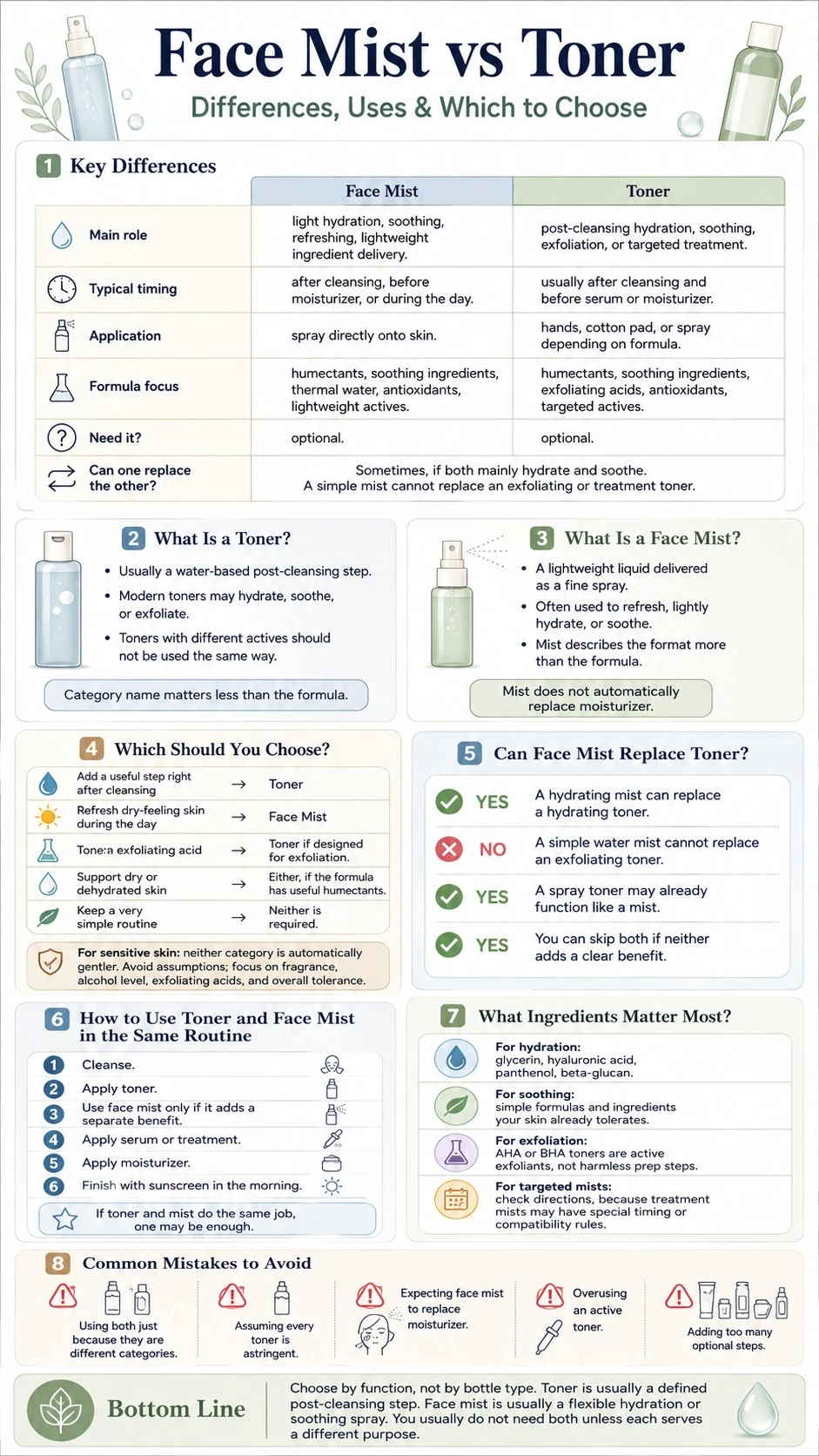
Face mists and toners can look almost identical: both are lightweight liquids, both may contain hydrating or soothing ingredients, and either one can come in a spray bottle. The useful difference is usually not the packaging. It is the product’s intended role in your routine.
A toner is generally designed as a post-cleansing step. A face mist is generally designed for lightweight hydration, soothing, or refreshing and can be used more flexibly. Modern formulas overlap, so the ingredient list and directions matter more than the category name alone.
Face Mist vs Toner: Key Differences
Use this comparison as a starting point, then check the actual formula. A hydrating toner in a spray bottle may behave very much like a face mist, while an exfoliating toner has a much more specific job.
| Factor | Face Mist | Toner |
|---|---|---|
| Main role | Light hydration, soothing, refreshing, or delivering a fine layer of skincare ingredients | Post-cleansing hydration, soothing, exfoliation, or another targeted treatment step |
| Typical timing | After cleansing, before moisturizer, or at selected times during the day | Usually after cleansing and before serum or moisturizer[1] |
| Application | Usually sprayed directly onto the face | Applied with hands, a cotton pad, or a spray depending on the formula |
| Common formula focus | Humectants, soothing ingredients, thermal water, antioxidants, or other lightweight actives | Humectants, soothing ingredients, exfoliating acids, antioxidants, or targeted actives |
| Do you need it? | Optional | Optional; it should add a useful function rather than exist only because a routine “should” have toner |
| Can one replace the other? | Sometimes. If both formulas mainly hydrate and soothe, their roles may overlap. A simple mist cannot replace a toner that provides a specific exfoliating or treatment function. | |
What Is a Toner?
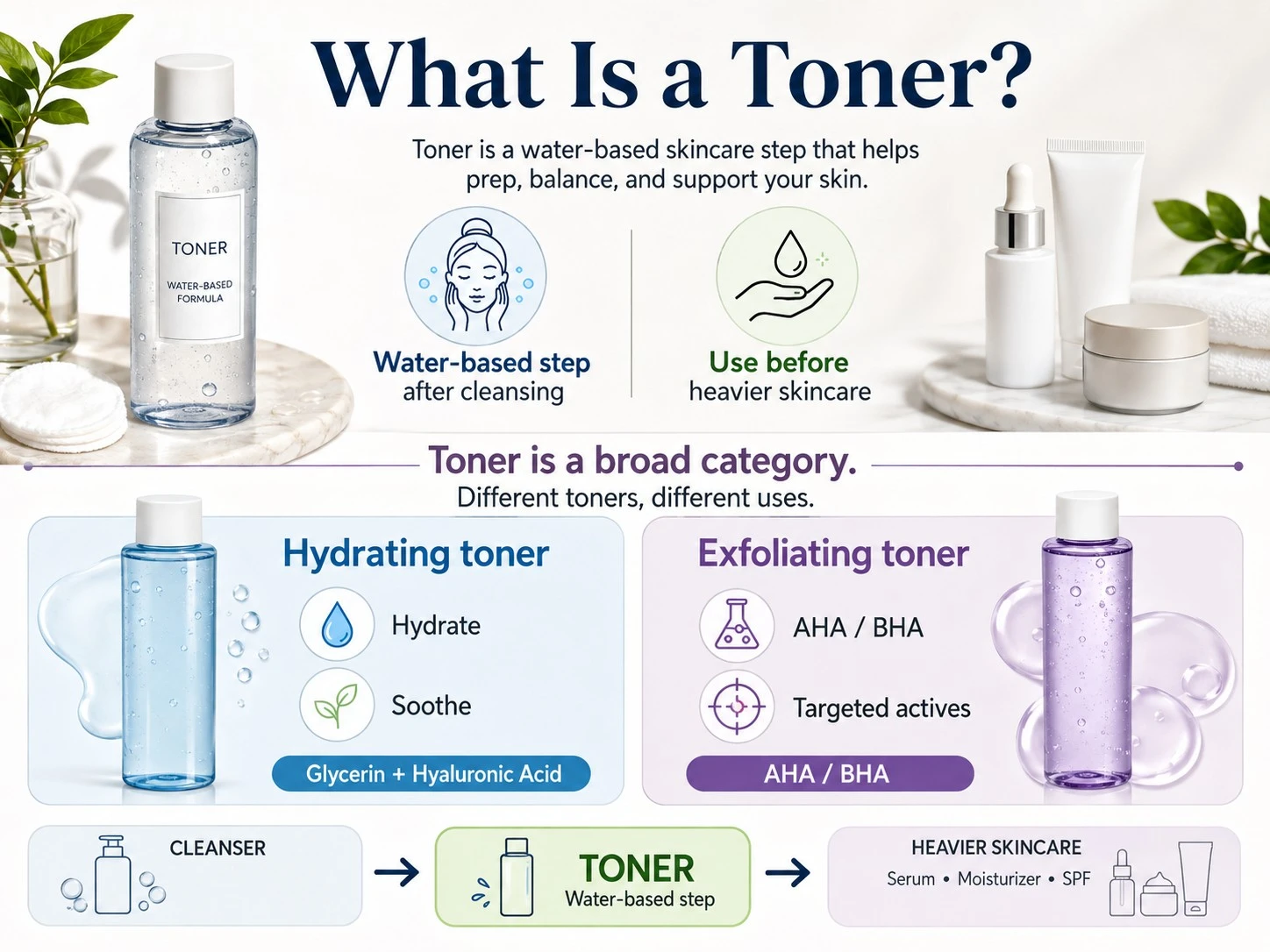
A facial toner is typically a water-based product used after cleansing and before heavier skincare steps. Modern toners can hydrate, soothe, or deliver active ingredients instead of acting like the highly astringent, alcohol-heavy toners that were once common.[1]
That means “toner” is now a broad product category. One toner may contain glycerin and hyaluronic acid for hydration, while another may contain an AHA or BHA for exfoliation. Those products should not be used in exactly the same way just because both are called toner.
If you are deciding whether toner adds anything to your routine at all, see Do You Really Need Toner. If you are comparing several lightweight treatment steps, Toner vs Essence vs Serum explains how those categories differ.
What Is a Face Mist?
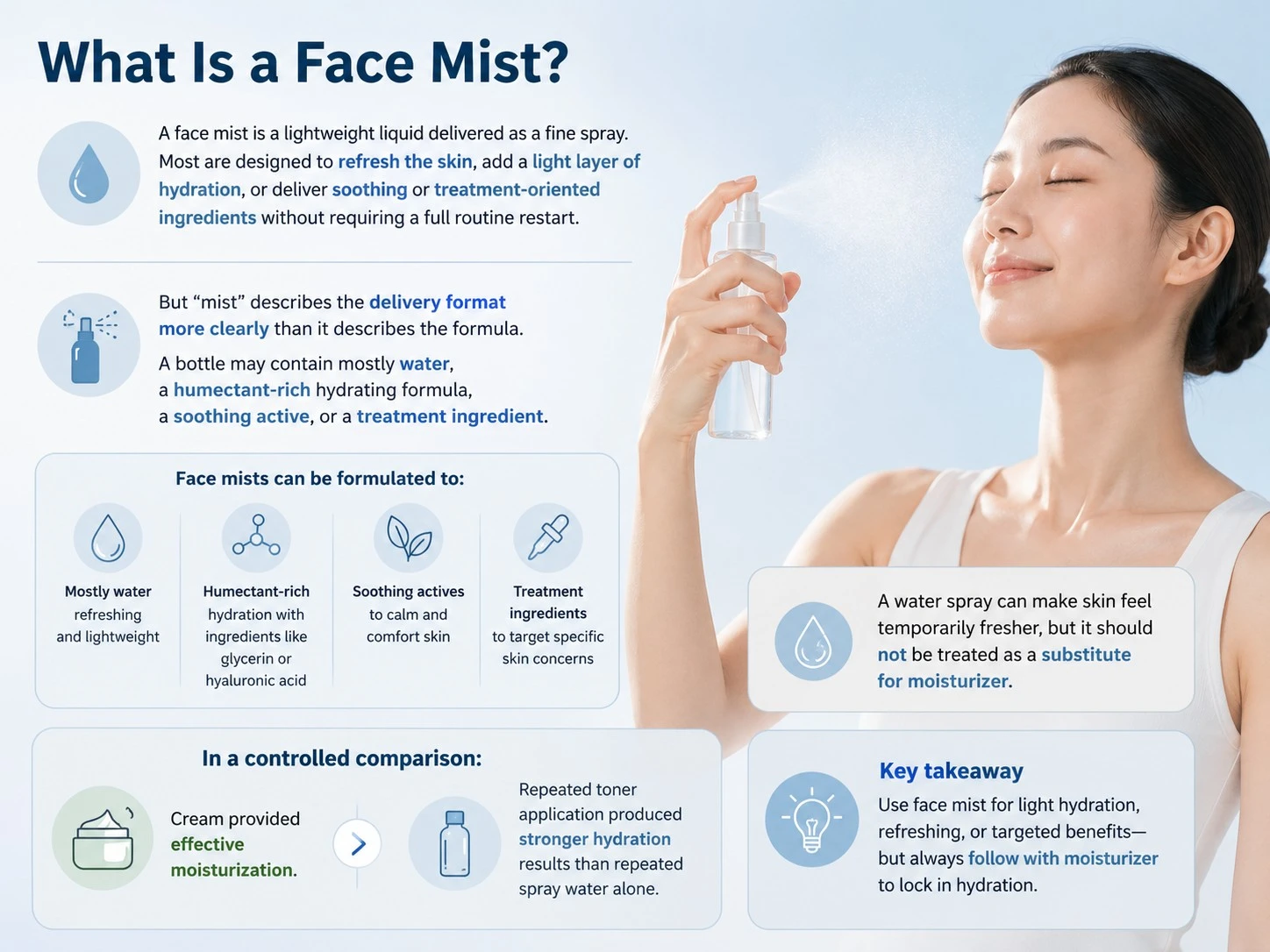
A face mist is a lightweight liquid delivered as a fine spray. Most are designed to refresh the skin, add a light layer of hydration, or deliver soothing or treatment-oriented ingredients without requiring a full routine restart.
But “mist” describes the delivery format more clearly than it describes the formula. A bottle may contain mostly water, a humectant-rich hydrating formula, a soothing active, or a treatment ingredient. That is why a face mist should be judged by what is inside it and how the manufacturer tells you to use it.
A water spray can make skin feel temporarily fresher, but it should not be treated as a substitute for moisturizer. In a controlled comparison of cream, toner, and spray water, cream provided effective moisturization and repeated toner application produced stronger hydration results than repeated spray water alone.[2]
Which Should You Choose?
Choose by the job you want the product to do. You do not need to own both categories to have a complete routine.
| Your goal | Better starting choice | Why |
|---|---|---|
| Add a useful step right after cleansing | Toner | A toner is designed to sit naturally between cleansing and later treatment or moisturizing steps. |
| Refresh dry-feeling skin during the day | Face mist | The spray format is convenient when you want a light layer without using a cotton pad or restarting your routine. |
| Use an exfoliating acid | Toner, if the formula is designed for exfoliation | Acid toners can provide a defined treatment step. Frequency should match the product strength and your tolerance. For the main acid categories, see AHA vs BHA. |
| Support dry or dehydrated skin | Either, if the formula contains useful humectants | Look for ingredients such as glycerin or hyaluronic acid, then follow with moisturizer when needed. |
| Keep a very simple routine | Neither is required | Cleanser, moisturizer, sunscreen, and any necessary treatment can form a complete basic routine. Extra steps should earn their place.[3] |
For Sensitive Skin
Neither category is automatically better for sensitive skin. A simple hydrating toner may be easier to tolerate than a fragranced mist, while a minimal soothing mist may be easier to tolerate than an exfoliating toner. Avoid assuming that “mist” means gentle or that “toner” means harsh.
If your skin reacts easily, introduce one new product at a time and pay attention to fragrance, alcohol level, exfoliating acids, and other actives that can increase irritation risk.[1] For a lower-irritation framework, see our skincare routine for sensitive skin.
Can Face Mist Replace Toner?
Sometimes, but only when the two products are doing essentially the same job.
- A hydrating face mist can replace a hydrating toner if you mainly want a light post-cleansing hydration step.
- A simple water mist cannot replace an exfoliating toner that contains AHA, BHA, or another treatment active.
- A spray toner may already function like a face mist if its formula is mainly hydrating and soothing.
- You can skip both if neither adds a clear benefit to your routine.
The category label should not force you into duplicate steps. Compare the purpose, active ingredients, texture, and directions instead.
How to Use Toner and Face Mist in the Same Routine
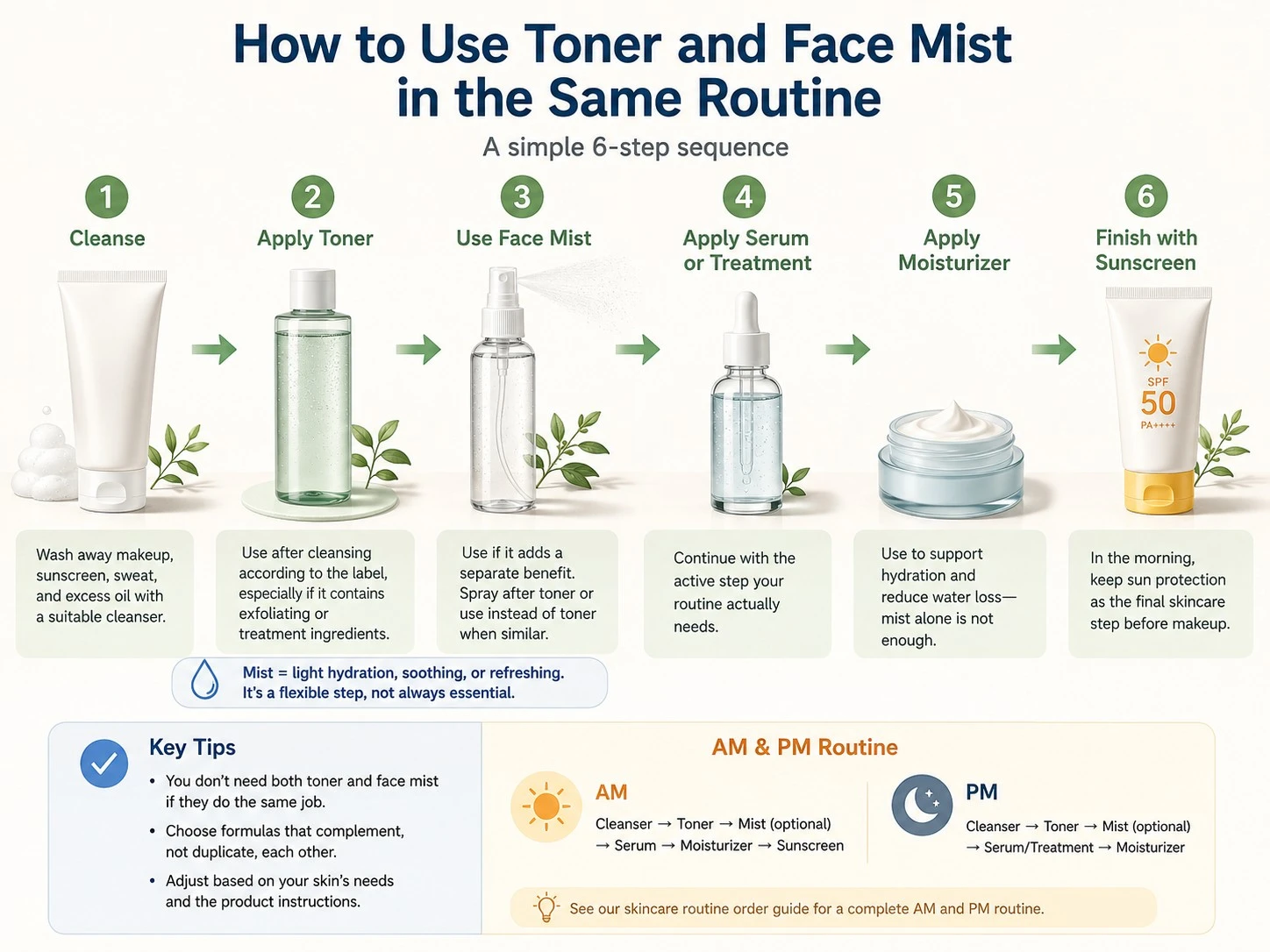
If you enjoy both products and their formulas do not duplicate each other, keep the order simple. A basic sequence is:
- Cleanse. Wash away makeup, sunscreen, sweat, and excess oil with a suitable cleanser.
- Apply toner. Use it after cleansing according to the label, especially if it contains exfoliating or treatment ingredients.
- Use face mist if it adds a separate benefit. A hydrating mist can be sprayed after toner or used instead of toner when their purposes overlap.
- Apply serum or treatment. Continue with the active step your routine actually needs.
- Apply moisturizer. Use it to support hydration and reduce water loss rather than expecting a mist alone to do the job.
- Finish with sunscreen in the morning. Keep sun protection as the final skincare step before makeup.[3]
For a complete AM and PM sequence, see our skincare routine order.
What Ingredients Matter Most?
The formula matters more than whether the label says “mist” or “toner.” From a formulation perspective, the two categories can share many of the same humectants, soothing agents, and treatment ingredients. A mist also has to work with its spray system, so viscosity, spray pattern, packaging compatibility, and active stability can affect how the finished product is designed.
- For hydration: glycerin, hyaluronic acid, panthenol, beta-glucan, and other humectant-focused ingredients can make either format more useful.
- For soothing: choose a simple formula with ingredients your skin already tolerates and avoid unnecessary fragrance if you are irritation-prone.
- For exfoliation: AHA or BHA toners should be treated as active exfoliants, not as harmless “prep” steps.
- For targeted mists: read the directions carefully. A mist containing a treatment active may have different timing and compatibility rules from a basic hydrating spray.
Common Mistakes to Avoid
- Using both just because they are different categories. If they perform the same hydration step, one may be enough.
- Assuming every toner is astringent. Modern toners range from hydrating to exfoliating, so the formula matters more than the old stereotype.[1]
- Expecting face mist to replace moisturizer. A light spray can add water or humectants, but it does not necessarily provide the emollient or occlusive support of a moisturizer.[2]
- Overusing an active toner. Exfoliating acids can irritate when frequency exceeds your skin’s tolerance.
- Adding too many optional steps. More products do not automatically create a better routine, and unnecessary layering can increase irritation risk.[3]
Final Thoughts
Face mist and toner are not strict opposites. Toner is usually a post-cleansing skincare step, while face mist is usually a spray format built for flexible hydration, soothing, or refreshing. Modern formulas can overlap enough that the ingredient list is often more informative than the product name.
Choose the product that fills a real gap in your routine. If both products mainly hydrate, you probably do not need both. If one provides a distinct treatment function and the other gives convenient lightweight hydration, using both can make sense.
FAQs About Face Mist vs Toner
Can I use face mist after moisturizer?
Yes. You can use a face mist after moisturizer for a light refresh, but if your main goal is hydration, applying the mist before moisturizer usually makes more sense because the moisturizer can help hold that added water in the skin.
Can I use face mist over makeup?
Yes, if the product is designed for that use. Spray lightly and avoid rubbing or wiping unless the product directions specifically tell you to do so.
Should I apply toner with my hands or a cotton pad?
Either can work. Hydrating toners are often easy to press in with clean hands, while some products are designed for cotton-pad application. Follow the label and avoid aggressive rubbing, especially if your skin is sensitive.
Is face mist good for oily or acne-prone skin?
It can be. Oily skin can still benefit from lightweight hydration, but choose a formula that matches your needs and avoid assuming that a mist will control acne or replace a proven acne treatment.
Is a spray toner the same as a face mist?
Not necessarily. A spray bottle only changes how the product is delivered. A spray toner may contain exfoliating or treatment ingredients, while a face mist may be designed mainly for hydration or soothing. Compare the formula and directions.
Do I need toner if I already use serum?
Usually not. Toner is optional. If your cleanser, serum, moisturizer, and sunscreen already cover your skin’s needs, you do not need to add toner simply to make the routine feel more complete.
Sources
[1] Cleveland Clinic. Do You Need a Face Toner?
[2] Li Y et al. Comparison of Skin Hydration in Combination and Single Use of Common Moisturizers (Cream, Toner, and Spray Water)
[3] American Academy of Dermatology. Should I Apply My Skin Care Products in a Certain Order?


