


What Is Face Toner?
Face toner is usually a watery or milky leave-on product applied after cleansing and before serum or moisturizer. Older toners were often alcohol-heavy astringents designed mainly to remove oil, while modern formulas may focus on hydration, soothing, exfoliation, brightening, or oil control.[1]
Because toner is a broad product category, the name alone does not tell you whether a formula is gentle, strong, hydrating, exfoliating, or suitable for daily use. A glycerin-based hydrating toner and a glycolic acid toner may look similar in the bottle but perform very different jobs. Some toners also overlap with essences, facial mists, liquid exfoliants, or lightweight serums, so the ingredients and intended function matter more than the label.
What Can Toner Actually Do?
The useful effects of a toner come from its ingredients and complete formula, not from the category name itself.
| Possible Function | How Toner May Help | Important Limitation |
|---|---|---|
| Light hydration | Humectants such as glycerin, hyaluronic acid, panthenol, or beta-glucan can increase surface moisture | A watery toner usually does not replace moisturizer for dry or barrier-stressed skin |
| Soothing support | A simple formula may reduce the tight or uncomfortable feel after cleansing | Fragrance, essential oils, and botanical extracts can still irritate reactive skin |
| Exfoliation | AHAs or BHAs can remove surface buildup or help unclog pores | An exfoliating toner is an active treatment and can cause irritation when overused |
| Oil-control feel | Astringent ingredients may temporarily make oily skin feel less greasy | Excessive oil removal can leave skin dry, tight, or more reactive |
| Targeted ingredient delivery | Niacinamide, antioxidants, or other ingredients may support a specific goal | The same ingredient may already be present in your serum or moisturizer |
Toner can contribute to hydration, but it is not automatically the most efficient moisturizing step. In a comparison of toner, cream, and spray water, cream alone provided effective and practical moisturization, particularly for dry skin, while toner worked better as a complementary hydration step.[3]
Do You Need Toner to Balance Skin pH or Remove Cleanser Residue?
You generally do not need toner solely to “rebalance” your skin after washing. A suitable cleanser should rinse clean, while skin hydration, oil levels, and other surface conditions naturally adjust after cleansing.[4]
Toner should not be required to complete the cleansing process either. If makeup, sunscreen, or cleanser repeatedly remains on your skin, improve your cleansing method or choose a cleanser that removes buildup and rinses away comfortably.
Use toner only when the formula provides a separate benefit, such as hydration, soothing support, or planned exfoliation—not as an automatic correction for every cleanser.
When Is Toner Worth Adding?
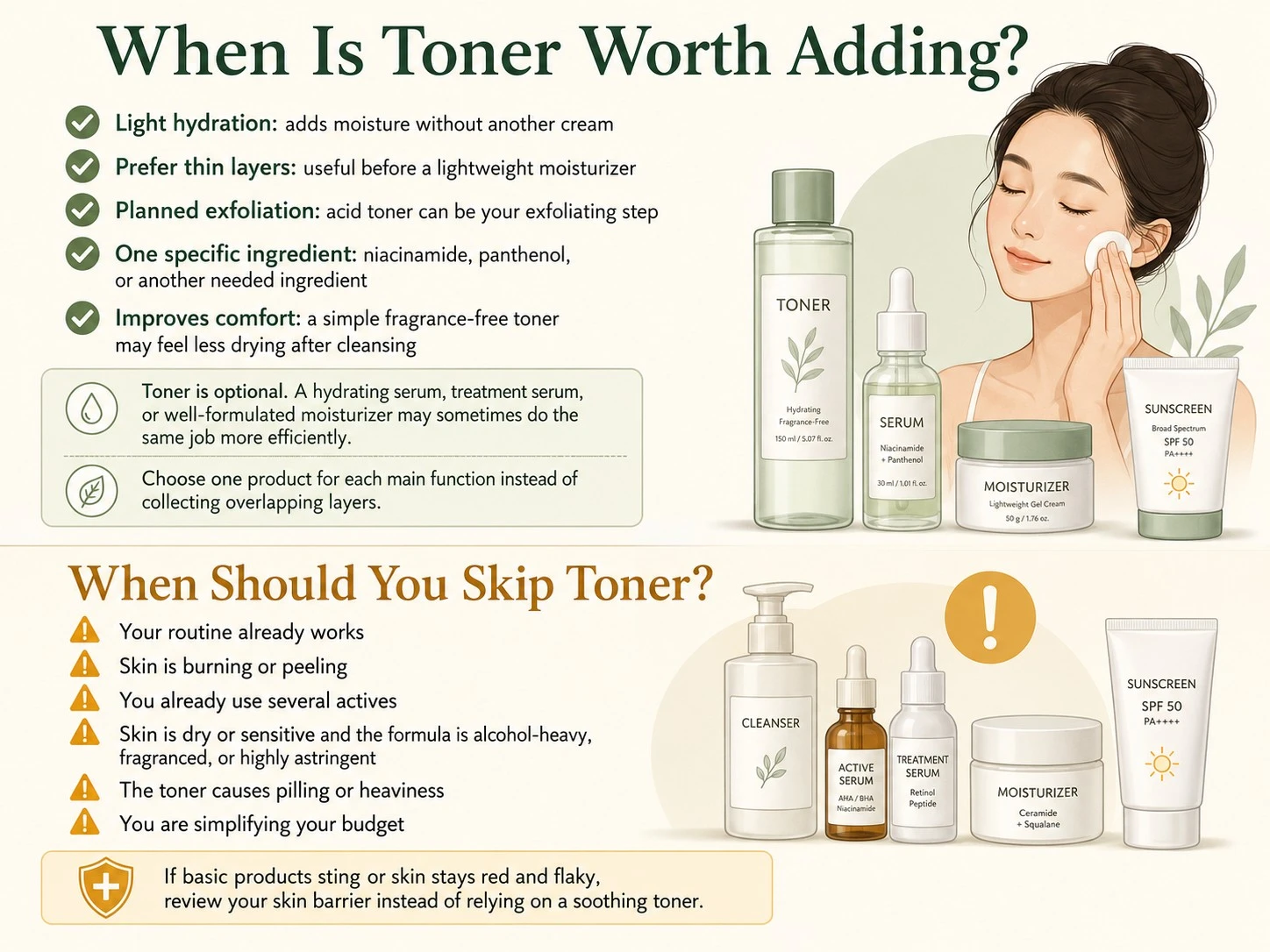
Toner is worth adding when you can name the missing function it provides.
- Your skin needs light hydration: a hydrating toner can add moisture without the weight of another cream.
- You prefer thin layers: oily or combination skin may enjoy a watery hydration step before a lightweight moisturizer.
- You need planned exfoliation: an acid toner may serve as your exfoliating treatment when used at a suitable frequency.
- You want one specific ingredient: toner can be a practical format for niacinamide, panthenol, or another ingredient not already present elsewhere.
- The product improves comfort: a simple fragrance-free toner may make cleansing feel less drying without complicating the routine.
Toner is optional even in these situations. A hydrating serum, treatment serum, or well-formulated moisturizer may deliver the same benefit more efficiently. Choose one product for each main function instead of collecting several overlapping layers.
When Should You Skip Toner?
- Your routine already works: clear, comfortable skin does not need another step simply for completeness.
- Your skin is burning or peeling: pause optional products and prioritize gentle cleansing, moisturizer, and sunscreen.
- You already use several actives: an exfoliating or treatment toner may duplicate acids, retinoids, or acne products.
- Your skin is dry or sensitive: alcohol-heavy, fragranced, or highly astringent formulas may worsen discomfort.
- The toner causes pilling or heaviness: removing a redundant watery layer can make serum, moisturizer, sunscreen, and makeup sit better.
- You are simplifying your budget: cleanser, moisturizer, and sunscreen usually deserve priority over toner.[2]
If basic products suddenly sting or your skin remains red and flaky, review your skin barrier rather than trying to solve the problem with a toner marketed as soothing.
Which Type of Toner Should You Choose?
Start with your skin need, then check the formula. Do not choose by packaging terms such as balancing, clarifying, pore-refining, or glow-enhancing without reading the active ingredients.
| Toner Type | Best Fit | What to Look For | What to Watch For |
|---|---|---|---|
| Hydrating toner | Dehydrated, tight, normal, oily, or combination skin | Glycerin, hyaluronic acid, panthenol, beta-glucan | Sticky layering or duplicated humectants |
| Soothing toner | Sensitive-feeling skin that tolerates the formula | Fragrance-free formula, panthenol, allantoin, colloidal oatmeal | Essential oils, fragrance, or numerous botanical extracts |
| Exfoliating toner | Clogged pores, rough texture, or planned chemical exfoliation | Salicylic, glycolic, lactic, or mandelic acid at a suitable strength | Combining with other acids, scrubs, retinoids, or drying acne treatments |
| Astringent toner | Very oily skin that tolerates temporary oil reduction | A simple formula used only as needed | High alcohol content, tightness, dryness, burning, or rebound discomfort |
| Milky toner | Normal to dry skin that prefers a richer liquid step | Humectants plus light emollients | Overlapping with essence, lotion, serum, and moisturizer |
Use our skin type guide if you are unsure what texture suits you. Tightness can also come from dehydration rather than naturally dry skin; see dehydrated vs dry skin for the difference.
Hydrating Toner vs Exfoliating Toner
A hydrating toner is an optional moisture layer. An exfoliating toner is a treatment. This distinction matters more than whether the bottle is called toner, tonic, clarifying lotion, or acid solution.
Hydrating toner can often be used once or twice daily if the formula is comfortable. Exfoliating toner should be introduced slowly and adjusted to your skin’s tolerance. Over-exfoliation can cause redness, dryness, peeling, irritation, and increased sensitivity.[5]
Do not automatically layer an acid toner with retinol, benzoyl peroxide, another exfoliating acid, or a facial scrub. Our guide to how often to exfoliate your face explains how to build a safer schedule.
How to Use Toner Correctly
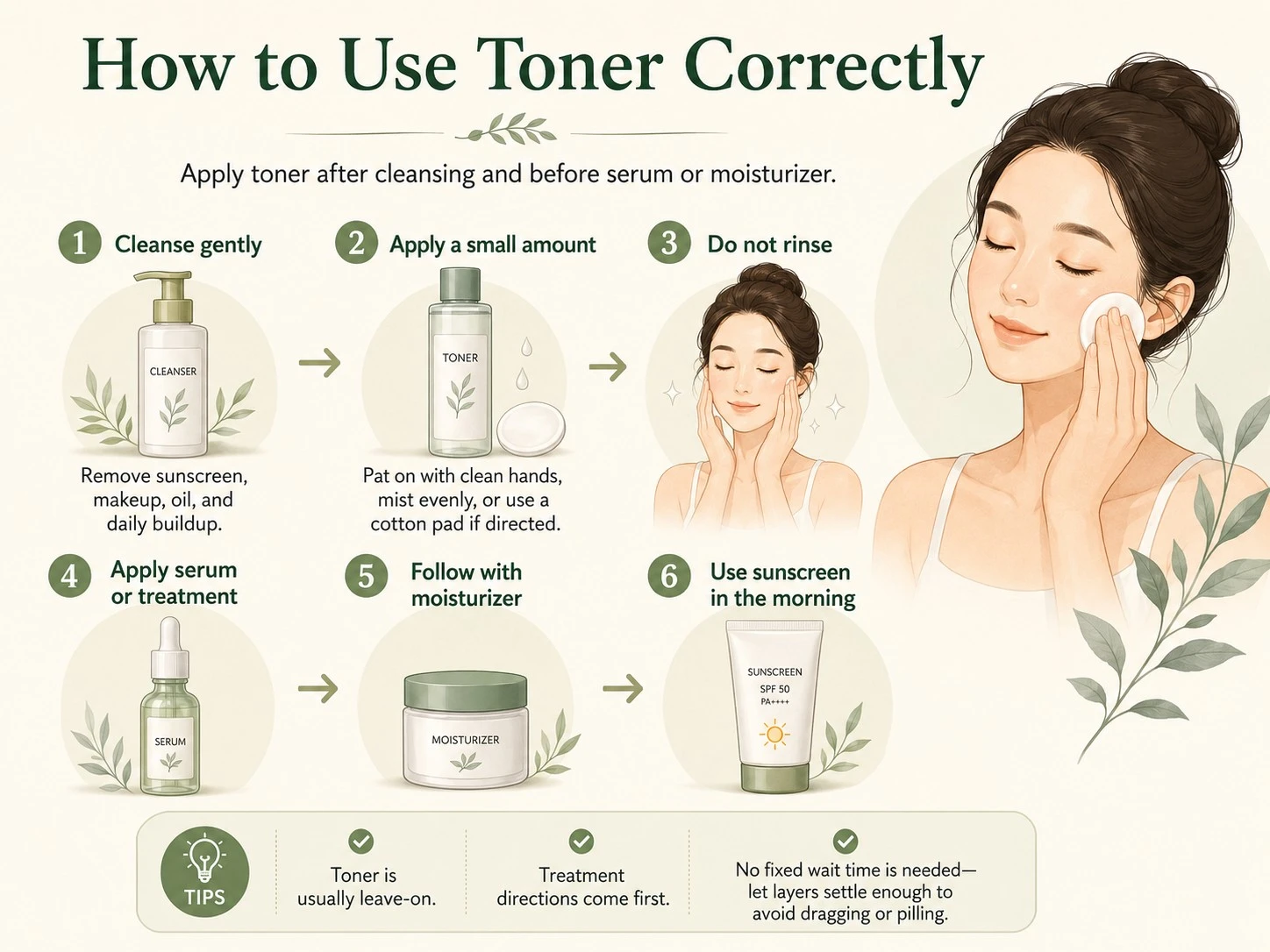
Apply toner after cleansing and before serum or moisturizer. Treatment directions take priority, especially when the toner contains acids or other active ingredients.[6]
- Cleanse gently: remove sunscreen, makeup, oil, and daily buildup without leaving the skin tight.
- Apply a small amount: pat it on with clean hands, mist it evenly, or use a cotton pad when the product directions recommend one.
- Do not rinse: toner is usually a leave-on product unless its instructions state otherwise.
- Apply serum or treatment: use only the products needed for your main concern.
- Follow with moisturizer: especially when your skin is dry, sensitive, or using an active toner.
- Finish with sunscreen in the morning: toner does not provide UV protection.
You do not need to wait a fixed number of minutes. Let the toner settle enough that the next product spreads without dragging or pilling. See our complete skincare routine order for the placement of treatments, moisturizer, oils, and sunscreen.
Common Toner Mistakes
- Using toner because every routine appears to include one.
- Expecting toner to replace a proper cleanser.
- Using toner instead of moisturizer when the skin is dry.
- Treating an exfoliating toner as a harmless daily hydration step.
- Choosing an astringent formula because oily skin feels temporarily cleaner.
- Stacking toner, essence, and serum with the same main ingredients.
- Applying several layers and blaming sunscreen or makeup for pilling.
- Continuing a toner that causes persistent burning, itching, swelling, or rash.
Introduce one new product at a time. Reactive skin should patch test a new toner before full-face use.[7]
When to See a Dermatologist
A toner cannot diagnose or treat every skin concern. See a dermatologist if you have persistent burning, itching, swelling, scaling, painful acne, hives, blistering, oozing, or repeated reactions to simple fragrance-free products.
Professional guidance is also appropriate when you are combining prescription acne or pigmentation treatment with exfoliating toner, or when your skin remains uncomfortable after simplifying the routine.
Final Thoughts
You do not really need toner for a complete or effective skincare routine. It is worthwhile only when the formula adds a specific benefit that your other products do not already provide.
Keep it when it improves hydration, comfort, exfoliation, or treatment without causing irritation. Skip it when it duplicates another step, complicates layering, or exists only out of habit.
FAQs About Face Toner
Can I skip toner and still have good skin?
Yes. Many effective routines use only cleanser, moisturizer, sunscreen, and a targeted treatment when needed. Toner is optional and should be added only when it provides a useful extra function.
Is toner necessary every day?
No. Hydrating toner can be used daily if you enjoy it and your skin tolerates it. Exfoliating toner may need to be used only once or a few times per week, depending on the formula and the rest of your routine.
Does toner replace cleanser?
No. Cleanser is the rinse-off step that removes oil, sunscreen, makeup, and buildup. Toner is a leave-on product used afterward and should not compensate for ineffective cleansing.
Can toner replace moisturizer?
Usually not. A hydrating toner adds water-binding ingredients, but most formulas do not provide the same emollient and moisture-sealing support as a moisturizer. Very oily skin may prefer a light moisturizer rather than skipping it automatically.
Is toner good for oily or acne-prone skin?
It can be, but the formula matters. A lightweight hydrating toner or a planned salicylic acid toner may fit oily or acne-prone skin. Harsh astringents and multiple overlapping acne actives can increase dryness and irritation.
Should toner sting or tingle?
Persistent stinging, burning, redness, or swelling is not a sign that toner is working. Stop using the product if irritation continues. Acid toners can sometimes cause a brief mild sensation, but they should not leave the skin painful or raw.
Sources
[1] Cleveland Clinic. Do You Need a Face Toner?
[2] American Academy of Dermatology. Skin Care on a Budget
[3] Li Yuanxi, et al. Comparison of Skin Hydration in Combination and Single Use of Common Moisturizers
[4] Eo J, et al. Facial Skin Physiology Recovery Kinetics During 180 Minutes Post-Washing With a Cleanser
[5] American Academy of Dermatology. How to Safely Exfoliate at Home
[6] American Academy of Dermatology. Should I Apply My Skin Care Products in a Certain Order?
[7] American Academy of Dermatology. How to Test Skin Care Products


