
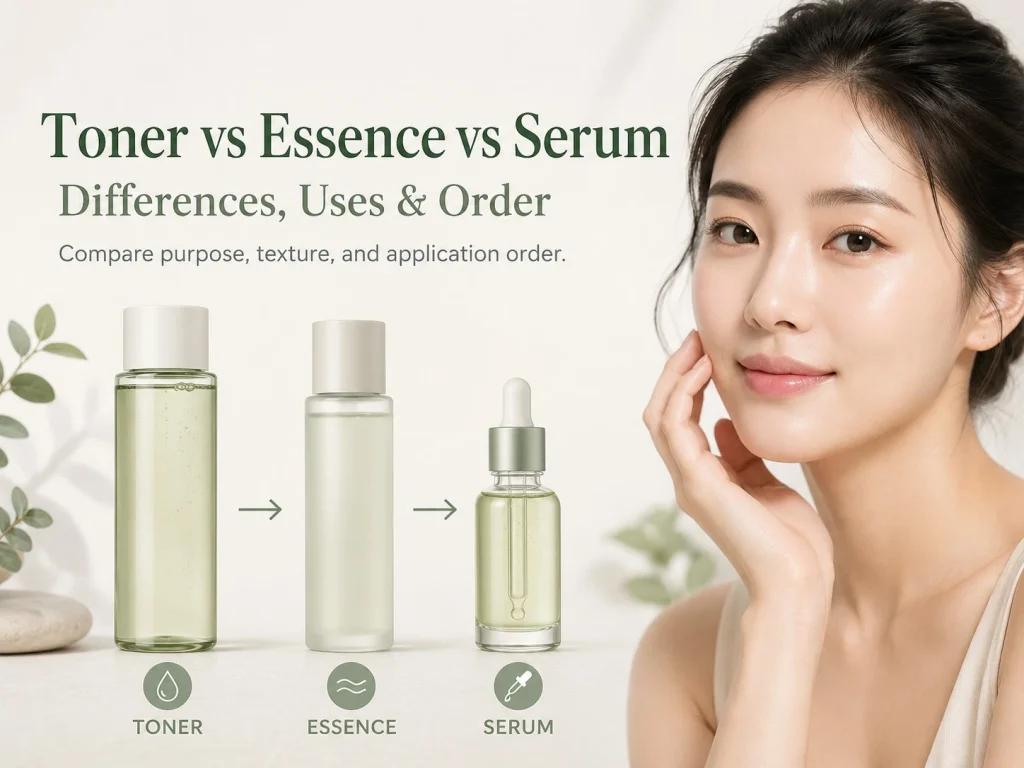


Toner vs Essence vs Serum: Key Differences
| Feature | Toner | Essence | Serum |
|---|---|---|---|
| Primary role | Light hydration, soothing, oil control, or exfoliation | Extra hydration and comfort | Targets a specific concern |
| Typical texture | Watery to milky | Watery to slightly viscous | Watery, gel-like, milky, cream-like, or oil-based |
| Common ingredients | Glycerin, panthenol, botanical extracts, AHAs, BHAs, witch hazel | Glycerin, hyaluronic acid, ferments, beta-glucan, soothing ingredients | Vitamin C, retinoids, niacinamide, peptides, acids, hyaluronic acid |
| Best reason to use it | You want a light post-cleansing step or a specific toner active | You want more hydration without a heavier moisturizer | You want to address acne, pigmentation, aging, oiliness, or dehydration |
| Usual order | First after cleansing | After toner | After toner or essence |
| Is it essential? | No | No | No, unless it delivers a needed treatment |
These categories overlap. A hydrating toner may feel almost identical to an essence, while an active essence may perform more like a serum. Read the ingredient list and product directions instead of assuming the product name tells you exactly how strong or useful it is.
What Is a Toner?
A toner is usually a watery leave-on product applied after cleansing. Modern toners can hydrate, soothe, exfoliate, reduce an oily feel, or deliver treatment ingredients.
The word “toner” does not describe one fixed formula. A hydrating toner with glycerin and panthenol is very different from an exfoliating toner with glycolic or salicylic acid. Toner can add light hydration, but it does not replace a suitable moisturizer when the skin is dry or barrier-stressed.[1]
A separate toner is also not automatically required to “rebalance” the skin after every wash. Skin parameters recover at different rates after cleansing without requiring a dedicated pH-balancing step.[2]
What Is an Essence?
An essence is usually a lightweight leave-on product used mainly for hydration, comfort, and a soft, plump-looking finish. It is closely associated with Korean and Japanese skincare routines, although brands now use the term globally. In Japanese skincare, a product called “lotion” may perform a similar watery hydration role rather than meaning a Western-style body lotion.
Essence often sits between toner and serum in texture, but this is not a strict rule. Some essences are as watery as toner, while others contain ferments, niacinamide, peptides, or exfoliating ingredients and behave more like treatment products.
What Is a Serum?
A serum is a leave-on product built around one or more targeted ingredients. Serums commonly address dehydration, acne, oiliness, dullness, dark spots, fine lines, texture, or firmness.
Serum does not automatically mean “stronger” or “more concentrated.” Some serums contain potent active ingredients, while others are simple hydrating formulas. The active ingredient, percentage, delivery system, supporting ingredients, and product directions matter more than the word on the bottle.
Why Toner, Essence, and Serum Sometimes Look the Same
Brands do not use toner, essence, and serum as rigid technical categories. Products with different names may contain similar ingredients, perform the same function, or have almost identical textures.
For example, a hydrating toner, essence, and serum may all rely on glycerin, hyaluronic acid, niacinamide, or panthenol. Layering all three may add more product without adding a genuinely different benefit.
Use these questions instead of relying on the product name:
- What concern is this product supposed to address?
- Which active ingredients does it contain?
- Is it hydrating, exfoliating, soothing, or treatment-focused?
- Does another product in my routine already perform the same job?
- Does the texture work comfortably with the products layered around it?
The most useful distinction is function. Toner and essence are often optional hydration or conditioning steps, while serum is usually the more targeted treatment step. The complete formula remains the final guide.
Do You Need Toner, Essence, and Serum?
Most people do not need all three. A basic routine can work with cleanser, moisturizer, sunscreen, and a treatment only when needed.[3][4][5]
- Use toner: when you want a light post-cleansing layer or need a specific hydrating, soothing, oil-control, or exfoliating formula.
- Use essence: when your skin feels dehydrated and you want extra moisture without a heavier cream.
- Use serum: when you have a defined goal such as acne, dullness, fine lines, uneven tone, or targeted hydration.
- Use two products: when they perform clearly different jobs, such as a hydrating essence followed by a vitamin C serum.
- Use all three: only when each product adds a separate function and the routine remains comfortable.
- Skip overlapping steps: when the products contain similar ingredients or provide the same main benefit.
Adding more layers does not guarantee better results. It can increase cost, heaviness, pilling, irritation, and the difficulty of identifying which product caused a reaction.[4][5][6]
What Is the Correct Toner, Essence, and Serum Order?

When you use all three, apply toner first, essence second, and serum third. Moisturizer follows, and sunscreen is the final morning skincare step.[3][4][6]
Morning order:
- Cleanser or water rinse: cleanse without leaving the skin tight.
- Toner: apply a thin layer if it serves a useful purpose.
- Essence: add lightweight hydration if needed.
- Serum: apply a targeted product such as vitamin C, niacinamide, or a hydrating serum.
- Moisturizer: choose a gel, lotion, or cream suited to your skin.
- Sunscreen: finish with broad-spectrum SPF.
Night order:
- Cleanser: remove sunscreen, makeup, oil, and daily buildup.
- Toner: use a hydrating formula or an exfoliating toner only on its planned schedule.
- Essence: add it if your skin benefits from another light hydration layer.
- Serum or treatment: use retinol, acne treatment, or another active as directed.
- Moisturizer: finish with enough moisture to keep the skin comfortable.
The “watery to thicker” rule is a practical guide, not a law. Prescription directions and product-specific instructions take priority. You also do not need to wait a fixed number of minutes between layers; let each product settle enough to avoid dragging or pilling.
For the placement of eye products, oils, treatments, moisturizer, and sunscreen, see our complete skincare routine order guide.
Which Product Should You Choose?
Choose the product that fills a missing role in your routine. Skin type helps determine the texture, while the concern determines whether you need hydration, soothing support, exfoliation, or a targeted active.
| Skin Need or Goal | Most Useful Starting Point | What to Look For | Practical Guidance |
|---|---|---|---|
| Dry or dehydrated skin | Essence or hydrating toner | Glycerin, hyaluronic acid, panthenol, beta-glucan | Follow with moisturizer; skip the extra watery step if serum and cream already provide enough hydration |
| Oily skin | Targeted serum or lightweight toner | Niacinamide, light humectants, salicylic acid if appropriate | Avoid stripping astringents and continue using a lightweight moisturizer |
| Acne-prone skin | Targeted serum or prescribed treatment | Salicylic acid, niacinamide, retinoid, or another suitable treatment | Do not combine an exfoliating toner with several acne actives without a clear plan |
| Sensitive or reactive skin | One simple hydrating product | Fragrance-free, low-irritation formula | Use the fewest steps that keep the skin comfortable and introduce one product at a time |
| Dullness or dark spots | Targeted serum | Vitamin C, niacinamide, retinoid, or another suitable active | Do not expect a basic hydrating essence to correct pigmentation |
| Fine lines or texture | Targeted serum | Retinol, peptides, vitamin C, or hydration support | Choose one main active instead of adding several anti-aging products at once |
| Barrier-stressed skin | Pause optional actives; use simple hydration if tolerated | Glycerin, panthenol, beta-glucan, fragrance-free formulas | Avoid exfoliating toner and strong treatment serums until the skin feels comfortable again |
Use our skin type guide if you are unsure whether your skin is dry, oily, combination, or sensitive. Tightness and dullness can also come from dehydration rather than a naturally dry skin type; see dehydrated vs dry skin.
How to Prevent Pilling and Irritation
Layering problems usually come from using too much product, combining overlapping formulas, or introducing several active ingredients at once.
- Apply only one thin layer of each product.
- Let each layer settle before applying the next.
- Remove redundant hydration steps if sunscreen or makeup pills.
- Treat exfoliating toner as an active rather than a harmless watery layer. Avoid casually combining it with retinol, benzoyl peroxide, another acid, or a facial scrub.[7]
- Introduce one new product at a time and patch test reactive skin before full-face use.[8]
Using too many products can increase irritation and make the cause harder to identify.[4][5][6] See our patch testing guide before introducing a new formula.
Common Toner, Essence, and Serum Mistakes
- Assuming all three products are required.
- Choosing by texture alone instead of ingredients and purpose.
- Expecting toner to close pores permanently.
- Expecting essence to make every serum penetrate deeper.
- Assuming every serum is highly concentrated or clinically stronger.
- Skipping moisturizer because several watery layers feel hydrating at first.
- Continuing a product that causes persistent burning, swelling, or rash.
A useful routine is defined by what each product does, not by how many category names appear on the shelf.
When to See a Dermatologist
Toner, essence, and serum can support cosmetic goals, but they cannot diagnose or treat every skin problem.
See a dermatologist if you have:
- Persistent burning, itching, redness, scaling, or swelling.
- Blistering, oozing, hives, or a spreading rash.
- Painful, cystic, or worsening acne.
- Suspected eczema, rosacea, psoriasis, or contact dermatitis.
- Questions about combining prescription treatment with cosmetic products.
Final Thoughts
Toner, essence, and serum are optional leave-on formats with overlapping roles. Toner is often a light post-cleansing step, essence usually adds hydration, and serum most often targets a specific concern.
You do not need all three. Choose the product that adds a missing function, apply it in the correct order, and remove any step that duplicates another product or makes the routine harder to tolerate.
FAQs About Toner vs Essence vs Serum
Do I need toner, essence, and serum?
No. Most people do not need all three. Choose toner or essence for extra light hydration, and choose serum for a specific treatment goal. A simple cleanser, moisturizer, sunscreen, and needed treatment can be enough.
Which goes first: toner, essence, or serum?
Use toner first, essence second, and serum third. Follow with moisturizer, then sunscreen in the morning. Product or prescription directions take priority when they recommend a different order.
Can essence replace toner?
Yes, when both products mainly provide lightweight hydration. You may still prefer toner if it contains a specific exfoliating, soothing, or oil-control ingredient that the essence does not provide.
Can serum replace essence?
A hydrating serum can replace essence for many people. Essence remains useful when you want another lightweight moisture layer, but it is not required if serum and moisturizer already keep the skin comfortable.
Is essence better than serum?
No. Essence is usually more hydration-focused, while serum is usually more targeted. Serum is the more useful choice for acne, uneven tone, fine lines, or another defined concern; essence may suit dehydration and lightweight layering.
Can I use toner, essence, and serum every day?
Hydrating formulas can often be used daily if tolerated. Exfoliating toners and treatment serums need a schedule based on their active ingredients. Using every product daily is not necessary and may increase irritation.
Sources
[1] Li X, et al. Comparison of Skin Hydration in Combination and Single Use of Common Moisturizers
[2] Eo J, et al. Facial Skin Physiology Recovery Kinetics During 180 Minutes Post-Washing With a Cleanser
[3] Cleveland Clinic. How To Order Your Skin Care Routine
[4] American Academy of Dermatology. Should I Apply My Skin Care Products in a Certain Order?
[5] American Academy of Dermatology. Skin Care on a Budget
[6] Cleveland Clinic. Steps to a Korean Skin Care Routine
[7] American Academy of Dermatology. How to Safely Exfoliate at Home
[8] American Academy of Dermatology. How to Test Skin Care Products


