

A skincare ingredient list can tell you much more than whether a product contains a trending ingredient. It can reveal the basic structure of a formula, show which ingredients appear relatively early or late, help you identify substances you want to use or avoid, and make two similar products easier to compare.
But ingredient-list reading becomes misleading when it turns into amateur reverse engineering. You usually cannot look at a label and calculate exact percentages, determine whether an ingredient is present at an effective level, or predict how the finished formula will feel and perform. The goal is to extract the information the list actually contains without inventing information that is not there.
What Is an INCI Ingredient List?
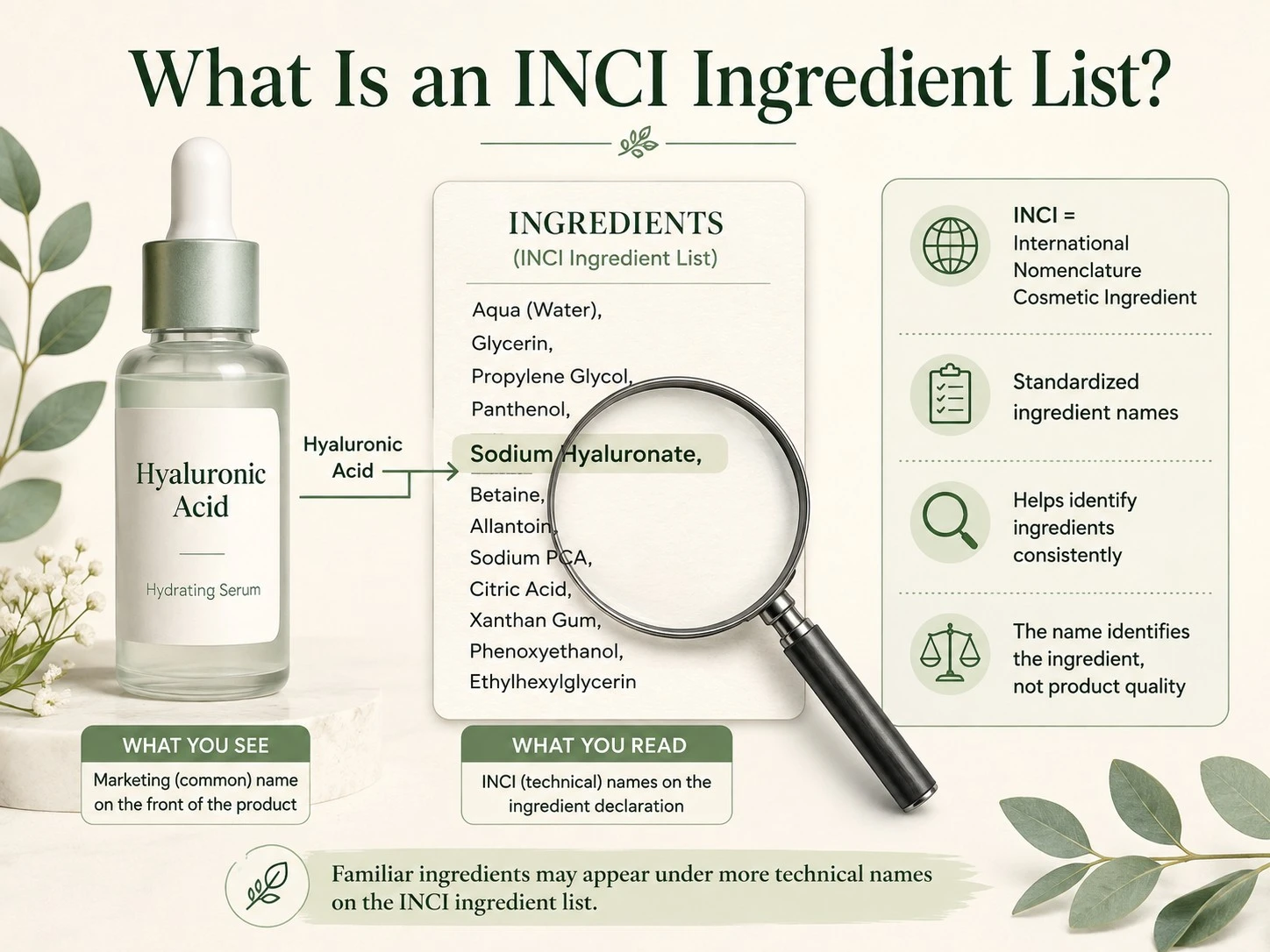
INCI stands for International Nomenclature Cosmetic Ingredient. INCI names are standardized ingredient names developed to help identify cosmetic ingredients consistently across the industry and international markets.[4]
This is why familiar ingredients can appear under names that look more technical than the language used on the front of the package. A marketing panel may say “hyaluronic acid,” for example, while the ingredient declaration may identify a specific form such as sodium hyaluronate.
However, it is too broad to say that every country simply requires one identical “INCI list.” Ingredient-naming and labeling requirements differ by jurisdiction. The EU uses common ingredient names from an official glossary that takes internationally recognized nomenclatures such as INCI into account, while U.S. cosmetic labeling rules require ingredients to be declared using names recognized under U.S. requirements.[1][3]
An INCI name also tells you what an ingredient is called, not whether it has been proven safe, approved for every cosmetic use, or guaranteed to perform well in a particular formula.[4]
How Are Skincare Ingredients Ordered?
Ingredient order is one of the most useful pieces of information on a cosmetic label, but it needs to be interpreted correctly.
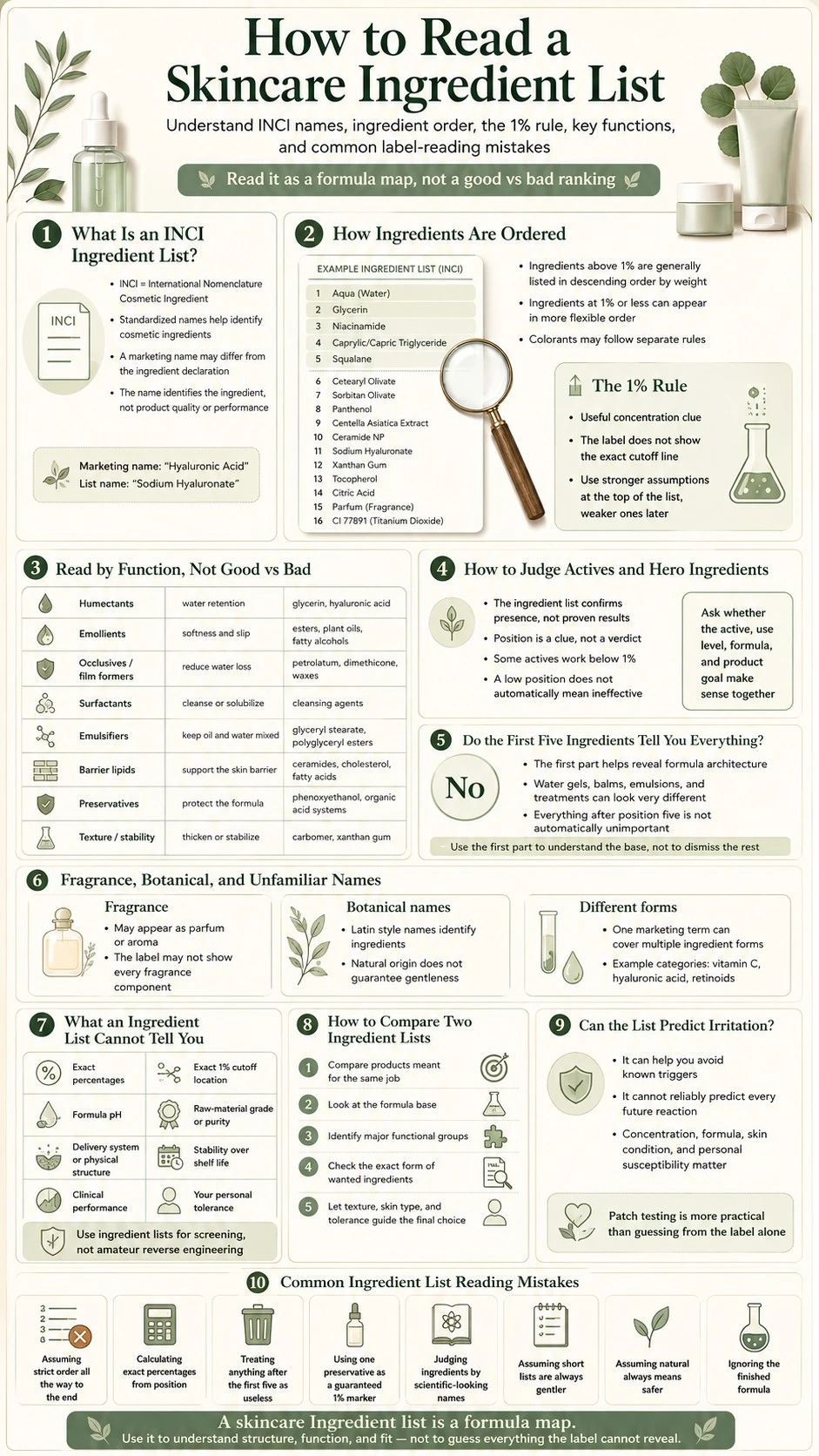
In both the United States and European Union, cosmetic ingredients above the applicable 1% threshold are generally declared in descending order by predominance or weight. Ingredients present at 1% or less can have more flexible ordering after the ingredients above that level, and colorants are subject to additional exceptions.[1][2][3]
This means an ingredient near the beginning of a conventional cosmetic list is usually present at a higher concentration than ingredients that clearly belong to the same descending-order portion of the list. It does not mean you can convert list position into an exact percentage.
Why the “1% Line” Is Useful but Easy to Misuse
People often talk about an invisible “1% line.” The concept is useful because ingredients below this threshold no longer need to remain in strict descending order under the U.S. and EU rules described above.[2][3]
The problem is that the label usually does not tell you exactly where that line begins. You may see online advice suggesting that a preservative such as phenoxyethanol automatically marks the 1% boundary, but that is only an estimate based on expected use levels, not information disclosed by the ingredient list itself.
A safer interpretation is: use the top of the list for stronger relative-concentration clues, but become increasingly cautious about concentration assumptions as you move into ingredients that may be used at low levels.
Read Ingredients by Function, Not as “Good” or “Bad”
A formula needs many ingredients that never appear in advertising. Some moisturize the skin, while others keep oil and water mixed, control viscosity, preserve the product, adjust pH, improve spreadability, or stabilize the finished formula. An ingredient does not need to be a hero active to be important.
| Ingredient Role | What It Does in a Formula | Common Examples |
|---|---|---|
| Humectants | Help increase and retain water in the outer skin | Glycerin, propanediol, hyaluronic acid |
| Emollients | Improve softness, slip, and surface smoothness | Esters, triglycerides, fatty alcohols, plant oils |
| Occlusive or film-forming materials | Help reduce water loss or form a protective surface film | Petrolatum, mineral oil, dimethicone, waxes |
| Surfactants | Help cleanse, foam, solubilize, or reduce surface tension depending on the ingredient | Various anionic, amphoteric, nonionic, and other surfactants |
| Emulsifiers | Help oil and water phases remain combined | Glyceryl stearate, emulsifying wax systems, polyglyceryl esters |
| Barrier lipids | Can contribute lipids relevant to the stratum corneum | Ceramides, cholesterol, fatty acids |
| Preservatives | Help control microbial contamination and protect the product during its intended use | Phenoxyethanol, organic acid systems, other permitted preservative systems |
| Texture and stability ingredients | Adjust thickness, suspension, spreadability, or physical stability | Carbomer, xanthan gum, cellulose derivatives |
This functional approach is more useful than searching for a list of “clean” ingredients and “toxic” ingredients. Whether an ingredient is appropriate depends on its identity, concentration, formulation, intended use, exposure, and the individual using the product.
How Should You Judge Active and “Hero” Ingredients?
The front of a package may focus on niacinamide, retinol, peptides, vitamin C, salicylic acid, or another recognizable ingredient. The ingredient list can confirm whether that substance is present, but its position should be treated as a clue rather than a verdict.
Some ingredients are commonly formulated at several percent, while others can have meaningful functions at fractions of 1%. A low position therefore does not automatically mean an ingredient is “too weak to work.” Conversely, seeing a popular active relatively early does not prove that the finished product has been tested to deliver a particular result.
The better question is whether the ingredient, its expected use level, the surrounding formula, and the product’s intended job make sense together. Our Skincare Active Ingredients: What They Do & How to Use article is a more useful next step when you need to evaluate what a specific active is supposed to do rather than simply locate its name on a label.
Do the First Five Ingredients Tell You Everything?
No. The first few ingredients often reveal a lot about the base of the formula because higher-concentration ingredients appear earlier in the descending-order portion of the list. But treating “the first five ingredients” as a universal rule is another shortcut that can become misleading.
There is no regulation saying the first five ingredients must account for a fixed percentage of every skincare formula. A water-rich gel, an anhydrous balm, a high-oil emulsion, and a concentrated treatment can all have very different concentration distributions.
The first part of the list is therefore useful for understanding formula architecture, not for declaring that everything after position five is unimportant.
How to Read Fragrance, Botanical, and Unfamiliar Ingredient Names
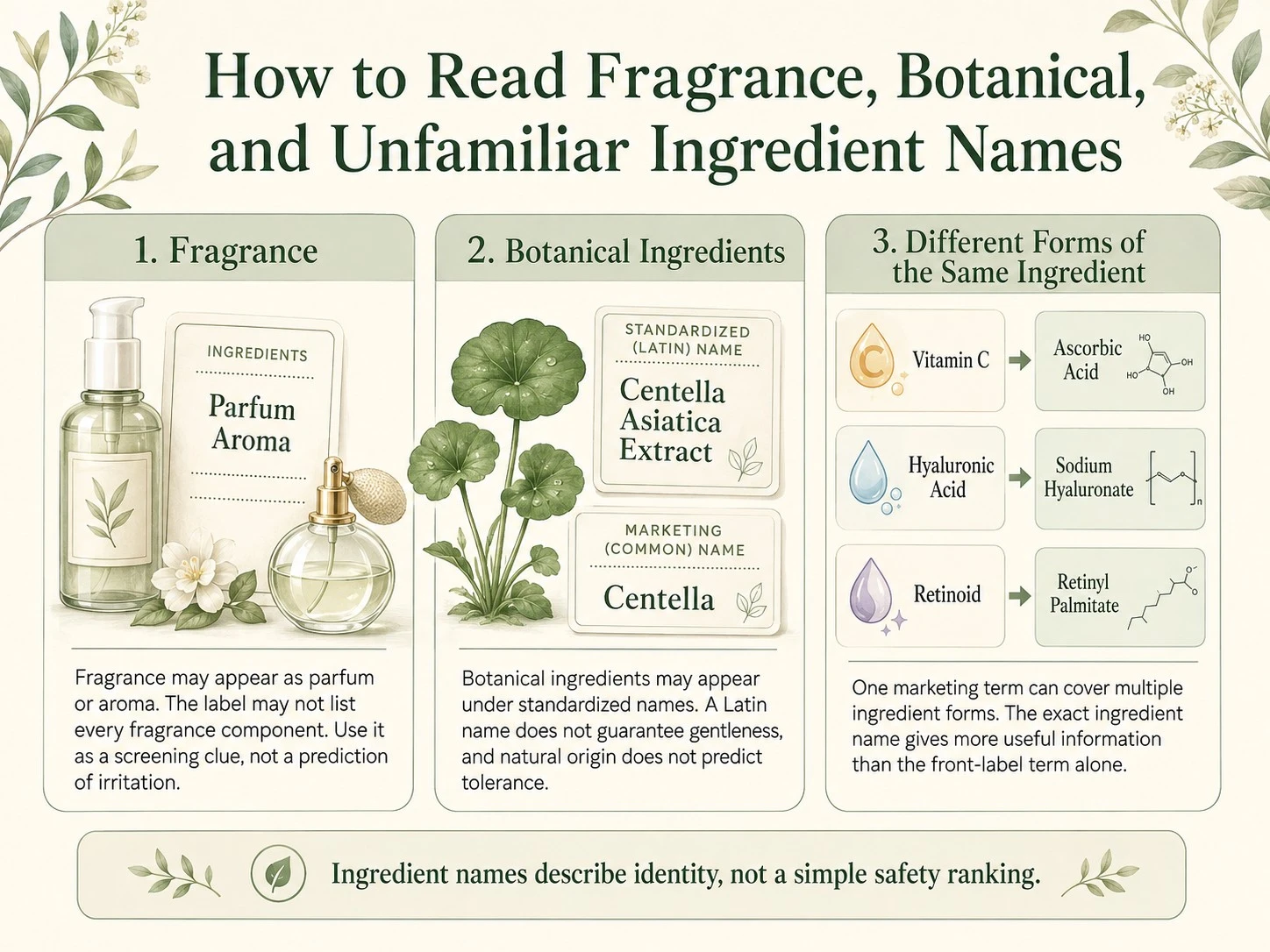
A long chemical-looking name is not evidence that an ingredient is harsh, and a recognizable botanical name is not evidence that an ingredient is automatically gentler. Ingredient nomenclature describes identity, not a simple safety ranking.
Fragrance
Fragrance labeling is one area where individual fragrance components are not always presented as a simple full list of every material in the fragrance composition. For example, EU rules permit perfume and aromatic compositions to appear under terms such as “parfum” or “aroma,” while additional substances must be declared individually when specific labeling requirements apply.[3]
If you know that fragrance is a personal trigger, the ingredient list can help you screen products, but the label alone cannot predict whether a product will irritate you.
Botanical Ingredients
Plant-derived ingredients may appear under standardized botanical or ingredient nomenclature rather than the everyday name used in marketing. Do not interpret the Latin-looking name as proof that the product contains a whole raw plant, nor assume that “natural” origin predicts how your skin will tolerate it.
Different Forms of the Same Marketing Ingredient
One marketing term can cover more than one ingredient form. “Vitamin C,” “hyaluronic acid,” and “retinoid” are examples where the exact ingredient named on the list can provide more useful information than the broader front-label category.
What Can an Ingredient List Not Tell You?
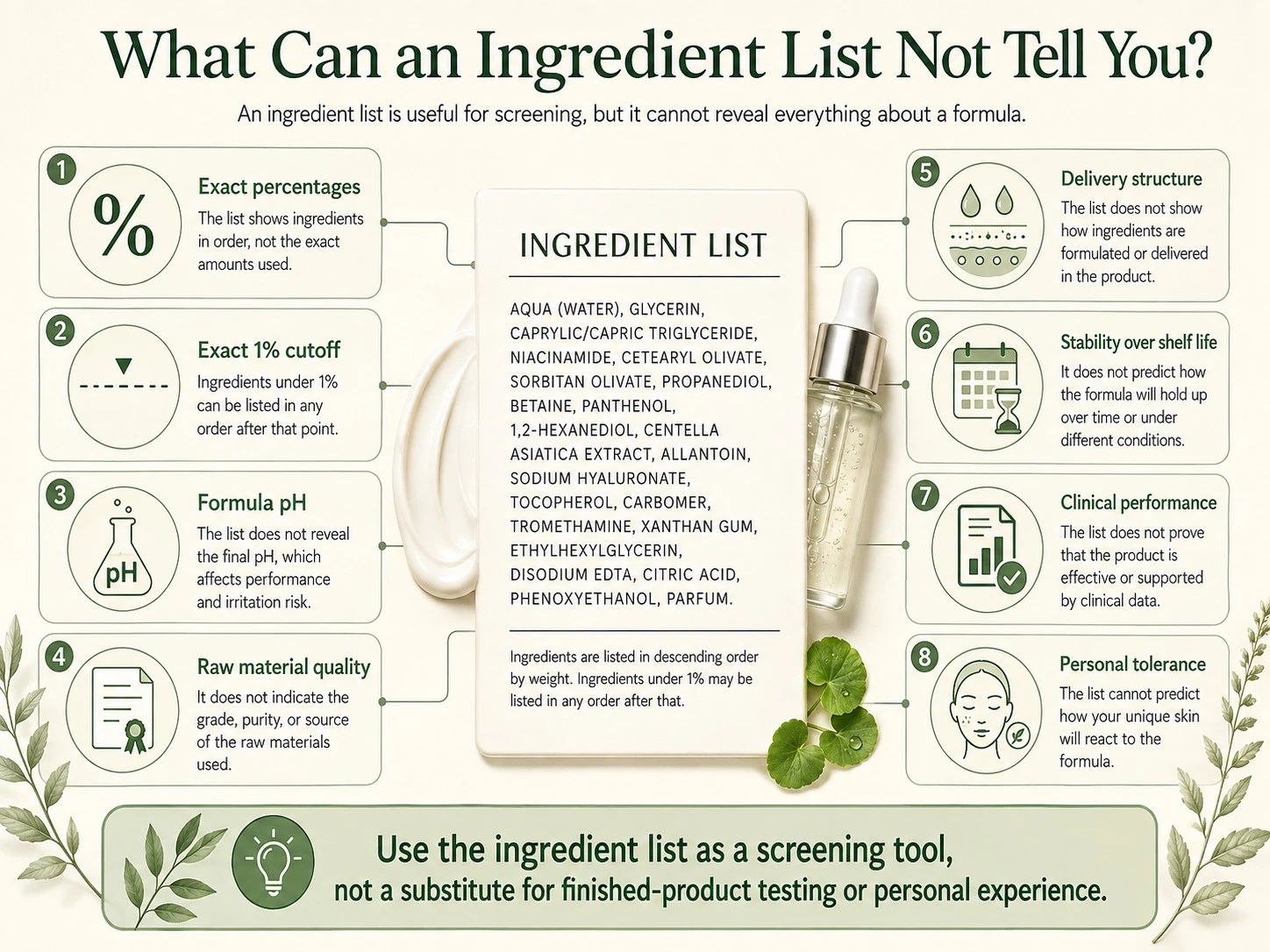
Knowing the limits of an ingredient list is as important as knowing how to read it.
- Exact percentages: cosmetic labels generally do not disclose the concentration of every ingredient.
- The exact 1% cutoff location: the list normally does not mark where flexible ordering begins.
- Formula pH: this is important for some ingredients but cannot usually be determined from ingredient order.
- Raw-material specifications: purity, grade, supplier specifications, and impurity profiles are not visible from the ingredient name alone.
- Delivery and physical structure: the same ingredient list does not fully describe droplet size, encapsulation, emulsion structure, or other formulation characteristics.
- Stability: a label cannot tell you whether sensitive ingredients remain stable throughout shelf life.
- Clinical performance: the presence of an ingredient does not prove that the finished product has demonstrated a specific result.
- Your individual tolerance: a theoretically suitable formula can still sting, cause allergy, worsen acne, or simply feel unpleasant on a particular person.
This is why an ingredient list is best used as a screening and interpretation tool rather than as a substitute for finished-product testing or actual use.
How to Compare Two Skincare Ingredient Lists
When two products make similar claims, avoid comparing them by counting recognizable ingredients. Compare the role and structure of the formulas instead.
- Confirm that the products are meant to solve the same problem. A hydrating serum and barrier cream should not be judged by the same ingredient pattern.
- Look at the formula base. Notice whether the list suggests a water-rich, oil-rich, silicone-rich, surfactant-based, or otherwise distinct product structure.
- Identify the major functional groups. Look for hydration, emolliency, cleansing, barrier support, preservation, and the targeted treatment ingredients that matter for the product’s job.
- Check the exact form of any ingredient you specifically want. Do not rely only on the front-label marketing name.
- Use texture, skin type, and tolerance to make the final choice. Ingredient similarity does not mean two finished products will feel or perform identically.
For moisturizers in particular, the ingredient list should be interpreted together with texture and skin needs. How to Choose a Moisturizer for Your Skin Type covers that product-level decision directly.
Can an Ingredient List Predict Whether a Product Will Irritate You?
It can help you avoid an ingredient you already know causes a problem, but it cannot reliably predict every future reaction. Irritation and allergy depend on more than whether an ingredient appears on the label, including concentration, exposure, the rest of the formula, skin condition, and individual susceptibility.
This matters especially if you have a history of reactions. Instead of rejecting every long ingredient list, identify known triggers and introduce unfamiliar leave-on products cautiously. How to Patch Test Skincare Products Before Using Them explains a more practical way to evaluate an individual product before applying it broadly.
Common Ingredient-List Reading Mistakes
- Assuming ingredients are in strict descending order all the way to the end. Low-concentration ingredients can have more flexible ordering under common labeling systems.[2][3]
- Trying to calculate exact percentages from list position. Ingredient order gives relative clues, not a complete formula.
- Assuming anything below the first five ingredients is useless. Some important ingredients are intentionally used at low levels.
- Using a preservative as a guaranteed marker for the 1% line. It may provide a rough clue in some formulas, but the label itself does not confirm that cutoff.
- Judging an ingredient by how scientific its name sounds. Standardized nomenclature is designed for identification, not consumer-friendly marketing.
- Assuming a short ingredient list is automatically gentler. Product tolerance depends on what the ingredients are, how they are used, and your skin.
- Assuming natural ingredients are automatically safer. Origin alone does not determine irritation, allergy, or overall safety.
- Ignoring the finished formula. Ingredients interact within a vehicle; a label cannot substitute for how the complete product behaves.
Final Thoughts
Learning how to read a skincare ingredient list is useful because it helps you see past a single hero ingredient and understand the broader formula. Start with ingredient order, identify the main functional groups, check the exact ingredients that matter to your goal, and use the 1% rule cautiously rather than pretending it reveals precise concentrations.
The most important limit is equally simple: an ingredient list tells you what is in the product, not everything about what the finished product will do. Use it to screen, compare, and ask better questions—not to reverse engineer a formula from the back of the box.
FAQs About Skincare Ingredient Lists
Are Skincare Ingredients Listed From Highest to Lowest Concentration?
For conventional cosmetics in markets such as the United States and EU, ingredients above the applicable 1% threshold are generally listed in descending order of predominance or weight. Ingredients at lower concentrations and certain colorants can have different ordering rules.[1][2][3]
What Is the 1% Rule in Skincare?
It refers to labeling rules that allow ingredients around or below 1% to be listed with more flexible ordering after the ingredients present above that level. The ingredient list normally does not identify the exact point where this lower-concentration section begins.[2][3]
Does an Ingredient Low on the List Mean It Does Not Work?
No. Different ingredients are designed to work at very different concentrations. Some can be important at levels below 1%, so list position alone is not enough to decide whether an ingredient is effective.
Can You Tell the Percentage of an Ingredient From the Ingredient List?
Usually not. You can sometimes infer relative order among higher-concentration ingredients, but a cosmetic ingredient declaration generally does not provide the exact percentage of every ingredient.
Does a Longer Ingredient List Mean a Product Is Worse?
No. Length does not tell you whether a formula is safe, effective, irritating, or suitable for your skin. A longer list may simply reflect a more complex emulsion, preservation system, texture system, or combination of functional ingredients.
Does an INCI Name Mean an Ingredient Is Approved or Safe?
No. An INCI name is an identification system. Assignment of an INCI name does not by itself mean that the ingredient has been approved for cosmetic use, proven safe in every context, or permitted under every country’s regulations.[4]
Sources
[1] U.S. Food and Drug Administration. Cosmetic Ingredient Names
[2] U.S. Food and Drug Administration. Cosmetics Labeling Guide
[3] European Union. Regulation (EC) No 1223/2009 on Cosmetic Products
[4] Personal Care Products Council. INCI – International Nomenclature Cosmetic Ingredient


