


The right moisturizer should reduce dryness and water loss without making your skin feel greasy, congested, irritated, or difficult to layer. The label “for dry skin” or “for oily skin” can help narrow the options, but texture, ingredients, climate, treatment use, and your current skin condition often matter just as much.
Start with your baseline skin type, then adjust for temporary changes such as dehydration, over-exfoliation, acne treatment, cold weather, or a stressed skin barrier. A lightweight gel can be enough for oily skin in humid weather, while the same person may need a lotion or cream during winter or when using a retinoid.
What Does a Moisturizer Actually Do?
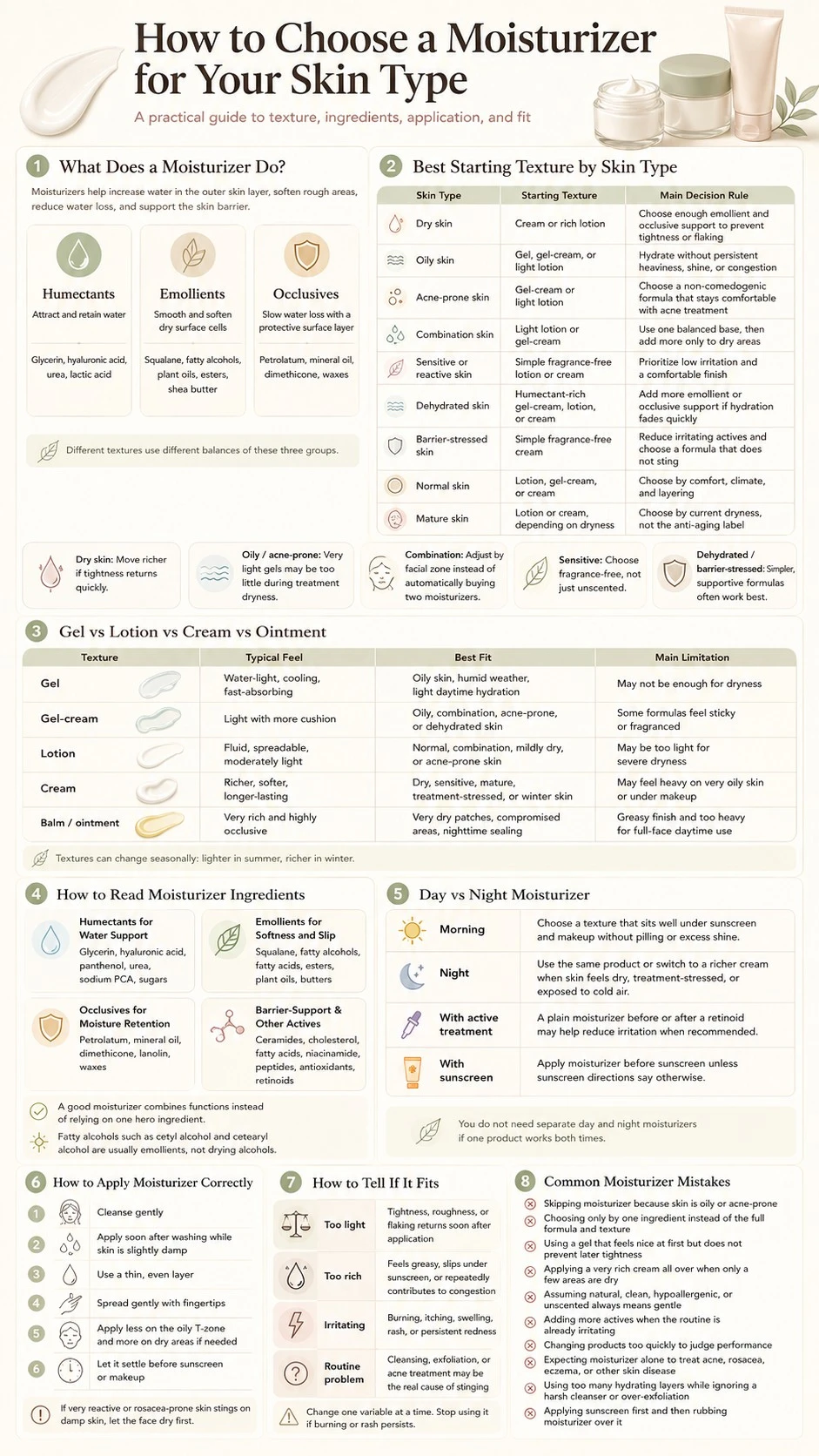
Moisturizers help increase water in the outer skin layer, soften rough areas, reduce evaporative water loss, and support a more comfortable skin barrier. Most formulas combine three functional ingredient groups: humectants, emollients, and occlusives.[1][2]
- Humectants: Attract and retain water in the outer skin layer. Common examples include glycerin, hyaluronic acid, urea, and lactic acid.
- Emollients: Smooth and soften the spaces between dry surface cells. Examples include squalane, fatty alcohols, plant oils, esters, and shea butter.
- Occlusives: Form a surface layer that slows water loss. Examples include petrolatum, mineral oil, dimethicone, and waxes.
A moisturizer does not need equal amounts of all three groups. A gel may rely heavily on humectants, while a richer cream or ointment usually contains more emollient and occlusive material. The best balance depends on how much water your skin needs and how much richness it tolerates.
Best Moisturizer for Each Skin Type
Use skin type to choose a starting texture, then adjust according to climate, treatment use, and how long the product keeps your skin comfortable. The table gives a quick starting point; the sections below explain the situations in which that choice may need to change.
| Skin Type or Condition | Better Starting Texture | Main Decision Rule |
|---|---|---|
| Dry skin | Cream or rich lotion | Choose enough emollient and occlusive support to prevent returning tightness or flaking |
| Oily skin | Gel, gel-cream, or light lotion | Hydrate without leaving persistent heaviness, shine, or congestion |
| Acne-prone skin | Gel-cream or light lotion | Choose a non-comedogenic formula that remains comfortable with acne treatment |
| Combination skin | Light lotion or gel-cream | Use one balanced base, then add more only to dry areas when needed |
| Sensitive or reactive skin | Simple fragrance-free lotion or cream | Prioritize low irritation and a comfortable finish over a long active-ingredient list |
| Dehydrated skin | Humectant-rich gel-cream, lotion, or cream | Add more emollient or occlusive support if hydration disappears quickly |
| Barrier-stressed skin | Simple fragrance-free cream | Reduce irritating actives and choose a formula that does not sting |
| Normal skin | Lotion, gel-cream, or cream | Choose according to comfort, climate, and how well it layers with other products |
| Mature skin | Lotion or cream, depending on dryness | Choose according to current dryness rather than the product’s anti-aging label |
Dry Skin
Dry skin produces less oil and often feels rough, tight, flaky, or uncomfortable. A cream is usually a better starting point than a watery gel because it combines water-binding ingredients with stronger surface-softening and moisture-sealing support. Dermatologists commonly recommend fragrance-free creams or ointments for more severe dryness.[1][5]
If tightness returns shortly after application, the formula may be too light, the amount may be too small, or another step such as cleansing or exfoliation may be increasing dryness. Move to a richer cream or apply a thin occlusive layer only to the driest areas rather than adding several watery products.
Oily and Acne-Prone Skin
Oily skin still needs hydration, and acne-prone skin is not always oily. Start with a gel-cream or light lotion that settles without a persistent film. Oil-free and non-comedogenic labels are useful screening tools, but the complete formula and your individual response matter more than whether one oil appears in the ingredient list.[3]
Acne treatments such as benzoyl peroxide, salicylic acid, topical retinoids, and isotretinoin can cause dryness and peeling. When that happens, a slightly richer lotion or cream may be more suitable than a very light gel. Moisturizer can support treatment tolerance, but it does not replace proven acne treatment.[4] See our Acne-Prone Skincare Routine for the full routine order.
Combination Skin
Combination skin usually has a more oily T-zone and drier or more comfortable cheeks. A light lotion or gel-cream can provide a balanced base across the face. If the cheeks remain dry, apply a second thin layer or a richer cream only to those areas.
You do not automatically need two separate moisturizers. Adjusting the amount by facial zone is usually simpler than using one very light product that leaves the cheeks tight or one rich product that overloads the T-zone.
Sensitive or Reactive Skin
Sensitive skin usually benefits from fewer unnecessary variables. Choose fragrance-free rather than merely unscented, and do not assume that botanical, natural, or multi-ingredient soothing formulas are automatically gentler.
A simple lotion or cream is often easier to assess than a formula containing several acids, retinoids, essential oils, or botanical extracts. Rosacea-prone skin may also prefer a fragrance-free, non-comedogenic cream with fewer potentially irritating ingredients.[6] Test unfamiliar products before full-face use; our Patch Testing Guide explains a cautious introduction method.
Dehydrated, Barrier-Stressed, and Mature Skin
Dehydration is a temporary lack of water rather than a permanent skin type. Oily, dry, and combination skin can all become dehydrated. A humectant-rich gel-cream may suit oily dehydrated skin, while dry dehydrated skin usually needs a cream that also slows water loss. See Dehydrated vs Dry Skin for the distinction.
Barrier-stressed skin usually benefits from a simple fragrance-free formula and fewer strong actives. Ceramides, fatty acids, cholesterol, glycerin, dimethicone, and petrolatum are common options, but no single ingredient repairs every barrier problem overnight. Our Ceramides Guide explains how barrier lipids fit into a moisturizer.
Mature skin often becomes drier, but age alone does not determine the ideal texture. Choose according to current dryness, climate, and comfort. A basic cream used consistently may be more useful than a lighter product chosen mainly for its anti-aging claims.
Gel vs Lotion vs Cream vs Ointment
Texture gives a practical clue about richness and occlusion, although manufacturers do not use these terms with perfect consistency.
| Texture | Typical Feel | Best Starting Fit | Main Limitation |
|---|---|---|---|
| Gel | Water-light, cooling, fast-absorbing | Oily skin, humid weather, light daytime hydration | May not provide enough emollient or occlusive support for dryness |
| Gel-cream | Light but more cushioned than gel | Oily, combination, acne-prone, or dehydrated skin | Some formulas still feel sticky or heavily fragranced |
| Lotion | Fluid, spreadable, moderately light | Normal, combination, mildly dry, or acne-prone skin | May be too light for severe dryness |
| Cream | Richer, softer, longer-lasting | Dry, sensitive, mature, treatment-stressed, or winter skin | May feel heavy under makeup or on very oily skin |
| Balm or ointment | Very rich and highly occlusive | Very dry patches, compromised areas, or nighttime sealing | Greasy finish and greater chance of feeling too heavy across the full face |
Ointments are generally the most occlusive, followed by creams and then lotions, although the exact ingredient system matters.[2] You can also change textures seasonally: use a gel-cream in summer and a cream during cold, dry weather without changing your underlying skin type.
How to Read Moisturizer Ingredients

Do not search for one “best” ingredient. A useful moisturizer usually combines several functions in a texture you can use consistently.
Humectants for Water Support
Glycerin, hyaluronic acid, panthenol, urea, sodium PCA, and some sugars help increase water in the outer skin layer. Humectants are useful across skin types, but a humectant-heavy product can still feel insufficient when very dry skin needs more emollient or occlusive support.
Hyaluronic acid is common but not uniquely necessary. A well-formulated glycerin moisturizer can perform the core hydration role without a high-profile ingredient claim. See our Hyaluronic Acid Guide for product-type and skin-type differences.
Emollients for Softness and Slip
Squalane, fatty alcohols, fatty acids, esters, plant oils, and butters help smooth rough texture and improve spread. “Alcohol” in an ingredient list does not always mean a drying solvent: fatty alcohols such as cetyl alcohol and cetearyl alcohol commonly function as emollients or texture builders.
Occlusives for Moisture Retention
Petrolatum, mineral oil, dimethicone, lanolin, and waxes slow water loss from the surface. They are especially useful for dry, barrier-stressed, or weather-exposed skin, but the richest options can feel heavy. Apply them selectively rather than rejecting or using them across the whole face by default.
Barrier-Support and Active Ingredients
Ceramides, cholesterol, and fatty acids are commonly included in barrier-focused moisturizers. Niacinamide, peptides, antioxidants, or retinoids may add a targeted role, but they are not required for a moisturizer to work. When sensitive or irritated skin needs basic support, a simpler formula is often easier to evaluate.
Day Moisturizer vs Night Moisturizer

You do not need two separate products if one moisturizer works comfortably both morning and night. The practical difference is usually finish and routine compatibility, not a mandatory daytime or nighttime ingredient.
- Morning: Choose a texture that settles well under sunscreen and makeup without pilling or excessive shine.
- Night: Use the same product or a richer cream when your skin feels dry, treatment-stressed, or exposed to cold air.
- With active treatment: A plain moisturizer before or after a retinoid may reduce irritation when the product directions or clinician recommend buffering.
- With sunscreen: Apply moisturizer before sunscreen unless the sunscreen directions state otherwise.
See Sunscreen or Moisturizer First? for morning layering, and use our Skincare Routine Order guide for serums, treatments, moisturizer, and SPF.
How to Apply Moisturizer Correctly

- Cleanse gently: Use a cleanser that removes buildup without leaving persistent tightness.
- Leave the skin slightly damp: For most dry or normal skin, applying moisturizer soon after washing helps trap water in the skin.[4][5]
- Use a practical amount: Start with enough to cover the face in a thin, even layer, then add more only where needed.
- Spread without rubbing aggressively: Use fingertips and gentle strokes.
- Adjust by area: Apply less to the oily T-zone and more to dry cheeks when necessary.
- Let it settle before sunscreen or makeup: There is no universal waiting time; continue when the surface feels even and the next layer will not drag.
One exception is highly reactive or rosacea-prone skin that stings more when products are applied to damp skin. In that situation, allowing the face to dry before moisturizing can improve comfort.[6]
How to Tell If the Moisturizer Fits
A suitable moisturizer should keep the skin comfortable until the next normal routine step without creating a new problem.
- It may be too light: Tightness, roughness, or flaking returns soon after application.
- It may be too rich: The product remains greasy, slides under sunscreen, or repeatedly contributes to congestion for you.
- It may be irritating: Burning, itching, swelling, a spreading rash, or persistent redness appears after use.
- The routine may be the problem: Moisturizer stings because cleansing, exfoliation, acne treatment, or another active has already irritated the barrier.
Change one variable at a time. If a moisturizer causes persistent burning or a rash, stop using it. Painful cracks, bleeding, widespread dermatitis, or dryness that does not improve with a simple routine should be assessed by a dermatologist.[1]
Common Moisturizer Mistakes
- Skipping moisturizer because the skin is oily or acne-prone.
- Choosing only by one ingredient instead of the complete formula and texture.
- Using a gel that feels pleasant initially but does not prevent later tightness.
- Applying a very rich cream across the whole face when only a few areas are dry.
- Assuming “natural,” “clean,” “hypoallergenic,” or “unscented” guarantees tolerance.
- Adding exfoliating or anti-aging actives to a moisturizer when the routine is already irritating.
- Changing products too quickly to judge whether the formula works.
- Expecting moisturizer alone to treat acne, rosacea, eczema, or another skin disease.
- Using too many hydrating layers while ignoring a harsh cleanser or over-exfoliation.
- Applying sunscreen first and then rubbing moisturizer over the protective film.
Final Thoughts
Choose moisturizer by matching richness to your skin’s oil level, water needs, sensitivity, current treatment, and environment. Dry skin usually benefits from cream; oily and acne-prone skin often prefers gel-cream or lotion; combination skin needs balanced or targeted application; and sensitive skin benefits from fragrance-free simplicity.
The best product is not the one with the longest ingredient list or strongest marketing claim. It is the formula that keeps your skin comfortable, layers well with the rest of your routine, and is easy to use consistently. For the difference between targeted treatment and basic moisture support, see Serum vs Moisturizer.
FAQs About Choosing a Moisturizer
How do I know which moisturizer is right for my skin?
Start with skin type and texture: cream for dry skin, gel or light lotion for oily skin, and a balanced lotion or gel-cream for combination skin. Then confirm that it prevents tightness without causing persistent heaviness, irritation, or congestion.
Should oily skin use moisturizer?
Yes. Oily skin still needs hydration and barrier support. Choose a lightweight, oil-free or non-comedogenic gel, gel-cream, or lotion rather than skipping moisturizer entirely.
Is gel or cream moisturizer better?
Gel is usually lighter and better suited to oily skin or humid weather. Cream contains more emollient or occlusive support and is usually better for dry, sensitive, mature, or weather-stressed skin. Gel-cream sits between the two.
What ingredients should a good moisturizer contain?
Look for a useful combination of humectants, emollients, and occlusives. Common examples include glycerin, hyaluronic acid, squalane, ceramides, dimethicone, and petrolatum. No single ingredient is required in every formula.
Can I use the same moisturizer morning and night?
Yes. One moisturizer can work for both routines if it is comfortable and layers well. Use a richer night product only when you need more moisture or your daytime formula feels too heavy under sunscreen.
Why does moisturizer sting my face?
Stinging can come from fragrance, active ingredients, damaged skin, recent exfoliation, acne treatment, or applying products to very reactive damp skin. Stop if burning persists, and simplify the routine before trying a stronger formula.
Sources
[1] American Academy of Dermatology. How to Pick the Right Moisturizer for Your Skin
[2] DermNet. Emollients and Moisturizers
[3] American Academy of Dermatology. How to Control Oily Skin
[4] American Academy of Dermatology. Moisturizer: Why You May Need It If You Have Acne
[5] American Academy of Dermatology. Dermatologists’ Top Tips for Relieving Dry Skin
[6] American Academy of Dermatology. 7 Rosacea Skin Care Tips Dermatologists Recommend


