


Eye cream is easy to overcomplicate. The useful technique is to place a thin, even layer where the formula is meant to be used while keeping it out of the eye itself. Product details still matter: a plain hydrating cream, a retinoid treatment, and a cooling gel may require different placement, frequency, or routine order, so package directions should override universal online rules.
Where Eye Cream Should Go
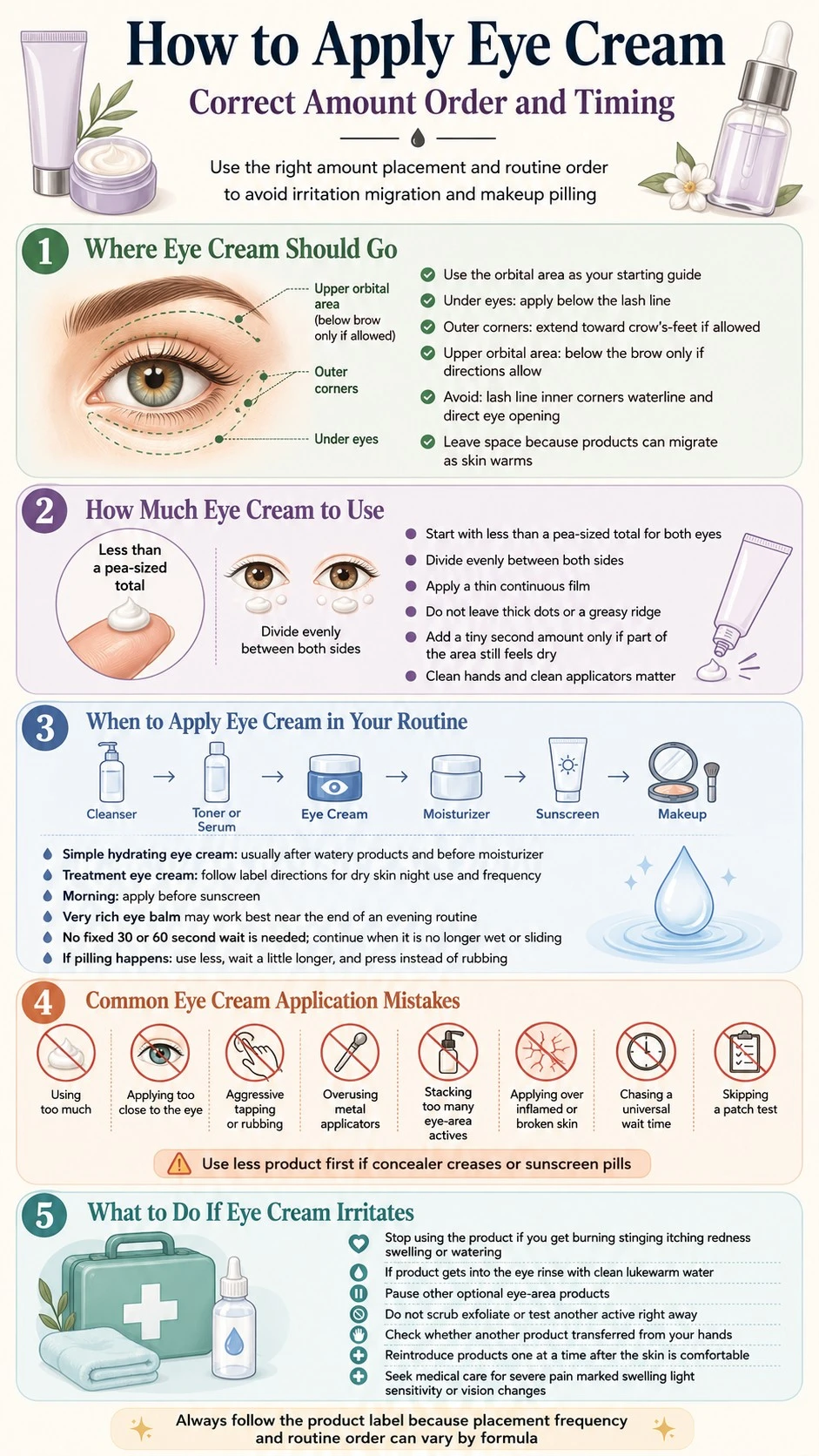
Start with the area named on the label. “Eye area” does not automatically mean the lash line, waterline, inner corner, or every part of the upper eyelid. A product may be tested for the under-eye and outer orbital area but not for direct use on the movable lid.
Use the bony rim around the eye socket as a practical starting guide. Dot the product beneath the eye and toward the outer corner, then spread it gently over the skin you want to moisturize. The orbital bone is not a magic boundary: creams can move as the skin warms, so leave enough distance that the formula does not easily migrate into the eye.
Placement by area:
- Under the eyes: Apply a thin layer below the lash line, covering the dry or textured area without bringing the product into the eye opening.
- Outer corners: Extend the layer toward visible crow’s-feet if the label permits use there.
- Upper orbital area: Apply below the eyebrow only when the directions allow it. Keep ordinary eye cream off the movable eyelid and lash line unless that exact use is stated.
- Inner corners and waterline: Avoid these areas. Product placed here can transfer into the eye and cause watering or irritation.
Do not assume that a facial treatment is suitable near the eyes merely because it is gentle elsewhere. Products used near the eyes should be intended for that area, and any applicator should be clean.[3] If you are still deciding whether a specialized product adds anything to your routine, the guide to whether eye cream works separates realistic cosmetic benefits from structural concerns that a cream cannot change.
How Much Eye Cream to Use
There is no universal drop count because pumps, nozzles, textures, concentrations, and permitted application areas differ. Use the amount on the label when one is provided. If it is not, begin with a total amount smaller than a pea for both eyes, divide it evenly, and add only enough to make a thin continuous film.
The right amount should spread without leaving thick white dots, a greasy ridge, or product that slips toward the lashes. A fast-absorbing gel may cover the area with very little product, while a dense cream may need several tiny dots so it spreads without tugging.
Using more does not prove that more active ingredient will reach the intended target. Excess can sit on the surface, migrate into the eyes, pill under sunscreen or concealer, and make a rich formula feel heavy. If the area still feels dry after the first layer settles, first check whether you missed part of the intended area. Add a very small second amount only if the product remains comfortable.
Avoid dipping unwashed fingers into a jar. Clean hands and clean applicators reduce the chance of introducing microorganisms into products used close to the eyes.[3]
When to Apply Eye Cream in Your Skincare Routine
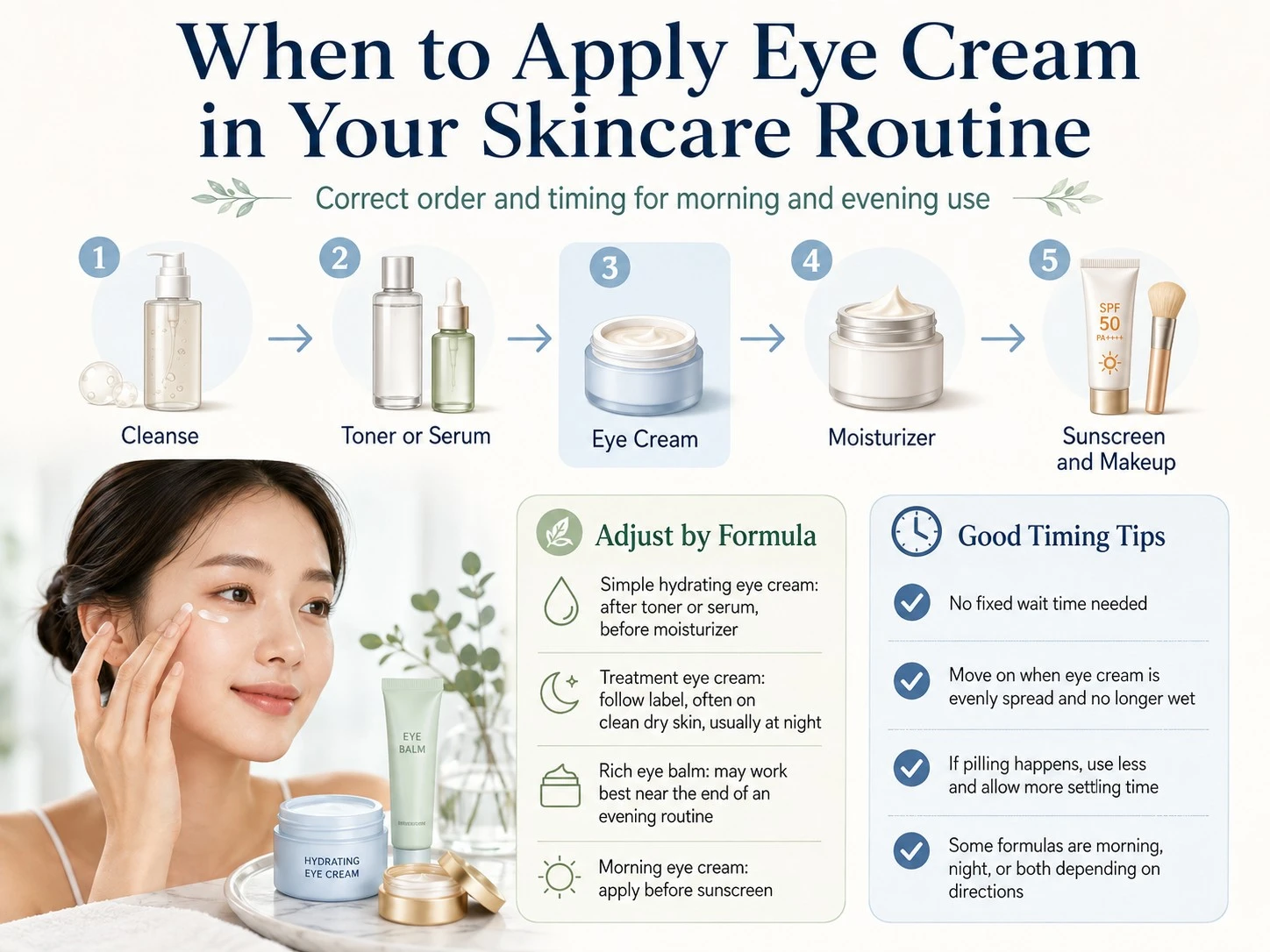
Eye cream usually goes after cleansing and watery leave-on products, then before face moisturizer, sunscreen, and makeup. That order lets you place a small targeted product precisely before thicker layers make the surface more slippery. General skincare guidance also places treatments after cleansing and moisturizer or sunscreen afterward.[1]
This is a practical default, not a rigid law. Let the formula’s job and directions decide:
- Simple hydrating eye cream: Apply after toner or serum and before face moisturizer. If the two creams meet at their edges, press rather than rub so you do not move the eye product.
- Treatment eye cream: Follow any instruction to use it on clean, fully dry skin, only at night, or at a limited frequency. Do not sandwich it among other strong actives unless the directions support that combination.
- Very rich eye balm: It may work best near the end of an evening routine because an occlusive texture can make products applied over it spread unevenly.
- Morning eye cream: Apply before sunscreen. Let it form an even layer first, then place sunscreen around the eyes as its own label permits rather than mixing the two products together.
You do not need a fixed wait of 30 or 60 seconds between every layer. Move on when the eye cream is evenly spread and is no longer wet or sliding. If the next product pills, reduce the amount, allow more settling time, and press on the next layer instead of rubbing. A complete skincare routine order can help when several serums or treatments compete for the same position.
Morning, night, or both also depends on the formula. A basic moisturizer may be suitable once or twice daily if the label allows and the skin stays comfortable. A treatment containing a retinoid, exfoliating acid, or another potentially irritating active may need a slower introduction or evening-only use.[4] Do not convert a once-daily direction into twice-daily use to speed results.
Common Eye Cream Application Mistakes
- Using too much: A thick layer is more likely to migrate, remain tacky, or interfere with makeup. Start small and judge coverage, not the size of an online “pea.”
- Applying too close to the eye: The lash line and inner corner give the product an easy route into the eye. Leave space unless the label specifically permits that placement.
- Tapping aggressively: Rapid or forceful tapping is still friction. A gentle pat or short glide is enough; skin-care guidance advises avoiding pulling and scrubbing around the delicate eye area.[2]
- Relying on a metal applicator to do the work: A cooling tip may feel pleasant, but pressing hard or repeatedly massaging does not improve the formula. Clean the applicator as directed and use minimal pressure.
- Stacking several eye-area actives: A retinoid eye cream, exfoliating facial serum, and strong vitamin C product may overlap at the edges. Keep each product in its intended area and introduce one new active at a time.
- Applying over inflamed skin: Do not cover burning, swollen, cracked, infected, or actively irritated eyelids with optional cosmetics. Wait for the area to recover and obtain medical advice when symptoms are persistent or significant.[3]
- Chasing a universal wait time: Dry-down depends on the amount, texture, humidity, and products layered above it. Use the surface as your guide rather than a stopwatch.
- Skipping a patch test: Test a new leave-on formula on a small area before regular use.[4] Follow the complete patch-test method, then introduce it cautiously around the eyes.
If concealer creases or sunscreen pills, change one variable at a time. Use less eye cream first, then give it more time to settle, and finally check whether the textures are compatible. Do not reduce sunscreen below its labeled amount merely to make the layers look smoother.
What to Do If Eye Cream Irritates Your Skin or Eyes
Brief coolness from a chilled applicator is different from burning, persistent stinging, itching, redness, scaling, swelling, or repeated watering. Those symptoms are a reason to stop, not proof that an active is working.
If the cream gets into the eye, stop applying it and rinse with clean lukewarm water. Follow any first-aid directions on the label. Stop using an eye-area cosmetic that causes irritation, and seek medical care if irritation persists.[3] Severe pain, marked swelling, light sensitivity, or vision changes need prompt evaluation.
If the reaction is on the skin:
- Gently remove the product and pause other optional eye-area cosmetics.
- Do not scrub, exfoliate, or immediately test another active formula on the irritated area.
- Check whether a facial serum, sunscreen, hair product, nail product, or fragrance could have transferred from your hands. Eyelid contact dermatitis can result from direct cosmetic exposure or indirect hand transfer.[5]
- Reintroduce products one at a time only after the skin is comfortable.
FAQs About Applying Eye Cream
Do you have to apply eye cream with your ring finger?
No. The ring finger is commonly suggested because it tends to apply less pressure, and it is included in general dermatology guidance for applying cream around the eyes.[1] A clean fingertip that lets you spread the product gently is acceptable. Pressure and friction matter more than the finger’s name.
Can you apply eye cream to your upper eyelids?
Only when the product directions permit it. Some formulas allow use beneath the eyebrow or on the upper orbital area, while others are intended only for under the eyes. Keep the product off the movable lid, lash line, and eye opening unless the label explicitly includes those locations.
Does eye cream go before or after moisturizer?
Eye cream usually goes before face moisturizer so you can place it precisely, but the order is flexible when both are simple moisturizers. Follow the directions for treatment formulas. Whichever comes second should be pressed on gently so so it does not drag the first layer toward the eyes.
How long should you wait before applying concealer or makeup?
Wait until the eye cream has settled and no longer feels wet or slippery. There is no universal number of minutes. If concealer slides or pills, use less cream, allow a longer settling time, and pat on makeup instead of rubbing.
Can you apply eye cream twice a day?
Yes, if the label permits twice-daily use and the formula remains comfortable. A basic hydrating cream may fit both morning and evening, while a retinoid or other active treatment may be intended only at night or a few times per week. Do not increase frequency beyond the directions to chase faster results.
Sources
[1] American Academy of Dermatology Association. Should I apply my skin care products in a certain order?
[2] American Academy of Dermatology Association. Face washing 101
[3] U.S. Food and Drug Administration. Eye Cosmetic Safety
[4] American Academy of Dermatology Association. How to test skin care products
[5] DermNet. Eyelid contact dermatitis


