

A combination formula can simplify morning skincare, but its label describes the finished product under tested conditions—not the amount or coverage a person will achieve in daily use. Keeping those two questions separate prevents both extremes: dismissing every SPF moisturizer and trusting every one as an all-purpose sunscreen.
When Moisturizer With SPF Counts as Sunscreen
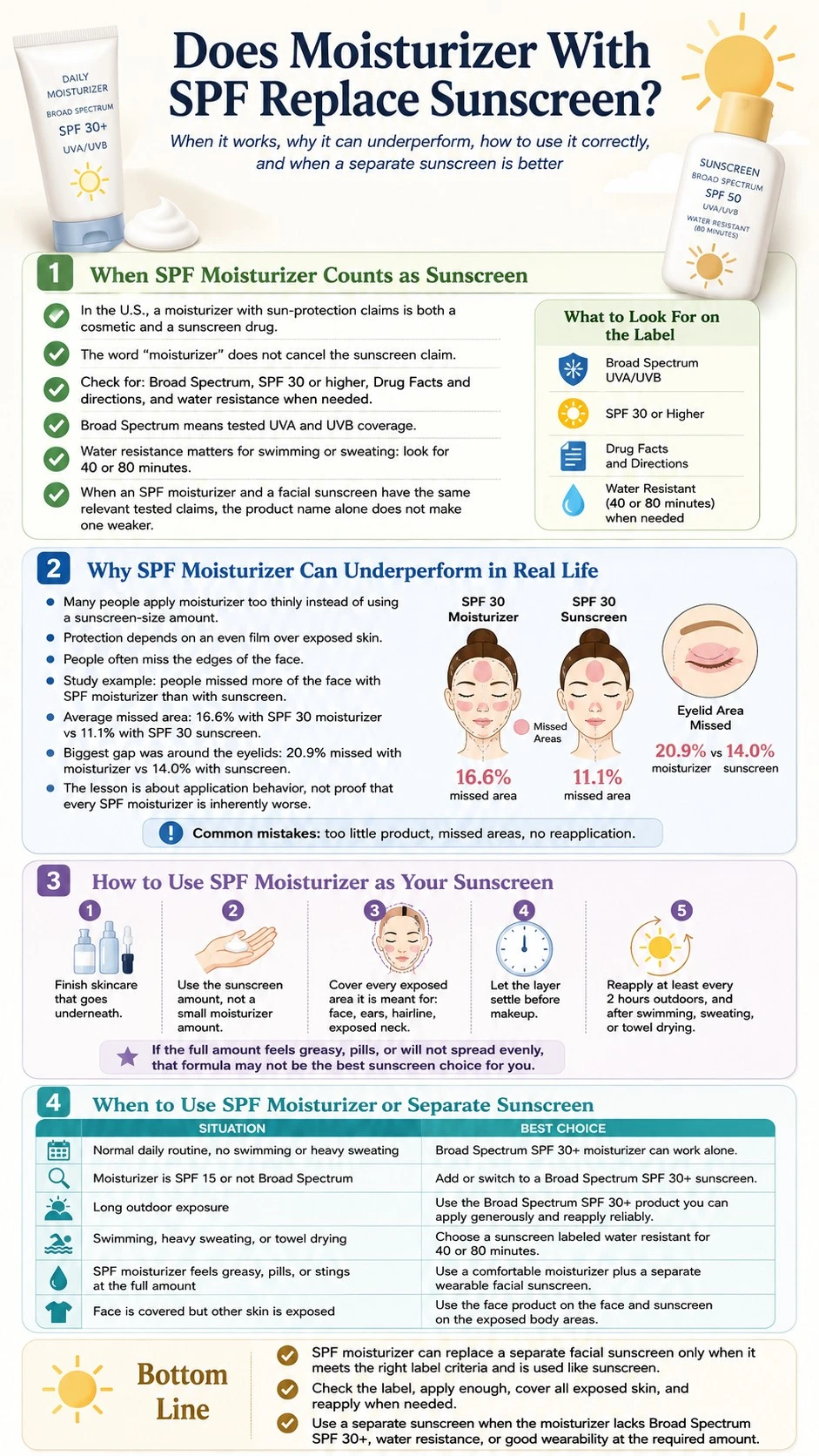
In the United States, a moisturizer marketed with sun-protection claims is both a cosmetic and a sunscreen drug. Its moisturizing purpose does not cancel its sunscreen purpose, and the product must meet the applicable requirements for both categories.[1] Look beyond the word “moisturizer” and check the sunscreen information on the label:
- Broad Spectrum: This means the product has passed the required test for protection across UVA and UVB radiation. SPF mainly describes sunburn protection, so an SPF number without the Broad Spectrum wording does not give the same UVA assurance. For more label context, see what broad-spectrum sunscreen means.[2]
- SPF 30 or higher: SPF 30 is the practical minimum recommended by the American Academy of Dermatology. An SPF 15 moisturizer offers some protection, but it falls below that recommendation. The comparison of SPF 15 vs SPF 30 explains why the numbers are not a simple “twice as strong” scale.[2]
- Drug Facts and directions: A U.S. sunscreen product should identify sunscreen active ingredients and tell you how to apply and reapply it. The SPF and Broad Spectrum claims belong to the tested finished formula, not merely to one ingredient in the bottle.[3]
- Water resistance when needed: If you will swim or sweat, look for “Water Resistant (40 minutes)” or “Water Resistant (80 minutes).” A moisturizer with no water-resistance claim should not be treated as if it has one.[3]
When an SPF moisturizer and a facial sunscreen carry the same relevant tested claims, the marketing name alone does not make one inherently weaker. Texture, hydration, finish, and wearability may differ, but the replacement decision begins with the label.
Why SPF Moisturizer Can Underperform in Real Life
A qualifying SPF moisturizer can still underperform if you use it like an ordinary moisturizer instead of sunscreen. People often spread moisturizer in a thin layer, stop when the skin feels comfortable, and concentrate on the center of the face. Sunscreen protection depends on forming an even film over the exposed area, so too little product or missed skin reduces the protection actually received.
In a study of 84 adults asked to apply products as they normally would, participants missed an average of 16.6% of the face with an SPF 30 moisturizer and 11.1% with an SPF 30 sunscreen. The gap was largest around the eyelids: 20.9% was missed with the moisturizer and 14.0% with the sunscreen. Participants were generally unaware of the incomplete coverage.[4]
The study does not prove that every SPF moisturizer formula is intrinsically less protective than every facial sunscreen. It compared routine application of one moisturizer and one sunscreen, and the researchers could not infer relative UVB protection from their imaging. Its practical lesson is about behavior: the “moisturizer” label can change how people apply the product.
Common ways that happens include:
- Using the amount that feels cosmetically comfortable rather than the amount needed for sunscreen coverage.
- Stopping at the face and leaving the ears, hairline, neck, or other exposed skin uncovered.
- Applying carefully in the morning but never renewing protection during extended outdoor exposure.
How to Use SPF Moisturizer as Your Sunscreen

If your product passes the label check, treat it as the sunscreen step every time you use it for sun protection.
- Finish the skincare steps that need to go underneath. Apply serum or a separate moisturizer first only if you need them, then use the SPF moisturizer as the last skincare layer before makeup. The guide to sunscreen and moisturizer order covers routines that use two separate products. Do not assume an SPF moisturizer must sit on top of another moisturizer; if it keeps your skin comfortable by itself, one product can perform both jobs.
- Apply the sunscreen amount, not your usual moisturizer amount. Follow the Drug Facts directions and use enough to form a continuous, even layer.[5] If the full amount feels too heavy, balls up, or will not spread evenly, that formula may be a poor sunscreen choice for you even though its label is adequate. See how much sunscreen to use on your face for a practical measuring guide.
- Cover every exposed area the product is intended for. Include the face, ears, hairline, and exposed neck rather than stretching one small amount across all four. Apply around the eyes only as the label permits, keep the product out of the eyes, and use sunglasses to protect areas you cannot coat comfortably.[3]
- Give the layer time to settle before makeup. Apply it before sun exposure as directed on the label. Once the film is even and no longer wet or pooling, press or glide makeup on gently rather than repeatedly rubbing the SPF layer.
- Reapply according to the exposure and label. During outdoor exposure, reapply at least every two hours and after swimming, sweating, or towel drying. A high SPF does not turn a morning application into all-day protection. The full guide to sunscreen reapplication explains how timing changes with activity.[3]
When to Use SPF Moisturizer or Separate Sunscreen
A separate sunscreen is not automatically stronger, but it can be the more reliable option when the combination product lacks a needed claim or becomes unpleasant at the required amount. Match the product to the day rather than treating one format as universally superior. For swimming or heavy sweating, the distinction between water-resistant and waterproof sunscreen matters because no sunscreen is waterproof and tested water resistance lasts for 40 or 80 minutes.[3]
| Situation | Better choice | Why |
|---|---|---|
| A normal daily routine with no swimming or heavy sweating | Broad Spectrum SPF 30+ moisturizer can work alone | It can combine hydration and facial sun protection if you apply the full amount and reapply when needed. |
| Your moisturizer is SPF 15 or is not labeled Broad Spectrum | Add or switch to a Broad Spectrum SPF 30+ sunscreen | The combination product does not meet the preferred label criteria for your only sunscreen. |
| You will be outdoors for a long period | Use the Broad Spectrum SPF 30+ product you can apply generously and reapply reliably | A dedicated sunscreen may be easier to carry or reapply, but the label, amount, and wear matter more than the product name. |
| You will swim, sweat heavily, or towel off | Choose a sunscreen labeled water resistant for 40 or 80 minutes | A product without a water-resistance claim has not shown that performance. |
| The full amount of SPF moisturizer feels greasy, pills, or stings | Use a comfortable moisturizer and a more wearable facial sunscreen separately | A theoretically suitable product is not reliable if its finish causes you to underapply, skip areas, or avoid reapplication. |
| Your face is covered but other skin is exposed | Keep the facial product if it works, and apply sunscreen to the exposed body areas | A face product replaces sunscreen only on the skin it actually covers. |
FAQs About Moisturizer With SPF
Do you need sunscreen over an SPF 30 moisturizer?
Not automatically. If the moisturizer is labeled Broad Spectrum SPF 30 or higher, suits the planned exposure, and is applied and reapplied in the full sunscreen amount, it can be your facial sunscreen. Add or switch to a separate sunscreen when one of those conditions is missing.
Is moisturizer with SPF 15 enough for daily use?
SPF 15 provides some sunburn protection, and a broad-spectrum SPF 15 product can meet certain U.S. sunscreen claims when used as directed. However, current dermatology guidance recommends Broad Spectrum SPF 30 or higher, so SPF 15 is not the preferred choice for your only daily sunscreen.
How often should you reapply moisturizer with SPF?
Follow the Drug Facts label. When you are outdoors, reapply at least every two hours and sooner after swimming, sweating, or towel drying. Treat it like sunscreen rather than assuming its moisturizing effect tells you when the UV protection needs renewal.
Can you mix sunscreen with moisturizer?
Do not mix two separate products together unless the label specifically directs you to. The labeled SPF applies to the tested finished sunscreen formula, not a hand-mixed blend; mixing also makes the amount and distribution harder to control. Use a professionally formulated moisturizer with SPF, or layer separate moisturizer and sunscreen in their normal amounts.[3]
Does layering two SPF products add their SPF numbers together?
No. An SPF 30 moisturizer plus an SPF 30 sunscreen does not equal SPF 60. Each number applies to its own tested finished formula; SPF values are not designed to be added together. If you layer products, do it for comfort or coverage—not SPF arithmetic—and make sure the sunscreen layer itself is applied in the full amount.[3]
Sources
[1] U.S. Food and Drug Administration. Is It a Cosmetic, a Drug, or Both? (Or Is It Soap?)
[2] American Academy of Dermatology Association. How to Select a Sunscreen
[3] U.S. Food and Drug Administration. Labeling and Effectiveness Testing: Sunscreen Drug Products for Over-the-Counter Human Use
[4] Lourenco EAJ, Shaw L, Pratt H, et al. Application of SPF Moisturisers Is Inferior to Sunscreens in Coverage of Facial and Eyelid Regions
[5] American Academy of Dermatology Association. How to Apply Sunscreen


