


Ampoules became especially visible through Korean skincare, but the word is now used for products ranging from watery hydrators in large dropper bottles to concentrated formulas in sealed single-use vials. Serum is also a broad category: it can describe a gentle hydrating liquid, an antioxidant formula, an exfoliating acid product, or a retinoid treatment.
This naming overlap explains why the front label cannot settle the comparison. A thick ampoule is not necessarily more concentrated, and a product sold as a serum is not necessarily mild enough for daily use. The useful question is what the particular formula does and whether that job is missing from your routine.
Ampoule vs Serum: Key Differences
These are common retail patterns rather than fixed formulation rules.
| Comparison point | Ampoule | Serum |
|---|---|---|
| Basic meaning | A serum-like leave-on product often marketed as an intensive booster | A broad category of lightweight oil- or water-based leave-on treatments |
| Typical positioning | Targeted, concentrated, short-course, or special-use care | Regular treatment for one or more ongoing skin goals |
| Concentration | Often claimed to be higher, but the name does not guarantee a percentage | Can be low, moderate, or highly concentrated depending on the formula |
| Texture | May be watery, gel-like, milky, or slightly viscous | May also be watery, gel-like, milky, oily, or emulsion-like |
| Packaging | Single-use vial, small bottle, dropper bottle, pump, or capsule-like dose | Commonly a dropper or pump bottle, but packaging varies |
| Use pattern | Daily, occasional, or time-limited according to the label | Daily or periodic according to the active ingredients and directions |
The categories therefore overlap more than the usual “ampoule is stronger” explanation suggests. A hydrating ampoule and a hydrating serum may perform nearly the same routine job. By contrast, two products both called serum can differ greatly if one contains hyaluronic acid and the other contains retinol or an exfoliating acid.
Serums are generally designed as light, easily absorbed oil- or water-based products used in small amounts. Their performance depends on the active ingredients, formulation, delivery vehicle, and ingredient stability—not on price or the word serum alone.[1] The guide to what face serum is explains the broader category without assuming that all serums work alike.
Why Ampoule Does Not Always Mean More Concentrated
“More concentrated” is a comparison that needs two numbers: the amount of a relevant ingredient in the ampoule and the amount in the serum being compared. The product names provide neither number. Some brands use ampoule to identify a small intensive dose; others use it for a gentle daily product with no disclosed active percentage.
The order of a cosmetic ingredient list offers clues, but it cannot prove exact potency. In the United States, cosmetic ingredients are generally listed in descending order of predominance, while ingredients at 1% or less can appear in any order after those above 1%. Most cosmetic ingredient concentrations do not have to be printed on the label.[2] A featured ingredient appearing first in marketing copy may therefore be present at an unknown level.
Viscosity is not a potency test either. Thickeners can make a formula feel dense without increasing its treatment ingredients, while a thin liquid can contain a substantial amount of an active. Bottle size and a single-use presentation may improve dosing or protect a sensitive formula from repeated opening, but they do not prove that the contents are stronger.
Use a disclosed percentage only when it is meaningful for that ingredient and the complete formula. Even then, a larger number is not automatically better: pH, ingredient form, vehicle, stability, supporting ingredients, frequency, and skin tolerance can change performance.
Which One Should You Choose?
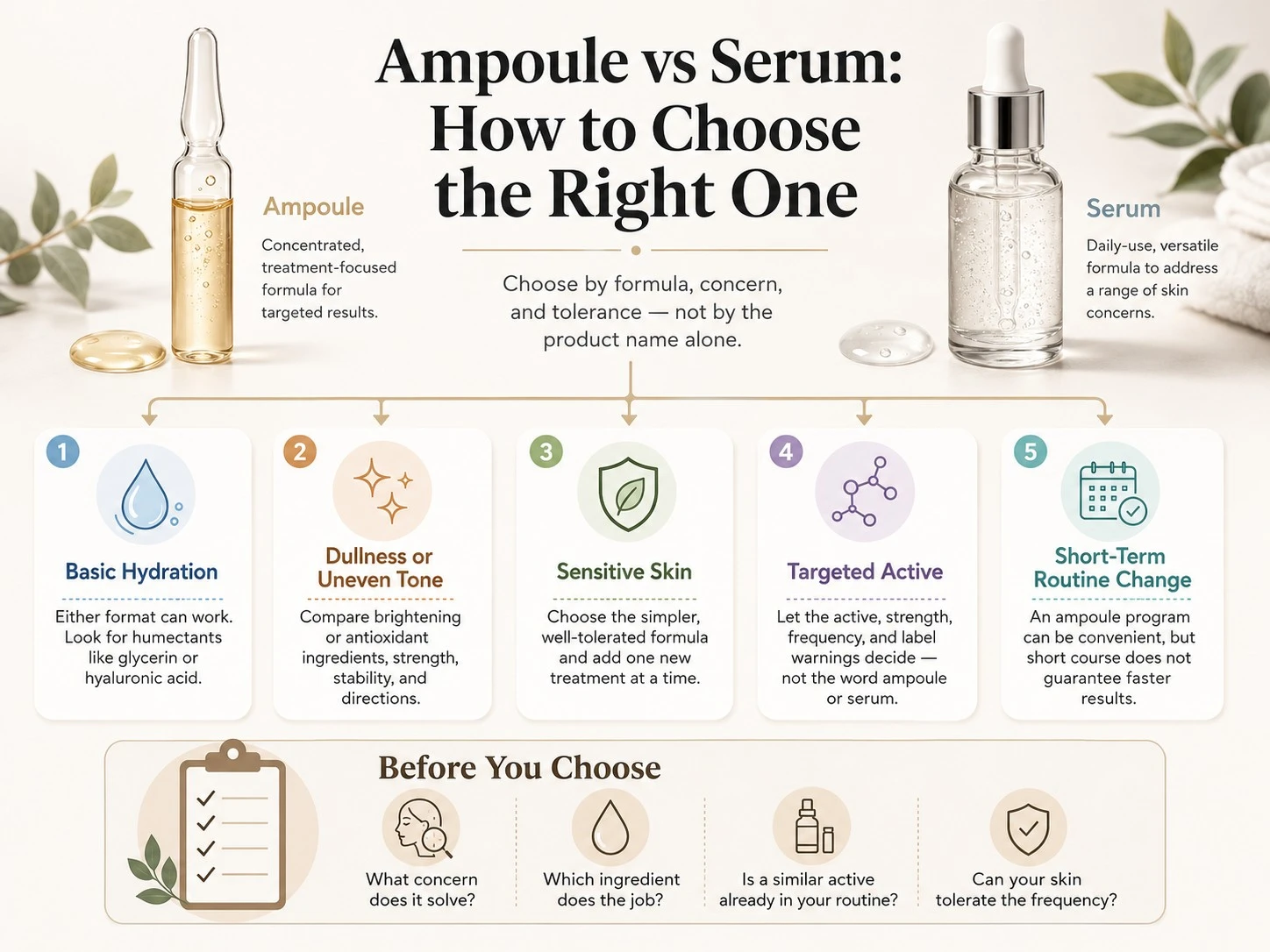
Choose the product that fills one defined gap in your routine. The category name should be a secondary detail.
- For basic hydration: Either format can work. Look for humectants such as glycerin or hyaluronic acid, then judge whether the finish and moisturizer pairing keep your skin comfortable. An ampoule is not automatically more hydrating because it feels thicker.
- For dullness or uneven-looking tone: Compare the actual brightening or antioxidant ingredients, their disclosed strengths when available, packaging stability, and directions. The skincare active ingredients guide can help separate the featured active from the product format.
- For sensitive or easily irritated skin: Prefer the simpler well-tolerated formula, whether it is called serum or ampoule. Avoid equating “high concentration” with better value, and introduce one treatment product at a time.
- For a targeted active such as retinol or an exfoliating acid: Let the active, strength, frequency, and label warnings control the decision. A daily-looking serum can still be potent, while an ampoule may be designed for gentle hydration.
- For a short-term routine change: An ampoule program can be convenient when the label gives a defined dose or schedule. The short course itself does not guarantee faster or greater results.
If several formulas appear suitable, compare them using the same questions: What concern does this solve? Which ingredient performs that job? Is a similar active already in the routine? Can the formula be used at a frequency your skin tolerates? The guide to choosing a face serum applies the same decision logic to serum-like products, including ampoules.
Can You Use an Ampoule and Serum Together?
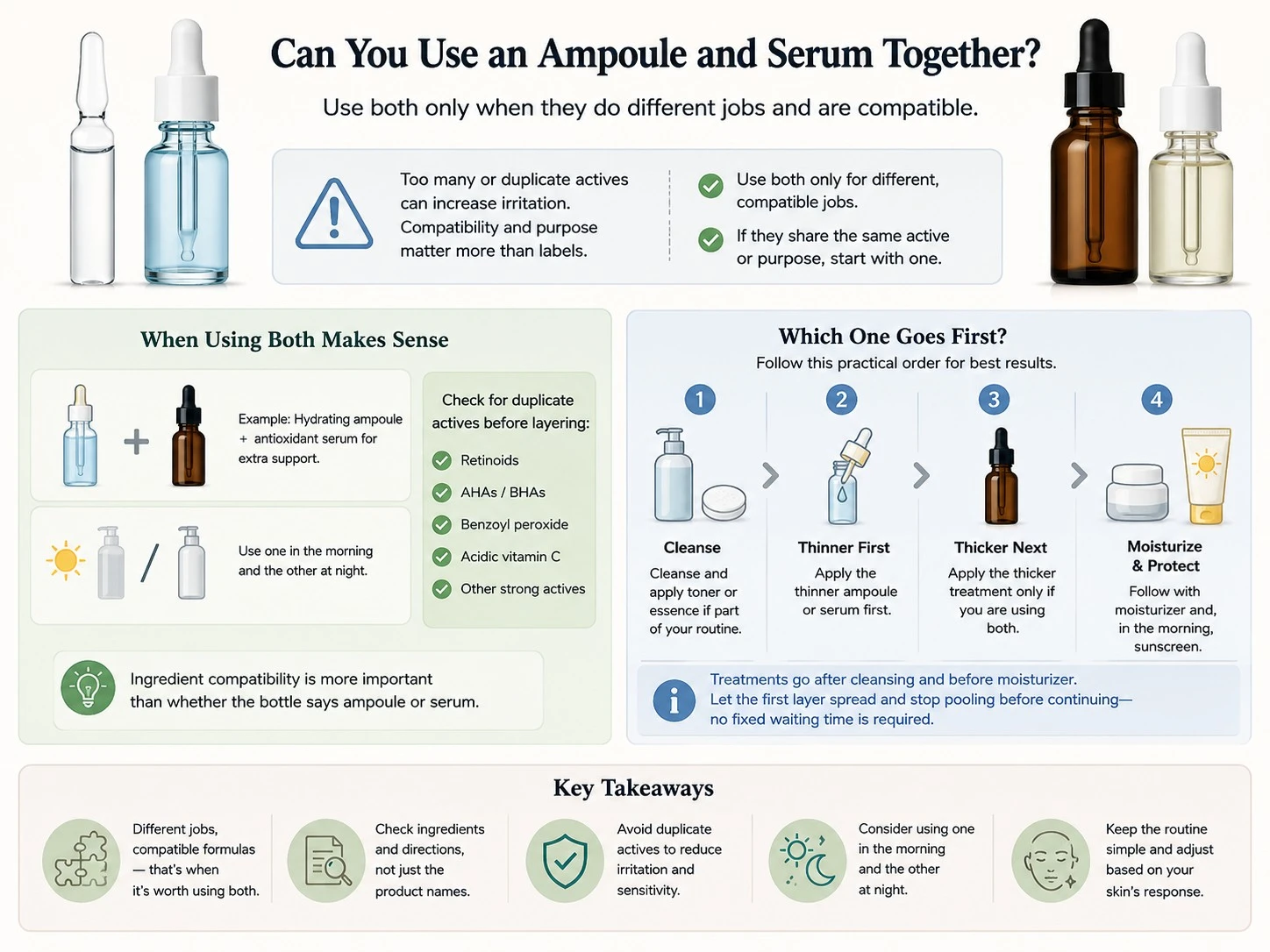
Yes, but using both is worthwhile only when they perform different, compatible jobs. You do not need to layer an ampoule and serum merely because a multi-step routine places them in separate categories. Using too many treatment products can increase irritation, especially when they repeat strong actives.[3]
When using both makes sense
A simple example is a hydrating ampoule paired with an antioxidant serum when both labels allow the combination and the routine remains comfortable. Another reasonable approach is using one in the morning and the other at night rather than layering both at once.
Check for duplicated retinoids, AHAs, BHAs, benzoyl peroxide, acidic vitamin C formulas, or other ingredients that can make the same routine harder to tolerate. Ingredient compatibility is more important than whether the bottle says ampoule or serum. If the products have the same primary active or make the same hydration claim, begin with one and assess whether the second adds a distinct benefit.
Which one goes first
Do not assume an ampoule must always go before serum. Apply prescription medication or a specifically directed treatment according to its instructions. For ordinary cosmetic products without conflicting directions, use this practical order:
- Cleanse and apply toner or essence if they are part of your routine.
- Apply the thinner ampoule or serum first.
- Apply the thicker treatment only if you are using both.
- Follow with moisturizer and, in the morning, sunscreen.
Treatment products generally sit after cleansing and before moisturizer.[1] The full skincare routine order can help place toner, essence, treatment liquids, moisturizer, and sunscreen without turning texture into an absolute rule. You do not need a fixed waiting period between an ampoule and serum; let the first layer spread and stop pooling before continuing.
How to Avoid Duplicate Actives and Irritation
Treat the ingredient list and directions as the safety information, not the product category. A soothing-looking ampoule can contain exfoliating acids, and a plain-looking serum can contain a retinoid.
- Compare active ingredients before layering. Repetition matters more than product names. Two formulas containing the same active can unintentionally raise the total amount or frequency.
- Introduce one new product at a time. This makes useful effects and irritation easier to trace. Constantly changing several treatment products can leave you with an irritated routine and no clear explanation for it.[4]
- Start below the maximum frequency when appropriate. If the formula contains a potentially irritating active, use the label as the ceiling and increase only when the directions allow and your skin remains comfortable.
- Do not use tingling as a potency score. Persistent burning, itching, marked redness, swelling, or new scaling is a reason to stop the product, not proof that the ampoule or serum is more effective.
- Keep the basic routine intact. Neither an ampoule nor serum replaces cleanser, moisturizer, or daytime sunscreen. If multiple treatment layers cause pilling or discomfort, simplify them before reducing sunscreen.
If you decide to use only one treatment layer, the detailed guide to using face serum covers amount, timing, and frequency. When dryness or sensitivity appears after adding several products, simplify the routine and identify the active responsible before introducing another booster.
FAQs About Ampoules and Serums
Can an ampoule replace a serum?
Yes. An ampoule can replace a serum when it addresses the same skin goal and fits the same treatment step. You do not need both labels represented in a complete routine. Compare the formula, directions, tolerance, and results rather than keeping two products that duplicate one job.
Can you use an ampoule every day?
Use it daily only when the label permits daily use and your skin tolerates the formula. Hydrating ampoules may be designed for once- or twice-daily use, while concentrated acids, retinoids, or short-course vial programs can require a different schedule. “Ampoule” alone does not determine frequency.
Is an ampoule better than a serum for sensitive skin?
Neither category is automatically better for sensitive skin. A fragrance-free hydrating ampoule may be gentle, but another ampoule may contain strong actives. The same variation exists among serums. Choose the simpler suitable formula, introduce it gradually, and stop if it causes persistent irritation.
Does ampoule always mean a single-use vial?
No. Ampoule traditionally describes a small sealed container, but skincare brands also use the term for multiuse products in droppers and pumps. Follow the packaging directions. Do not save an opened single-use vial unless the manufacturer says it can be stored, and never inject a cosmetic skincare ampoule.
Should you apply an ampoule before or after moisturizer?
Apply an ordinary ampoule before moisturizer unless its directions say otherwise. Moisturizer usually follows lightweight treatment products and helps reduce water loss. If you also use serum, place the thinner treatment first or follow the brand’s tested order.
Sources
[1] Harvard Health Publishing. Skin Serum: What It Can and Can’t Do
[2] U.S. Food and Drug Administration. Cosmetics Labeling Guide
[3] American Academy of Dermatology Association. Should I Apply My Skin Care Products in a Certain Order?
[4] American Academy of Dermatology Association. Dermatologist-Recommended Skin Care for Your 20s


