

Serum shelves contain watery gels, light emulsions, and even oil-based formulas. Two bottles labeled “face serum” can therefore have completely different ingredients, uses, and irritation risks.
The most useful way to understand a serum is as an optional targeted step between cleansing and moisturizing. Its job comes from the complete formula—not from the word “serum,” the dropper bottle, or one highlighted ingredient on the front label.
How Face Serum Works
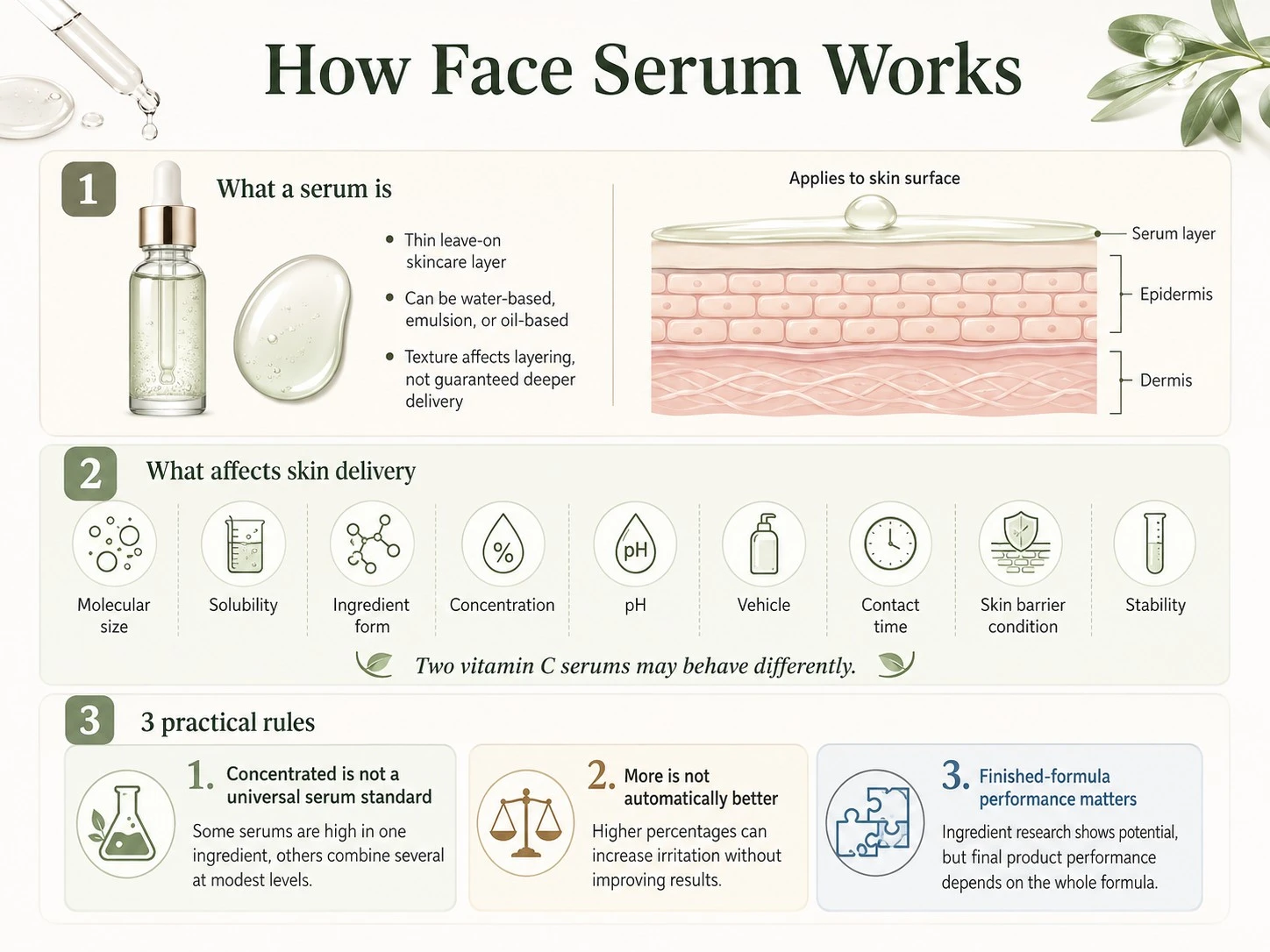
A face serum spreads a relatively thin layer of leave-on ingredients over the skin. Water-based serums often use humectants, solvents, polymers, and emulsifiers to dissolve or suspend ingredients. Other serums are emulsions or water-free oils. Texture may affect how easily a product layers, but a thinner texture does not prove that every ingredient travels deeper into the skin.
Skin delivery depends on factors such as molecular size, solubility, ingredient form, concentration, pH, vehicle, contact time, and the condition of the skin barrier. Stability matters too. For example, vitamin C derivatives differ in stability, skin delivery, and supporting evidence, so two “vitamin C serums” are not interchangeable.[4]
This leads to three practical rules:
- “Concentrated” is not a universal serum standard. Some serums contain a high level of one ingredient; others use several ingredients at modest levels.
- More is not automatically better. A high percentage can increase irritation without improving the result if the ingredient, pH, or vehicle does not suit the user.
- Finished-formula performance matters. Ingredient research can explain potential, but it cannot prove that every product with that ingredient will work the same way.
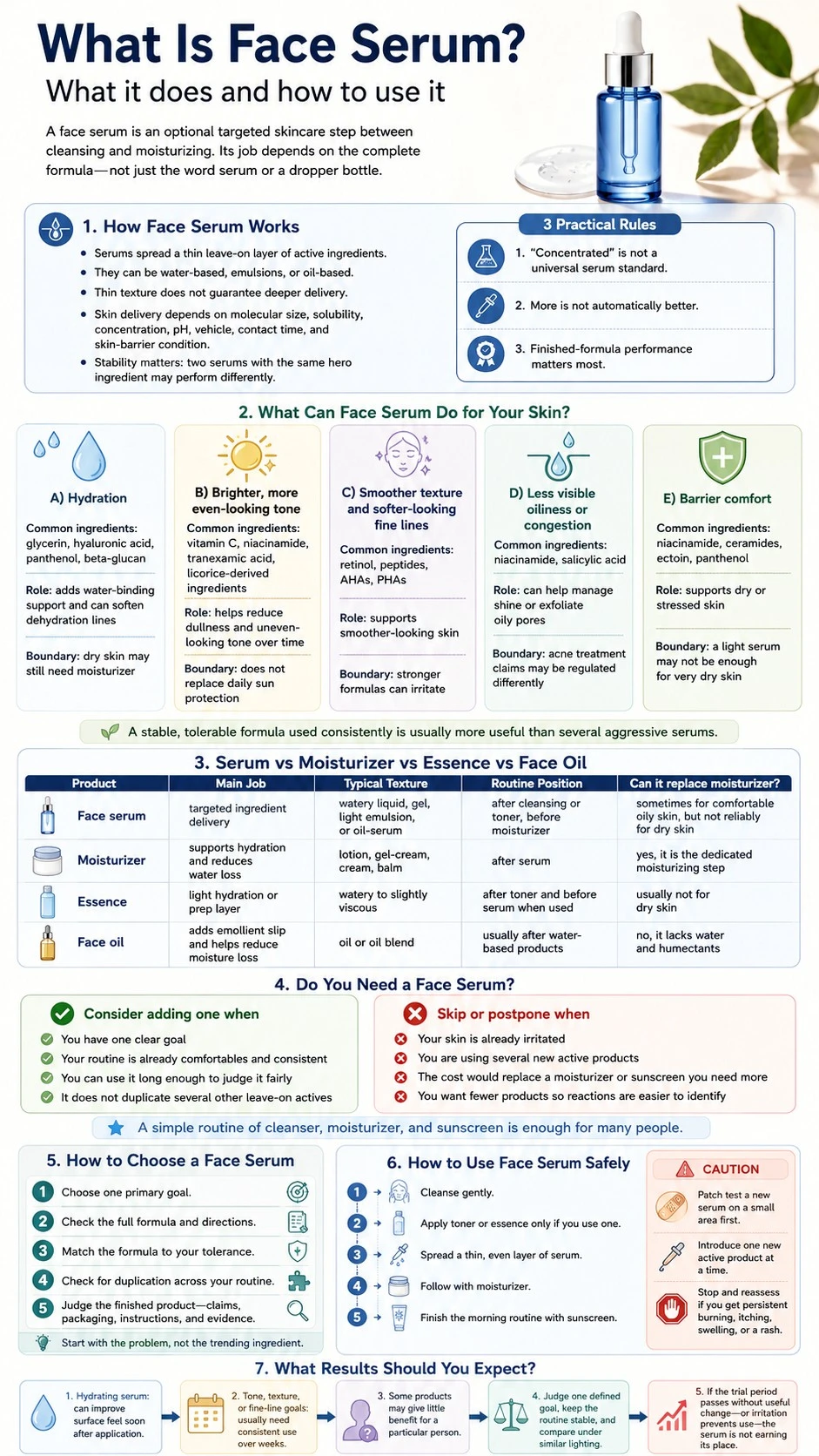
What Can Face Serum Do for Your Skin?
A serum can support hydration, tone, texture, oil balance, or barrier comfort, depending on its ingredients. Topical niacinamide has evidence for supporting the skin barrier and improving several visible signs of pigmentation and aging, although its effects depend on the formula and use conditions.[3] Vitamin C performance varies with the chemical form and delivery system.[4] A study of one specific hyaluronic acid serum found improved hydration and visible skin qualities, but its open-label, formula-specific results should not be treated as proof for every hyaluronic acid product.[5]
| Primary goal | Common serum ingredients | Realistic role | Important boundary |
|---|---|---|---|
| Hydration | Glycerin, hyaluronic acid, panthenol, beta-glucan | Adds water-binding support and can temporarily soften the look of dehydration lines | Dry skin may still need a moisturizer to reduce water loss |
| Brighter, more even-looking tone | Vitamin C, niacinamide, tranexamic acid, licorice-derived ingredients | Helps reduce dullness or the appearance of uneven tone with consistent use | It does not remove every cause of discoloration; daily sun protection remains important |
| Smoother texture and softer-looking fine lines | Retinol, peptides, AHAs, PHAs | Supports surface renewal or the appearance of smoother skin, depending on the active | Stronger formulas can irritate, and results are gradual and formula-specific |
| Less visible oiliness or congestion | Niacinamide, salicylic acid | Can help manage shine or exfoliate inside oily pores | In the United States, a product marketed to treat acne may be regulated as a drug, not solely as a cosmetic.[1] |
| Barrier comfort | Niacinamide, ceramides, ectoin, panthenol | Supplements a routine with soothing or barrier-supportive ingredients | A light serum may not supply enough emollient or occlusive support for very dry skin |
One serum may address more than one goal, but a long ingredient list does not guarantee better performance. A stable, tolerable formula used consistently is usually more useful than several aggressive serums that make the routine difficult to follow. Readers comparing antioxidant options can explore the formulation differences in vitamin C for skin.
How Serum Differs From Moisturizer, Essence, and Face Oil
Product names overlap, so texture alone is not a perfect classifier. The clearest distinction is the main job each product is designed to perform.
| Product | Typical main job | Common texture | Usual routine position | Can it replace moisturizer? |
|---|---|---|---|---|
| Face serum | Delivers ingredients toward a targeted goal | Watery liquid, gel, light emulsion, or oil-serum | After cleansing or toner; before moisturizer | Sometimes for comfortable oily skin, but not reliably for dry skin |
| Moisturizer | Supports hydration and reduces water loss with humectants, emollients, and occlusives | Lotion, gel-cream, cream, or balm | After serum | It is the dedicated moisturizing step |
| Essence | Usually adds light hydration or a preparatory layer; definitions vary by brand and market | Watery to slightly viscous | After toner and before serum, when all are used | Usually not for dry skin |
| Face oil | Adds emollient slip and helps reduce moisture loss at the surface | Oil or oil blend | Usually after water-based products | It lacks water and humectants, so it does not perform every moisturizer function |
For closer decisions, see serum vs moisturizer, toner vs essence vs serum, and face oil vs serum.
Do You Need a Face Serum?
No. A serum is useful when it solves a specific problem, but it is not a basic requirement for healthy-looking skin. A simple routine built around gentle cleansing, moisturizer, and sun protection can cover the core needs for many people.[2]
Consider adding one serum when:
- you have one clear goal, such as added hydration or a more even-looking tone;
- the rest of your routine is comfortable and consistent;
- you can use the product as directed long enough to judge it fairly; and
- the formula does not duplicate several other leave-on actives.
Skip or postpone serum when your skin is already irritated, your routine contains several new active products, or the cost would displace a moisturizer or sunscreen you need more. Adding fewer products also makes it easier to identify what helped—or what caused a reaction.
How to Choose a Face Serum

Start with the problem, not the trending ingredient.
- Choose one primary goal. “Hydration” or “dull-looking tone” gives you a clearer target than “better skin.”
- Check the full formula and directions. The ingredient list, active form, pH, supporting ingredients, packaging, and required frequency can all affect performance. Learn what the list can and cannot reveal in how to read a skincare ingredient list.
- Match the formula to your tolerance. Sensitive or already-dry skin usually benefits from a simpler starting point rather than multiple acids or a high-strength retinoid serum.
- Check for duplication. A niacinamide serum may add little if niacinamide is already present across your toner, moisturizer, and sunscreen.
- Judge the finished product. Look for realistic claims, suitable packaging, clear use instructions, and evidence tied to the actual formula when available.
For a skin-type and concern-based decision process, use the full guide to choosing a face serum.
How to Use Face Serum Safely
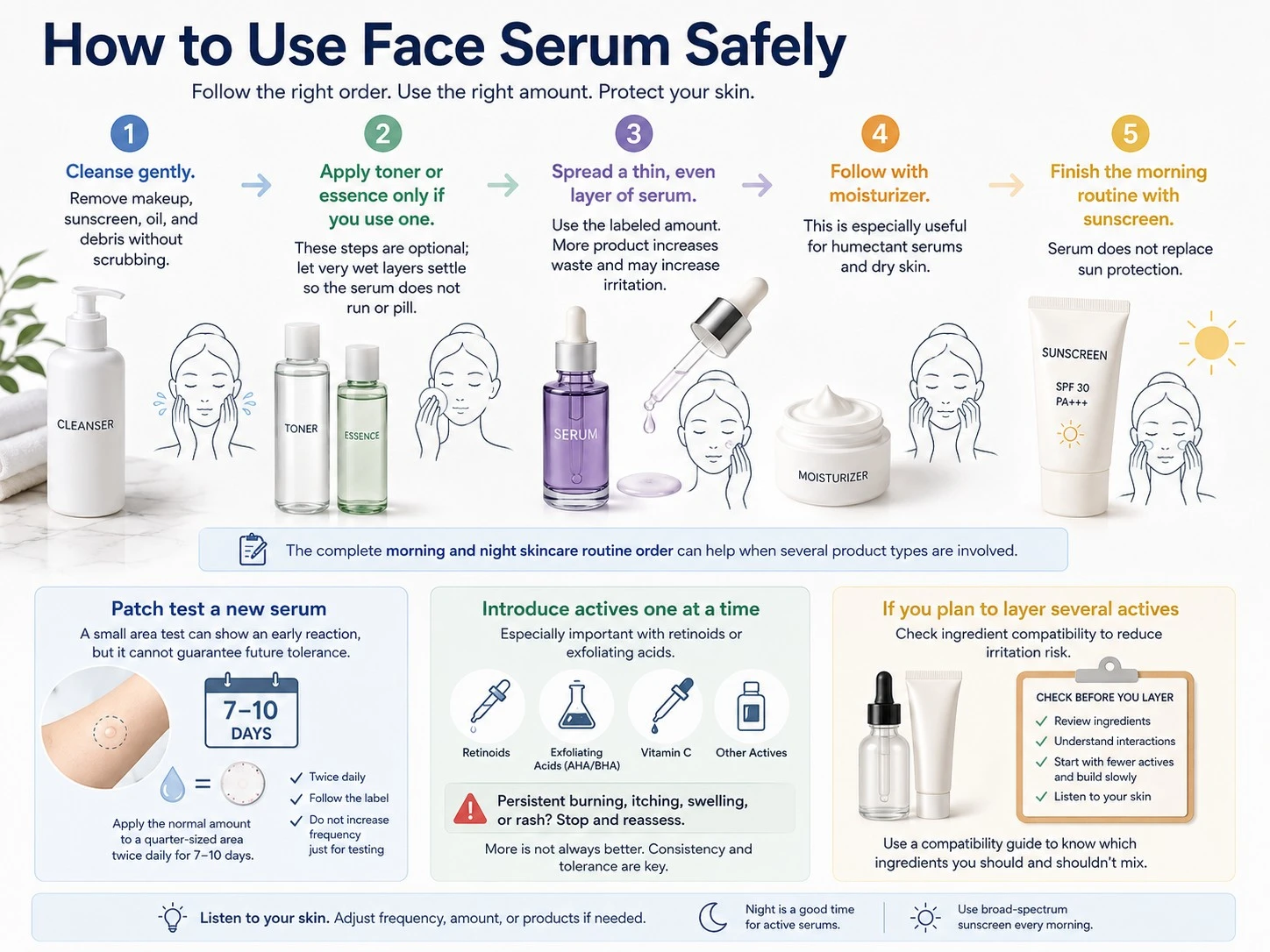
The product label should control the amount, frequency, time of day, and ingredient-specific cautions. For a typical leave-on serum, the basic order is:
- Cleanse gently. Remove makeup, sunscreen, oil, and debris without scrubbing.
- Apply toner or essence only if you use one. These steps are optional; let very wet layers settle so the serum does not run or pill.
- Spread a thin, even layer of serum. Use the labeled amount. More product increases waste and may increase irritation.
- Follow with moisturizer. This is especially useful for humectant serums and dry skin.
- Finish the morning routine with sunscreen. Serum does not replace sun protection, including when it contains antioxidants.
The complete morning and night skincare routine order can help when several product types are involved.
Test a new serum on a small area before broader use. For a product intended for twice-daily use, one practical method is to apply the normal amount to a quarter-sized test area twice a day for seven to ten days; follow the label rather than increasing the frequency for products with different directions.[6] A small-area test can reveal an early reaction, but it cannot guarantee future tolerance.
Introduce one new active product at a time, especially with retinoids or exfoliating acids. Persistent burning, itching, swelling, or a rash is a reason to stop and reassess rather than assume the product is “working.” If you plan to layer several actives, check the guide to skincare ingredients you should and shouldn’t mix.
What Results Should You Expect?
The timeline depends on the goal and formula. A hydrating serum can change surface feel soon after application. Changes in uneven-looking tone, texture, or fine lines generally require consistent use over weeks, and some users will see little benefit from a particular product.
Judge a serum against one defined goal. Use it as directed, keep the rest of the routine stable, and compare your skin under similar lighting. If the recommended trial period passes without a useful change—or irritation prevents consistent use—the serum is not earning its place in the routine.
Final Thoughts
Face serum is a flexible product format, not a promise of stronger or deeper action. The right serum gives one useful benefit in a tolerable formula and fits between the foundational steps you already use. If you cannot name the gap it fills, you probably do not need to add it.
FAQs About Face Serum
Can you use face serum every day?
Many hydrating and antioxidant serums are designed for daily use, but frequency depends on the formula. Retinoid or exfoliating serums may need a slower introduction. Follow the label and reduce frequency if irritation develops.
Is face serum suitable for teenagers?
A serum is usually optional for teenagers. A gentle cleanser, suitable moisturizer, and sunscreen are a better foundation. If acne treatment is needed, choose an appropriately labeled product or ask a healthcare professional instead of building a complicated active-serum routine.
Can you apply face serum under makeup?
Yes. Apply a thin layer, follow with moisturizer and sunscreen as needed, and allow the layers to settle before makeup. If products pill, reduce the amount, simplify the layers, or check whether the formulas are compatible.
Does an expensive serum work better?
Price does not prove effectiveness. Ingredient form, concentration, stability, packaging, tolerability, and finished-formula testing are more informative than luxury positioning alone.
Should face serum be refrigerated?
Only refrigerate a serum when its label recommends it. Most products should be stored tightly closed in a cool, dry place away from direct light and heat. Refrigeration does not repair an unstable formula and can change the texture of products not designed for cold storage.
Sources
[1] U.S. Food and Drug Administration. Cosmetics Labeling Claims
[2] American Academy of Dermatology Association. Skin Care on a Budget
[4] Enescu CD, Bedford LM, Potts G, Fahs F. A Review of Topical Vitamin C Derivatives and Their Efficacy
[5] Draelos ZD, Diaz I, Namkoong J, Wu J, Boyd T. Efficacy Evaluation of a Topical Hyaluronic Acid Serum in Facial Photoaging
[6] American Academy of Dermatology Association. How to Test Skin Care Products


