


The simple rule is “patch first, skincare around it,” but the type of patch matters. A plain hydrocolloid sticker mainly absorbs fluid and protects the spot. A medicated or micropoint patch is designed to deliver ingredients, so its label—not a generic routine chart—controls placement, wear time, and frequency.
This order also prevents an easy mistake: trapping several leave-on products under an occlusive sticker. More layers do not make the patch stronger. They usually make adhesion worse and may make an already inflamed blemish harder to tolerate.
Why Pimple Patches Usually Go on Before Skincare
A standard pimple patch is usually made from hydrocolloid, an absorbent material originally used in wound dressings. On a surface-level pimple that contains or releases fluid, the patch absorbs moisture while creating a protective cover. It can also discourage touching and picking.[1]
Direct contact matters for two practical reasons:
- Adhesion: Water, toner, serum, moisturizer, oil, and sunscreen can leave a film that stops the edge from sealing evenly.
- Absorption: A layer of cream or treatment between the blemish and hydrocolloid can block contact with the fluid the patch is meant to absorb.
Wash gently, rinse away cleanser, and dry the exact patch area. The full guide to washing your face properly covers cleansing technique without turning the patch step into a second round of scrubbing.
If hydrocolloid becomes white or opaque, that usually reflects absorbed moisture swelling the material—not “toxins” being pulled from deep inside the pore. Clinical evidence suggests hydrocolloid patches can improve some visible acne measures, but studies remain limited and results from one design do not prove that every patch performs the same way.[2]
Does the Type of Pimple Patch Change the Order?
Yes. “Pimple patch” describes several products with different mechanisms. Start with the label and ingredient list before deciding what belongs underneath or how long the patch should stay on.
| Patch type | Intended job | Default place in the routine | Important caution |
|---|---|---|---|
| Plain hydrocolloid patch | Absorbs fluid and covers a surface-level or draining blemish | Clean, completely dry skin before leave-on products | Less useful when the bump is deep, intact, or has no fluid near the surface |
| Medicated patch | Holds ingredients such as salicylic acid or tea tree oil against one spot | Usually clean, dry skin before other products, but follow its directions | Added actives and adhesive can irritate sensitive or damaged skin |
| Micropoint or microdart patch | Uses tiny projections designed to deliver ingredients to the targeted spot | Exactly where and as often as the label directs | Do not treat every design as equivalent to plain hydrocolloid or improvise combinations with other acne treatments |
Some products combine hydrocolloid with added actives, while others are mainly treatment stickers. A patch marketed for early bumps may therefore behave differently from one intended for a visible whitehead. Do not assume that a thicker, cloudier, or more expensive patch treats a deeper pimple.
What Can You Put Under a Pimple Patch?
For a plain hydrocolloid patch, the best default is nothing: no toner, serum, spot treatment, moisturizer, or oil. Clean and dry skin gives the adhesive its best chance to form a continuous seal.
Do not automatically put benzoyl peroxide, adapalene, retinol, exfoliating acid, or another strong treatment under an occlusive patch. The patch may adhere poorly, and trapping an active against irritated skin can make the combination harder to tolerate. Use the medication at another time or on uncovered areas unless its instructions or a healthcare professional specifically support covering it.
Medicated patches are the exception only because the treatment is built into the product and tested for that delivery format. If the patch already contains salicylic acid, adding a separate acid underneath is not automatically more effective. The same caution applies to tea tree oil and other ingredients that can irritate some users.[1]
Prescription directions take priority over general skincare order. If you are unsure whether a prescribed acne treatment can be covered, ask the prescriber or pharmacist rather than experimenting with occlusion.
How to Apply the Rest of Your Skincare Around the Patch
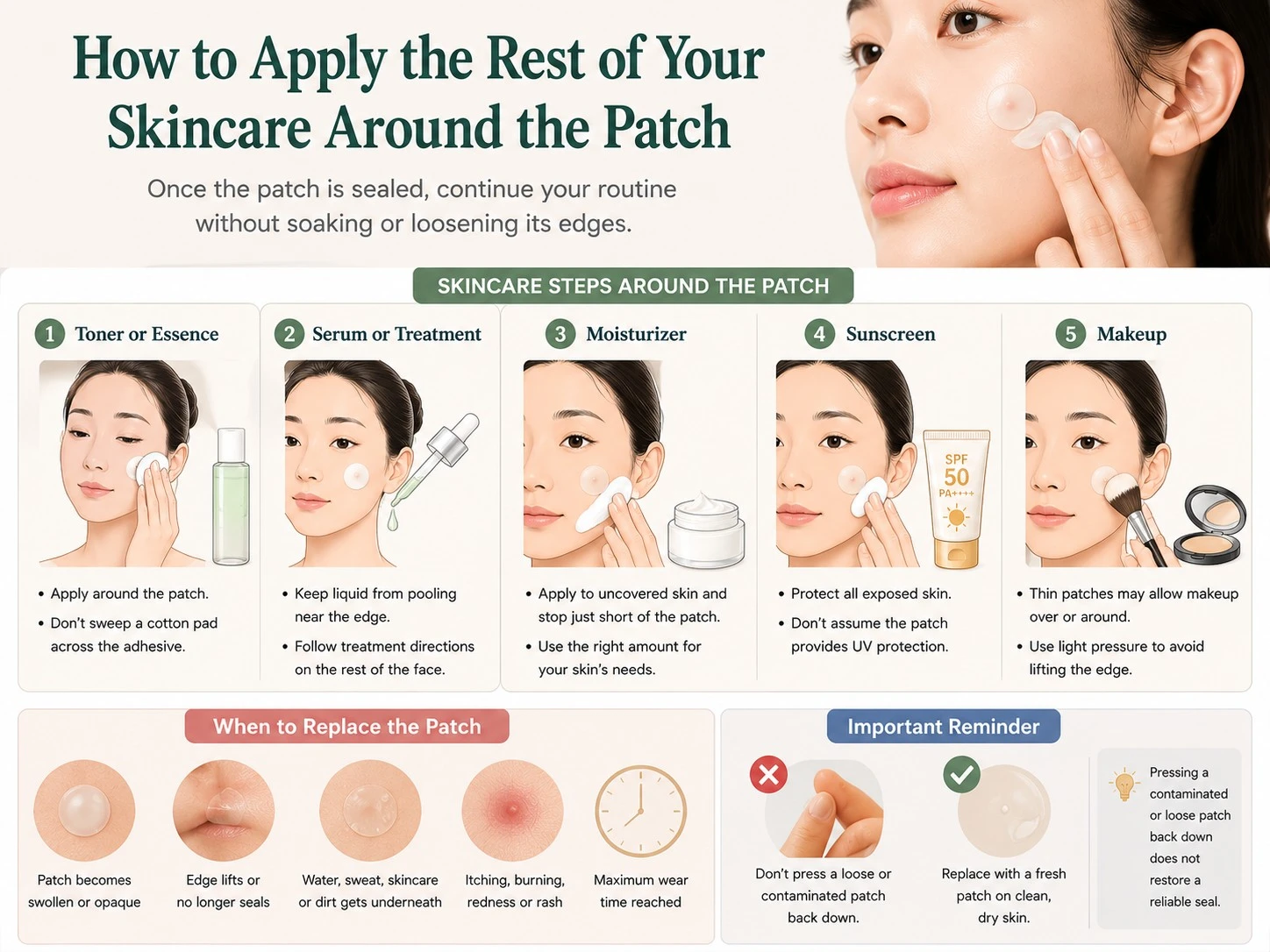
Once the patch is sealed, complete the routine without soaking or loosening its edges. The sequence for the uncovered skin can stay the same; the skincare routine order guide explains how the other steps fit together.
- Toner or essence: Apply it around the patch without sweeping a cotton pad across the adhesive.
- Serum or treatment: Keep liquid from pooling against the edge. Follow treatment directions on the rest of the face.
- Moisturizer: Spread it over the uncovered skin and stop just short of the patch. If dryness is an issue, the guide to applying moisturizer explains amount and timing.
- Sunscreen: Protect all exposed skin. Do not assume a clear or colored pimple patch provides tested UV protection unless its label specifically says so.
- Makeup: A thin daytime patch may allow makeup over or around it, but foundation and rubbing can lift the edge. Follow the patch directions and use light pressure.
If a watery product reaches the patch and the edge starts lifting, replace it with a fresh patch on clean, dry skin. Pressing a contaminated or loose sticker back down does not restore a reliable seal.
When Should You Remove or Replace a Pimple Patch?
There is no universal wear time for every material and active ingredient. Leave the patch on for the period stated on the package; many are designed for several hours or overnight.[1] Remove or replace it sooner when:
- the patch becomes visibly swollen or opaque from absorbed fluid;
- the edge lifts and no longer seals the area;
- water, sweat, skincare, or dirt gets underneath it;
- the patch causes itching, burning, spreading redness, or a rash; or
- the label’s maximum wear time has been reached.
Peel slowly rather than pulling sharply. If the adhesive feels stubborn, moisten the outside or remove it after cleansing, provided the product directions allow this. Discard the used patch; it is not reusable. Clean and dry the area before deciding whether it needs a new one.
A white patch does not always mean the pimple is empty or healed. The hydrocolloid may contain absorbed fluid while the inflammation underneath still needs time to settle.
Common Pimple Patch Mistakes
- Applying it to damp or moisturized skin: The patch is more likely to slide, wrinkle, or lift.
- Completing skincare before adding the patch: Leave-on products create a barrier between the adhesive and the blemish.
- Choosing the wrong type of spot: Plain hydrocolloid is better suited to a surface-level or draining pimple than a blackhead or deep, intact lump.[1]
- Popping the pimple to make the patch work: Squeezing can increase inflammation and the risk of infection, discoloration, and scarring, especially with deep acne.[3]
- Leaving a loose or dirty patch in place: Once the seal is compromised, replace it instead of repeatedly pressing the same sticker down.
- Using the patch as the entire acne routine: Covering one blemish does not prevent new clogged pores or manage widespread breakouts.
When a Pimple Patch Is Not Enough
A pimple patch is a spot tool, not a complete acne treatment. Plain hydrocolloid cannot reliably prevent acne, clear every clogged pore, or reach the main inflammation in a deep nodule or cyst.[1] Evidence-based acne care may include ingredients such as benzoyl peroxide, topical retinoids, salicylic acid, or azelaic acid, depending on the person and the type of acne.[4]
If breakouts are frequent, use a consistent routine that treats acne beyond individual spots; this routine for acne-prone skin provides a practical starting framework. Seek medical care for multiple deep or painful bumps, acne that is scarring, a rapidly worsening reaction, or breakouts that do not improve with appropriate over-the-counter care.[3]
FAQs About Pimple Patches and Skincare Order
Can you use toner before a pimple patch?
Usually no. Apply the patch to clean, completely dry skin first, then use toner around it. Even a lightweight toner can leave enough moisture or residue to weaken the adhesive.
Can you apply moisturizer over a pimple patch?
Apply moisturizer around the patch and avoid coating its edges. Some thin patches can tolerate makeup or skincare on top, but the product directions should confirm that use. Replace the patch if moisturizer causes it to lift.
Can you put a pimple patch over acne medication?
Not by default. Covering benzoyl peroxide, a retinoid, an acid, or prescription medication can affect adhesion and may increase irritation. Use a patch with its own active ingredients or follow specific medical and label directions instead of building an untested combination.
Can you wear a pimple patch under makeup?
Yes, if the patch is designed for daytime wear. Put it on clean, dry skin before makeup, let the edge seal, and apply makeup with light tapping rather than rubbing. Makeup should not be used to hold down a lifting patch.
Can you use a pimple patch after popping a pimple?
It is safer not to pop pimples. If a spot is already open or draining, gently clean it, stop manipulating it, dry the surrounding skin, and follow the patch directions. Hydrocolloid can absorb fluid and protect the area, but worsening pain, warmth, swelling, or pus needs medical evaluation.
Sources
[1] Cleveland Clinic. Can Pimple Patches Make a Zit Go Away?
[2] Nguyen N, et al. Narrative Review of the Use of Hydrocolloids in Dermatology
[3] American Academy of Dermatology Association. How to Treat a Deep, Painful Pimple at Home
[4] American Academy of Dermatology Association. American Academy of Dermatology Issues Updated Guidelines for the Management of Acne


