
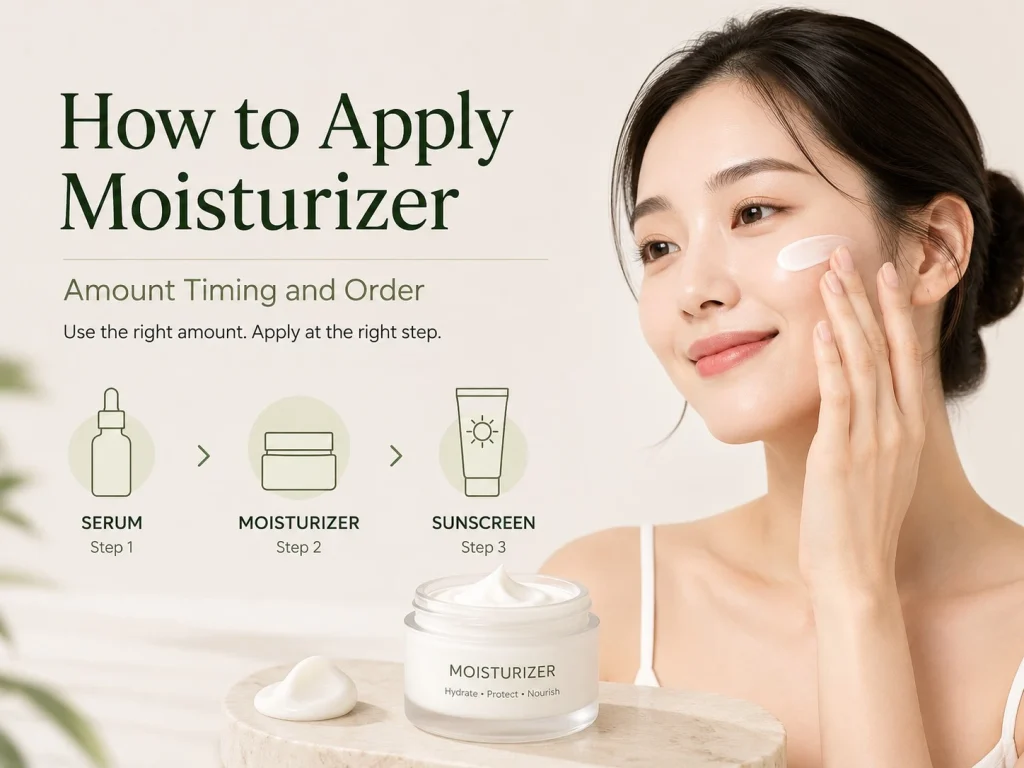

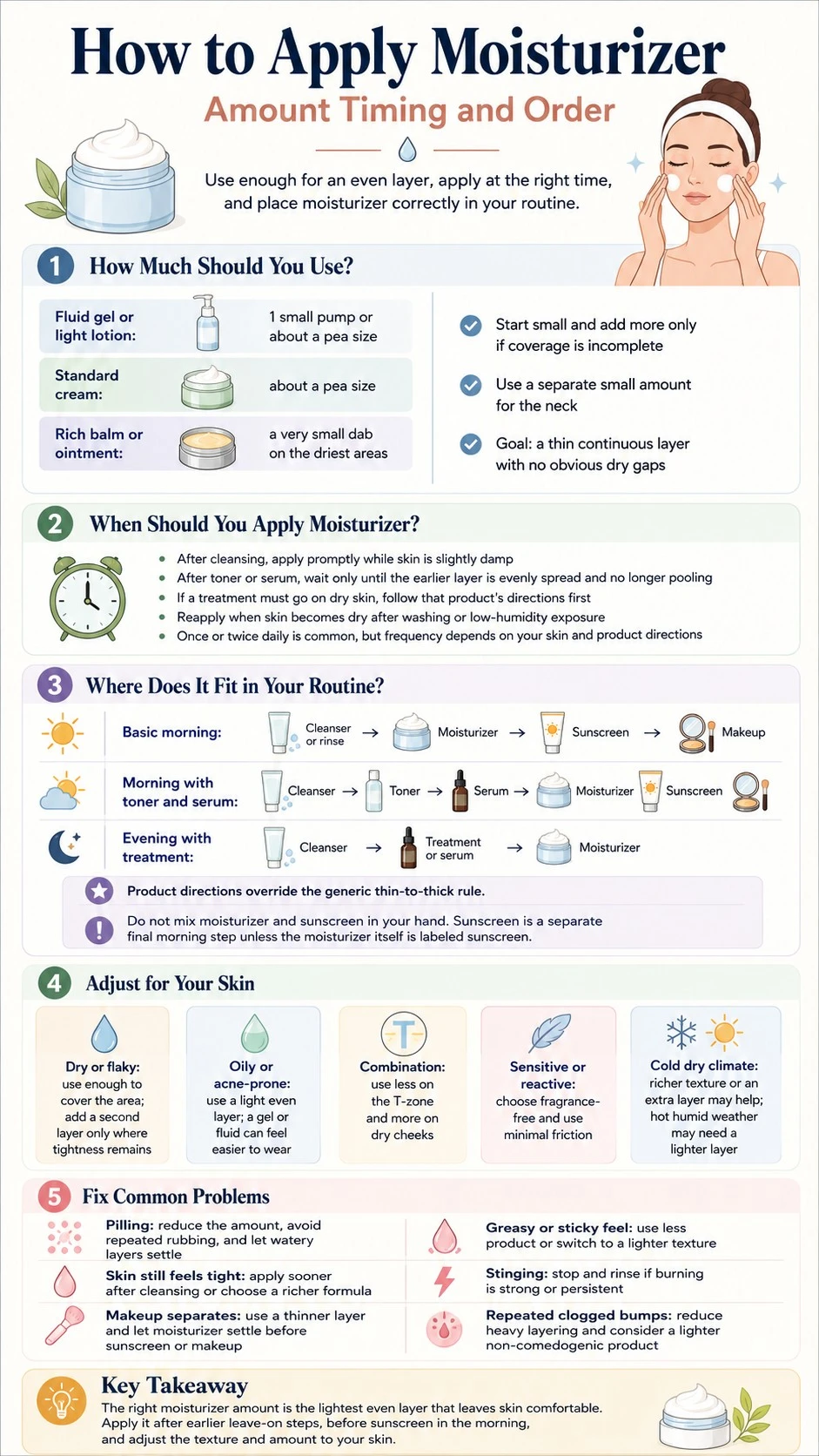
Moisturizer is a leave-on product, so application affects everything that follows. Too little can leave tight or uncovered patches; too much can cause residue, pilling, or a heavy feel. Aim for an even layer suited to the formula and your skin, not a universal coin-size rule.
How Much Moisturizer Should You Use?
A pea-sized amount is a useful starting reference for many facial creams and lotions, but it is not a standardized dose. A dense cream, fluid lotion, airless pump, jar, and dropper can deliver very different volumes. The formula’s water-binding, smoothing, and water-loss-reducing balance also affects how it spreads; see what moisturizer does for those mechanisms. The face alone needs less than the face, neck, and upper chest together.
Judge the endpoint instead: the moisturizer should form a thin, continuous layer over the intended area, spread without force, and settle without leaving obvious dry gaps. Start small because adding a little more is easier than removing excess.
| Moisturizer texture | Practical starting amount for the face | When to add more |
|---|---|---|
| Fluid, gel, or light lotion | One small pump or roughly a pea-sized pool, depending on the dispenser | The product disappears before reaching the full face or leaves areas feeling uncovered |
| Standard cream | About a pea-sized amount | It does not spread into a thin layer across the full face without tugging |
| Rich balm or ointment | A very small dab, often used first on the driest areas | Only the targeted dry area remains rough or tight after the first layer settles |
Use an additional small amount for the neck rather than stretching the facial amount too thin. If your moisturizer contains sunscreen, acne medication, or another regulated or treatment active, follow its labeled application amount instead of this cosmetic starting guide.
Texture affects both spread and finish. The comparison of gel vs cream moisturizer can help if you are consistently using too much because the product is hard to spread or too little because it feels heavy.
When Should You Apply Moisturizer?
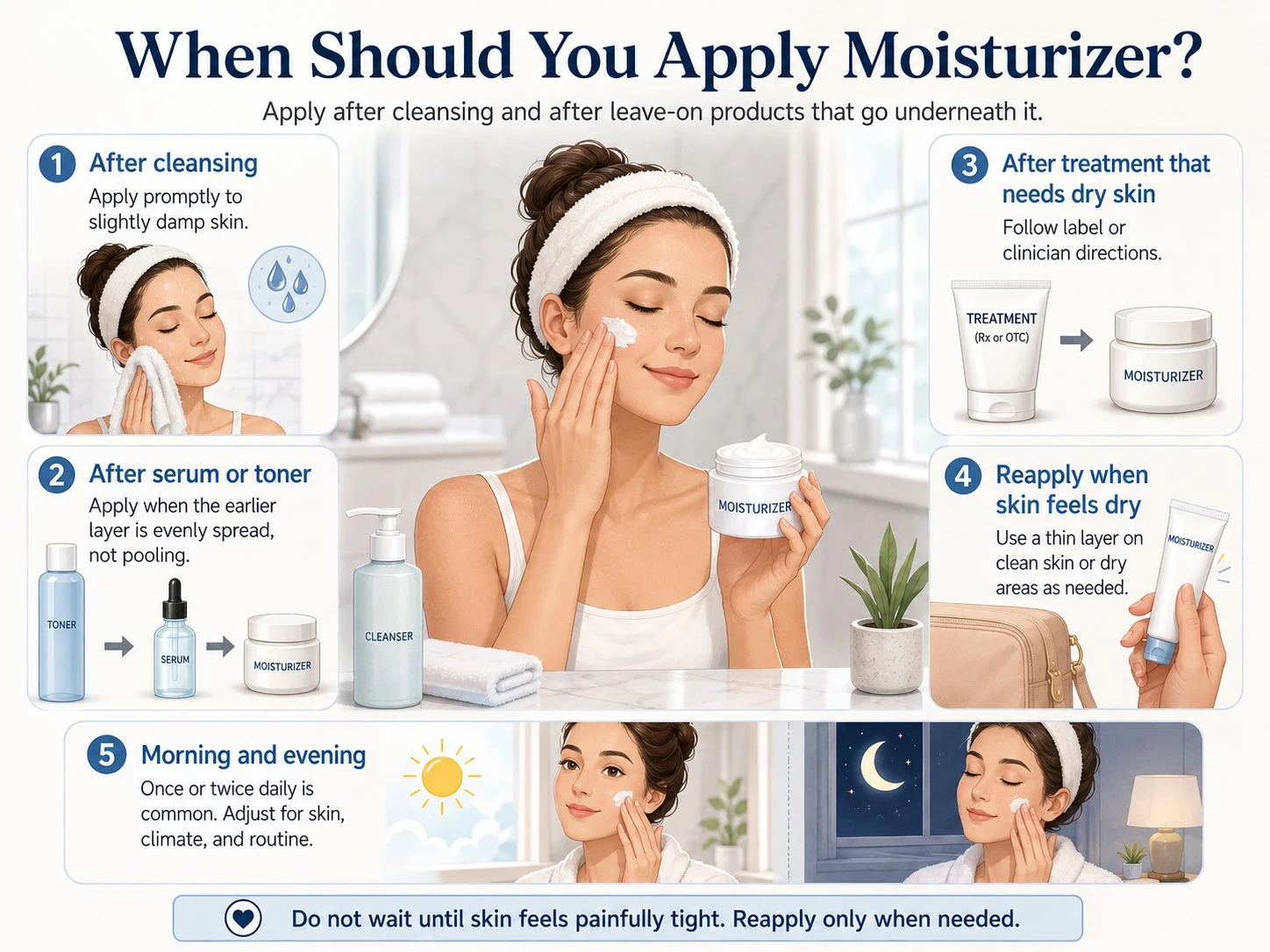
Apply moisturizer after cleansing and after any leave-on product that is meant to sit beneath it. For a simple routine, slightly damp skin is usually the best starting point because moisturizer can help retain some of the water already on the surface.[1] Damp means no longer dripping—not wet enough to dilute the product or make it slide unevenly.
- After an ordinary cleanse: Pat away excess water, leave the skin slightly damp, and apply moisturizer promptly.
- After a serum or hydrating toner: Apply moisturizer when the earlier layer is evenly distributed and no longer pooling. A fixed 30-second or five-minute wait is unnecessary for every product combination. If serum technique is the uncertain step, see the guide to using face serum.
- With a treatment that requires dry skin: Let the skin dry and apply the treatment as directed, then use moisturizer in the order specified by its label or your clinician. Do not let general layering advice override medication instructions.
- When skin feels dry later: Reapply a thin layer to clean skin or the dry area as needed. Dry skin may need moisturizer several times a day, especially after washing or exposure to low humidity.[2]
- Morning and evening: Once or twice daily is common, but frequency should follow your skin, climate, cleansing schedule, and product directions. Acne treatments such as benzoyl peroxide, salicylic acid, and topical retinoids can increase dryness, making regular moisturizer useful for tolerability.[3]
Do not wait for skin to feel painfully tight before moisturizing. At the same time, you do not need to reapply on a schedule when the skin remains comfortable and the extra layer creates residue.
Where Moisturizer Fits in Your Skincare Order
Moisturizer normally follows thinner leave-on products and most treatments, then precedes sunscreen and makeup. Product directions are more important than the generic “thin to thick” rule because some medications have specific placement or dry-skin requirements.[4]
| Routine | Typical order | Important exception |
|---|---|---|
| Basic morning | Cleanser or rinse → moisturizer → sunscreen → makeup | A moisturizer labeled and applied as adequate sunscreen may combine two steps; ordinary moisturizer does not |
| Morning with toner and serum | Cleanser → toner → serum → moisturizer → sunscreen → makeup | Optional products can be skipped when they do not serve a clear need or cause irritation |
| Evening with a leave-on treatment | Cleanser → treatment or serum → moisturizer | Follow the treatment label when it requires dry skin, a different order, or no product over it |
| Sensitive or irritated routine | Gentle cleanser → moisturizer; sunscreen in the morning | A clinician may advise moisturizer before and after a retinoid to reduce irritation, but do not change prescription use on your own |
If the distinction between two leave-on steps is unclear, compare serum vs moisturizer. The full skincare routine order covers optional products and treatment exceptions.
In the morning, treat sunscreen as its own application step unless a moisturizer with sunscreen is labeled and applied to provide the required protection. Otherwise, spread moisturizer first, let it stop moving or pooling, then apply sunscreen in its labeled amount without mixing the two in your hand.[5] See sunscreen or moisturizer first for the complete reasoning.
How to Adjust Moisturizer Application for Your Skin
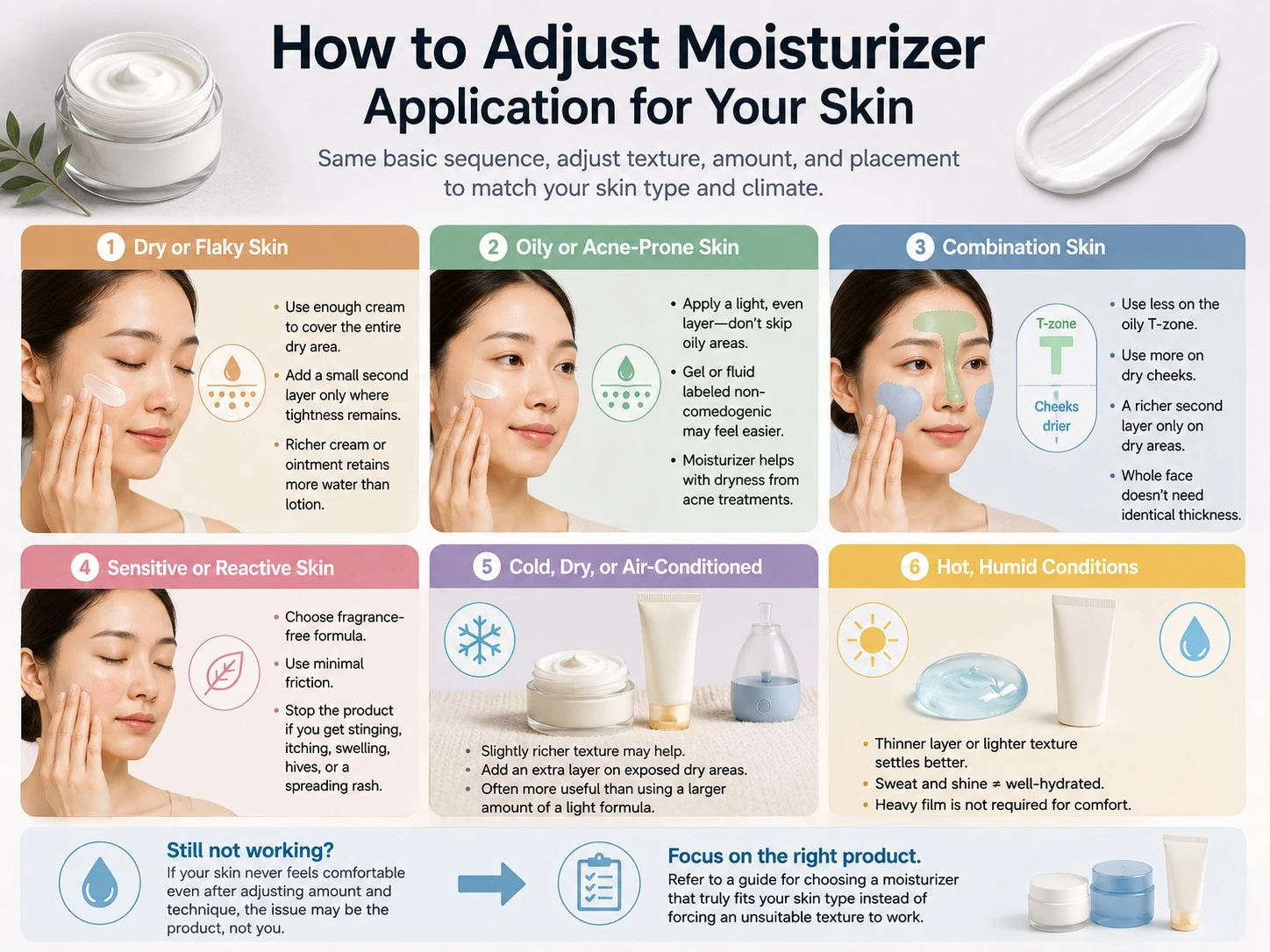
The basic sequence stays the same, but the texture, amount, and placement can change with skin type and climate.
- Dry or flaky skin: Use enough cream to cover the entire dry area, and add a small second layer only where tightness remains. A richer cream or ointment generally retains more water than a lotion.[1]
- Oily or acne-prone skin: Apply a light, even layer instead of skipping every oily area automatically. A gel or fluid labeled non-comedogenic may feel easier to wear, especially alongside drying acne treatments. This guide explains why oily skin may still need moisturizer.
- Combination skin: Use less on the oily T-zone and more on dry cheeks, or limit a rich second layer to the dry areas. The whole face does not need identical coverage thickness.
- Sensitive or reactive skin: Favor a fragrance-free formula and use minimal friction. Repeated stinging, itching, swelling, hives, or a spreading rash is a reason to stop the product rather than change the massage technique.
- Cold, dry, or air-conditioned conditions: A slightly richer texture or an extra layer on exposed dry areas may be more useful than applying a much larger amount of a light formula.
- Hot, humid conditions: A thinner layer or lighter texture may settle better. Sweat and shine do not prove the skin is adequately moisturized, but a heavy film is not required for comfort.
If the product never feels appropriate even after adjusting the amount, the problem may be product choice rather than technique. Use the guide to choosing a moisturizer for your skin type instead of forcing an unsuitable texture to work.
How to Fix Common Moisturizer Application Problems
- The moisturizer pills into flakes or rolls: Reduce the amount, avoid rubbing repeatedly, and let watery layers stop pooling before adding moisturizer. If sunscreen pills next, allow the moisturizer to settle and change one product or amount at a time. Do not reduce sunscreen below its labeled amount to fix pilling.
- Skin stays greasy or sticky: Start with less product and spread it more evenly. If the correct thin layer still feels heavy for hours, switch to a lighter texture rather than applying it only to a small random part of the face.
- Skin still feels tight: Apply sooner after cleansing, make sure coverage is continuous, and add a little more to the dry areas. If this repeatedly fails, use a richer formula or examine whether the cleanser, exfoliant, retinoid, or environment is driving the dryness.
- The product stings: Brief sensation is not a required sign that moisturizer is working. Stop and rinse if burning is strong or persistent. Do not apply ordinary moisturizer over broken, infected, or severely inflamed skin unless a clinician or product direction supports it.
- Makeup separates over moisturizer: Use a thinner layer, give it time to stop moving on the skin, and check compatibility with the sunscreen and base product. Adding more moisturizer immediately before makeup can increase slip rather than improve the surface.
- New clogged bumps appear repeatedly: Reduce heavy layering and consider a lighter, non-comedogenic product. Because breakouts have several possible causes, change one product at a time rather than assuming the amount is the only factor.
FAQs About Applying Moisturizer
Can you use the same moisturizer morning and night?
Yes, if it suits your skin and layers well in both routines. A heavy cream may be comfortable at night but difficult under sunscreen, while a light daytime lotion may not be enough in dry conditions. You need separate products only when the same formula cannot meet both needs.
Can you apply facial moisturizer around your eyes?
Only if the label permits it and the formula does not sting. Use a very small amount around the orbital bone and avoid the eyelids, lash line, and inner corners unless the product is specifically intended for those areas. Stop if it causes watering, swelling, or irritation.
Can you mix moisturizer with serum or face oil?
Layer them separately unless the product directions explicitly support mixing. Mixing changes the amount, distribution, and finish of each product and can make irritation or pilling harder to trace. Apply serum before moisturizer; if you use face oil, follow its directions because different formulas are designed for different positions.
Sources
[1] American Academy of Dermatology Association. How to Pick the Right Moisturizer for Your Skin
[2] American Academy of Dermatology Association. Dermatologists’ Top Tips for Relieving Dry Skin
[3] American Academy of Dermatology Association. Moisturizer: Why You May Need It If You Have Acne
[4] American Academy of Dermatology Association. Should I Apply My Skin Care Products in a Certain Order?
[5] Cleveland Clinic. How to Order Your Skin Care Routine


