


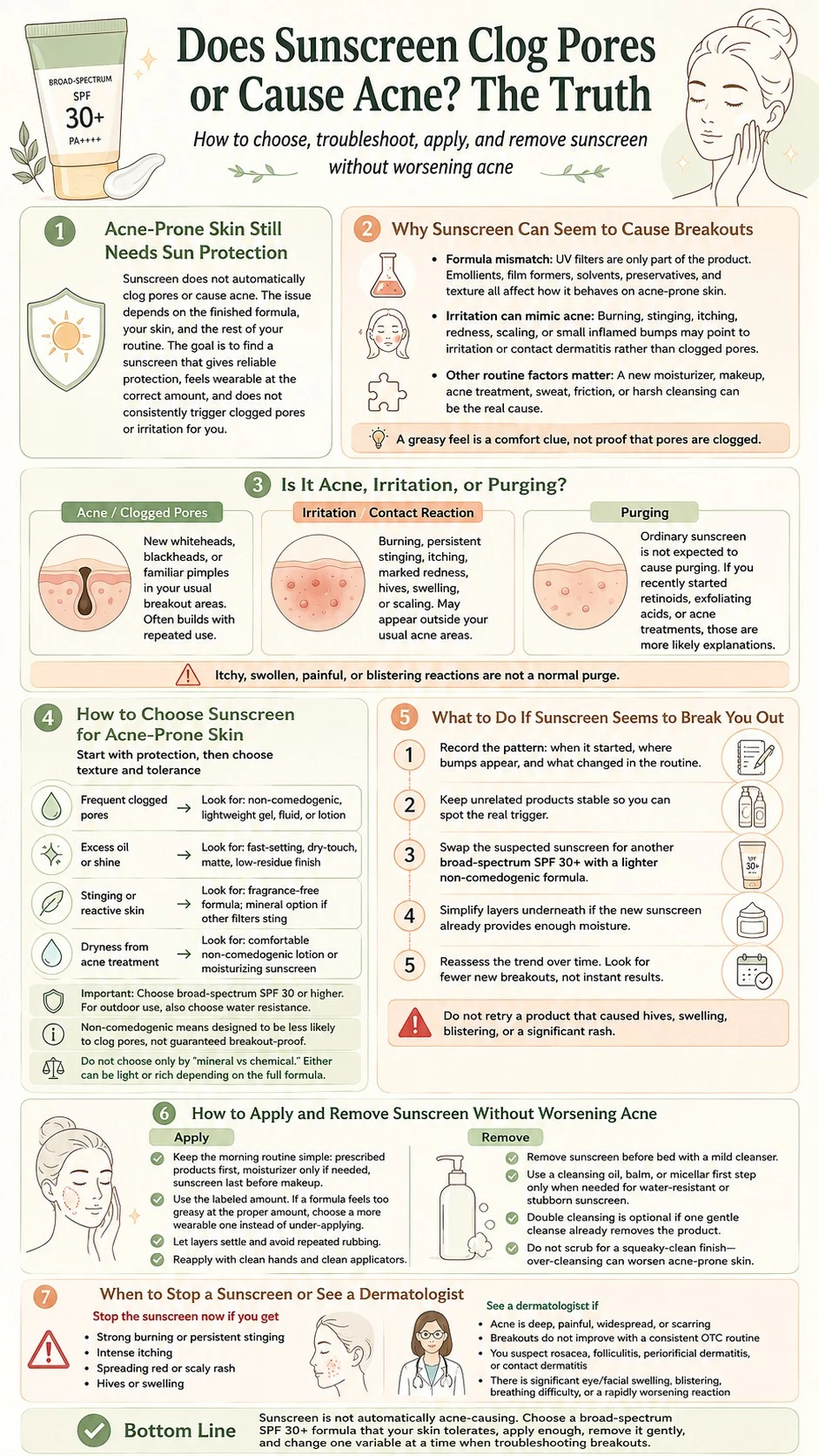
Acne-prone skin still needs sun protection. Photoprotection is commonly recommended during acne care, particularly because some treatments increase irritation or sun sensitivity and ultraviolet or visible light can make post-acne dark marks more noticeable. Research specifically testing sunscreens in acne remains limited, but compatible formulas have been used without worsening acne and may improve treatment tolerance.[5]
The practical goal is therefore not to prove that sunscreen is universally “acne-safe.” It is to find a product that supplies reliable protection, feels wearable at the required amount, and does not consistently create clogged pores or irritation for you.
Why Sunscreen Can Seem to Cause Breakouts
Acne begins when oil and dead skin cells accumulate inside a follicle. A sunscreen may become part of that problem for a susceptible user, but several different events can look like the same “SPF breakout.”
- The finished formula may not suit your skin. Sunscreens contain UV filters plus solvents, emollients, film formers, thickeners, preservatives, and other ingredients. The way these materials are combined and used matters more than finding one supposedly pore-clogging name on an online list. Human testing has shown that a finished product can contain ingredients historically rated as comedogenic without the complete formula being comedogenic.[3]
- Irritation can resemble acne. A formula may sting, itch, redden, or produce small inflamed bumps because of an irritant or allergic contact reaction. Fragrance, preservatives, UV filters, and other components can all be relevant, but the responsible ingredient cannot be identified from appearance alone.[4]
- The surrounding routine may be responsible. Starting a new sunscreen at the same time as a moisturizer, makeup product, acne treatment, or hair product makes the cause difficult to isolate. Sweat, friction, repeated rubbing, and harsh cleansing can also aggravate acne-prone skin.[2]
A greasy finish is a useful comfort clue, not proof of clogged pores. Likewise, a dry-touch formula is not automatically non-comedogenic. If you want to understand what is physically happening inside a follicle, the guide to clogged pores separates blackheads, whiteheads, and inflammatory blemishes.
Is It Acne, Irritation, or Skin Purging?
The safest first step is to describe the reaction rather than calling every new bump acne. These patterns can overlap, so use them as troubleshooting clues rather than a diagnosis.
- Clogged pores or an acne flare: Look for new whiteheads, blackheads, or familiar pimples in areas where you commonly break out. The change may build across repeated use rather than appearing immediately after one application. If bumps cluster beneath a hat, mask edge, or sports gear, heat, sweat, and friction may also be contributing.
- Irritant or allergic reaction: Burning, persistent stinging, itching, scaling, marked redness, hives, or swelling is not a normal purge. The reaction may occur outside your usual acne areas and can affect the eyes, lips, ears, or neck.[4]
- Purging: Ordinary sunscreen filters do not speed the turnover of cells inside pores, so a standard sunscreen is not expected to cause purging. If you recently added a retinoid, exfoliating acid, or acne treatment, that product—or simple irritation—may better explain the timing.
The comparison of skin purging vs a breakout provides a fuller decision framework. Stop the suspected sunscreen promptly when the pattern is itchy, swollen, blistering, or painful instead of waiting for the skin to “adjust.”
How to Choose Sunscreen for Acne-Prone Skin
Start with protection, then narrow the texture and tolerance features. For outdoor use, choose broad-spectrum protection, SPF 30 or higher, and water resistance; acne-prone and oily skin should also look for “non-comedogenic” or “won’t clog pores” on the label.[1]
| Your main concern | Useful formula clues | What not to assume |
|---|---|---|
| Frequent clogged pores | Non-comedogenic; lightweight gel, fluid, or lotion | One “safe” ingredient list guarantees no breakout |
| Excess oil or shine | Fast-setting, dry-touch, matte, or low-residue finish | A high SPF number makes a sunscreen heavier |
| Stinging or reactive skin | Fragrance-free formula; a mineral option if other filters sting | “Natural,” “hypoallergenic,” or mineral means reaction-proof |
| Dryness from acne treatment | Comfortable non-comedogenic lotion or moisturizing sunscreen | Every cream or emollient is pore-clogging |
“Non-comedogenic” means a product is designed to be less likely to clog pores; it does not mean no individual can break out from it. The complete explanation of non-comedogenic skincare also explains why ingredient-rating charts cannot predict your response with certainty.
Do not choose solely between mineral and chemical filters. Either type can be delivered in a light or rich base, and either can contain components your skin dislikes. Mineral formulas containing zinc oxide or titanium dioxide can be helpful when other filters sting, but some are thick or drying. Organic filters—often called chemical filters—can be very lightweight and wearable. The comparison of mineral vs chemical sunscreen covers their broader differences.
Texture should help you apply enough sunscreen, not encourage you to use a thin token layer. If several options meet the protection requirements, select the one that feels comfortable, sets without excessive rubbing, and works with the fewest unnecessary layers. The guide to choosing sunscreen for oily and acne-prone skin gives a more detailed shopping framework.
What to Do If Sunscreen Seems to Break You Out
Use a controlled product swap instead of replacing the entire routine. That protects your skin and gives you a better chance of identifying the actual trigger.
- Record the pattern. Note when you started the sunscreen, where the bumps appear, what they look or feel like, and whether heat, exercise, makeup, or a new treatment changed at the same time.
- Keep unrelated products stable. Do not add a new cleanser, exfoliant, acne treatment, and moisturizer while testing the sunscreen. Frequent product changes can irritate skin and obscure cause and effect.[2]
- Replace the suspected sunscreen. Choose another broad-spectrum, water-resistant SPF 30 or higher with a lighter non-comedogenic formula. Use shade, clothing, and other sun protection as additional measures; do not leave exposed skin unprotected simply to run the test.
- Simplify the layers beneath it. If the new sunscreen is moisturizing enough, you may need less moisturizer underneath. Keep prescribed acne treatment directions unchanged unless your clinician tells you otherwise.
- Reassess the trend. Look for fewer new lesions rather than expecting existing pimples to vanish immediately. Do not deliberately retry a product that caused hives, swelling, blistering, or a significant rash.
This process cannot prove that one ingredient caused the reaction. It can show whether replacing one finished product while holding the rest of the routine steady improves the pattern. If breakouts continue, review the full routine for acne-prone skin rather than repeatedly changing SPF alone.
How to Apply and Remove Sunscreen Without Worsening Acne
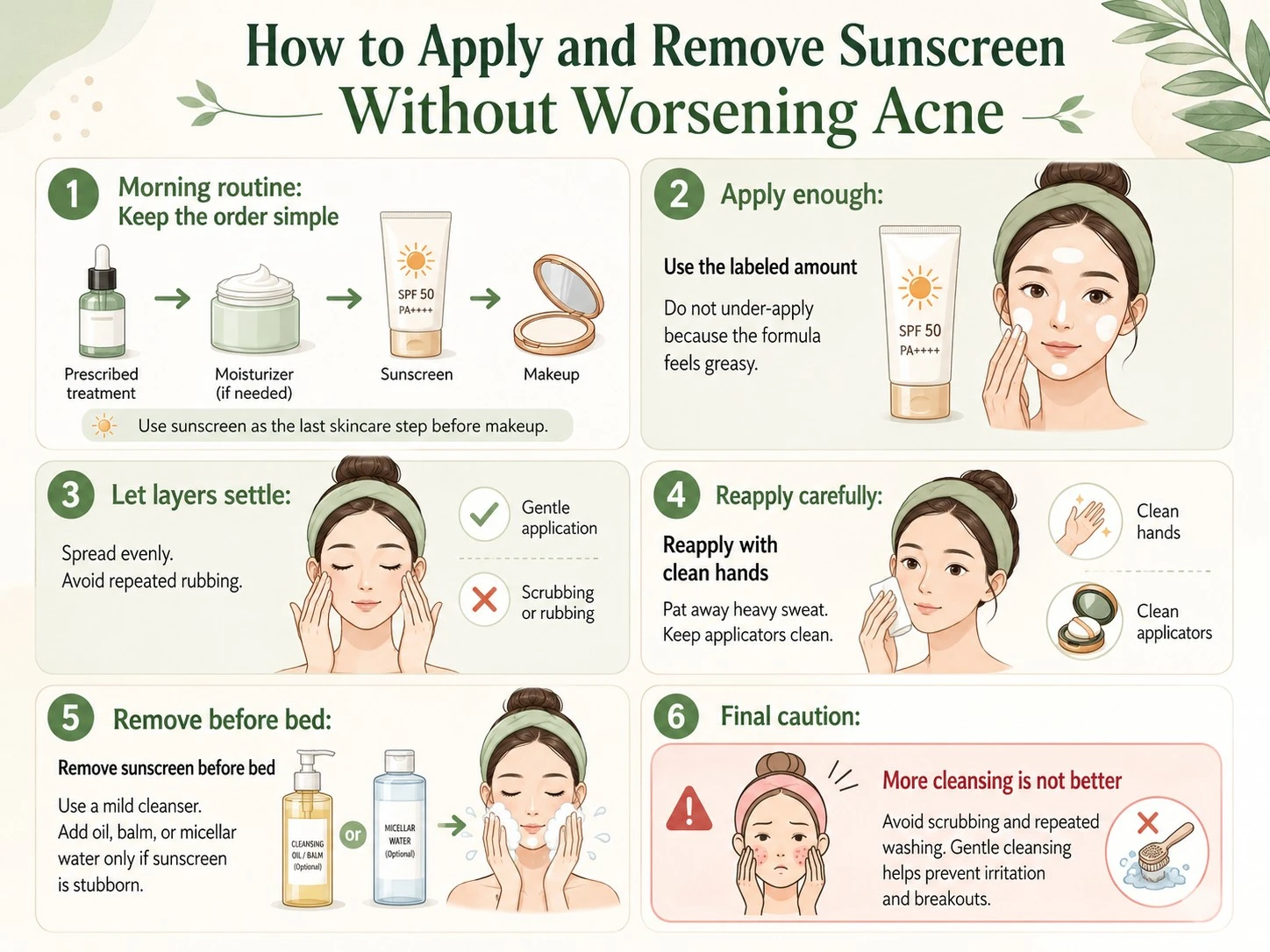
Correct application preserves protection while reducing avoidable rubbing, residue, and routine overload.
- Keep the morning order simple: Apply prescribed products as directed, add moisturizer only if needed, and use sunscreen as the last skincare step before makeup. The guide to sunscreen and moisturizer order explains the exceptions.
- Use the labeled amount: Reducing the layer because a product feels greasy also reduces the protection you can expect. Choose a more wearable formula rather than under-applying; see how much sunscreen to use on your face for practical measurement methods.
- Let layers settle without scrubbing: Spread each product evenly and avoid repeatedly rubbing or adding several overlapping primers, oils, and creams when they are not needed.
- Reapply with clean hands: Pat away heavy sweat and avoid grinding dirt, oil, or makeup back across inflamed areas. Replace contaminated applicators and wash reusable ones regularly.
- Remove sunscreen before bed: Use a mild cleanser that fully removes the formula without leaving skin tight or raw. A cleansing oil, balm, or micellar first step can help with persistent water-resistant or tinted sunscreen, but double cleansing is optional when one gentle cleanse already removes it. The full guide to removing sunscreen covers face and body methods.
More cleansing is not automatically better. Washing repeatedly or scrubbing to achieve a squeaky finish can irritate acne-prone skin and worsen breakouts; gentle cleansing twice daily and after heavy sweating is a more useful baseline.[2]
When to Stop a Sunscreen or See a Dermatologist
Stop using the suspected product and rinse it off if it causes strong burning, persistent stinging, intense itching, a spreading red or scaly rash, hives, or swelling. Seek prompt medical care for significant facial or eye swelling, blistering, breathing difficulty, or a rapidly worsening reaction.[4]
A few clogged pores do not usually require urgent care, but professional evaluation is useful when acne is deep, painful, scarring, widespread, or does not improve with a consistent over-the-counter routine. A dermatologist can also help distinguish acne from folliculitis, rosacea, periorificial dermatitis, or contact dermatitis when the bumps do not behave like your usual breakouts.
FAQs About Sunscreen and Acne
Can mineral sunscreen clog pores?
Yes, a mineral sunscreen can clog pores for some users if the finished base does not suit their skin. Zinc oxide or titanium dioxide does not guarantee a lightweight or non-comedogenic product, so check the full label and judge the complete formula.
Is chemical sunscreen more likely to cause acne?
Not automatically. Organic or “chemical” UV filters can be formulated into light fluids, gels, or richer creams. Acne risk and tolerance depend on the finished sunscreen, the rest of the routine, and individual skin response—not the filter category alone.
Is non-comedogenic sunscreen guaranteed not to break you out?
No. The label indicates a lower intended risk of clogging, and these products do not cause breakouts in most people, but individual reactions still occur.[2] Keep the rest of your routine stable when trying a new formula so you can evaluate it more clearly.
Can sunscreen cause skin purging?
A standard sunscreen is not expected to cause purging because UV filters do not speed cell turnover. New bumps are more likely to be an ordinary breakout, irritation, or a response to another newly introduced active product.
Do you have to double cleanse sunscreen off acne-prone skin?
No. Double cleanse only when one gentle cleanser does not fully remove a water-resistant, tinted, or makeup-layered sunscreen. If one wash removes the product comfortably, adding a second cleanse may create unnecessary dryness or irritation.
Sources
[1] American Academy of Dermatology Association. How do I know if I’m using the right sunscreen?
[2] American Academy of Dermatology Association. 10 skin care habits that can worsen acne
[3] Draelos ZD, DiNardo JC. A re-evaluation of the comedogenicity concept
[4] DermNet. Contact reactions to cosmetics
[5] Piquero-Casals J, et al. Sun exposure, a relevant exposome factor in acne patients and how photoprotection can improve outcomes


