

Facial essences occupy a flexible space between watery toners and more concentrated treatments. Some are simple hydrators; others contain acids, brightening ingredients, oils, or fermented materials. That variety makes the product name less useful than the formula.
This guide focuses on choosing an essence rather than repeating every difference among toner, essence, and serum. The practical goal is to find a product that adds one useful function without making your routine harder to tolerate.
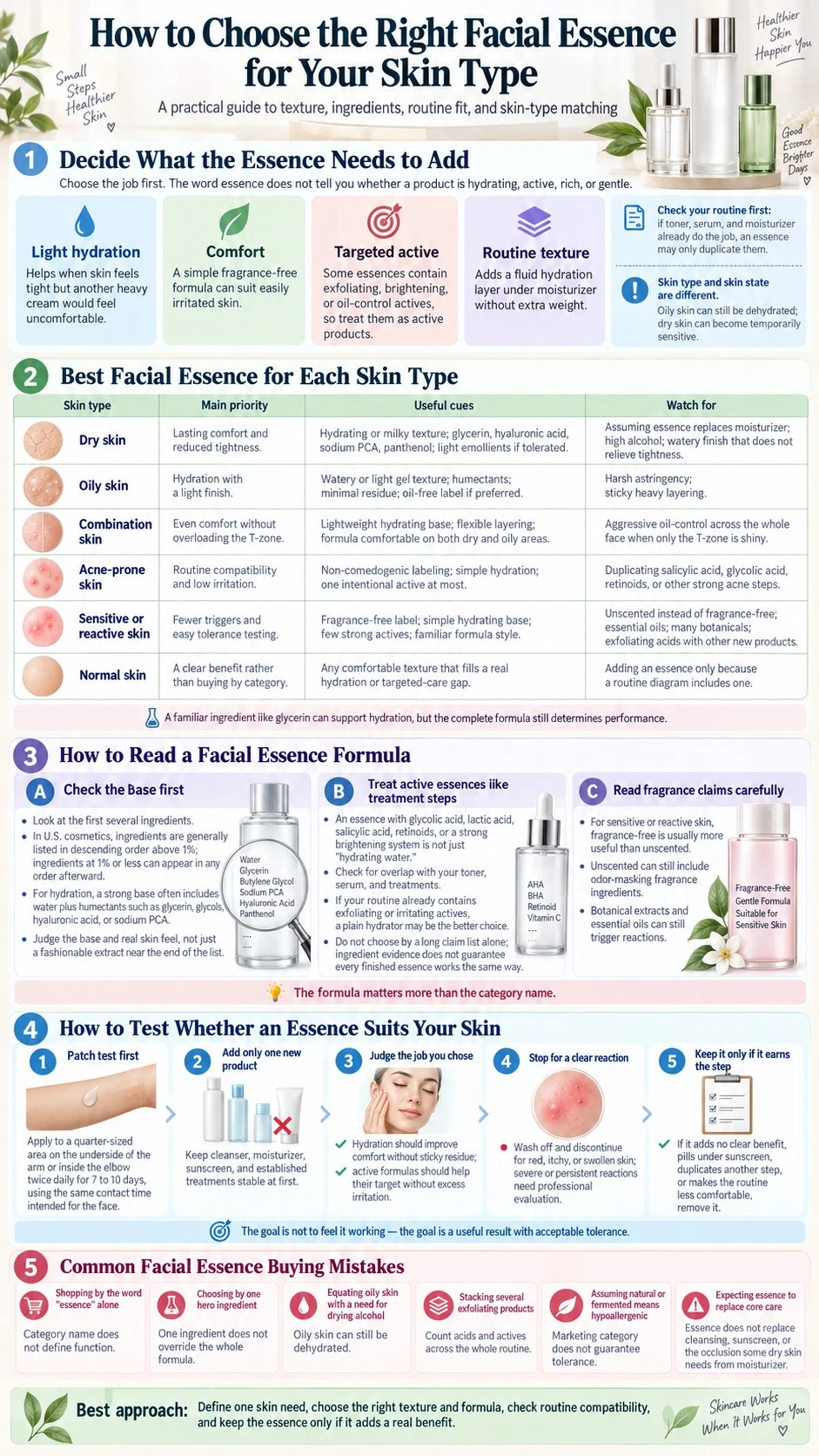
Decide What the Essence Needs to Add
Before comparing ingredients, name the problem the essence should solve. “I want an essence” is not a selection criterion; “my light moisturizer is comfortable, but my cheeks still feel dehydrated” is.
Most essence purchases fall into one of four jobs:
- Add light hydration: Useful when skin feels tight or looks less supple, but another rich layer would feel uncomfortable.
- Add comfort: A simple, fragrance-free formula may suit skin that becomes uncomfortable with complex routines.
- Deliver one targeted active: Some essences contain exfoliating, brightening, or oil-control ingredients. Treat these as active products rather than assuming every essence is a gentle hydration step.
- Improve routine texture: A fluid essence can provide a layer of hydration beneath moisturizer without the weight of another cream.
Skin type and skin state are not identical. Oiliness or dryness describes a baseline pattern, while dehydration and temporary sensitivity can occur alongside it. If you are unsure of your baseline, identify your skin type before shopping. If oily skin also feels tight, distinguishing dehydrated and dry skin can prevent an unnecessarily heavy choice.
Now audit the routine you already have. If a toner, serum, and moisturizer already keep skin comfortable and address your main concern, an essence may only duplicate them. If the categories still overlap in your routine, compare toner, essence, and serum before buying. If one clear gap remains, use it as the product brief.
Best Facial Essence for Each Skin Type
The best match combines a comfortable texture with a formula that does not conflict with the rest of your routine. Use these starting points, then judge the finished product on your own skin.
| Skin type or tendency | Main selection priority | Useful formula cues | Watch for |
|---|---|---|---|
| Dry skin | Lasting comfort and reduced tightness | Hydrating or milky texture; glycerin, hyaluronic acid, sodium PCA, panthenol; light emollients when tolerated | Assuming a watery essence can replace moisturizer; high alcohol content; a finish that evaporates without relieving tightness |
| Oily skin | Hydration with a light finish | Watery or light gel texture; humectants; minimal residue; oil-free labeling if preferred | Choosing harsh astringency to “dry out” oil; heavy layering that feels sticky or congesting |
| Combination skin | Even comfort without overloading the T-zone | Lightweight hydrating base; flexible layering; a formula comfortable on both dry and oily areas | Buying an aggressive oil-control essence for the whole face when only the T-zone is shiny |
| Acne-prone skin | Routine compatibility and low irritation | Non-comedogenic labeling; simple hydration; one intentional active at most | Duplicating salicylic acid, glycolic acid, retinoids, or other irritating steps; judging a product only by “oil-free” wording |
| Sensitive or reactive skin | Fewer triggers and easy tolerance testing | Fragrance-free labeling; simple hydrating base; few strong actives; a familiar formula style | “Unscented” instead of fragrance-free; essential oils; several botanicals; exfoliating acids introduced with other new products |
| Normal skin | A clear benefit rather than category completion | Any comfortable texture that fills a real hydration or targeted-care gap | Adding an essence only because a routine diagram includes one |
Glycerin is a well-established humectant that supports stratum corneum hydration, but its presence does not guarantee that every finished essence will perform the same.[1] Dry skin may prefer some emollience, whereas oily skin often finds a watery formula easier to layer.
For acne-prone skin, “non-comedogenic” or “won’t clog pores” is a useful screening label, although no label can guarantee an identical result for every person.[2] More importantly, do not mistake stinging, tightness, or flaking for proof that an oil-control essence is working. Drying and irritating acne-prone skin can make the routine harder to tolerate.[2]
How to Read a Facial Essence Formula

Ingredient lists help screen products, but they do not reveal exact performance. Ingredient combinations, concentrations, packaging, and formulation all affect the result.
Check the Base Before the Hero Ingredients
Start with the first several ingredients. For cosmetics sold in the United States, ingredients are generally declared in descending order of predominance, but ingredients at 1% or less can appear in any order after those above 1%.[3] This means a highlighted extract near the end of the list may be present at a low level, but its exact concentration cannot be calculated from position alone.
For a hydrating essence, look for a coherent base rather than a long list of fashionable extracts. Water followed by humectants such as glycerin, glycols, hyaluronic acid, or sodium PCA suggests a hydration-focused structure. A milky appearance may signal emollients, but the ingredient list and actual feel matter more than color.
Use the complete guide to reading a skincare ingredient list when unfamiliar INCI names or label order are the main obstacle. For this purchase, the essential question is whether the base supports your chosen job.
Treat Active Ingredients as Separate Routine Steps
An essence with glycolic acid, lactic acid, salicylic acid, retinoids, or a strong brightening system is not merely “hydrating water.” It occupies an active-treatment slot and should be evaluated alongside every serum, toner, and treatment you already use.
Check for duplication before buying. If your toner exfoliates and your serum contains another potentially irritating active, an exfoliating essence adds burden without filling a new need. A plain hydrator is often more useful. The guide to combining skincare ingredients can help with that separate check.
Do not select a brightening or anti-aging essence by a long claim list alone. Evidence for a named ingredient or one tested formula does not prove that every essence carrying a similar claim will deliver the same result. For example, one four-week split-face study found increased cheek hydration from the specific royal-jelly essence tested, but it enrolled only 35 adults aware of dryness and was funded and supplied by the manufacturer.[4] That supports a formula-specific finding, not a category-wide promise.
Read Fragrance Claims Carefully
If your skin is sensitive, reactive, very dry, or already irritated, “fragrance-free” is more useful than “unscented.” Unscented products can still contain fragrance-related ingredients used to mask odor.[5] Botanical extracts and essential oils also deserve attention when you already know a particular plant or fragrance component causes a reaction.
A short ingredient list is not automatically safer, nor is a long one automatically irritating. Use past reactions to identify relevant exclusions. When no pattern is known, favor a simpler hydrator instead of avoiding every unfamiliar name.
How to Test Whether an Essence Suits Your Skin
The final selection happens after purchase. Introduce one new essence at a time so you can connect changes to the right product.
- Test a small area first. Apply the essence to a quarter-sized area on the underside of the arm or bend of the elbow twice daily for seven to ten days, using it for the same contact time intended on the face.[5]
- Add it without changing the rest of the routine. Follow the label and keep your cleanser, moisturizer, sunscreen, and established treatments stable at first.
- Judge the job you selected. A hydrating essence should reduce tightness or improve comfort without creating unwanted stickiness. An active essence should be assessed against its stated purpose without ignoring irritation.
- Stop for a clear adverse reaction. Wash the product off and discontinue it if you develop red, itchy, or swollen skin. Severe or persistent reactions need professional evaluation.[5]
- Keep it only if it earns the step. If the essence adds no noticeable benefit, duplicates another product, pills under sunscreen, or makes the routine less comfortable, removing it is a valid result.
Some concerns take longer to change than surface hydration, so follow the directions rather than applying more. The goal is not to feel the product working; it is to get the intended benefit with acceptable tolerance.
Common Facial Essence Buying Mistakes
- Shopping by the word “essence”: The category includes watery hydrators, milky emulsions, and active formulas. Product name alone cannot establish function or gentleness.
- Choosing by one hero ingredient: A familiar ingredient does not override the base, fragrance, active load, packaging, or the rest of the formula.
- Equating oily skin with a need for drying alcohol: Oily skin can still be dehydrated or irritated. Choose a light finish, not deliberate tightness.
- Stacking several exfoliating products: Count acids and other active ingredients across toner, essence, serum, and treatment instead of viewing each category separately.
- Assuming natural or fermented means hypoallergenic: Plant, yeast, and fermentation-derived ingredients can suit many users, but the marketing category does not guarantee tolerance.
- Expecting essence to replace core care: An essence does not clean the skin, replace broad-spectrum sunscreen, or reliably provide the occlusion dry skin may need from moisturizer.
FAQs About Facial Essence
Is facial essence necessary for every skin type?
No. Facial essence is an optional leave-on step. It is useful when it adds hydration, comfort, or a targeted function that your current toner, serum, and moisturizer do not already provide. If your routine works well without one, there is no skin type that must add an essence.
Can oily skin use a facial essence every day?
Yes, if the formula is comfortable and the label permits daily use. A lightweight hydrating essence can suit oily skin, but a daily exfoliating essence may be too much when you already use acne treatments or exfoliating products. Frequency should follow the formula, not the word “essence.”
Is a facial essence better than a serum for dry skin?
Not automatically. A hydrating essence can add a light water-binding layer, while a serum may deliver hydration or a more targeted formula. Dry skin often still needs a moisturizer to reduce moisture loss. Choose the product that fills the missing function instead of using both by default.
Are fermented essences suitable for sensitive skin?
They can be, but fermentation does not guarantee gentleness. Sensitive skin should judge the complete ingredient list, including fragrance, acids, preservatives, and known personal triggers. Test the finished product before broad facial use and stop if it causes redness, itching, or swelling.
Sources
[1] Fluhr JW, Darlenski R, Surber C. Glycerol and the Skin: Holistic Approach to Its Origin and Functions
[2] American Academy of Dermatology Association. 10 Skin Care Habits That Can Worsen Acne
[3] U.S. Food and Drug Administration. Cosmetics Labeling Guide
[4] Maeda Y, Fujikura C, Asama T, et al. Effect of Facial Application of Essence Containing Royal Jelly Extract on Stratum Corneum Moisture Content: A Placebo-Controlled, Double-Blind, Parallel-Group Study
[5] American Academy of Dermatology Association. How to Test Skin Care Products


