


Bakuchiol and retinol are often placed in the same anti-aging category because both are used for wrinkles, uneven tone, and texture. That does not make them chemically related or equally proven.
The practical choice is a tradeoff. Retinol has deeper clinical support, while bakuchiol has encouraging but much more limited human evidence and is often easier to tolerate. Results also depend on the finished formula, concentration, frequency, and the rest of your routine.
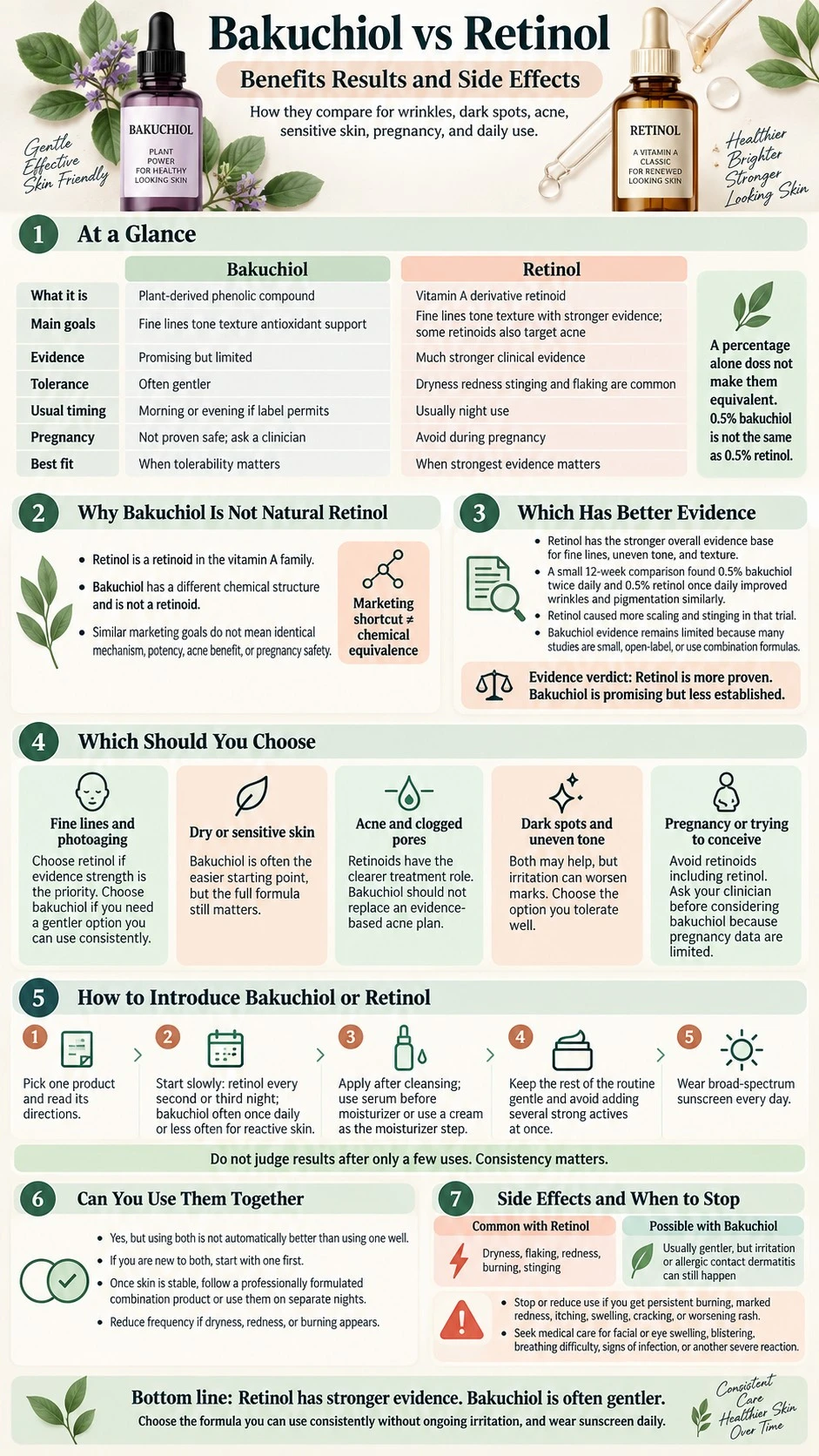
Bakuchiol vs Retinol at a Glance
The two ingredients overlap in cosmetic goals but differ in identity, evidence, and usual irritation profile.
| Comparison point | Bakuchiol | Retinol |
|---|---|---|
| What it is | Plant-derived phenolic compound used as a cosmetic active | Vitamin A derivative and member of the retinoid family |
| Main cosmetic goals | Fine lines, uneven tone, texture, and antioxidant support | Fine lines, uneven tone, and texture; some retinoid products also target acne |
| Evidence base | Promising but limited; many studies are small, uncontrolled, or use combination formulas | Substantially larger and longer clinical evidence base |
| Direct comparison | One small 12-week trial found similar improvement in measured wrinkles and pigmentation under different application schedules | Same trial found similar measured improvement but more scaling and stinging |
| Common tolerance | Often better tolerated, though irritation or allergy remains possible | Dryness, redness, burning, stinging, and flaking are common during introduction |
| Usual timing | Morning or evening if the label permits | Normally used at night |
| Pregnancy | Not proven safe in pregnancy; ask a healthcare professional | Avoid during pregnancy |
| Best fit | People prioritizing tolerability or unable to use retinol comfortably | People prioritizing the stronger evidence base and able to tolerate gradual use |
A percentage alone cannot rank two products across these categories. A 0.5% bakuchiol serum is not equivalent in strength to a 0.5% retinol product, and delivery systems can change stability, penetration, and irritation.
Why Bakuchiol Is Not a Natural Retinol
Retinol is a vitamin A derivative. It belongs to the retinoid family and is used in over-the-counter skincare for concerns such as fine lines, uneven pigmentation, and texture. Prescription retinoids such as tretinoin are related but are not interchangeable with cosmetic retinol; they differ in activity, evidence, regulation, and expected irritation.[1]
Bakuchiol is a plant-derived compound with a different chemical structure. Laboratory work and early human studies suggest that it can influence some skin-aging pathways and visible outcomes associated with retinol, but it is not converted into retinoic acid and is not a retinoid. Calling it “natural retinol” is convenient marketing language, not a chemical definition.
That distinction matters when setting expectations. Similar-looking outcomes in one trial do not prove identical mechanisms, potency, acne performance, long-term effects, or pregnancy safety. The broader retinol guide explains where OTC retinol sits within the retinoid family.
Which Has Better Evidence for Results?
Retinol has the stronger overall evidence base. Clinical research has examined topical retinoids for decades, and controlled trials of retinol have reported improvements in fine wrinkling and skin changes associated with aging.[4] Bakuchiol is promising, but the quantity and quality of its human data are not yet comparable.
The best-known direct comparison enrolled 44 participants with facial photoaging. Participants used either 0.5% bakuchiol twice daily or 0.5% retinol once daily for 12 weeks. Both groups improved in measured wrinkle surface area and hyperpigmentation, with no statistically significant difference between them for those outcomes; retinol users reported more scaling and stinging.[2]
This result supports bakuchiol as a plausible, often better-tolerated alternative for the outcomes and regimen tested. It does not establish universal equivalence. The groups used different application frequencies, the sample was small, follow-up lasted 12 weeks, and the trial did not compare bakuchiol with prescription tretinoin.
A systematic review of 15 human trials found that 12 were open-label studies without a control group, 10 tested combination products, and four did not specify the bakuchiol dose or concentration. The reviewers concluded that weak study designs, inconsistent treatments, and combination formulas limited firm conclusions.[3]
For a consumer, the evidence-based summary is simple: retinol is the more proven option; bakuchiol is the more evidence-limited option with encouraging results and a favorable tolerability signal. If you are comparing retinoid strengths rather than alternatives, retinol and retinal require a separate decision.
Which Should You Choose for Your Skin and Goals?
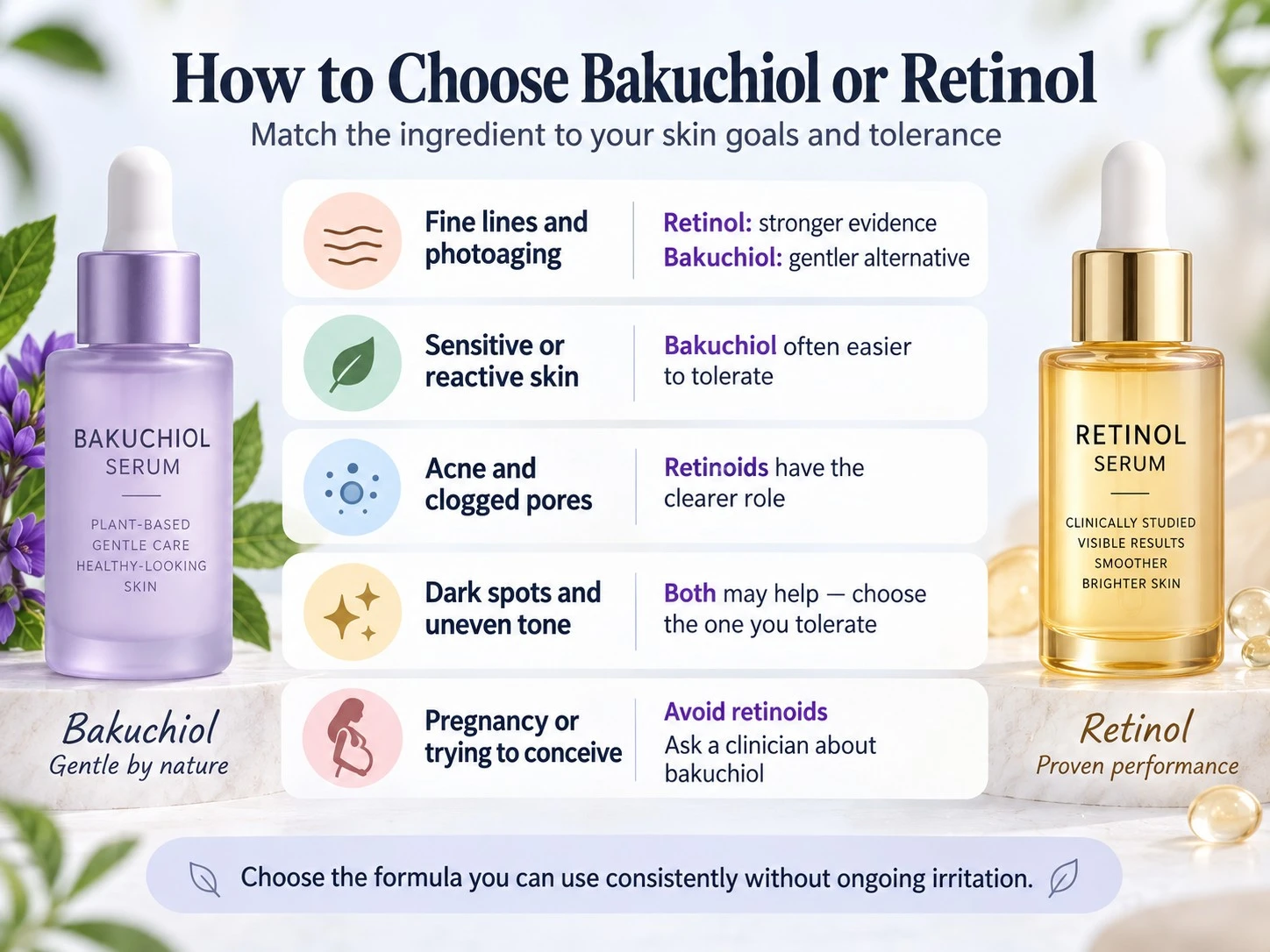
Choose according to the result you want and the amount of irritation your skin can realistically tolerate.
- Fine lines and photoaging: Retinol is the first choice when evidence strength is the priority. Bakuchiol is reasonable when retinol causes repeated irritation or you know you will use the gentler option more consistently.
- Dry, sensitive, or easily irritated skin: Bakuchiol is often the more practical starting point. “Gentler” does not mean reaction-proof, so judge the complete formula, including fragrance and other active ingredients. If your skin has recently become reactive, first distinguish sensitive from sensitized skin rather than immediately adding another active.
- Acne and clogged pores: Topical retinoids have an established role in acne care because they help prevent clogged pores.[1] OTC retinol is not the same as prescription tretinoin or OTC adapalene, and bakuchiol should not replace medical treatment for persistent or inflammatory acne.
- Dark spots and uneven tone: The direct trial found improvement with both ingredients.[2] Irritation itself can leave or worsen dark marks, especially in skin prone to post-inflammatory hyperpigmentation.[1] Choose the option you can use without ongoing redness, burning, or peeling. The guide to hyperpigmentation explains why the type and cause of a dark mark also matter.
- Pregnancy or trying to conceive: Avoid retinoids, including OTC retinol, during pregnancy.[5] Bakuchiol is not a retinoid, but no adequate pregnancy-specific clinical studies establish its safety. Discuss it with your obstetrician or dermatologist instead of treating “retinol alternative” as a pregnancy-safety claim.[6]
Breastfeeding decisions also deserve individual medical advice. Do not apply either active where an infant could have direct skin or mouth contact, and ask your clinician about the exact product and application area.[5]
How to Introduce Bakuchiol or Retinol
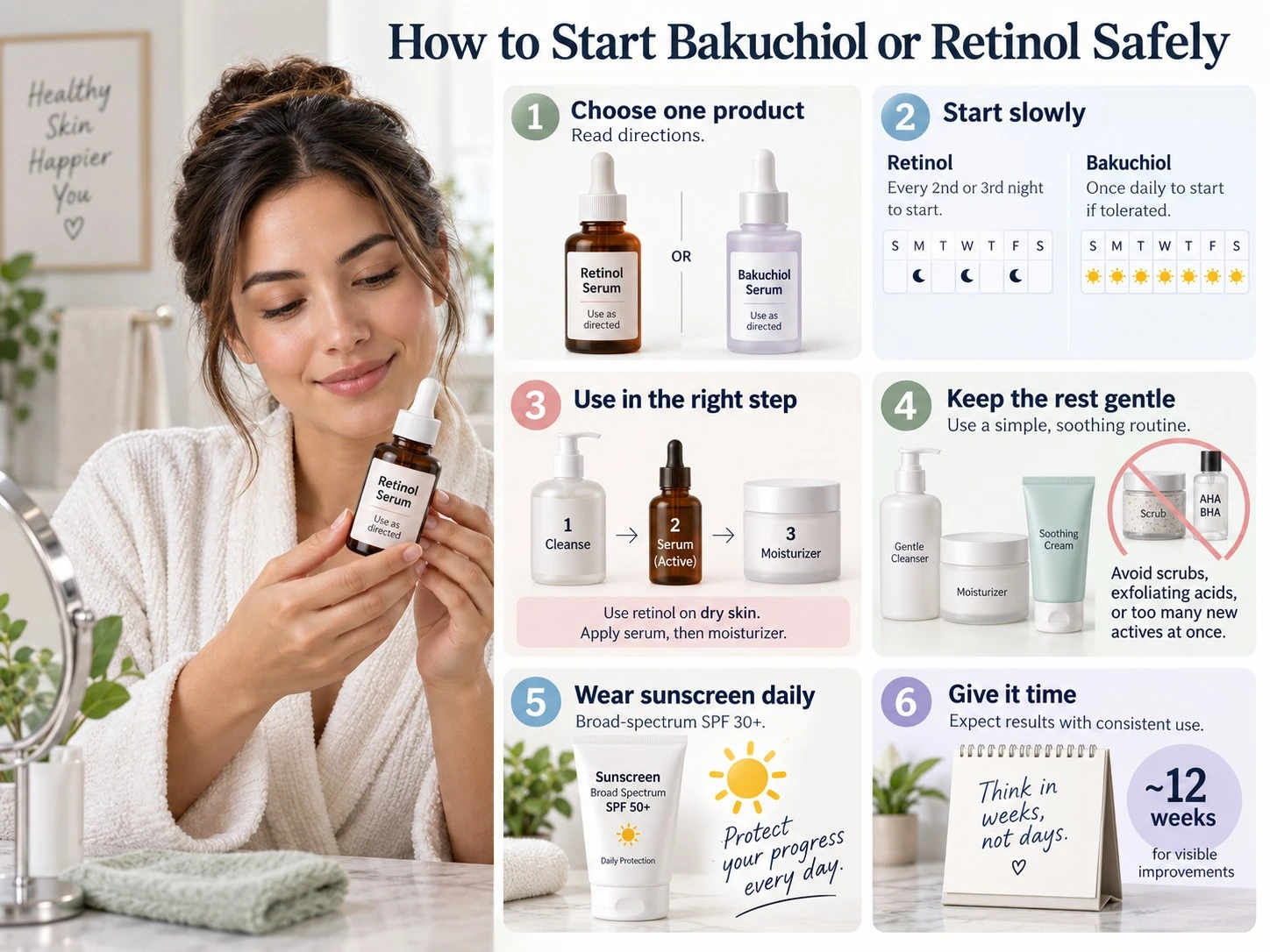
Introduce one active at a time so you can judge both tolerance and results.
- Choose one product and read its directions. Concentration, vehicle, encapsulation, and accompanying ingredients affect how a product behaves, so do not copy another product’s schedule.
- Start on a limited schedule. For retinol, every second or third night is a cautious starting point; increase only when skin remains comfortable.[1] Bakuchiol products are often labeled for once- or twice-daily use, but starting once daily or less often is reasonable for reactive skin.[6]
- Apply in the correct routine position. After cleansing, apply a serum before moisturizer or use a bakuchiol or retinol cream as the moisturizer step. Applying retinol to fully dry skin and using only the label-directed amount may improve tolerance.
- Keep the rest of the routine gentle. Avoid introducing exfoliating acids, scrubs, or several new actives at the same time. If you already use strong treatments, check the complete ingredient-mixing guide or ask your prescriber how to separate them.
- Use broad-spectrum sunscreen every day. Sunscreen protects against ongoing UV damage and is especially important when your goal is fewer dark spots or signs of photoaging. Retinol is normally reserved for night use, while bakuchiol can be used in the morning when its label permits.[1]
Do not judge either ingredient after a few applications. The direct comparison measured its main changes after 12 weeks, while real-world results also depend on the product and consistent use.[2]
Can You Use Bakuchiol and Retinol Together?
You can use products that contain both ingredients, but using both is not automatically better than choosing one. Evidence that bakuchiol alone performs similarly in one trial does not prove that layering it over retinol creates faster or larger results.
If you are new to both, start with one. Once your skin is stable, follow the directions of a professionally formulated combination product or introduce the second ingredient on separate nights. Stop increasing frequency if persistent dryness, redness, or burning appears. This approach makes it easier to identify the cause of a reaction and avoids turning a tolerable routine into an irritating one.
Side Effects and When to Stop
Retinol commonly causes dryness, flaking, redness, burning, or stinging when introduced too quickly. Starting with a lower-strength product, using it less often, and moisturizing can improve tolerance.[1] Repeated irritation is not proof that the product is working.
Bakuchiol tends to cause fewer irritation symptoms in the limited comparative evidence, but it can still cause irritant or allergic contact dermatitis. Published case reports show that plant-derived does not mean allergy-free.[7]
Reduce frequency or stop the new product if you develop persistent burning, marked redness, itching, swelling, cracking, or a worsening rash. Seek medical care promptly for facial or eye swelling, blistering, breathing difficulty, signs of infection, or another severe reaction. Persistent acne, rosacea-like redness, eczema flares, or pigment changes deserve professional evaluation rather than repeated product switching.
FAQs About Bakuchiol and Retinol
Is bakuchiol a retinoid?
No. Bakuchiol is a plant-derived compound with a different structure and mechanism from vitamin A derivatives. It is called a retinol alternative because some early research reports overlapping cosmetic outcomes, not because it belongs to the retinoid family.
Can you use bakuchiol in the morning?
Yes, when the product label permits morning use. Apply it in the position appropriate for its format, then use broad-spectrum sunscreen. Morning compatibility does not make sunscreen optional because UV exposure contributes to the wrinkles and uneven pigmentation bakuchiol is intended to improve.
Should a beginner start with bakuchiol or retinol?
Start with retinol if you want the stronger evidence base and your skin is not especially dry or reactive. Start with bakuchiol if tolerability is the main concern or previous retinol use caused persistent irritation. Whichever you choose, begin with one product and increase frequency gradually.
Can bakuchiol replace prescription tretinoin?
No direct evidence establishes bakuchiol as a replacement for prescription tretinoin. Bakuchiol may be a cosmetic option for visible signs of aging, but tretinoin and other prescription retinoids have different evidence, potency, and medical uses. Do not replace a prescribed treatment without speaking with the prescriber.
Sources
[1] American Academy of Dermatology Association. Retinoid or Retinol?
[2] Dhaliwal S, et al. Prospective, Randomized, Double-Blind Assessment of Topical Bakuchiol and Retinol for Facial Photoageing
[3] Fanning JE, et al. Human Clinical Trials Using Topical Bakuchiol Formulations for the Treatment of Skin Disorders: A Systematic Review
[4] Kafi R, et al. Improvement of Naturally Aged Skin With Vitamin A (Retinol)
[5] American Academy of Dermatology Association. Dermatologist-Approved Pregnancy Skin Care
[6] Cleveland Clinic. Should You Be Using Bakuchiol in Your Skin Care Routine?
[7] Puyana C, et al. Applications of Bakuchiol in Dermatology: Systematic Review of the Literature


