

Lip scrub and lip balm are often marketed as a pair, but they are not interchangeable. A scrub changes surface texture by lifting loose material. Balm supports comfort by softening rough edges and reducing water loss. The right choice therefore depends on the present condition of your lips—not simply whether you want them to look smoother.
What Lip Scrub and Lip Balm Actually Do
Lip scrub removes loose surface flakes
A lip scrub is a mechanical exfoliant. Fine particles—often sugar or another granular material—move across the lip surface and loosen visible flakes. Mechanical exfoliation can create an immediate smoother feel, but exfoliation is cosmetic rather than medically necessary.[1] It does not correct the cause of dryness or rebuild an irritated lip barrier.
Pressure matters as much as the formula. Coarse particles or vigorous rubbing can turn mild flaking into tenderness. Lips also have distinct barrier properties, and lip hydration is closely related to the condition and arrangement of surface cells.[2] “Scrub until perfectly smooth” is therefore a poor goal. Only loose flakes should release easily; attached skin should not be polished or pulled away.
Lip balm softens and protects the surface
A lip balm leaves emollient and/or occlusive ingredients on the lips. Emollients soften rough edges, while occlusives form a film that slows water from escaping. A controlled study found that a highly occlusive lip formulation improved lip roughness and dryness, although the result from one tested formula does not prove that every balm performs equally.[3]
This protective role makes balm the more useful product for everyday dryness. Apply it several times a day and before bed when needed. For very dry, cracked lips, a thick ointment such as white petroleum jelly holds water longer than many waxes or oils.[4] If a balm burns, stings, or feels uncomfortable, stop using it rather than treating the sensation as proof that it is working.[4]
Lip Scrub vs Lip Balm: Side-by-Side Comparison
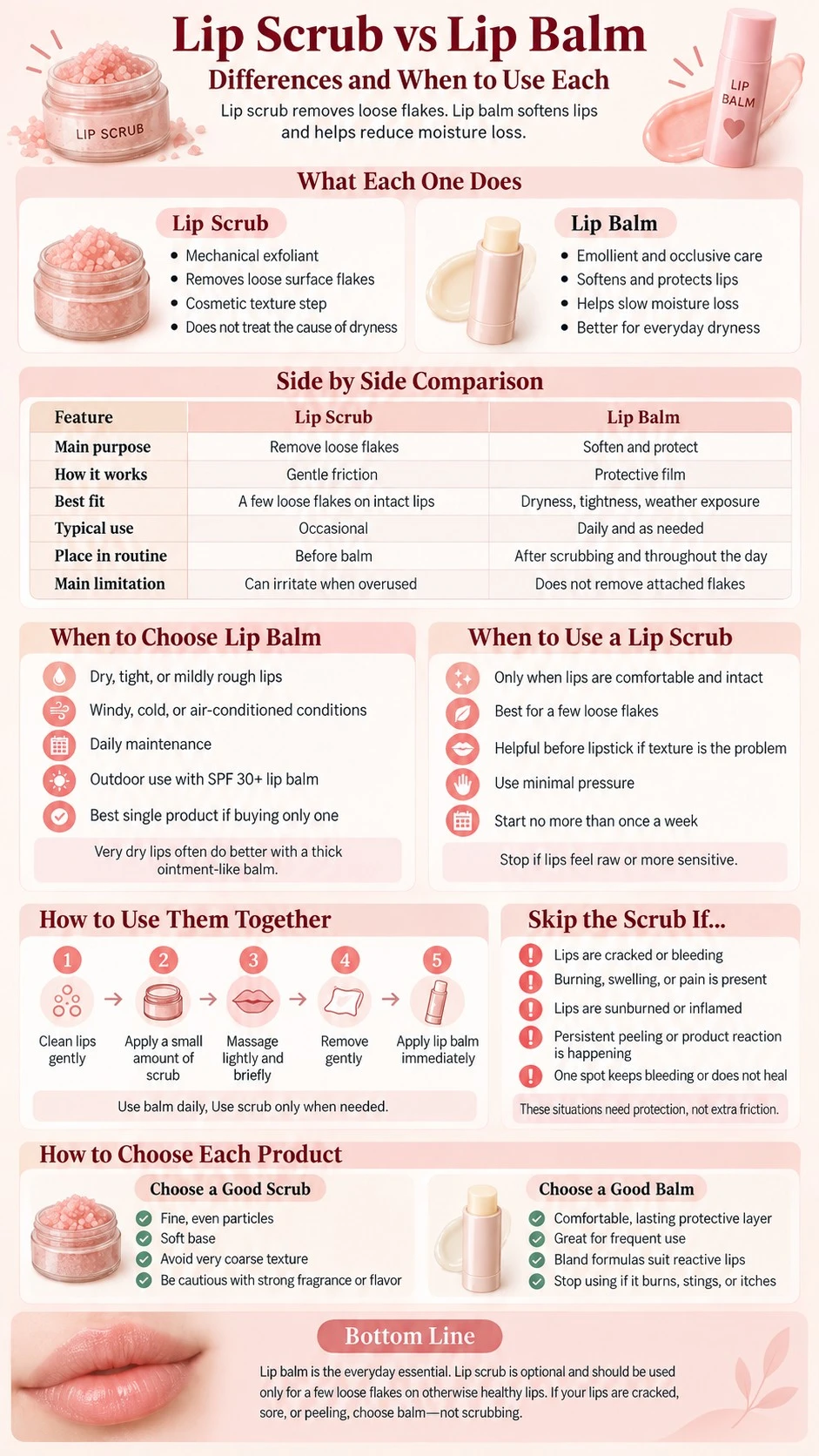
The clearest difference is removal versus protection. The remaining differences determine where each product belongs in a routine.
| Comparison point | Lip scrub | Lip balm |
|---|---|---|
| Main purpose | Removes loose surface flakes | Softens lips and reduces moisture loss |
| How it works | Uses mild mechanical friction | Leaves an emollient and/or occlusive film |
| Best fit | A few loose flakes on comfortable, intact lips | Dryness, tightness, weather exposure, and daily maintenance |
| Typical use | Occasional and based on visible need | Daily and whenever the protective film wears away |
| Place in routine | Before lip balm | After scrubbing and throughout the day as needed |
| Immediate result | A smoother-feeling surface | Softer, more comfortable lips with a protective coating |
| Main limitation | Does not treat dryness and can irritate when overused | Does not mechanically remove attached flakes |
| Avoid or stop when | Lips are cracked, raw, bleeding, burning, swollen, or inflamed | The formula repeatedly burns, stings, itches, or worsens redness |
Neither category guarantees a particular formula quality. A scrub can contain oils or butters, and a balm can contain ingredients that sting or irritate. Product type tells you the intended job; the complete formula and your response determine whether it performs that job comfortably.
When Should You Choose Lip Balm?
Choose lip balm whenever dryness or exposure is the main problem. It is the practical option for tight lips, mild roughness without loose flakes, windy or cold conditions, air-conditioned environments, and daily maintenance. Balm is also the safer first choice when you cannot tell whether the surface is ready for exfoliation.
For outdoor use, select a broad-spectrum SPF 30 or higher lip balm and reapply it as directed. Sun exposure can aggravate dry, chapped lips, while an ordinary balm or scrub without an SPF label should not be treated as sun protection.[4]
Consistent balm use may also make visible flakes softer and less noticeable without exfoliation. If that solves the texture problem, there is no need to add a scrub merely to complete a routine.
When Should You Use a Lip Scrub?
Consider a lip scrub when your lips feel comfortable but a few loose surface flakes remain, especially when those flakes affect the appearance of lipstick. The surface should be intact: no open cracks, bleeding, burning, marked redness, swelling, or pain.
Use the minimum friction needed to release flakes that are already loose. A scrub should not hurt, create a tingling challenge, or leave the lips feeling raw. Start no more than once a week and repeat only when the same mild texture returns. If your lips become drier, more sensitive, or more visibly peeled, reduce the frequency or stop.
The scrub is finished once the loose material has lifted. Continuing until every line or rough area disappears increases friction without addressing the cause of dryness.
How to Use Lip Scrub and Lip Balm Together
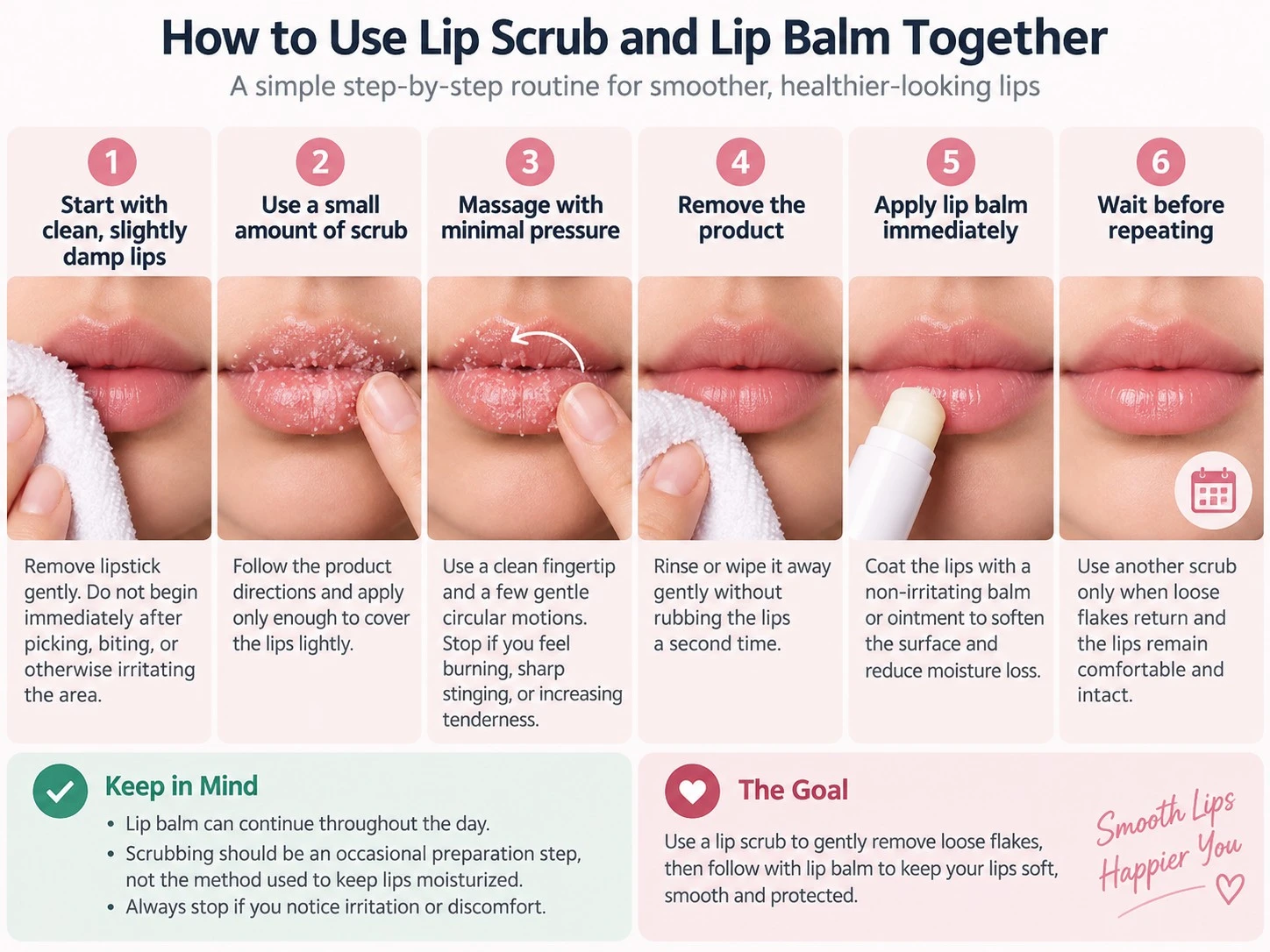
When mild flaking is the only problem, use the products in this order:
- Start with clean, slightly damp lips. Remove lipstick gently. Do not begin immediately after picking, biting, or otherwise irritating the area.
- Use a small amount of scrub. Follow the product directions and apply only enough to cover the lips lightly.
- Massage with minimal pressure. Use a clean fingertip and a few gentle circular motions. Stop if you feel burning, sharp stinging, or increasing tenderness.
- Remove the product as directed. Rinse or wipe it away gently without rubbing the lips a second time.
- Apply lip balm immediately. Coat the lips with a non-irritating balm or ointment to soften the surface and reduce moisture loss.
- Wait before repeating. Use another scrub only when loose flakes return and the lips remain comfortable and intact.
Lip balm can continue throughout the day. Scrubbing should remain an occasional preparation step, not the method used to keep lips moisturized.
When Should You Skip a Lip Scrub?
Do not exfoliate lips that are split, bleeding, swollen, blistered, crusted, sunburned, or actively inflamed. Also pause after a product reaction or when even plain water and balm sting. These conditions call for protection and cause-finding rather than added friction.
Persistent redness, scaling, cracking, itch, burning, or pain can occur with allergic contact cheilitis. Fragrances, flavorings, preservatives, and other substances that touch the lips are among the possible triggers.[5] Scrubbing cannot remove an allergy and may worsen discomfort. Simplify the routine, stop suspicious products, and arrange professional evaluation if symptoms do not settle.
Avoid pulling or biting off attached flakes because doing so can create a fresh crack and restart the irritation cycle. Use a thick, non-irritating balm while the surface recovers. Seek medical advice for persistent or recurring peeling, spreading redness, marked swelling, crusting, blisters, significant pain, or an area that repeatedly bleeds or does not heal.
How to Choose a Lip Scrub or Lip Balm
For a scrub, texture and restraint matter more than an impressive ingredient list. Choose fine, evenly distributed particles in a soft base. Avoid sharp or very coarse particles, and be cautious with strongly flavored or fragranced formulas if your lips are sensitive. A scrub that feels harsh during one light pass is not a good match.
For a balm, look for a formula that feels comfortable and leaves a lasting protective layer. Ingredient roles can overlap, but humectants, emollients, and occlusives contribute in different ways: humectants attract water, emollients soften, and occlusives reduce water loss. Very dry lips often benefit from a simple, ointment-like product with a strong occlusive component.
“Natural,” tingling, cooling, plumping, or heavily flavored does not automatically mean gentler. When lips are reactive, a bland fragrance-free, flavor-free formula can make possible triggers easier to identify. Whatever the label promises, stop using a product that repeatedly burns, stings, itches, or worsens redness.
FAQs About Lip Scrub vs Lip Balm
Do you apply lip balm before or after a lip scrub?
Apply lip balm after you remove the scrub. The scrub lifts loose flakes; the balm then softens the lips and leaves a protective film. If your lips need balm first just to tolerate the scrub, skip exfoliation and focus on recovery.
Can lip balm replace a lip scrub?
Lip balm cannot mechanically remove flakes, but it can make dry surface skin softer and less noticeable over time. For many people, consistent balm use is enough. A scrub is optional when a few loose flakes remain on otherwise comfortable, intact lips.
Can you use a lip scrub every day?
Daily lip scrubbing is usually unnecessary and raises the chance of irritation. Begin no more than once weekly and use it only when needed. Your product’s directions may be more specific, but burning, tenderness, increased peeling, or cracking are reasons to stop regardless of the schedule.
Why do my lips keep peeling even though I use lip balm?
The balm may contain an irritating or allergenic flavor, fragrance, preservative, or other ingredient; habits such as licking or picking can also keep the cycle going. Persistent peeling can have additional causes, so repeated scrubbing is not the answer. Switch to a bland product and seek professional advice if the problem continues or is painful.
Sources
[1] Harvard Health Publishing. Have you exfoliated lately?
[3] Tamura E et al. The efficacy of a highly occlusive formulation for dry lips
[4] American Academy of Dermatology Association. 7 dermatologists’ tips for healing dry, chapped lips
[5] DermNet. Allergic contact cheilitis


