

Humectants, emollients, and occlusives are often presented as three competing moisturizer types. In practice, they describe different moisturizing functions, and many well-designed products combine two or all three. The useful question is not “Which category is best?” but “Does my skin mainly need more water retention, more surface smoothness and lipid support, less water loss, or a combination?”[1][2]
That distinction matters because dry, flaky skin and dehydrated skin can feel similar while reflecting different needs. A lightweight humectant serum may make skin feel temporarily plumper, while a richer formula may be more useful when roughness and water loss are the bigger problems.
Humectants vs Emollients vs Occlusives: What Is the Difference?
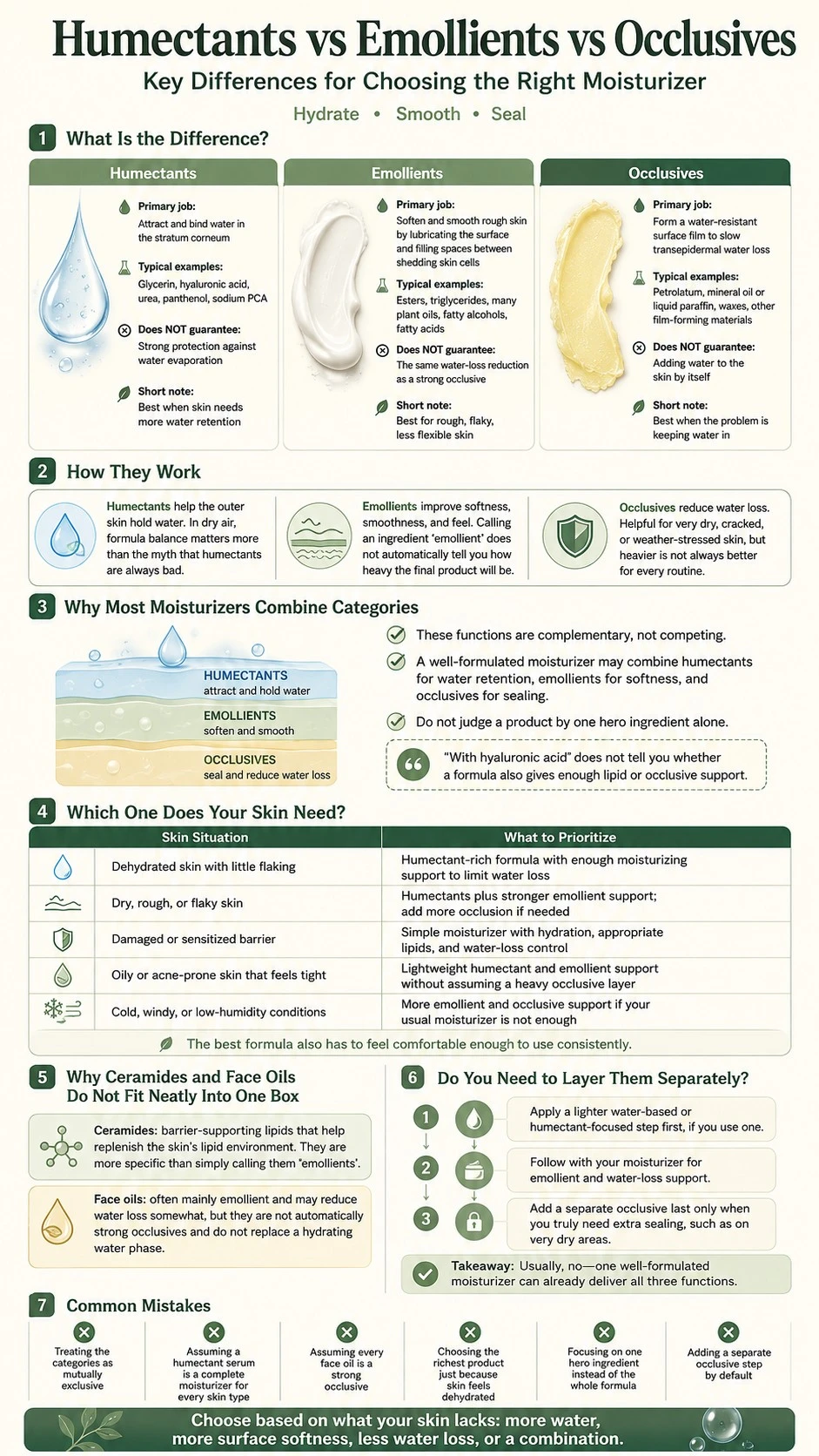
The three categories are easiest to understand by the job they perform in the outer skin. The examples below are typical rather than rigid: some ingredients and finished formulas provide more than one moisturizing effect.[1][2][3]
| Category | Primary Job | Typical Examples | What It Does Not Guarantee |
|---|---|---|---|
| Humectants | Increase water retention in the stratum corneum by attracting and binding water | Glycerin, hyaluronic acid, urea, panthenol, sodium PCA | Strong protection against water evaporation |
| Emollients | Soften and smooth rough skin by lubricating the surface and filling spaces between shedding skin cells | Esters, triglycerides, many plant oils, fatty alcohols, fatty acids | The same degree of water-loss reduction as a strong occlusive |
| Occlusives | Form a water-resistant surface film that slows transepidermal water loss | Petrolatum, mineral oil or liquid paraffin, waxes, and other film-forming materials | Adding water to the skin by itself |
Humectants Help the Skin Hold Water
Humectants are most relevant when the goal is to increase water availability in the outer skin. Water can come from deeper skin layers and, when ambient humidity is high enough, from the surrounding environment.[2][4] This is why humectants are common in lightweight serums, lotions, and creams rather than being limited to one product texture.
The common claim that humectants always “pull water out of your skin” in dry weather is too simplistic. Low humidity changes where the water comes from, and some reviews note that evaporation can become a concern when a humectant is used without enough occlusive support.[4] That does not mean humectants are bad in dry climates. It means the complete formula matters more than the presence of one humectant.
Emollients Improve Softness and Surface Smoothness
Emollients are especially useful when skin feels rough, flaky, or less flexible. Their main value is improving the feel and continuity of the outer skin surface rather than simply increasing water content.[1][2]
This category is also where ingredient labels become less tidy. Oils, esters, fatty acids, fatty alcohols, and other lipophilic materials can differ substantially in spreadability, richness, barrier effects, and sensory finish. Calling something an “emollient” describes a useful function, but it does not tell you exactly how heavy or occlusive the final product will feel.
Occlusives Slow Water Loss
Occlusives are most useful when the problem is not just getting water into the stratum corneum but keeping it there. They reduce evaporation by creating a more water-resistant film on the surface.[1][2]
That stronger water-loss control can be valuable for very dry, cracked, or weather-stressed skin, but heavier occlusion is not automatically better for every face or routine. Texture tolerance, climate, skin condition, and the products underneath all affect whether a highly occlusive finish is useful or simply uncomfortable.
Why Most Moisturizers Combine More Than One Category
A moisturizer does not have to choose between hydration, softness, and water-loss control. Modern formulas commonly combine complementary ingredients because these functions solve different parts of the same problem.[1][3]
For example, a formula may use a humectant to increase water retention, emollient materials to improve roughness and flexibility, and an occlusive component to slow evaporation. A 2025 review of basic emollient formulations also emphasized the value of combining ingredients with complementary biophysical properties, such as glycerol for humectancy with petrolatum or paraffin for occlusion.[3]
This is why judging a moisturizer by one highlighted ingredient can be misleading. “With hyaluronic acid” does not tell you whether the formula also contains enough lipids or occlusive support for very dry skin, just as a product containing oil does not automatically tell you how much hydration it provides.
Which One Does Your Skin Need?
Start with the problem you are trying to solve rather than choosing a category in isolation. If you are not sure whether your skin is lacking water, oil, or both, our Dehydrated vs Dry Skin: Signs, Causes & Best Routine guide explains the distinction in more detail.
| Skin Situation | What to Prioritize | Why |
|---|---|---|
| Dehydrated skin without much flaking | A humectant-rich formula with enough moisturizing support to limit water loss | The main complaint is often low water content rather than a need for a very heavy finish |
| Dry, rough, or flaky skin | Humectants plus stronger emollient support; add more occlusion if needed | Water retention and surface lipid/smoothness support often need to be addressed together |
| Damaged or sensitized skin barrier | A simple moisturizer that combines hydration with appropriate lipids and water-loss control | A humectant-only serum may not address the full barrier problem |
| Oily or acne-prone skin that feels tight | Lightweight humectant and emollient support without assuming a heavy occlusive layer is necessary | Oily skin can still be dehydrated, while an unnecessarily rich texture may feel uncomfortable |
| Cold, windy, or low-humidity conditions | More emollient and occlusive support if your usual moisturizer is no longer enough | Environmental conditions can increase the practical need to reduce water loss and surface roughness |
The right texture still matters. A formula can look excellent on an ingredient list and fail in practice if it is too greasy, sticky, light, or irritating for you to use consistently. If you are choosing between moisturizer formats rather than individual ingredients, see How to Choose a Moisturizer for Your Skin Type.
Why Ceramides and Face Oils Do Not Fit Neatly Into One Box
The humectant–emollient–occlusive framework is useful, but it should not be treated as a perfect ingredient taxonomy. Some materials provide overlapping effects, and some important barrier ingredients are better understood by what they contribute to skin structure than by forcing them into one of the three labels.[1][3]
Ceramides, for example, are physiological lipids found in the stratum corneum. In moisturizers they can help replenish the lipid environment of the barrier, which is more specific than simply calling them “emollients.”[2]
Many face oils primarily provide emollient effects and can also reduce water loss to varying degrees, but an oil is not automatically equivalent to a strong occlusive such as petrolatum. It also does not replace the water phase supplied by a hydrating formula. If you are deciding where oils belong in a routine, Face Oil vs Serum: Differences, Benefits & Which to Use covers that decision directly.
Do You Need to Layer a Humectant, Emollient, and Occlusive Separately?
Usually not. If one moisturizer already combines the functions your skin needs, adding three separate products can create complexity without a clear benefit. The ingredient list and the finished texture matter more than whether your routine contains one product labeled for each category.
If you do use separate products, the practical sequence is usually:
- Apply the lighter water-based or humectant-focused step first if you use one.
- Follow with your moisturizer to add emollient and water-loss support.
- Add a separate occlusive layer last only when you actually need extra sealing, such as on very dry areas or when your normal moisturizer is not enough.
This order is a texture-based rule, not a requirement to buy three products. A single well-formulated cream can already deliver all three functions.
Common Mistakes When Choosing Moisturizing Ingredients
- Treating the categories as mutually exclusive. Real formulas and some individual ingredients can provide overlapping effects.
- Assuming a humectant serum is a complete moisturizer for every skin type. Very dry or barrier-impaired skin may also need lipid and water-loss support.
- Assuming every face oil is a strong occlusive. Oils vary in composition and occlusive effect.
- Choosing the richest possible product because your skin feels dehydrated. Dehydration does not always require a heavy ointment-like finish.
- Focusing on one hero ingredient instead of the whole formula. A product’s performance depends on ingredient combinations, levels, vehicle, and how the formula behaves on skin.
- Adding a separate occlusive step by default. Extra occlusion is useful when it solves a real dryness or water-loss problem, not simply because it is the final category in a diagram.
Final Thoughts
Humectants, emollients, and occlusives solve different parts of moisturization. Humectants help increase water retention, emollients improve softness and surface smoothness, and occlusives reduce water loss. None is universally “best,” and most people do not need to choose only one.[1][2]
The more useful approach is to match the formula to what your skin is missing. Dehydrated skin may benefit from stronger humectant support, dry and flaky skin often needs more emolliency, and skin that keeps losing moisture may need greater occlusion. In many cases, one balanced moisturizer already combines these functions more effectively than a complicated three-product layering routine.
FAQs About Humectants, Emollients and Occlusives
Is Hyaluronic Acid a Humectant or an Emollient?
Hyaluronic acid is generally used as a humectant because of its water-binding role. Its presence does not tell you whether the finished product also provides meaningful emollient or occlusive support, so judge the complete formula rather than the ingredient alone.[2]
Are Ceramides Humectants, Emollients, or Occlusives?
Ceramides are skin-identical barrier lipids rather than a perfect fit for a single simplified category. They are often discussed alongside emollient or barrier-replenishing ingredients because they help support the lipid structure of the stratum corneum.[2]
Is Petrolatum an Occlusive?
Yes. Petrolatum is a classic occlusive material that forms a hydrophobic surface layer and reduces transepidermal water loss.[1][3] It is useful when stronger sealing is needed, but its heavy feel is not necessary for every routine.
Can Humectants Make Skin Drier in Low Humidity?
Low humidity changes how humectants obtain water, and some formulations can benefit from occlusive support to reduce evaporation.[4] This does not mean humectants should be avoided in dry climates. A complete moisturizer that combines hydration with appropriate emollient or occlusive support is usually a more useful solution than avoiding humectants altogether.
Can Oily Skin Use Humectants and Emollients?
Yes. Oil production and skin hydration are different issues, so oily skin can still feel tight or dehydrated. A lightweight moisturizer can provide humectant and emollient functions without requiring a very rich occlusive finish.
Do I Need a Humectant Serum Under My Moisturizer?
Not necessarily. Many moisturizers already contain humectants alongside emollient and occlusive ingredients. A separate serum is useful only when it improves your routine for a specific reason, such as giving you a lighter extra hydration step without making the final texture too heavy.
Sources
[1] Rajkumar J, Chandan N, Lio P, Shi V. The Skin Barrier and Moisturization: Function, Disruption, and Mechanisms of Repair
[2] Del Rosso JQ, Kircik LH. Skin 101: Understanding the Fundamentals of Skin Barrier Physiology—Why Is This Important for Clinicians?
[3] Wollenberg A et al. Basic Emollients for Xerosis Cutis in Atopic Dermatitis: A Review of Clinical Studies
[4] Barnes TM et al. Vehicles for Drug Delivery and Cosmetic Moisturizers: Review and Comparison


