

Lip masks are often sold as simple overnight moisturizers, but the category also includes hydrogel patches, short-contact treatments, and formulas with exfoliating or plumping ingredients. Those products do not share one universal application method or schedule. The safest routine begins with the directions on the specific package, then adjusts only within those directions according to comfort and dryness.
First, Identify What Type of Lip Mask You Have
The product format determines whether you leave the mask on, remove it, or limit how often you use it. Check both the directions and ingredient list before the first application.
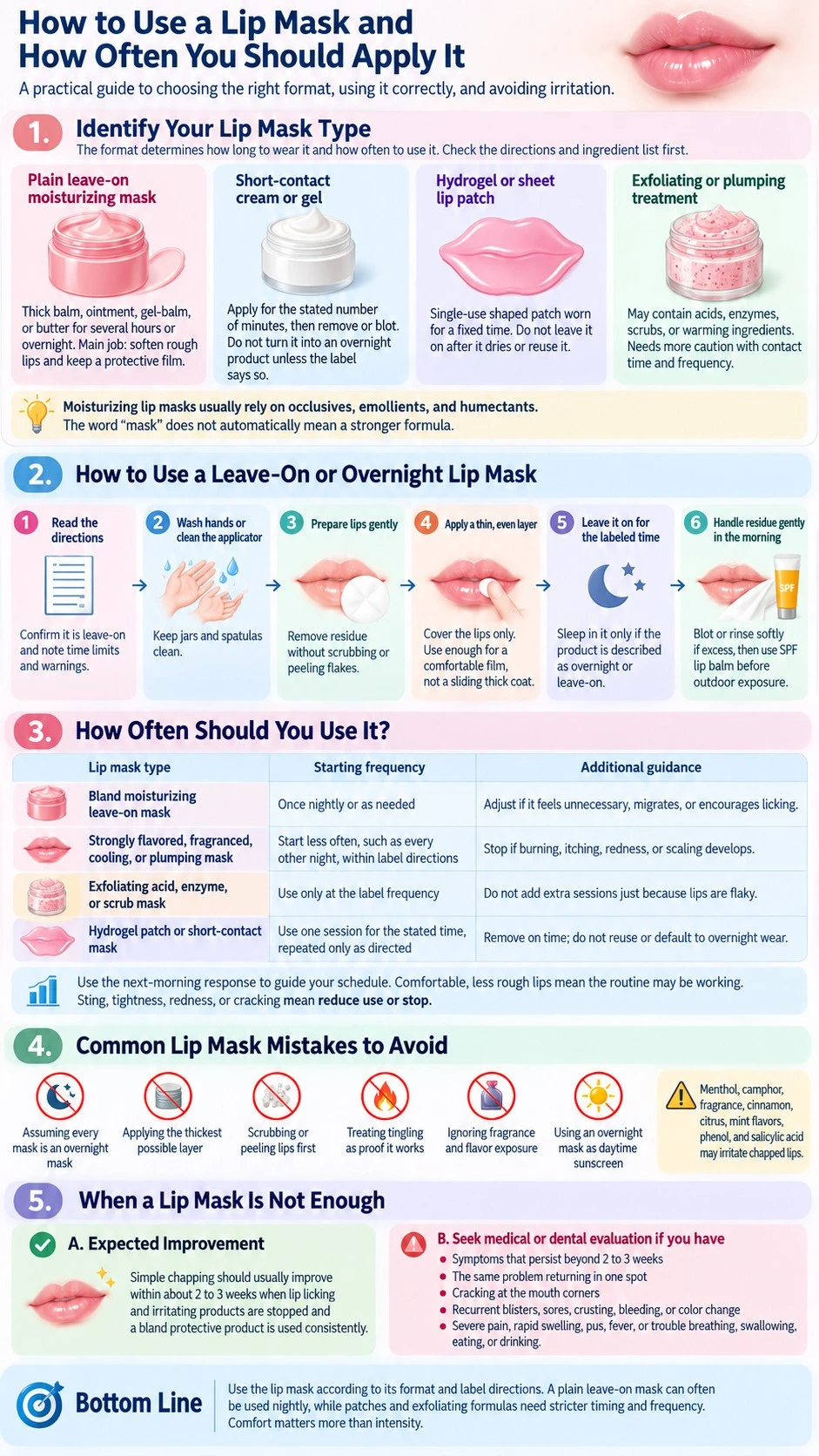
- Plain leave-on moisturizing mask: Usually a thick balm, ointment, gel-balm, or butter designed to remain on for several hours or overnight. Its main job is to soften rough surface cells and maintain a protective film.
- Short-contact cream or gel: Applied for a stated number of minutes and then removed or blotted. Do not convert it into an overnight product unless the label allows that use.
- Hydrogel or sheet-style lip patch: A shaped single-use patch worn for a fixed time. It is not the same as a jarred sleeping mask and should not be left on after it dries or reused.
- Exfoliating or plumping treatment: May contain acids, enzymes, scrubbing particles, or ingredients that create warmth or tingling. Its frequency and contact time require more caution than a plain moisturizer.
Most moisturizing lip masks rely on the same functional groups found in other moisturizers. Occlusives slow water loss, emollients smooth rough cells, and humectants help attract and hold water near the surface.[1] A richer texture may keep the film in place longer, but the word “mask” does not guarantee a particular formula or stronger result. For help interpreting those roles, see humectants, emollients, and occlusives.
Look beyond the featured ingredient on the front label. The full list can reveal fragrance, flavor, cooling agents, exfoliating acids, sunscreen actives, or potential allergens that change how the product should be used. The guide to reading a skincare ingredient list explains ordering and label conventions.
How to Use a Leave-On or Overnight Lip Mask
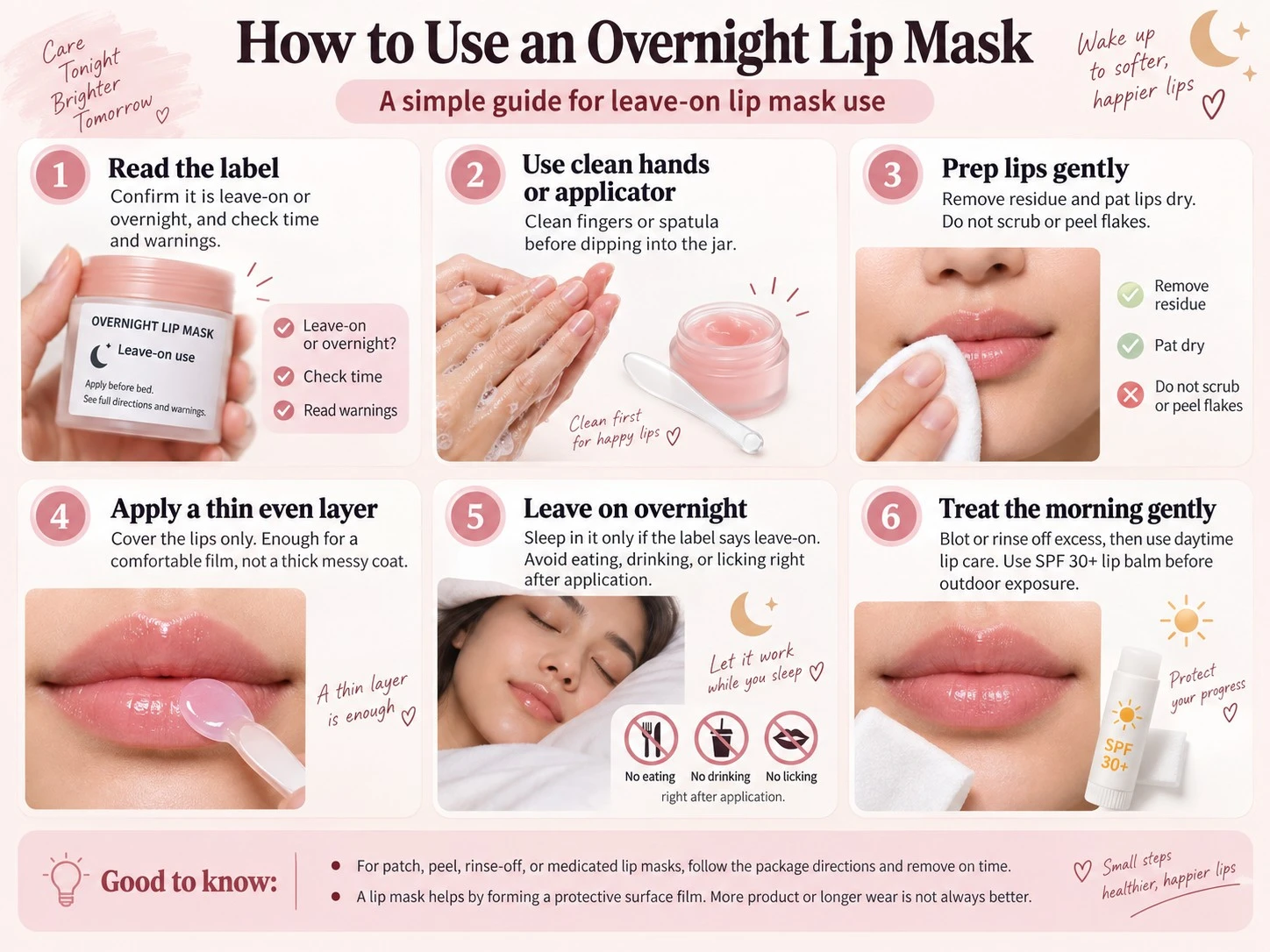
The following sequence fits a standard moisturizing mask labeled for leave-on or overnight use. It does not override different directions on a patch, peel, rinse-off treatment, or medicated product.
- Read the directions before applying. Confirm that the product is leave-on, check the suggested contact time, and note any warnings or frequency limits.
- Wash your hands or clean the applicator. If the mask comes in a pot, avoid repeatedly dipping an unwashed finger into it. Use the supplied spatula when available and clean it as directed.
- Prepare the lips gently. Remove food, toothpaste, lipstick, and other residue without scrubbing. Pat the lips dry enough for the mask to stay in place. Do not peel attached flakes or use a rough towel.
- Spread a thin, even layer. Cover the visible lip surface without pushing the product far onto the surrounding skin. Add only enough to maintain a comfortable film; a layer that slides, drips, or transfers heavily is more product than you need.
- Leave it on for the labeled time. An overnight mask can remain on while you sleep. Avoid eating, drinking, or licking immediately after application because these actions remove the film and can move product into the mouth.
- Handle morning residue gently. If little remains and the lips feel comfortable, you do not have to scrub it off. Blot or rinse away sticky excess, then apply daytime lip care as needed. Before outdoor exposure, use a broad-spectrum SPF 30 or higher lip balm and reapply it at least every two hours.[2]
For a short-contact cream, hydrogel patch, or rinse-off mask, follow the same clean-hands and gentle-preparation principles but remove the product when its timer ends. Leaving a patch on until it becomes dry or sleeping in a formula designed for brief contact can increase friction, mess, or irritation without proving a better result.
A lip mask works mainly at the surface. Lip skin has relatively low water-holding capacity and a vulnerable barrier, which helps explain why a persistent protective film can improve comfort.[3] Research on one highly occlusive lip formulation found improved roughness, but that result does not mean every mask must be thickly layered or that more contact time is always better.[4]
How Often Should You Use a Lip Mask?
For a plain, non-exfoliating leave-on mask, once nightly is a reasonable routine when the label permits daily use and your lips remain comfortable. You can use it less often when dryness is mild. The correct schedule changes when the formula contains exfoliating or irritating ingredients, uses a patch format, or gives a fixed treatment interval.
| Lip mask type | Practical starting frequency | When to adjust |
|---|---|---|
| Bland moisturizing leave-on mask | Once nightly or as needed | Use less often if the layer feels unnecessary, migrates, or encourages licking |
| New, strongly flavored, fragranced, cooling, or plumping mask | Start less often, such as every other night, within label directions | Stop rather than “build tolerance” if burning, itching, redness, or scaling develops |
| Exfoliating acid, enzyme, or scrub mask | Only at the frequency printed on the label | Do not add extra sessions because the lips are flaky; damaged lips usually need gentler care |
| Hydrogel patch or short-contact mask | One session for the stated time, repeated only as directed | Remove on time; do not reuse a single-use patch or default to overnight wear |
Dry air, cold weather, wind, mouth breathing, lip licking, and frequent eating or drinking can remove moisture or shorten the life of the product film. During those periods, a bland mask may be useful more often. When the lips feel comfortable, there is no benefit in following an intensive schedule simply because a mask is marketed for nightly use.
Use the next-morning response to adjust the schedule. Continue at the same frequency if the lips feel comfortable and less rough. Reduce use or stop if sting, tightness, redness, cracking, or the urge to lick and reapply increases.
Common Lip Mask Mistakes to Avoid
Most problems come from using the wrong format, too much product, or a formula that irritates already-chapped lips.
- Assuming every mask is an overnight mask: Contact time comes from the label, not the product name alone.
- Applying the thickest possible layer: Excess product is more likely to migrate, collect hair and debris, or transfer to bedding. An intact, comfortable film is enough.
- Scrubbing or peeling first: Removing attached flakes can deepen cracks. A moisturizing mask does not require freshly exfoliated lips to work.
- Treating tingling as proof of efficacy: Burning, stinging, or discomfort can mean the formula is irritating your lips. Menthol, camphor, fragrance, cinnamon, citrus, mint flavors, phenol, and salicylic acid are among the ingredients that can bother chapped lips.[2]
- Ignoring fragrance and flavor exposure: Products remain close to the mouth for hours. If you are sensitive, choose a simpler formula and understand the difference between fragrance-free and unscented.
- Using the overnight mask as daytime sunscreen: A glossy or oily layer does not provide dependable UV protection unless the product carries tested SPF labeling and directions.
Do not keep using a mask that repeatedly makes the lips worse. Allergic contact cheilitis can cause dryness, scaling, cracking, itching, burning, or pain, and fragrance or flavorings and preservatives are recognized allergen groups.[5]
When a Lip Mask Is Not Enough
A lip mask can support the surface barrier, but it cannot diagnose or correct every cause of peeling, cracking, soreness, or swelling. Simple chapping should show noticeable improvement within about two to three weeks when irritating products and lip licking are stopped and a bland protective product is used consistently.[2]
Arrange a medical or dental evaluation if symptoms persist beyond that period, keep returning in the same spot, affect the corners of the mouth, or include recurrent blisters, sores, crusting, bleeding, or color change. Seek prompt care for severe pain, rapidly spreading swelling, pus, fever, or trouble breathing, swallowing, eating, or drinking. These situations require more than another layer of cosmetic lip care.
FAQs About Using a Lip Mask
Can you sleep with a lip mask on?
Yes, if the product is labeled as an overnight or leave-on lip mask. Apply a thin, even layer and keep it within the lip line. Do not sleep in a hydrogel patch, peel, scrub, medicated treatment, or short-contact mask unless its directions specifically allow overnight wear.
Should you apply lip balm before or after a lip mask?
A rich leave-on mask usually already contains the emollient and occlusive ingredients that would be supplied by a balm, so layering is often unnecessary. If a light, water-rich mask dries down quickly, a thin layer of a compatible bland occlusive balm can go on last. Stop layering if the mixture stings or migrates beyond the lips.
Do you need to wipe off a lip mask in the morning?
Only remove what remains sticky or uncomfortable. Gently blot or rinse away the excess instead of scrubbing. If the mask has already worn away and your lips feel comfortable, you can proceed with your daytime lip balm or SPF lip product.
Can you use a lip mask during the day?
Yes, a leave-on moisturizing mask can be used during the day if it is comfortable and the label allows it. A rich texture may move during eating, drinking, or speaking, so a lighter balm is often more practical. A daytime mask does not replace SPF unless it is specifically labeled as a broad-spectrum sunscreen.
Sources
[1] Kang et al. Moisturizer in Patients with Inflammatory Skin Diseases
[2] American Academy of Dermatology. 7 Dermatologists’ Tips for Healing Dry, Chapped Lips
[4] Tamura et al. The Efficacy of a Highly Occlusive Formulation for Dry Lips
[5] DermNet. Allergic Contact Cheilitis


