


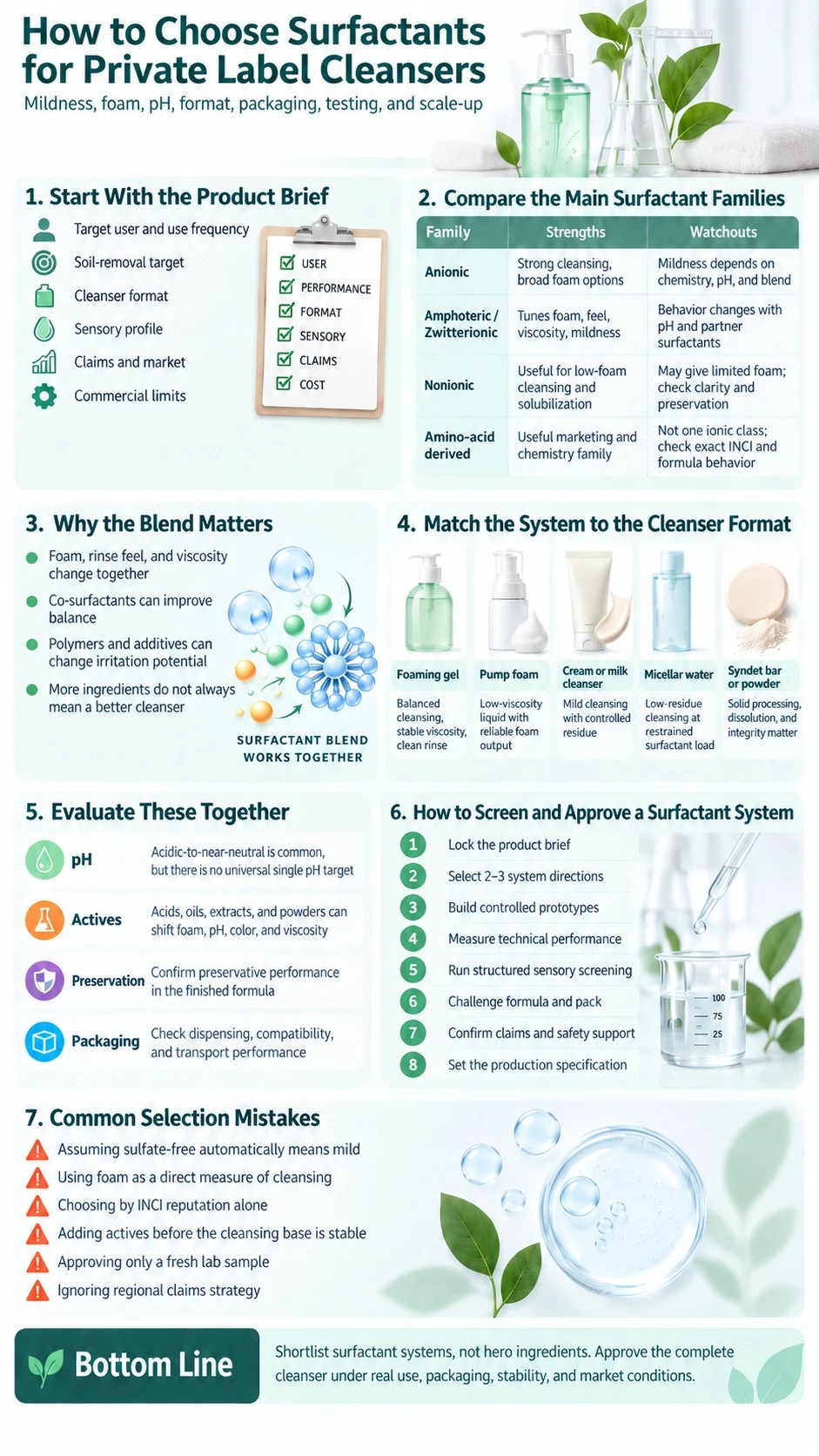
A surfactant is the working core of most water-based facial cleansers. It helps water lift and carry away sebum, sunscreen, makeup residue, and particulate soil.[2] Yet a recognizable ingredient name does not tell a product team how the finished cleanser will foam, rinse, thicken, feel after washing, or perform through shelf life.
For a private label project, the right question is not “Which surfactant is best?” It is “Which surfactant system can deliver our target cleansing experience, claims direction, cost, packaging, and market requirements?” Research on cleanser mildness also shows why the answer must be made at formula level: surfactants can interact with skin proteins and lipids, while the type of surfactant, the blend, pH, and other formula components can change that interaction.[1]
Start With the Product Brief, Not a Surfactant Trend
Before asking a manufacturer for sulfate-free, amino-acid, glucoside, or high-foam options, define what the product has to do. A useful brief should establish:
- Target user and use frequency: For example, a daily cleanser for dry-feeling skin, a refreshing wash for oily-feeling skin, or a second-step evening cleanser.
- Soil-removal target: Decide whether the product must remove light daily residue, water-resistant sunscreen, makeup, or mainly excess surface oil.
- Format: Gel, cream, milk, micellar water, pump foam, syndet bar, and powder formats impose different solubility, viscosity, and processing constraints.
- Sensory profile: Specify foam volume and density, cushion, slip, rinse speed, eye-area expectations, fragrance direction, and acceptable after-feel.
- Claims and market: “Cleanses,” “removes makeup,” “sulfate-free,” and “helps treat acne” do not carry the same formulation, testing, or regulatory implications. In the United States, intended use can place a cleanser in the cosmetic category, the drug category, or both.[5]
- Commercial limits: Include target cost, pack type and size, launch market, forecast volume, and whether the project uses an existing base or a custom development route.
This information gives a custom skincare formulation team a measurable target. It also prevents a common mismatch: selecting a fashionable surfactant first, then trying to force it into a texture, foam profile, and package it was not chosen to support.
Compare the Main Surfactant Families
Ionic class is a useful first screen, but it is not a finished-product mildness score. Ingredients within the same class can behave differently, and blends can behave differently from their components.
| Surfactant family | Typical role in a facial cleanser | Potential strengths | Development watchouts | Often considered for |
|---|---|---|---|---|
| Anionic | Primary cleansing and foaming | Efficient soil removal; strong foam potential; broad formulation options | Some chemistries can interact more strongly with skin proteins; salt response, pH range, and blend ratio affect viscosity and feel | Foaming gels, daily washes, syndet formats, and formulas needing clear foam cues |
| Amphoteric or zwitterionic | Primary surfactant in some mild systems or co-surfactant with anionics | Can modify foam quality, reduce harshness in a blend, and help tune viscosity | Behavior changes with pH and partner surfactants; impurities and exact INCI still require review | Gentle foaming cleansers, pump foams, and balanced mixed systems |
| Nonionic | Mild cleansing, solubilization, emulsification, or co-surfactant support | Useful in low-foam or emulsion-like formats; can help disperse oils and fragrance | Foam may be limited; clarity, rinse feel, cloud point, and preservative interactions require evaluation | Micellar waters, cream or milk cleansers, and low-foam systems |
| Cationic | Conditioning or antimicrobial function in selected applications, not the usual primary facial-cleansing base | Can provide deposition or conditioning effects in compatible systems | Compatibility with anionic surfactants can be poor; regulatory and safety context depends on ingredient and claim | Specialized systems rather than a default face-wash platform |
This table is a screening map, not a recipe. Even a cleanser built with a generally mild surfactant family can disappoint if the total system removes too much lipid, leaves residue, stings, collapses in viscosity, or fails packaging and stability work.
Why “amino acid surfactant” is not a separate ionic class
The phrase usually refers to surfactants made with amino-acid-related building blocks, such as glutamate, glycinate, alaninate, or sarcosinate derivatives. Many commonly marketed examples are anionic; others can be amphoteric. The label therefore overlaps the charge-based families rather than sitting beside them.
For sourcing, request the exact INCI name, supplied active matter, solvent system, salt content, recommended pH and processing conditions, and supporting safety or performance data. “Amino acid cleanser” may be a useful consumer-facing direction, but it does not replace a formula specification. The same caution applies to “coconut-derived,” “plant-based,” and “natural-origin”: source language alone does not establish finished-product safety or mildness.[4]
Why the Blend Matters More Than One Ingredient
Surfactant molecules exist as free monomers and organize into aggregates such as micelles. Their concentration, molecular structure, partners, polymers, electrolytes, oils, and pH influence the amount and behavior of surfactant available to interact with soil and skin. That is why changing one co-surfactant can alter foam, viscosity, cleansing, rinse feel, and irritation potential at the same time.
Mixed systems are often used to balance these tradeoffs. An amphoteric ingredient may soften the sensory profile of an anionic base, while a nonionic component may support oil solubilization or a creamier cleansing format. Polymers and mildness enhancers can also change how surfactants associate and interact with skin; experimental work has shown that polymer-surfactant complexes can reduce irritation potential in cleanser systems.[3]
This does not mean that adding more ingredients automatically improves a formula. Each addition can affect clarity, preservation, fragrance solubilization, viscosity response, rinse residue, cost, and scale-up. A concise, well-characterized system is often easier to control than a crowded ingredient story.
Match the Surfactant System to the Cleanser Format
Start with the consumer experience and dispensing method, then select candidate systems that can physically deliver it.
| Cleanser format | Surfactant-system priority | Prototype questions |
|---|---|---|
| Foaming gel | Balanced cleansing, foam persistence, controllable viscosity, and clean rinse | Does viscosity remain stable across temperature and raw-material variation? Does the formula foam in hard and soft water? |
| Pump foamer | Low-viscosity liquid with reliable aeration and compatible foam quality | Does it pass through the mesh consistently? Does output stay uniform after storage and repeated use? |
| Cream or milk cleanser | Mild emulsifying and cleansing balance with controlled residue | Does it remove the intended soil without waxy drag, excessive film, or emulsion instability? |
| Micellar water | Low-residue solubilization and cleansing at a restrained surfactant load | Does it remove the claimed soil without tack, haze, eye-area discomfort, or residue? |
| Syndet bar or powder | Solid-state processing, dissolution, bar integrity, and controlled dust or moisture sensitivity | Does it manufacture consistently, survive distribution, wet out properly, and rinse as intended? |
Packaging is part of this choice. A viscous gel that works in a tube may not move through a foamer, while a thin micellar cleanser needs a closure that controls leakage and dispensing. Use the face cleanser packaging guide to align pack format with viscosity and dispensing behavior, then plan packaging compatibility testing on the actual formula and intended components.
Evaluate pH, Actives, Preservation, and Packaging Together
Face cleansers are often developed in an acidic-to-near-neutral range because very alkaline conditions can increase stratum-corneum swelling and disturb lipid organization.[1] However, “exactly pH 5.5” is not a universal specification. The workable range must also support surfactant performance, preservative efficacy, active stability, viscosity, packaging compatibility, and the product’s intended claims.
Consider these interactions during prototype design:
- Rheology: Electrolytes, amphoterics, polymers, acids, extracts, and fragrance can change viscosity or clarity. A laboratory texture may shift after scale-up or temperature cycling.
- Actives: Acids, enzymes, clays, oils, and botanical extracts may change pH, foam, color, odor, preservation demand, or rinse behavior. A rinse-off active story must remain technically and legally supportable.
- Preservation: A water-based cleanser still needs an appropriate preservation strategy. Surfactants can affect how preservatives partition, so efficacy is confirmed in the finished formula rather than inferred from the ingredient list.
- Claims: Cleansing and cosmetic appearance claims differ from disease-treatment claims. An acne-treatment or antibacterial positioning can change the U.S. regulatory pathway.[5]
- Manufacturing: Order of addition, mixing energy, aeration control, heating and cooling, and raw-material variability can affect the final batch.
A broader skincare formulation guide can help commercial teams understand how these dependencies move from brief to laboratory sample and production specification.
How to Screen and Approve a Surfactant System
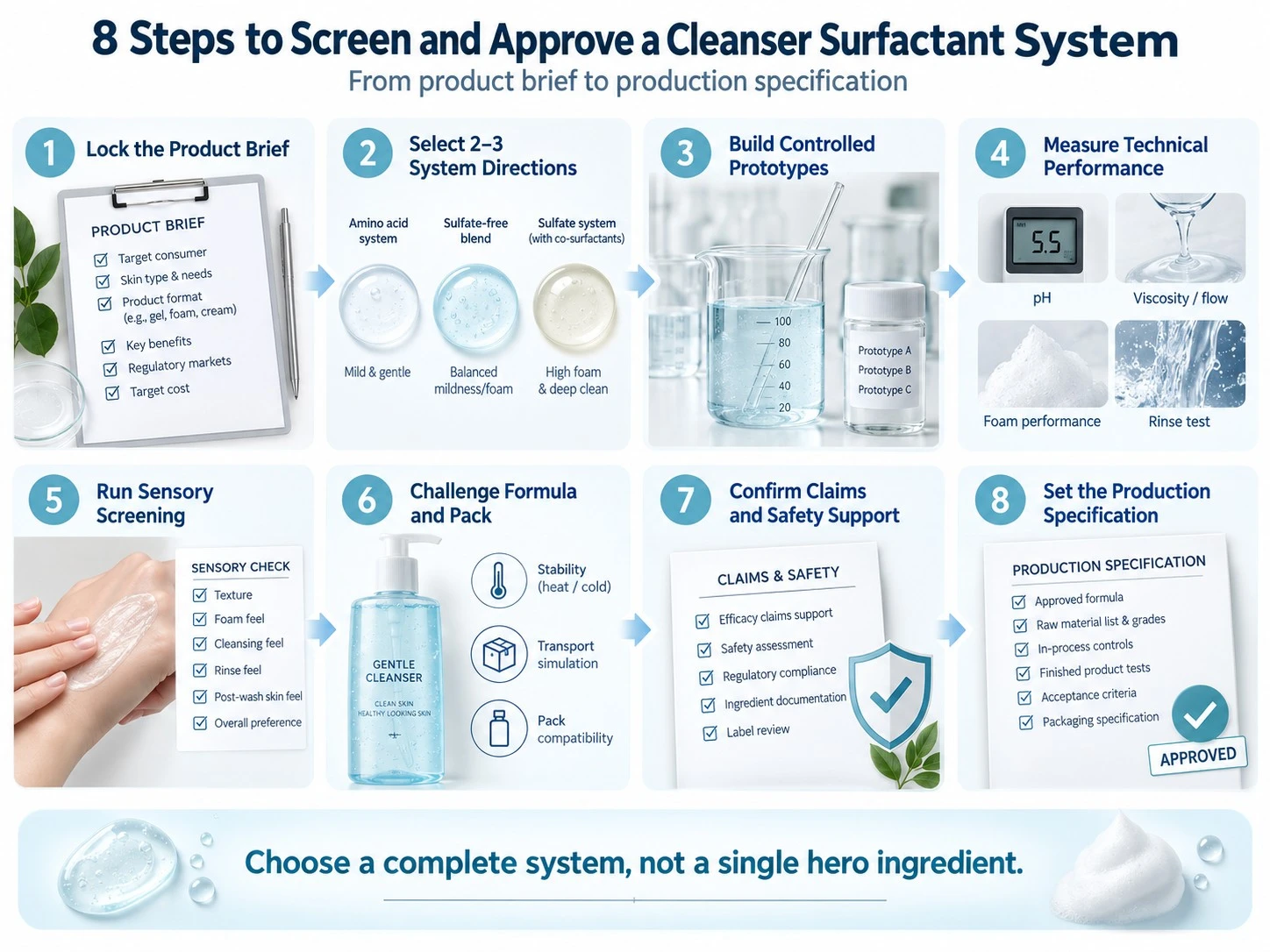
Use a staged approval process so that an appealing first sample does not become the only decision criterion.
- Lock the product brief. Define user, format, soil-removal target, foam, after-feel, fragrance, claims, pack, market, target cost, and reference products.
- Select two or three system directions. Compare complete platforms, such as a higher-foam mixed anionic/amphoteric system and a lower-foam nonionic-led system, rather than swapping one hero ingredient in isolation.
- Build controlled prototypes. Keep the brief stable and document each formula change so sensory differences can be traced to the system.
- Measure technical performance. Review appearance, odor, pH, viscosity or flow, foam behavior, rinse behavior, and soil removal using methods relevant to the product.
- Run structured sensory screening. Evaluate slip, cushion, eye-area experience where relevant, tightness, residue, and after-feel with consistent use instructions.
- Challenge the formula and pack. Conduct suitable stability, microbiological, packaging compatibility, transport, and dispensing work for the formula, market, and package.
- Confirm claims and safety support. FDA does not prescribe one universal test list for every cosmetic; the manufacturer or distributor remains responsible for marketed-product safety, and the testing plan should fit the formula and intended use.[4]
- Set the production specification. Define acceptable ranges, critical process controls, raw-material requirements, batch-release checks, and change-control expectations before commercialization.
Ask the manufacturer to explain why the selected system fits the brief and which tests will resolve its main risks. That discussion is more informative than a request for a generic “mild surfactant list.”
Common Surfactant Selection Mistakes
- Treating sulfate-free as proof of mildness: Removing sulfates changes the ingredient story, but it does not establish how the replacement blend interacts with skin or performs in use.
- Using foam as a direct measure of cleansing: Consumers may read foam as efficacy, yet high foam and soil removal are separate formulation outcomes.
- Choosing by INCI reputation alone: Supplier grade, active matter, impurities, solvent, pH, and blend architecture can all change performance.
- Adding actives before the cleansing base is stable: Every acid, extract, oil, or powder can create new pH, preservation, foam, color, and viscosity work.
- Approving only a fresh laboratory sample: A successful sample still needs stability, microbiological, compatibility, dispensing, scale-up, and safety substantiation appropriate to the product.
- Ignoring regional claims strategy: The same formula can face different requirements when the marketing moves from cosmetic cleansing language to acne, antibacterial, or other treatment language.
The best system is therefore not the one with the most fashionable ingredient list. It is the one that meets the brand brief reproducibly and remains supportable through manufacturing, testing, packaging, and market review.
Discuss Your Private Label Face Cleanser Project
ZICAIL can review your target cleanser format, consumer profile, sensory direction, claims brief, packaging concept, launch market, and commercial constraints as one development brief. Share reference products and define what must be matched, improved, or deliberately avoided.
Explore ZICAIL’s private label face cleanser options or contact the team to discuss which development route and prototype directions fit your project.


