

What Skincare Formulation Really Means for Brands
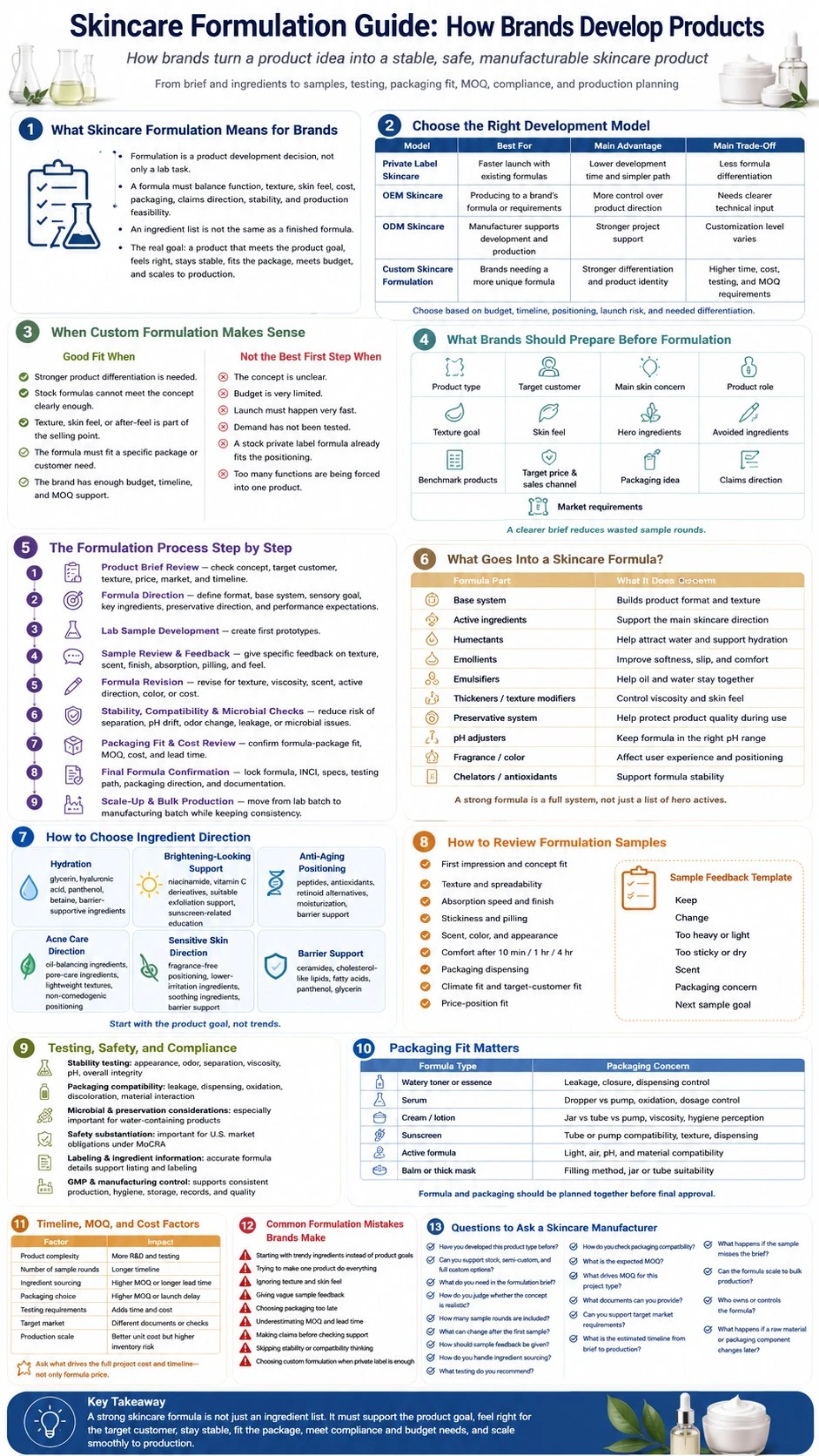
For a skincare brand, formulation is a product development decision, not only a lab task.
A formula needs to balance function, texture, skin feel, target skin type, cost, packaging, claims direction, shelf stability, and production feasibility. A sample may feel promising in the lab, but it still needs to work during filling, storage, shipping, and customer use.
This is why an ingredient list is not the same as a formula. Two products can use similar hero ingredients but feel and perform very differently because of the base system, concentration, pH, emulsifiers, preservatives, texture modifiers, packaging, and manufacturing process.
For B2B buyers, the better question is not “Can we add this ingredient?” It is:
Can this formula meet the product goal, feel right for the target customer, stay stable, fit the packaging, meet the budget, and scale to production?
That is the real work of skincare formulation.
Skincare Formulation vs Private Label vs OEM/ODM
Before starting a skincare project, brands need to choose the right development model. Private label, OEM, ODM, and custom skincare formulation can overlap, but they do not mean the same thing.
| Model | Best For | Main Advantage | Main Trade-Off |
|---|---|---|---|
| Private label skincare | Faster launch with existing formulas | Lower development time and simpler path | Less formula differentiation |
| OEM skincare | Producing according to a brand’s formula or requirements | More control over product direction | Needs clearer technical input |
| ODM skincare | Manufacturer supports development and production | Stronger project support | Customization level varies |
| Custom skincare formulation | Brands needing a more unique formula | Stronger differentiation and product identity | Higher time, cost, testing, and MOQ requirements |
Private label skincare is often better for a faster launch, demand testing, or a lower-complexity first product. Custom skincare formulation is better when the brand needs a unique product direction, specific texture, stronger ingredient story, or long-term hero product.
Neither model is automatically better. The right choice depends on budget, timeline, product positioning, launch risk, and how much differentiation the brand needs.
When Does Custom Skincare Formulation Make Sense?
Custom skincare formulation makes sense when a stock formula cannot support the product idea clearly enough.
It is a good direction when:
- The brand needs stronger product differentiation.
- The product concept cannot be met by an existing base formula.
- Texture, skin feel, or after-feel is part of the selling point.
- The target customer has a specific skin concern, climate, or usage habit.
- The brand needs a clearer hero product.
- The formula must fit a specific packaging format.
- The product needs a more tailored ingredient direction.
- The brand has enough budget and timeline for sampling, testing, and production planning.
- The launch plan can support the MOQ and lead time.
Custom formulation may not be the best first step when:
- The brand has no clear product concept.
- The budget is very limited.
- The launch needs to happen very fast.
- The brand has not tested customer demand.
- A stock private label formula already fits the positioning.
- The brand wants too many functions in one product.
A good formulation partner helps the brand choose the right development path, even when that means starting with a simpler option.
What Brands Should Prepare Before Formulation

A strong formulation project starts with a clear brief. The brief does not need to be perfect, but it should give the manufacturer enough direction to understand the product, target user, and commercial goal.
Before speaking with a skincare formulation manufacturer, prepare:
- Product type: Serum, moisturizer, cleanser, toner, sunscreen, mask, eye cream, lip product, body care product, or another format.
- Target customer: Age range, skin type, skin concern, market, climate, lifestyle, and usage habits.
- Main skin concern: Hydration, acne care, brightening-looking support, anti-aging, sensitive skin, barrier support, oil control, or soothing care.
- Product role: Hero product, entry product, routine support, professional-use product, refill product, travel-size product, or retail line extension.
- Texture goal: Gel, lotion, cream, balm, watery serum, milky toner, rich mask, lightweight emulsion, or cushiony cream.
- Skin feel: Fast-absorbing, dewy, matte, silky, rich, lightweight, cooling, non-sticky, or soft after-feel.
- Hero ingredients: Ingredients you want to include, such as niacinamide, hyaluronic acid, peptides, ceramides, panthenol, vitamin C derivatives, or botanical extracts.
- Avoided ingredients: Fragrance, colorants, essential oils, specific allergens, animal-derived ingredients, or ingredients restricted by your brand position.
- Benchmark products: Products you like or dislike, with notes on texture, scent, finish, packaging, and price.
- Target price and sales channel: DTC, Amazon, spa, salon, distributor, retail, hotel amenity, professional use, or influencer brand.
- Packaging idea: Bottle, jar, tube, airless pump, dropper, sachet, pouch, or refill format.
- Claims direction: Moisturizing, soothing, brightening-looking, oil-control, firming-looking, barrier support, or sensitive-skin-friendly positioning.
- Market requirements: U.S., EU, Middle East, Southeast Asia, halal, vegan, cruelty-free, fragrance-free, or other market needs.
The clearer the brief, the fewer wasted sample rounds. Specific goals give the R&D team a stronger starting point.
The Skincare Formulation Process Step by Step
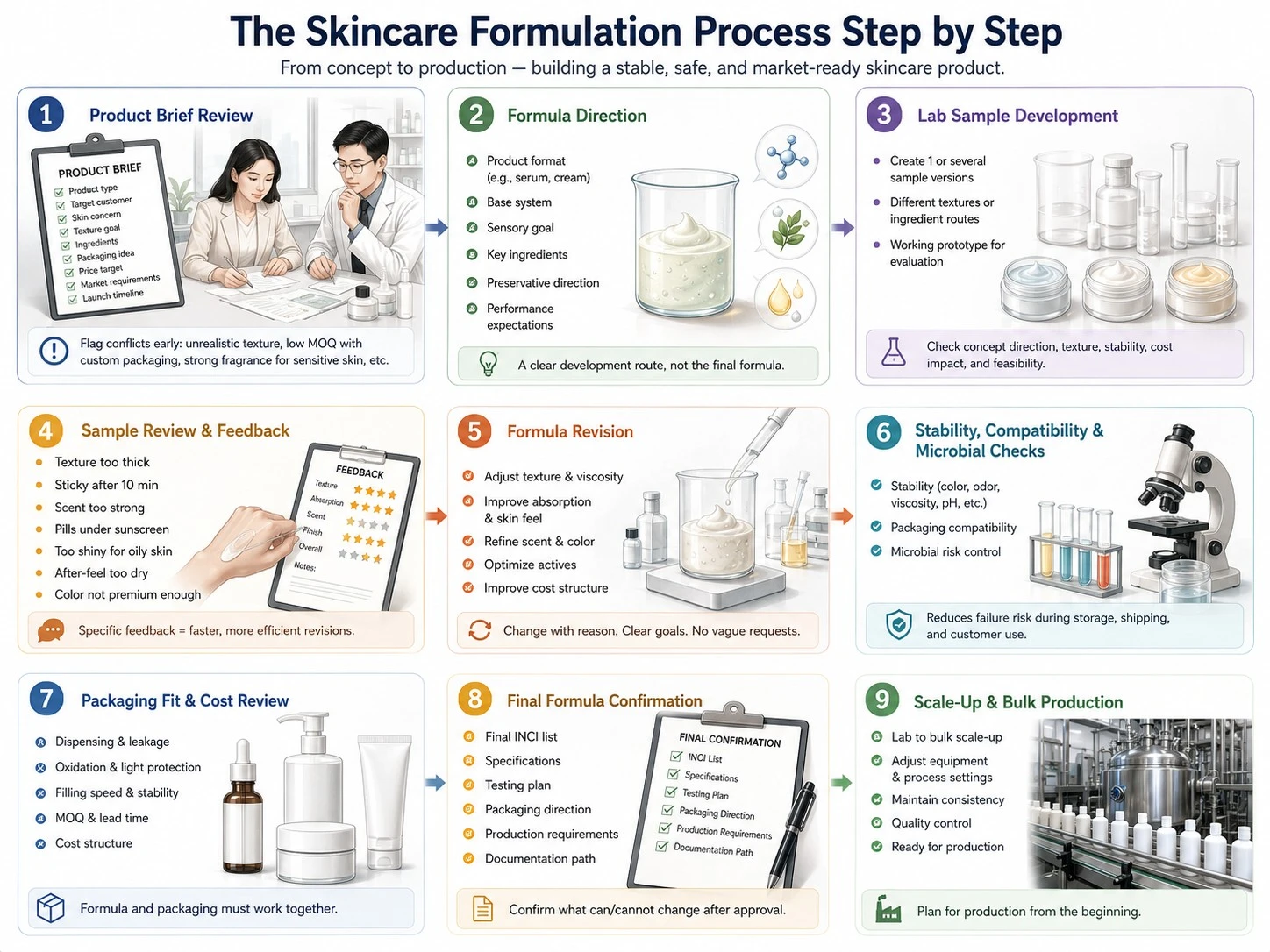
The skincare formulation process moves from concept to formula direction, lab samples, revisions, testing, packaging fit, and production planning. [1]
1. Product Brief Review
The manufacturer or R&D team first reviews the product brief. This step checks whether the concept is clear, realistic, and commercially aligned.
The team may review:
- Product type.
- Target customer.
- Main skin concern.
- Texture goal.
- Ingredient direction.
- Packaging idea.
- Price target.
- Market requirements.
- Expected launch timeline.
This is also where the manufacturer should flag conflicts early, such as a lightweight gel cream with many oils, a low MOQ with custom packaging, or a sensitive-skin product with strong fragrance. These issues should be addressed before sample development starts.
2. Formula Direction
After the brief is reviewed, the team defines the formula direction. This includes the product format, base system, sensory goal, key ingredients, preservative direction, and general performance expectations.
Formula direction does not mean the formula is final. It means the R&D team has a clear development route. For example, a brightening-looking serum may need a lightweight texture and packaging that helps protect the formula, while a rich barrier cream may need a fuller skin feel and packaging that supports thicker viscosity.
3. Lab Sample Development
The lab then develops the first samples. Depending on the project, the first round may include one version or several versions with different textures, ingredient routes, or sensory profiles.
At this stage, the first sample is a working prototype. It helps the brand and manufacturer see whether the concept is moving in the right direction and which changes may affect cost, stability, texture, or timeline.
4. Sample Review and Feedback
The brand tests the sample and gives specific feedback. “Make it better” is not enough. Better feedback sounds like:
- The texture is too thick for our target customer.
- The serum feels sticky after 10 minutes.
- The scent is too strong.
- The cream pills under sunscreen.
- The finish is too shiny for oily skin.
- The product absorbs well, but the after-feel is too dry.
- The sample fits the product concept, but the color is not premium enough.
Specific feedback helps the R&D team revise the formula more efficiently.
5. Formula Revision
After feedback, the formula may be revised for texture, viscosity, absorption, scent, color, skin feel, active direction, or cost structure.
Each change should have a reason. If texture is the main issue, focus on texture. If scent is the problem, focus on scent. If the formula is too expensive, focus on cost structure. Unclear revision requests slow the project down.
6. Stability, Compatibility, and Microbial Checks
A skincare formula must stay acceptable through storage, shipping, and use. Testing can check issues such as color change, odor change, separation, precipitation, viscosity change, pH movement, packaging interaction, and microbial risk. [2]
Stability and compatibility checks reduce the risk of a product looking good in a lab sample but failing during storage, transport, or customer use. For water-containing products, preservation and microbial risk control also matter. The exact testing plan depends on product type, market, packaging, claims, and manufacturer standards.
7. Packaging Fit and Cost Review
Formula and packaging should be reviewed together because the formula can affect dispensing, leakage, oxidation, filling speed, and customer experience, while packaging can affect MOQ, lead time, cost, and compatibility.
A thin serum in the wrong dropper may leak or dose poorly. A thick cream in the wrong pump may not dispense well. A formula with sensitive ingredients may need packaging that reduces light or air exposure. Packaging should not be left until the formula is already final.
8. Final Formula Confirmation
Once the brand approves the sample direction, the final formula needs to be confirmed. This may include the final INCI list, specifications, testing plan, packaging direction, production requirements, and documentation path.
The brand should also confirm what can and cannot be changed without restarting development. Changing fragrance, color, active ingredients, packaging, or texture after confirmation may affect testing, cost, and timeline.
9. Scale-Up and Bulk Production
A lab sample is not the same as bulk production. Scale-up means moving from small lab batches to larger manufacturing batches while keeping the formula consistent. [1]
During scale-up, the manufacturer may need to adjust mixing time, temperature control, equipment settings, filling conditions, and quality checks.
A serious formulation project should plan for production from the beginning.
What Goes Into a Skincare Formula?
A skincare formula contains more than active ingredients. Each part has a role in texture, stability, safety, skin feel, preservation, or product performance. [2]
| Formula Part | What It Does | Buyer’s Question |
|---|---|---|
| Base system | Builds the product format and texture | Does this match the product type? |
| Active ingredients | Support the main skincare direction | Are the actives suitable and realistic? |
| Humectants | Help attract water and support hydration | Does the product feel hydrating enough? |
| Emollients | Improve softness, slip, and comfort | Does it feel too heavy or too light? |
| Emulsifiers | Help oil and water phases stay together | Is the texture stable? |
| Thickeners / texture modifiers | Control viscosity and skin feel | Does it dispense and spread well? |
| Preservative system | Helps protect product quality during use | Is it suitable for the formula and target market? |
| pH adjusters | Help keep the formula in the right pH range | Does pH fit the product type and actives? |
| Fragrance / color | Affect user experience and positioning | Is it needed, and does it increase irritation risk? |
| Chelators / antioxidants | Support formula stability | Does the product need extra stability support? |
B2B buyers do not need to become cosmetic chemists. But they should understand enough to ask better questions.
A formula is strong when each ingredient has a purpose and the full system works together.
How to Choose Ingredient Direction

Ingredient direction should start with the product goal, not with trends. A trending ingredient can help marketing, but it should still fit the formula, target customer, texture, cost, claims direction, and packaging.
For B2B product development, ingredient direction can be grouped by concept:
- Hydration: Glycerin, hyaluronic acid, panthenol, betaine, and barrier-supportive ingredients.
- Brightening-looking support: Niacinamide, vitamin C derivatives, licorice-style ingredients, exfoliation support where suitable, and sunscreen-related education.
- Anti-aging positioning: Peptides, antioxidants, retinoid alternatives, moisturization, and barrier support.
- Acne care direction: Oil-balancing ingredients, pore-care ingredients, lightweight textures, and non-comedogenic positioning.
- Sensitive skin direction: Fragrance-free positioning, lower-irritation ingredients, soothing ingredients, and barrier support.
- Barrier support: Ceramides, cholesterol-like lipids, fatty acids, panthenol, glycerin, and rich but comfortable textures.
These are concept directions, not finished formula instructions. The final formula still needs to consider concentration, stability, pH, preservative system, texture, packaging, regulatory limits, and target market requirements.
A common mistake is trying to make one product do everything. A stronger product usually has one clear promise and a supporting ingredient system around it.
How to Review Skincare Formulation Samples
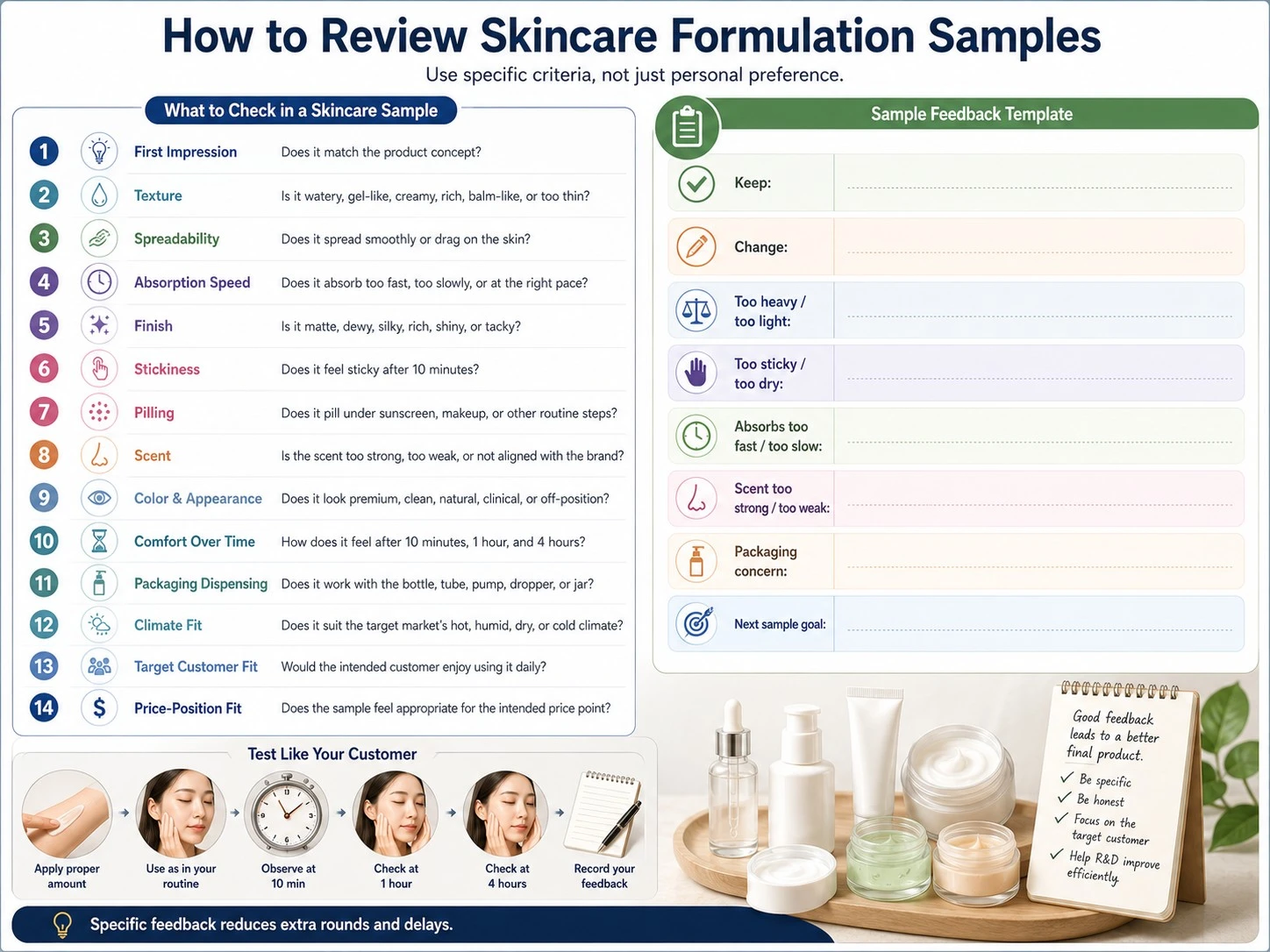
A sample should be reviewed with specific product criteria, not only personal preference.
When reviewing a skincare formulation sample, check:
- First impression: Does it match the product concept?
- Texture: Is it watery, gel-like, creamy, rich, balm-like, or too thin?
- Spreadability: Does it spread smoothly or drag on the skin?
- Absorption speed: Does it absorb too fast, too slowly, or at the right pace?
- Finish: Is it matte, dewy, silky, rich, shiny, or tacky?
- Stickiness: Does it feel sticky after 10 minutes?
- Pilling: Does it pill under sunscreen, makeup, or other routine steps?
- Scent: Is the scent too strong, too weak, or not aligned with the brand?
- Color and appearance: Does it look premium, clean, natural, clinical, or off-position?
- Comfort over time: How does it feel after 10 minutes, 1 hour, and 4 hours?
- Packaging dispensing: Does it work with the bottle, tube, pump, dropper, or jar?
- Climate fit: Does it suit the target market’s hot, humid, dry, or cold climate?
- Target customer fit: Would the intended customer enjoy using it daily?
- Price-position fit: Does the sample feel appropriate for the intended price point?
Use this feedback template after testing a sample:
- Keep:
- Change:
- Too heavy / too light:
- Too sticky / too dry:
- Absorbs too fast / too slow:
- Scent too strong / too weak:
- Packaging concern:
- Next sample goal:
Specific sample feedback reduces extra rounds and delays.
Testing, Safety, and Compliance in Skincare Formulation
Testing and compliance should be planned early in a skincare formulation project. Brands should confirm requirements for each target market before launch.
Stability Testing
Stability testing looks at how the formula behaves over time and under different conditions. It may check color, odor, separation, precipitation, viscosity, pH, appearance, and overall product integrity. [2]
The goal is to reduce visible or functional changes before customer use.
Packaging Compatibility
Packaging compatibility checks whether the formula works with the chosen bottle, jar, tube, pump, dropper, airless package, sachet, or other component.
Possible problems include leakage, discoloration, odor change, poor dispensing, oxidation, formula separation, or material interaction. A formula and package should be tested as a system, not as two separate decisions.
Microbial and Preservation Considerations
Most water-containing skincare products need a preservation strategy. A preservative system helps protect the product during normal use.
The formula type, packaging, pH, water content, and intended use can all affect microbial risk. A leave-on cream, rinse-off cleanser, toner, serum, mask, and eye product may need different preservation thinking.
Safety Substantiation
For the U.S. market, brands need to understand safety substantiation obligations under MoCRA. Responsible persons are expected to maintain adequate substantiation of cosmetic product safety. [3]
Safety support can include ingredient safety data, formula review, testing, supplier documentation, and other relevant records. The exact path depends on the product and market.
Labeling and Ingredient Information
Ingredient information matters because cosmetic product listing and labeling depend on accurate formula details. Marketed cosmetic product listing requires product and ingredient information, and cosmetic labeling rules include ingredient declaration requirements. [4][5]
Brands should keep formula documentation organized before launch.
GMP and Manufacturing Control
Good manufacturing practice supports consistent production, quality control, hygiene, storage, records, and product handling. GMP guidance for cosmetics is designed to help reduce risks related to adulteration or misbranding. [6]
For buyers, the key question is whether the manufacturer has a controlled process for turning the approved formula into consistent finished products.
Packaging Fit: Why Formulation and Packaging Must Be Planned Together
Skincare formulation and packaging should be planned together because a lab-approved formula still needs to dispense well, stay stable, survive shipping, and feel right in the customer’s hand.
| Formula Type | Packaging Concern |
|---|---|
| Watery toner or essence | Leakage, bottle closure, dispensing control |
| Serum | Dropper vs pump, oxidation, dosage control |
| Cream / lotion | Jar vs tube vs pump, viscosity, hygiene perception |
| Sunscreen | Tube or pump compatibility, texture, dispensing |
| Active formula | Light, air, pH, and material compatibility |
| Balm or thick mask | Filling method, jar or tube suitability |
Packaging also affects MOQ, cost, lead time, shipping protection, and brand positioning. A dropper bottle may look premium for a serum, but it is not the best choice for every texture or ingredient direction. An airless pump may support a more premium position, but it can raise packaging cost and MOQ.
The strongest product plan considers formula and packaging together before final approval.
Timeline, MOQ, and Cost Factors
Custom skincare formulation usually takes longer than stock private label because the product is developed around a specific brief. Timeline and MOQ may be driven by product complexity, sample rounds, ingredient sourcing, packaging components, raw materials, filling setup, testing, compliance needs, or production schedule.
| Factor | How It Affects the Project |
|---|---|
| Product complexity | More complex formulas need more R&D and testing |
| Number of sample rounds | More revisions extend timeline |
| Ingredient sourcing | Special ingredients may require higher MOQ or longer lead time |
| Packaging choice | Custom packaging can raise MOQ and delay launch |
| Testing requirements | Stability, compatibility, microbial, or claim support adds time |
| Target market | Different regions may require different documents or checks |
| Production scale | Larger runs can improve unit cost but raise inventory risk |
A buyer should not ask only, “How much is the formula?” A better question is:
What drives the full project cost and timeline?
That includes R&D work, sampling, revisions, raw materials, packaging, testing, documentation, production setup, freight, and reorder planning. If MOQ is a major concern, discuss it early because packaging or raw material suppliers may require higher minimums than the formula itself.
Common Skincare Formulation Mistakes Brands Make
Many formulation problems come from unclear direction, late decisions, or unrealistic expectations. Avoid these common mistakes:
- Starting with trendy ingredients instead of product goals.
Better: start with the target customer, product role, main skin concern, texture, and price position. - Trying to make one product do everything.
Better: choose one main product promise and support it well. - Ignoring texture and skin feel.
Better: treat the sensory profile as part of product value, not as a small detail. - Giving vague sample feedback.
Better: describe exact changes, such as texture, stickiness, scent, absorption, finish, or pilling. - Choosing packaging too late.
Better: discuss packaging during formulation so the formula and package can work together. - Underestimating MOQ and lead time.
Better: ask what drives MOQ early, including packaging, raw materials, filling, and testing. - Making claims before checking support.
Better: align claims with formula direction, available data, testing plan, and target market rules. - Skipping stability or compatibility thinking.
Better: treat testing as launch protection, not a delay. - Choosing custom formulation when private label is enough.
Better: match the development model to the brand’s budget, timeline, and differentiation needs.
A disciplined formulation project needs clear decisions at the right time.
Questions to Ask a Skincare Manufacturer
Before starting a skincare formulation project, ask questions that reveal the manufacturer’s technical process, project management style, and production readiness.
Use this checklist:
- Have you developed this product type before?
- Can you support stock formula, semi-custom, and full custom options?
- What information do you need in the formulation brief?
- How do you evaluate whether the concept is realistic?
- How many sample rounds are included?
- What can be changed after the first sample?
- How should we give sample feedback?
- How do you handle ingredient sourcing?
- What testing do you recommend for this formula type?
- How do you check packaging compatibility?
- What is the expected MOQ?
- What usually drives MOQ for this type of project?
- What documents can you provide?
- Can you support target market requirements?
- What is the estimated timeline from brief to production?
- What happens if the sample does not meet the brief?
- Can the formula be scaled to bulk production?
- Who owns or controls the formula?
- What happens if a raw material or packaging component changes later?
A strong manufacturer will explain options, limits, risks, and next steps clearly. Be careful with answers that sound too easy, such as “Do not worry, we can do everything.”
Where to Go Next
Use this guide as your starting point, then go deeper based on your project stage.
- For tailored formula development, visit Custom Skincare Formulation.
- If MOQ is your main concern, read MOQ for Private Label Skincare.
- If you are preparing supplier questions, read Questions to Ask a Skincare Manufacturer.
- If you are still choosing a supplier, read How to Choose a Skincare Manufacturer.
- If packaging affects your formula direction, visit Packaging Customization.
- If you need broader project support, see OEM/ODM Skincare.
Final Thoughts
Ready to develop a skincare formula for your brand? Start with a clear product brief, a realistic development model, and a manufacturer that can explain the path from concept to sample to production.
At ZICAIL, we support brands with custom skincare formulation, sample development, packaging fit, testing coordination, and production planning. If you are preparing a new skincare line or improving an existing product, contact us to discuss your formulation project.


