


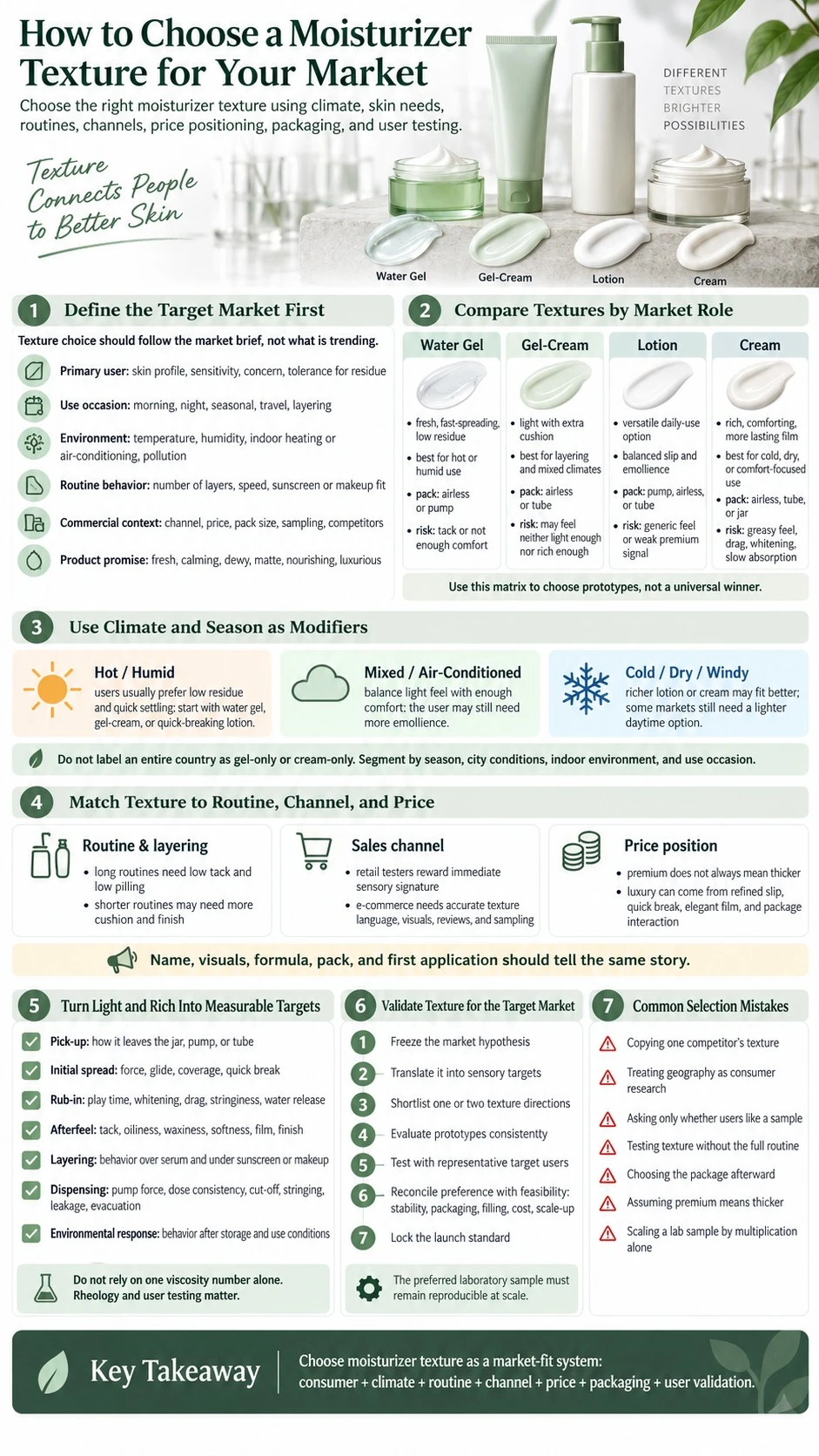
Texture is one of the first product signals a consumer understands. Before reading an ingredient list, the user can feel whether a moisturizer spreads quickly, breaks with water, drags, cushions, leaves tack, or forms a lasting film. That experience can reinforce the brand promise—or contradict it.
For a brand team, choosing a moisturizer texture is therefore a market-fit decision, not only a formulation choice. The goal is to connect a defined consumer and use occasion with a texture the laboratory can reproduce, the package can dispense, and the target market will want to use repeatedly.
Define the Target Market Before Choosing a Texture
A target market should be specific enough to guide a prototype. “Young consumers in Asia” or “premium customers in Europe” is not a usable texture brief. Neither age nor geography alone predicts preference, skin need, climate exposure, routine, or purchase behavior.
Define the market through six practical inputs:
- Primary user: State the intended skin profile, sensitivity considerations, concern, routine knowledge, and tolerance for residue. Keep the description inclusive and do not assume that every person in a demographic group has the same skin.
- Use occasion: Decide whether the product is for morning, night, year-round use, seasonal relief, travel, post-cleansing hydration, or layering under sunscreen and makeup.
- Environment: Record outdoor temperature and humidity patterns, indoor heating or air-conditioning, pollution exposure where relevant, and seasonal variation. Use actual launch-market conditions rather than a regional label.
- Routine behavior: Note how many products are commonly layered, how quickly the user expects to finish the routine, and whether the moisturizer must work under sunscreen or color cosmetics.
- Commercial context: Define channel, price position, pack size, sampling method, repeat-purchase target, and competitor set.
- Product promise: Translate words such as fresh, calming, barrier-supporting, nourishing, dewy, matte, or luxurious into a sensory and evidence brief. In the United States, intended use and promotional claims can affect whether a product is regulated as a cosmetic, a drug, or both.[6]
Once these inputs are written, texture becomes easier to evaluate. The team is no longer choosing between abstract names; it is judging which prototype best satisfies the same market brief.
Compare Moisturizer Textures by Market Role
The following matrix assigns each texture a commercial role. It does not prescribe a formula: a product’s actual oil phase, humectant system, rheology, and film can make two products with the same format name feel very different.
| Market decision | Water gel | Gel-cream | Lotion | Cream |
|---|---|---|---|---|
| First impression | Cooling, fresh, light, visibly water-led | Fresh with more cushion and opacity | Familiar, fluid, practical | Rich, comforting, substantive |
| Typical afterfeel goal | Low residue, quick dry-down | Soft film without heavy drag | Balanced slip and emollience | Lasting softness or protective feel |
| Routine fit | Dense routines and fast morning use | Layering with added comfort | Broad day or night use | Short routines, night care, or comfort-led use |
| Climate starting point | Hot or humid use where low residue matters | Warm or mixed climates needing light comfort | Flexible across seasons with formula tuning | Cold, dry, or air-conditioned conditions where richer feel is accepted |
| Skin-need positioning | Oily-feeling or combination-skin concepts | Broad lightweight hydration | Normal, combination, or general daily hydration | Dry-feeling, tight, or comfort-focused concepts |
| Channel strength | Social-first demonstrations and sampling where instant break is visible | Prestige-light concepts and tactile retail trial | Pharmacy, mass, e-commerce, and broad retail | Prestige, dermocosmetic, night-care, and seasonal stories |
| Packaging starting point | Airless or treatment pump; compatible tube | Airless pump or tube | Pump bottle, airless pack, or tube | Airless pump, tube, or jar when justified |
| Main rejection risk | Tack, pilling, insufficient comfort, “too basic” perception | Neither light enough nor rich enough | Generic feel, leakage, weak premium signal | Greasiness, drag, whitening, slow absorption |
| Best launch role | Distinct lightweight hero | Bridge between gel freshness and cream comfort | Broad-market core SKU | Rich hero or targeted seasonal/need-state SKU |
Use the matrix to choose prototypes, not to declare a universal winner. General skin guidance describes gels as lighter and creams as more suitable when dryness is greater, but it also emphasizes that moisturizer choice is not one-size-fits-all.[1] A brand still needs to confirm how its finished formula performs for the intended users.
For deeper technical decisions about ingredients, rheology, and manufacturing, use a separate skincare formulation guide. This market matrix should remain the commercial input to that work, not replace it.
Use Climate and Season as Modifiers, Not Shortcuts
Climate changes the use context, but it should not dictate texture by itself. Temperature, humidity, wind, sun exposure, indoor climate control, cleansing habits, and time spent outdoors interact. Research on transepidermal water loss shows that environmental temperature and humidity can influence skin-barrier measurements and must also be controlled when skin is evaluated.[2]
In hot or humid conditions, users may reject a product that feels sticky, slow to settle, or difficult to layer. A water gel, gel-cream, or quick-breaking lotion is a logical starting point. Yet a humid-market user who spends the day in air-conditioning or uses drying treatments may still want more comfort. The prototype must balance low surface residue with adequate emollience.
In cold, windy, dry, or heavily heated indoor conditions, a cream or richer lotion may better match the desire for cushion and a persistent film. The same market may still need a lighter daytime option under sunscreen. Instead of labeling an entire country “gel” or “cream,” segment by season, city conditions, indoor environment, and use occasion.
This approach can produce one adaptable hero formula, two seasonal textures, or one core texture with locally adjusted sensory targets. Make that portfolio choice from projected demand and operational complexity, not climate theory alone.
Match Texture to Routine, Channel, and Price Position
Routine and Layering Behavior
A moisturizer at the end of a long serum-based routine has less room for tack, rolling, or a heavy surface film. A low-residue gel-cream or lotion may integrate more easily. In a shorter routine, the moisturizer may need to provide more of the cushion and finish, which can justify a cream or richer gel-cream.
Define what goes immediately before and after the product. Test it over representative serums and under the intended sunscreen or makeup, using realistic application amounts and wait times. “Absorbs fast” is not enough if the formula pills during the complete routine.
Sales Channel and Trial Experience
Retail testers reward an immediate, recognizable sensory signature: a watery break, silky glide, cushion, or quick transformation can help communicate the concept. E-commerce cannot provide touch before purchase, so product photography, naming, reviews, sampling, and precise texture language must set an accurate expectation.
Published moisturizer research found that cosmetic elegance—including feel, scent, color, and absorption—matters to product preference and continued use.[4] The study examined best-selling general moisturizers rather than face-only products and represents one historical retail snapshot, so it should support the principle of sensory acceptance, not a current global format forecast.
Price Position and Brand Language
Premium positioning does not require a heavy cream. Luxury can be expressed through a refined quick break, low-tack film, controlled slip, distinctive pick-up, or elegant package interaction. Likewise, a mass-market lotion should not be treated as technically simple if it must deliver broad appeal, reliable pumping, and consistent stability at scale.
Align the naming with the actual experience. Terms such as water cream, aqua gel, sorbet cream, milk lotion, cloud cream, and balm cream create different expectations, but they have no universal technical definition. The name, visuals, formula, pack, and first application should tell the same story.
Turn “Light” and “Rich” Into Measurable Sensory Targets
Subjective words become useful only when the team defines what will be observed. Create a scorecard for each prototype and keep the method constant.
- Pick-up: how the product leaves a finger, spatula, pump, or nozzle.
- Initial spread: force required, glide, coverage, and whether the product breaks quickly.
- Rub-in: play time, whitening, drag, stringiness, and perceived water release.
- Afterfeel: tack, oiliness, waxiness, powderiness, softness, film, and finish at set time points.
- Layering: interaction with representative serum, sunscreen, and makeup products.
- Dispensing: actuation force, dose consistency, cut-off, stringing, leakage, and evacuation.
- Environmental response: sensory and dispensing behavior after relevant storage and use conditions.
Do not rely on one viscosity number as a proxy for texture. Rheology—the way a product flows and deforms—affects production, pumping, filling, storage, and application.[5] Instrumental data can help control repeatability, while trained-panel and target-user evaluations answer different questions about perception and liking.
Texture preference also varies within a demographic. One controlled study of four cream textures found that age and tactile perception influenced acceptance, but its participants and forearm-use design do not justify a universal age rule.[3] Use demographic assumptions to form hypotheses, then verify them with representative users.
How to Validate a Moisturizer Texture for a Target Market
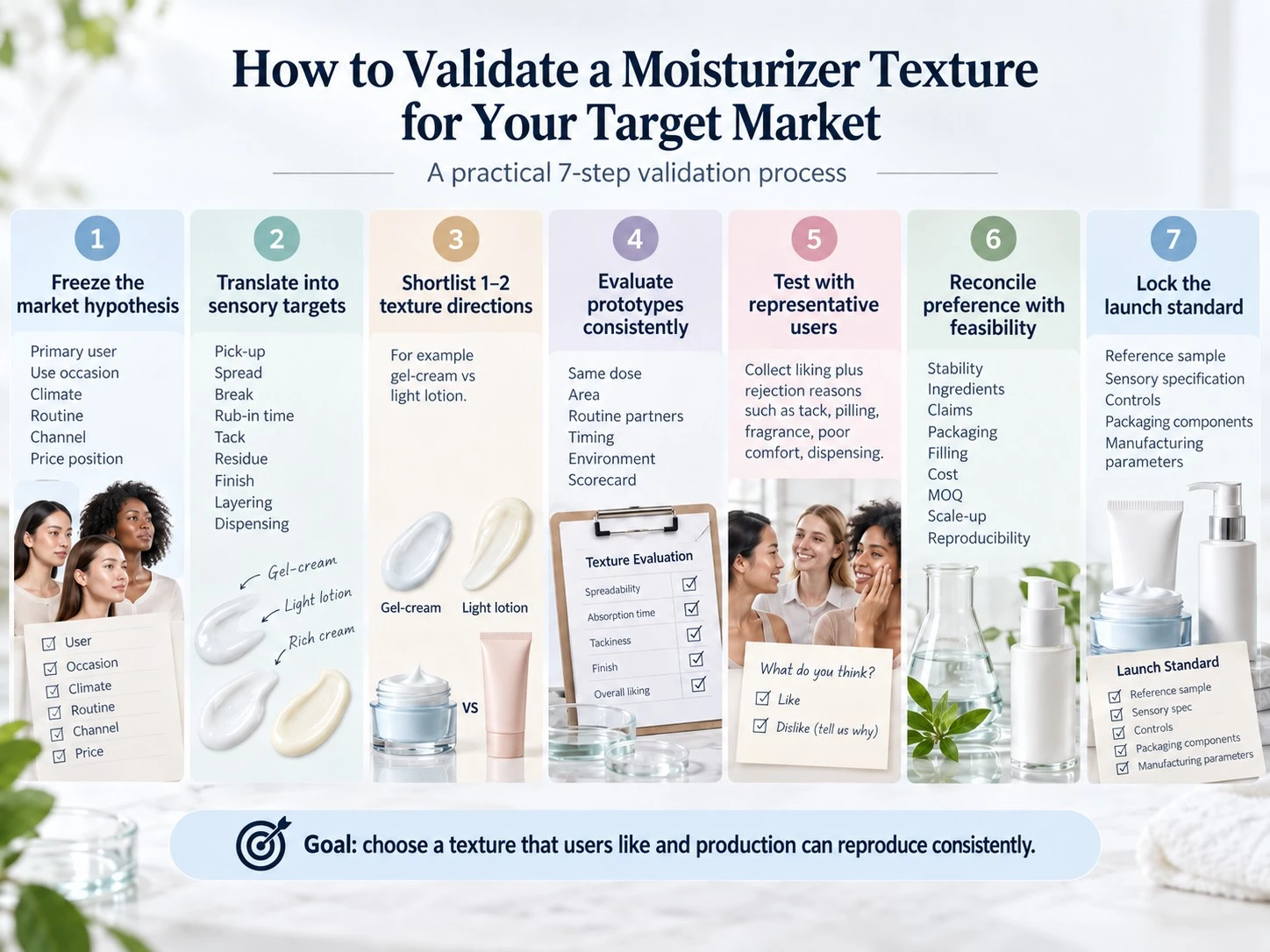
- Freeze the market hypothesis. Record the primary user, use occasion, climate exposure, routine, channel, price position, claims direction, pack, and competitor references. Separate evidence from assumptions.
- Translate the hypothesis into targets. Define the desired pick-up, spread, break, rub-in time, tack, residue, finish, layering behavior, and dispensing experience. Mark which attributes are non-negotiable.
- Shortlist one or two texture directions. Choose the smallest set capable of testing the real uncertainty. For example, compare a gel-cream with a light lotion when the market needs both freshness and comfort; do not request five unrelated bases without a decision rule.
- Evaluate prototypes consistently. Use the same dose, application area, routine partners, timing, environmental conditions, and scorecard. Blind coding can reduce bias when brand language would otherwise influence evaluation.
- Test with representative target users. Recruit for the actual use case rather than convenience alone. Capture both liking and reasons for rejection, such as tack, insufficient comfort, pilling, fragrance, dispensing, or mismatch with expected richness.
- Reconcile preference with feasibility. Review formula stability, ingredient and claim requirements, package compatibility, filling, cost, order quantity, and scale-up. Texture characteristics can change with composition and manufacturing process, so the preferred laboratory sample must remain reproducible.[5]
- Lock the launch standard. Approve a reference sample, sensory specification, instrumental controls where useful, packaging components, and manufacturing parameters. Define how future batches and approved changes will be compared.
This process prevents a common late-stage failure: selecting a popular sample by intuition, then discovering that the active system, pack, target cost, or production process cannot preserve the same experience. If the project requires a new base rather than a stock adjustment, confirm the path through custom skincare formulation before finalizing launch timing.
Common Market-Texture Selection Mistakes
- Copying one competitor’s texture: A reference product can clarify an attribute, but its audience, formula, pack, price, and brand promise may differ from yours.
- Treating geography as consumer research: “Asian markets prefer gels” and “Western markets prefer creams” hide climate, city, season, routine, income, age, and individual variation.
- Asking only whether users like a sample: Overall liking does not reveal which attribute drives rejection or which change would improve it. Collect diagnostic sensory feedback.
- Testing texture without the routine: A moisturizer that feels elegant alone may pill, become greasy, or lose slip over other products.
- Choosing the package afterward: Pump force, air intake, nozzle cut-off, exposure during use, and product evacuation influence the experience. Review the skincare packaging options while prototypes are still adjustable.
- Assuming premium means thicker: Premium perception comes from coherence and execution, not viscosity alone.
- Scaling from a laboratory sample by multiplication: Mixing, heating, cooling, deaeration, transfer, and filling can change structure. Confirm the sensory standard at pilot scale.
Discuss Your Target-Market Moisturizer Project
ZICAIL can help brands connect a market brief with moisturizer development, sampling, packaging, and production requirements. Explore our private label face moisturizer capabilities and packaging customization options when defining the complete product experience.
For a more useful feasibility discussion, share the launch countries, target user, climate and season, routine position, desired texture references, required ingredients, claims direction, pack type, fill size, target cost, order volume, and launch timing. This lets the development team compare texture options against the same commercial constraints.


