


Emulsifiers are not plug-and-play ingredients. A system that forms an elegant lotion with one oil blend can lose viscosity, separate, or feel waxy after an electrolyte, botanical extract, fragrance carrier, or different cooling profile is introduced. Supplier starting formulas help teams screen options, but they do not prove that a finished commercial product is stable.
This guide gives skincare brands and product developers a practical selection framework. It does not prescribe universal percentages because the workable level depends on the exact emulsifier grade, oil phase, formula, process, package, and performance target.
Start With Emulsion Architecture, Not an Emulsifier Name
Begin by deciding which phase should be continuous and what the finished product must do. In an oil-in-water emulsion, oil droplets are dispersed through a continuous water phase. This architecture is common in lotions, gel-creams, and many facial moisturizers because it can support lighter spreading and easier rinsing. In a water-in-oil emulsion, water droplets sit inside a continuous oil phase, which can support richer feel, stronger water resistance, or a more protective film.
More complex structures include multiple emulsions, liquid-crystalline or lamellar systems, and particle-stabilized emulsions. These can serve specific sensory, delivery, or positioning goals, but the structure name does not prove better performance. The complete formula and process must create and maintain the intended droplet organization.
This is why HLB, or hydrophilic–lipophilic balance, should be treated as a screening tool rather than a final formula. For many conventional nonionic surfactants, a formulator can estimate the required HLB of the oil phase and blend emulsifiers toward that value. HLB does not fully describe polymeric emulsifiers, liquid-crystalline structures, particle stabilization, phase inversion, electrolyte sensitivity, or sensory finish.
An emulsifier also does not work alone. It lowers interfacial tension during manufacture and helps create a protective film around droplets, while co-emulsifiers, fatty alcohols, polymers, waxes, and continuous-phase rheology can slow droplet movement and strengthen the system. Droplet size distribution, interfacial-film strength, viscosity, density difference, processing energy, and temperature history all influence stability.[1] A thick cream is not automatically stable, and a fluid emulsion is not automatically weak.
Build the Emulsifier Selection Brief
Before requesting samples, turn the product concept into technical constraints. This prevents the team from choosing an appealing ingredient story and then rebuilding the product around it.
| Input to define | Why it changes the decision | Evidence or decision to record |
|---|---|---|
| Product format and emulsion architecture | A lotion, gel-cream, rich cream, sprayable emulsion, and water-resistant product require different structures | Intended continuous phase, dispersed-phase range, use case, and performance target |
| Oil phase | Oil polarity, waxes, silicones, UV filters, fragrances, and oil-soluble actives change interfacial requirements | Complete oil-phase composition and expected variation |
| Sensory and rheology | Quick break, cushion, tack, rub-in, gloss, pick-up, flow, and recovery affect both formula and package choices | Observable sensory language plus viscosity or rheology window |
| pH and electrolytes | Charged materials and neutralized polymers can lose structure outside their operating range | Initial pH, stability range, salt load, and ionic actives |
| Powders and active systems | Clays, pigments, encapsulates, extracts, solvents, and carriers can change viscosity or interface behavior | Addition method and compatibility screen in the complete formula |
| Process and equipment | Some systems need matched phase temperatures, phase inversion, high shear, or controlled cooling | Batch sequence, temperature limits, shear method, hold times, and vessel capability |
| Packaging and filling | Pump geometry, closure, headspace, evaporation, dose, and filling temperature can expose hidden weaknesses | Representative components, filling conditions, and dispensing criteria |
| Claims and standards | Natural-origin, PEG-free, retailer, certification, or regional policies can narrow the shortlist | Written standard and non-negotiable restrictions |
| Shelf life and specifications | Appearance alone cannot define stability | Test plan, acceptance criteria, formula version, and change-control triggers |
The brief should contain the actual commercial formula assumptions, not only words such as “premium,” “natural,” or “lightweight.” Ask potential suppliers for the technical data sheet, safety data sheet, INCI composition, recommended processing conditions, compatibility limits, suggested use range, regulatory statements, and representative starting formulas. These documents define a useful screening window; they do not replace finished-product testing.
Compare Emulsifier Approaches Without Choosing by Trend
Cosmetic emulsifier categories are useful when they help a team ask better questions. They should not be treated as a universal ranking.
| Emulsifier approach | Useful screening question | Important caution |
|---|---|---|
| Nonionic surfactant systems | Does the blend match the oil phase, process temperature, desired texture, and active load? | Broad compatibility does not guarantee tolerance of every electrolyte, polymer, or preservative |
| Anionic systems | Can the system create the required oil-in-water structure at the target pH and salt level? | Cationic ingredients, electrolytes, or low pH can reduce compatibility |
| Cationic systems | Is deposition or conditioning central to the product function? | Compatibility, skin feel, intended use, and safety assessment need careful control |
| Polymeric emulsifiers | Does the formula need a fluid or gel-cream texture, efficient stabilization, or cold processing? | pH, salts, shear, and dispersed-phase load can sharply change viscosity and performance |
| Sugar-based or other natural-origin systems | Does the supplier documentation satisfy the selected standard while meeting sensory and process needs? | Natural origin does not prove mildness, safety, stability, or simple preservation |
| Particle-stabilized or Pickering systems | Does the concept justify the distinctive interface and development burden? | Sensory, dispersion, scale-up, regulatory, and package questions can be more complex |
“Natural,” “PEG-free,” and “clean” are positioning or sourcing constraints, not technical performance classes. Define the exact standard, target markets, certification rules, permitted processing, supply documentation, and ingredient exclusions. A long informal blacklist can reduce formula robustness without creating a clear consumer benefit.
Avoid the opposite shortcut as well: a conventional system is not automatically easier. Two emulsifier blends with similar HLB values can produce different droplet structures, rheology, rub-in behavior, and temperature sensitivity. Compare complete prototype systems under the same formula and process conditions.
Use a Stage-Gated Emulsifier Selection Process

Use the following sequence for each commercial formula. Teams may iterate between stages, but a later pass does not prove that an earlier requirement was met.
- Define the commercial product. Lock the product format, user scenario, target markets, texture, claims, packaging, shelf-life assumption, and cost boundaries.
- Select the emulsion architecture. Decide which phase should be continuous and what dispersed-phase range, water resistance, spread, and afterfeel the structure must support.
- Map formula stressors. Review the full oil phase, pH, electrolytes, polymers, powders, active carriers, preservative system, fragrance, and likely raw-material variation.
- Create a technical shortlist. Compare supplier data, INCI composition, HLB where relevant, processing window, recommended co-structurants, regulatory fit, and documentation.
- Develop controlled prototypes. Prepare side-by-side batches using recorded temperature, shear, addition order, hold time, and cooling conditions. Eliminate structurally weak options before fine sensory work.
- Optimize texture without hiding instability. Adjust emulsifier ratio, oil phase, co-emulsifiers, fatty alcohols, and continuous-phase rheology while tracking pH, viscosity, droplet behavior, rub-in, and recovery after shear.
- Confirm pilot, filling, and package performance. Reproduce the process in relevant equipment and evaluate the formula in representative components. Production and quality activities should be controlled under an appropriate cosmetic GMP system.[2] ZICAIL’s skincare project process shows why technical transfer should be planned before formula approval.
- Validate and approve with change control. Link stability, compatibility, microbiological, batch, and specification records to the approved formula, process, and package. Reassess changes that could alter the interface or product structure.
Do not optimize one attractive bench sample indefinitely. A small comparative matrix often reveals whether the main problem is the emulsifier family, oil-phase design, thickener, electrolyte load, or process. Once a route is selected, use the same raw-material grades and documented procedure for confirmation batches.
Why Emulsion Systems Fail
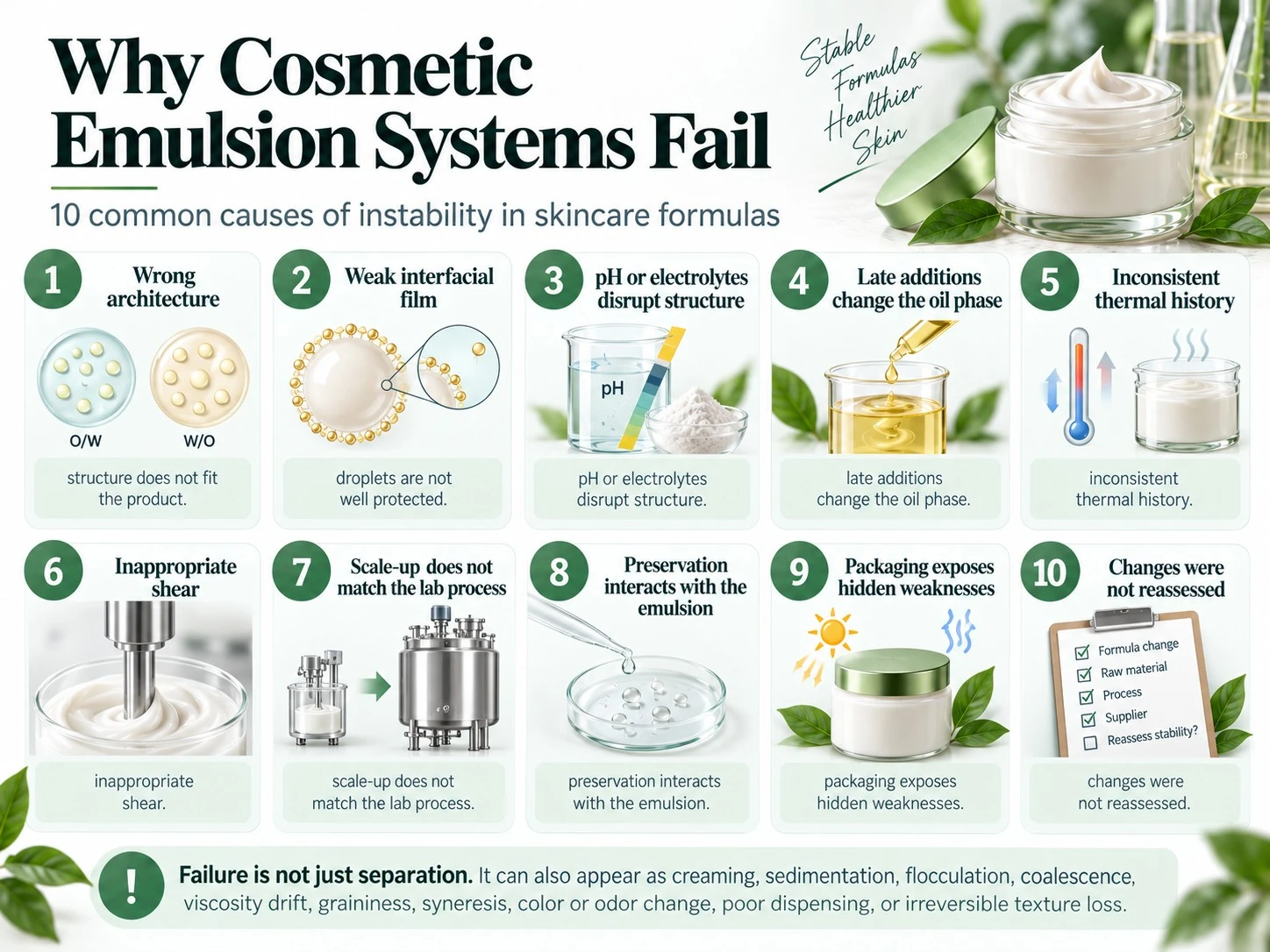
When an emulsion fails, identify the mechanism before adding more emulsifier or thickener. Common causes include:
- The architecture does not fit the product. The selected continuous phase or dispersed-phase volume conflicts with the desired feel, water resistance, or process.
- The interfacial film is too weak. The emulsifier blend may not cover and protect the newly formed droplets under the formula’s oil composition and temperature history.
- Electrolytes or pH collapse the structure. Salts, ionic actives, acids, and bases can change polymer conformation, surfactant behavior, or viscosity.
- A late addition changes the oil phase. Fragrance, solubilized actives, or carrier solvents can shift polarity after the base system was optimized.
- Thermal history is inconsistent. Inadequate melting, mismatched phase temperatures, long hot holds, or uncontrolled cooling can change wax crystallization and lamellar organization.
- Shear is inappropriate. Too little energy can leave large droplets; excessive or poorly timed shear can damage polymer structure, destabilize some systems, or entrain air.
- Scale-up does not reproduce the lab process. Matching rpm does not reproduce tip speed, circulation, shear distribution, heat transfer, or cooling rate across different vessels.
- Preservation and the emulsion interact. Surfactant micelles, oil-water partitioning, polymers, and packaging can change how much antimicrobial material remains available. Finished-product antimicrobial protection should be evaluated with a justified method where applicable.[3] ZICAIL’s guide to preservatives in skincare formulations explains that selection as a separate but connected development job.
- The package exposes a hidden weakness. Evaporation, headspace, pump shear, closure leakage, poor dose recovery, or fill temperature can make a stable bulk formula unacceptable in use.
- A change was not reassessed. A new supplier grade, fragrance, active, package, manufacturing site, or batch size can invalidate earlier evidence.
Visible separation is only one failure mode. Creaming, sedimentation, coalescence, flocculation, viscosity drift, graininess, syneresis, color or odor change, poor dispensing, and irreversible texture loss can also make a product commercially unacceptable.
Validate Stability, Packaging, and Scale-Up
Validation should test the marketed system, not an early base formula. Use the near-final composition, approved process, representative package, and clearly defined acceptance criteria. In the United States, manufacturers and distributors are responsible for ensuring cosmetic safety, and no single universal test list is prescribed for every cosmetic product.[4] The program therefore needs to be risk-based and scientifically sound.
Track attributes that can reveal the likely failure modes: appearance, odor, color, pH, viscosity or rheology, homogeneity, droplet behavior where useful, mass loss, fill and dispensing performance, and package condition. Use appropriate elevated and low temperatures, cycling or freeze–thaw conditions, transport or vibration evaluation, and real-time follow-up according to the product risk and launch plan. Accelerated stability can expose weaknesses and compare prototypes, but it does not mathematically guarantee an exact real-time shelf life.
Package compatibility is a two-way assessment. The formula can swell, soften, crack, stain, corrode, or extract from a component, while the package can change product mass, odor, appearance, dose, or structure. Test the intended bottle, jar, tube, pump, dip tube, gasket, liner, decoration, and closure as a system. ZICAIL’s guide to packaging compatibility testing covers this relationship in more detail.
Keep each test in its own lane. Physical stability evaluates how the formula changes over time. Compatibility evaluates the formula-package relationship. Microbial limits assess microorganisms present in the sample. Preservative-efficacy testing evaluates antimicrobial protection under a defined challenge. One passing result cannot substitute for the others; the stability, compatibility, and challenge testing guide summarizes the boundaries.
Finally, define release and shelf-life specifications that the factory can measure consistently. Appearance, odor, pH, viscosity or rheological range, fill quantity, package function, and relevant microbiological criteria should refer to the approved version. Trending pilot and production data is more useful than treating one laboratory value as permanently fixed.
Develop an Emulsion System With ZICAIL
ZICAIL’s custom skincare formulation support is suitable for brands developing lotions, creams, gel-creams, and other emulsified skincare products that need a defined texture, active system, package, and scale-up path. A productive technical discussion starts with the product format, target users and markets, oil phase or key actives, sensory direction, ingredient restrictions, package type, expected shelf life, claims, and launch volume.
Share these inputs early so emulsifier selection, rheology, preservation, processing, packaging, and validation can be evaluated as one product system. Contact ZICAIL to discuss the project brief and the development evidence required before scale-up.


