
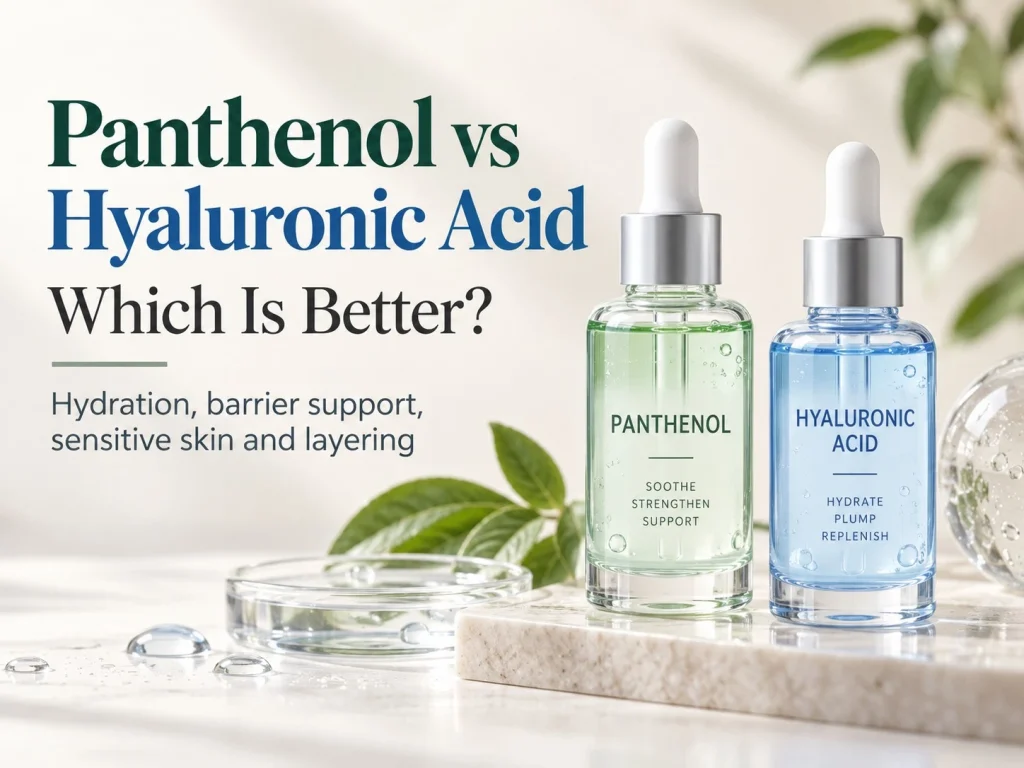

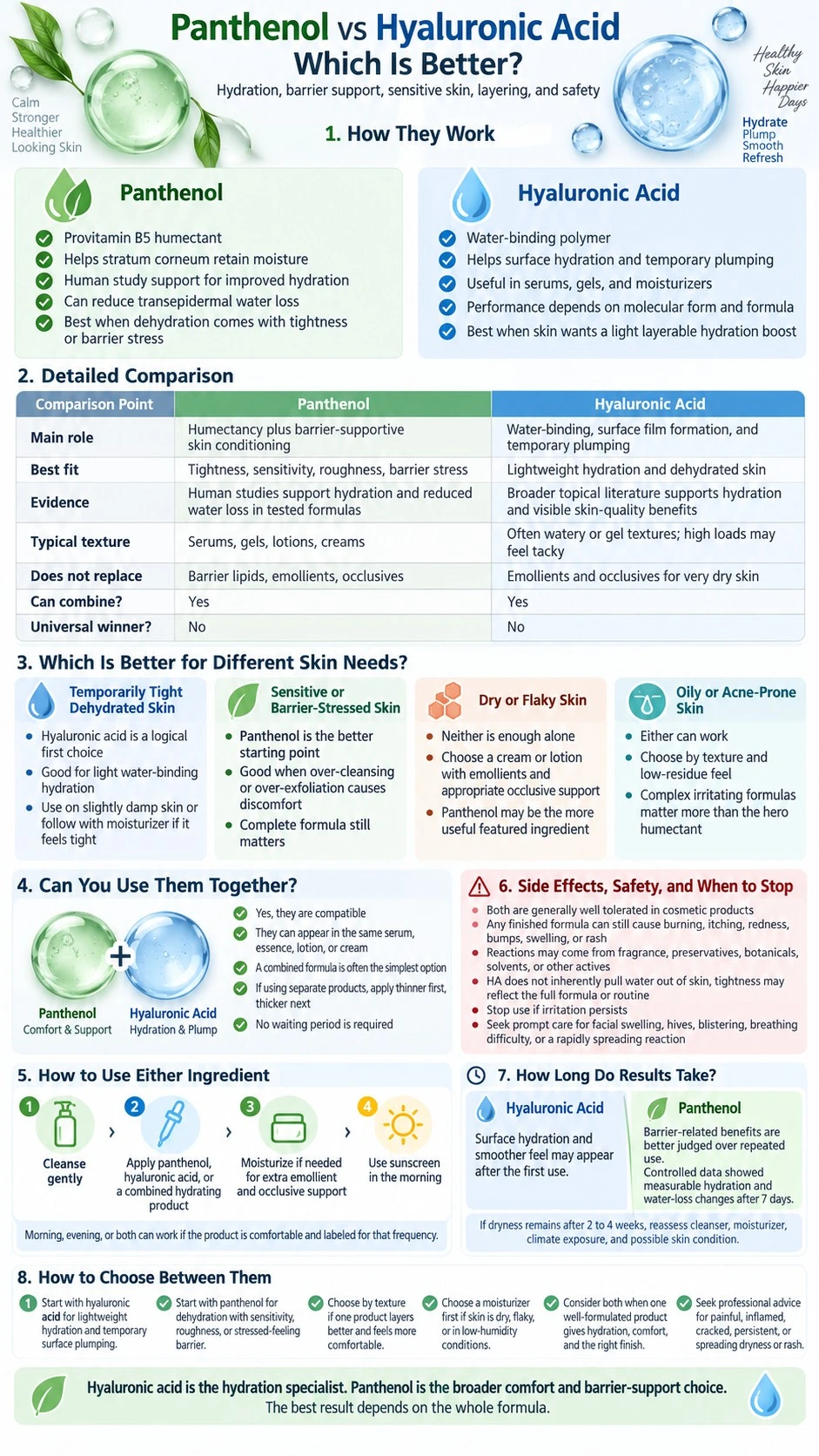
There is no strong direct head-to-head trial proving that panthenol or hyaluronic acid hydrates every skin type better. The useful distinction is functional: hyaluronic acid mainly acts as a water-binding polymer, while panthenol—also called provitamin B5—acts as a humectant and has evidence for improving stratum-corneum hydration and reducing transepidermal water loss.[1] The finished formula, climate, skin condition, and moisturizer layered over it can matter more than the ingredient name.
How Panthenol and Hyaluronic Acid Work
Both ingredients are humectants, meaning they help the outer skin hold water. They differ in structure and in the additional role each brings to a formula.
Panthenol
Panthenol is the alcohol form of pantothenic acid, or vitamin B5. In topical products, the dextrorotatory form—dexpanthenol—is hygroscopic and helps the stratum corneum retain moisture. A controlled human study found that 2.5% dexpanthenol applied twice daily for seven days improved stratum-corneum hydration and reduced transepidermal water loss compared with the vehicle.[1]
That evidence gives panthenol for skin a practical advantage when dehydration is linked with roughness, tightness, or barrier stress. It does not replace ceramides, fatty acids, cholesterol, or an occlusive moisturizer, and it should not be presented as a treatment for eczema or another skin disease.
Hyaluronic acid
Hyaluronic acid is a glycosaminoglycan naturally present in skin and other connective tissues. It has a strong affinity for water, which makes it useful in serums, gels, and moisturizers designed to improve surface hydration and soften the appearance of fine dehydration lines.[2]
Ingredient lists may show hyaluronic acid, sodium hyaluronate, hydrolyzed hyaluronic acid, or modified derivatives. Molecular size affects film formation, viscosity, skin interaction, and sensory character, but “multi-weight” does not automatically prove multi-layer hydration. Clinical performance still depends on concentration, vehicle, supporting ingredients, and test design.[3] For a fuller ingredient overview, see ZICAIL’s guide to hyaluronic acid.
Panthenol vs Hyaluronic Acid: Detailed Comparison
| Comparison point | Panthenol | Hyaluronic acid |
|---|---|---|
| Main role | Humectancy plus barrier-supportive skin conditioning | Water binding, surface film formation, and temporary plumping |
| Best fit | Dehydration with tightness, sensitivity, roughness, or barrier stress | Dehydrated skin seeking a light, layerable hydration boost |
| Evidence strength | Human studies support improved hydration and reduced water loss in tested formulas | A broader topical literature supports hydration and visible skin-quality benefits, but formulas vary widely |
| Typical texture | Can appear in watery serums, gels, lotions, and creams | Often used in watery or gel textures; higher polymer loads may feel tacky |
| What it does not replace | Barrier lipids, emollients, occlusives, or medical treatment | Emollients and occlusives needed for lasting comfort on very dry skin |
| Main limitation | Benefits cannot be predicted from the ingredient name or percentage alone | May feel tight, sticky, or insufficient when the overall formula lacks lipid or occlusive support |
| Can they be combined? | Yes; it can add comfort and barrier support | Yes; it can add surface water binding and slip |
| Universal winner? | No direct evidence proves it is always more hydrating | No direct evidence proves it is always more hydrating |
Compare finished products rather than isolated ingredients. A balanced moisturizer containing neither can outperform a poorly designed serum containing both, because lasting hydration depends on humectants, emollients, occlusives, and how well the product suits your environment.
Which Is Better for Different Skin Needs?
Start by identifying whether your main problem is simple dehydration, barrier-related discomfort, or deeper dryness with flaking. Those concerns overlap, but they do not require the same product structure.
Dehydrated skin that feels temporarily tight
Hyaluronic acid is a logical first choice when skin needs a light water-binding layer and otherwise feels comfortable. It can work well under sunscreen or makeup, especially in a serum with glycerin and a non-sticky finish. If the serum leaves a tight film, apply less, use it on slightly damp skin, or follow with a moisturizer rather than assuming a higher percentage will work better.
Sensitive or barrier-stressed skin
Panthenol is the more targeted starting point when dehydration comes with sensitivity, over-cleansing, over-exfoliation, or discomfort from a strong routine. Its humectant action is paired with evidence for reducing water loss and supporting barrier recovery in tested formulas.[1] The complete product still matters: fragrance, acids, alcohol, preservatives, and other actives can change tolerability. ZICAIL’s skin barrier guide explains why hydration and lipid support must work together.
Dry or flaky skin
Neither ingredient is sufficient on its own when skin lacks both water and lipids. Panthenol may be the more useful featured ingredient, but choose a cream or lotion that also contains emollients and an appropriate occlusive. Hyaluronic acid can remain part of the formula, yet a watery HA serum alone may not stop recurring tightness in cold, dry, or heavily air-conditioned conditions.
Oily or acne-prone skin
Either ingredient can fit oily or acne-prone skin. Texture is the deciding factor: a low-residue hyaluronic-acid fluid or panthenol gel may layer more comfortably than a rich cream. No single ingredient guarantees that a finished product will be non-comedogenic, and irritation from a complex formula can matter more than the featured humectant.
Can You Use Panthenol and Hyaluronic Acid Together?
Yes. They have no routine-level conflict and can appear in the same serum, essence, lotion, or cream. A combined formula is often the simplest choice because the formulator controls pH, polymer behavior, preservation, and afterfeel.
If you use separate products, apply the thinner product first and the thicker product next. There is no required waiting period between them. Finish with a moisturizer when your skin still feels tight, and do not add a second serum merely to collect both ingredient names. ZICAIL’s skincare routine order guide covers the broader layering principle.
Keep the rest of the routine stable when testing a new product. Starting panthenol, hyaluronic acid, an exfoliating acid, and a retinoid together makes it difficult to identify the cause if irritation develops.
How to Use Either Ingredient in Your Routine
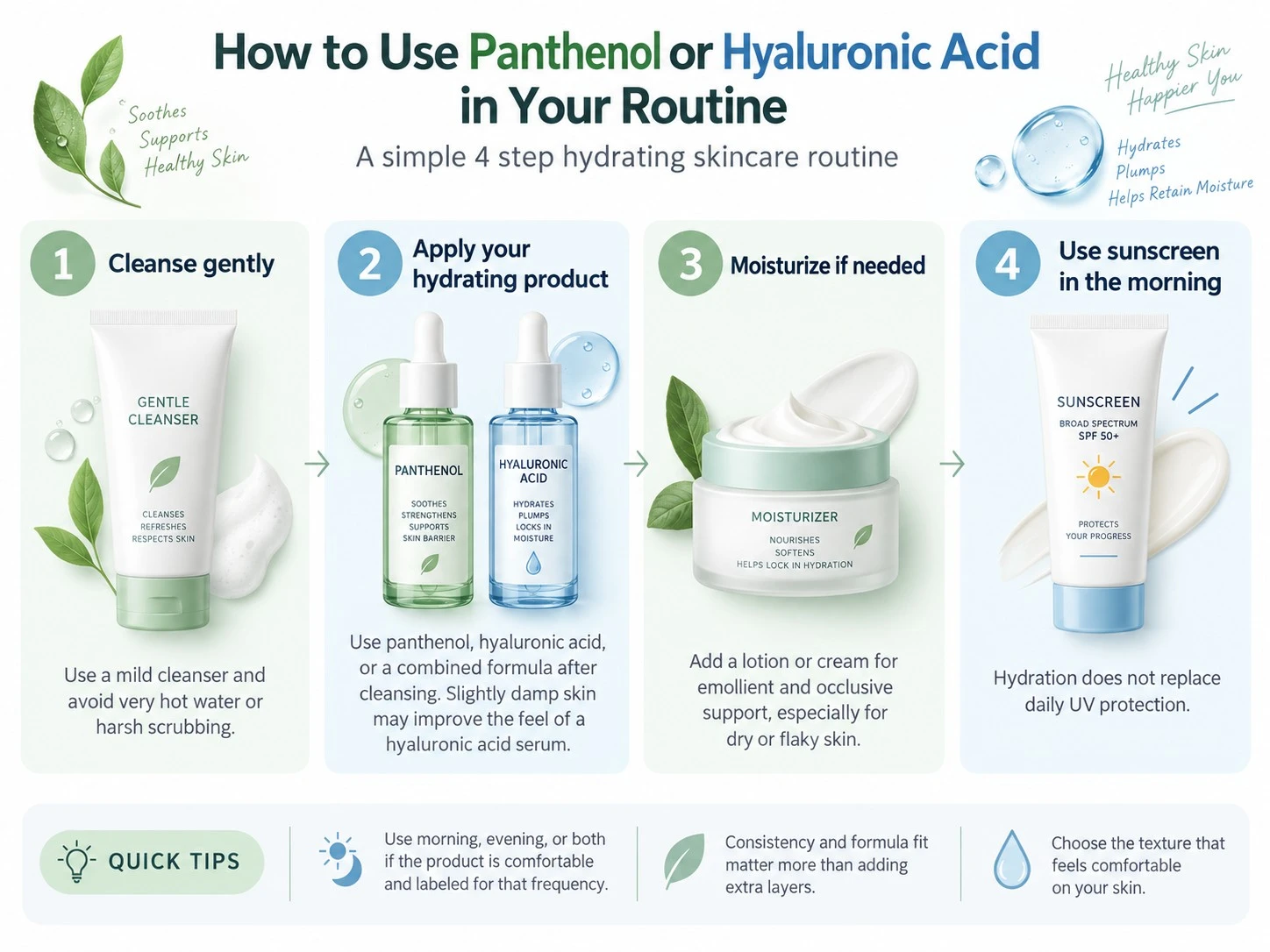
Use the finished product according to its label. A simple four-step routine is enough:
- Cleanse gently. Avoid very hot water and aggressive scrubbing, which can worsen tightness.
- Apply the hydrating product. Use panthenol, hyaluronic acid, or a combined formula after cleansing. Slightly damp skin may improve the feel of a hyaluronic-acid serum.
- Moisturize if needed. Add a lotion or cream to supply emollient and occlusive support, especially for dry or flaky skin. A serum and moisturizer perform different routine jobs.
- Use sunscreen in the morning. Hydration does not replace daily ultraviolet protection.
Either ingredient can be used in the morning, evening, or both if the product is designed for that frequency and your skin remains comfortable. Consistency and formula fit matter more than forcing multiple daily layers.
Side Effects, Safety, and When to Stop
Panthenol and hyaluronic acid are generally well tolerated in cosmetic products, but any finished formula can cause burning, itching, redness, bumps, swelling, or a rash. Panthenol allergy or irritation has been reported, although it is uncommon, and reactions to a product may come from fragrance, preservatives, botanical extracts, solvents, or another active instead.[4]
Hyaluronic acid does not inherently “pull water out” of skin. A tight or sticky feeling is more often a sign that the serum film, amount used, climate, or rest of the routine is not working for you. Reduce the amount or layer a moisturizer over it.
Stop using the product if irritation persists after rinsing or reducing frequency. Seek prompt care for facial swelling, hives, blistering, breathing difficulty, or a rapidly spreading reaction. Persistent cracking, oozing, pain, or eczema-like symptoms deserve professional evaluation rather than stronger cosmetic layering.
How Long Do Hydration Results Take?
Surface hydration and a smoother feel can appear after the first application, especially with a well-formulated hyaluronic-acid product. That immediate effect is not the same as long-term barrier improvement. Studies of topical hyaluronic-acid formulations have reported both immediate and longer-term hydration effects, but the result belongs to the tested formula, not every HA product.[3]
Panthenol’s barrier-related benefits should be judged over repeated use. Controlled data have shown measurable hydration and water-loss changes after seven days.[1] Longer studies of dexpanthenol-containing emollients have assessed daily use over several weeks.[4] These time frames are not guarantees for a different serum or cream.
Track comfort, flaking, tightness, and how long hydration lasts through the day. If skin remains persistently dry after two to four weeks of a gentle routine, reconsider the cleanser, moisturizer, climate exposure, and possible skin condition instead of automatically adding more humectants.
How to Choose Between Them
- Start with hyaluronic acid if you want a lightweight hydration step and temporary surface plumping.
- Start with panthenol if dehydration comes with sensitivity, roughness, or a stressed-feeling barrier.
- Choose by texture if one product layers better, pills less, and remains comfortable for longer.
- Choose a moisturizer first if skin is dry, flaky, or exposed to a cold or low-humidity environment.
- Consider both when one well-formulated product provides hydration, comfort, and a finish that suits your routine.
- Seek professional advice when dryness is painful, inflamed, cracked, persistent, or associated with a spreading rash.
FAQs About Panthenol and Hyaluronic Acid
Is panthenol more hydrating than hyaluronic acid?
There is no direct evidence showing that panthenol is always more hydrating. Hyaluronic acid is more specialized for surface water binding, while panthenol combines humectancy with barrier-supportive effects. Compare complete formulas and choose by your main skin need.
Can hyaluronic acid dry out skin?
Hyaluronic acid does not inherently dehydrate skin. A humectant-heavy serum can feel tight in dry conditions or when the routine lacks enough emollient and occlusive support. Use less product or apply moisturizer over it.
Can you use panthenol and hyaluronic acid every day?
Yes, many products containing either or both are designed for daily use. Follow the label, introduce one new product at a time, and reduce frequency if persistent irritation develops.
Which ingredient is better for sensitive skin?
Panthenol is often the more relevant starting point when sensitivity comes with barrier stress. Neither ingredient guarantees gentleness, because fragrance, solvents, preservatives, acids, and the overall vehicle determine how the finished product feels.
Can you use them with retinol, vitamin C, or exfoliating acids?
Usually, yes. Panthenol and hyaluronic acid can support hydration in routines containing those actives, but they do not cancel irritation. Add one product at a time and reduce the frequency of the stronger active if burning, redness, or persistent peeling develops.
Sources
[1] Gehring W, Gloor M. Effect of Topically Applied Dexpanthenol on Epidermal Barrier Function and Stratum Corneum Hydration
[2] Papakonstantinou E, Roth M, Karakiulakis G. Hyaluronic Acid: A Key Molecule in Skin Aging
[3] Bravo B et al. Benefits of Topical Hyaluronic Acid for Skin Quality and Signs of Skin Aging
[4] Cho YS et al. Use of Dexpanthenol for Atopic Dermatitis—Benefits and Recommendations Based on Current Evidence


