
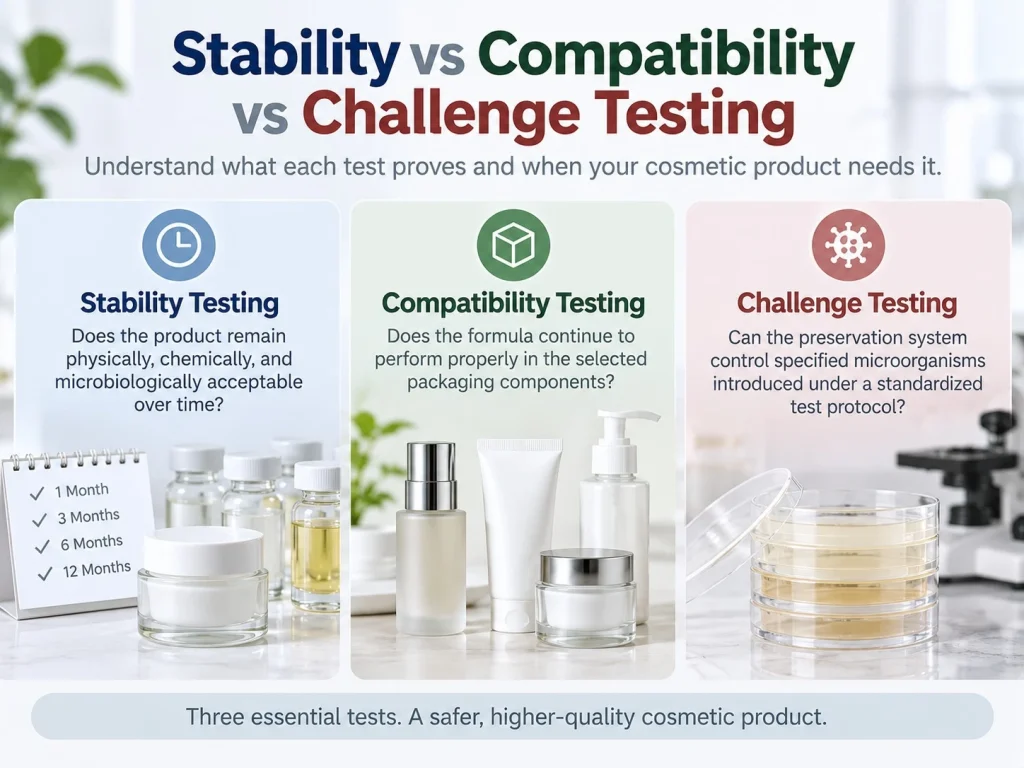

A serum can remain uniform in a laboratory container yet clog its final pump. A cream can look stable while its preservative system performs poorly when challenged. A formula can pass a preservative efficacy test but discolor, separate, lose viscosity, or attack its packaging during storage.
That is why “the product passed testing” is not a useful approval statement unless the brand knows which test was run, on which formula and packaging configuration, under which protocol, and against which acceptance criteria. ISO/TR 18811 provides a framework for choosing cosmetic stability methods.[1] ISO 11930 addresses evaluation of a cosmetic product’s antimicrobial protection.[2]
Cosmetic Stability, Compatibility, and Challenge Testing Compared
The simplest distinction is the failure mode each study is designed to reveal.
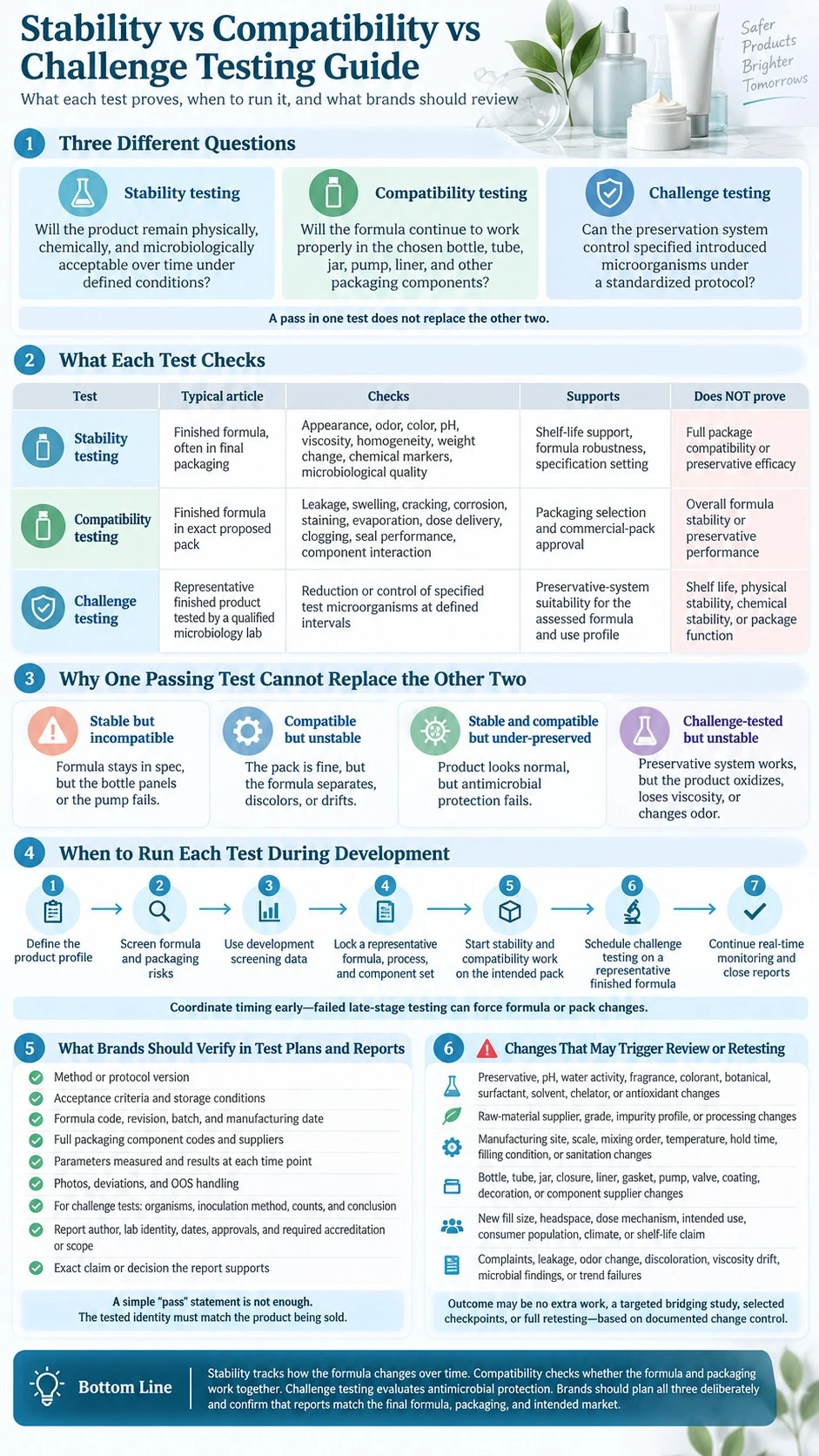
| Test | Primary question | Typical test article | What is observed or measured | Typical decision supported | What a pass does not prove |
|---|---|---|---|---|---|
| Stability testing | Will the product remain acceptable over time under defined conditions? | Finished formula, often in final packaging plus controls where appropriate | Appearance, odor, color, pH, viscosity, homogeneity, weight change, chemical markers, and microbiological quality as relevant | Formula robustness, provisional storage guidance, specification setting, and shelf-life support | That every packaging component is compatible or that the preservation system will resist introduced contamination |
| Compatibility testing | Will the formula and packaging continue to function together? | Finished formula in the exact proposed pack, including closure and dispensing system | Leakage, swelling, cracking, corrosion, paneling, discoloration, sorption, migration concerns, dose delivery, clogging, evaporation, and seal or actuator performance | Packaging selection and approval of the commercial pack | That the formula is stable in every condition or adequately preserved |
| Challenge testing | Can the preservation system control specified introduced microorganisms? | Representative finished product, tested by a qualified microbiology laboratory | Reduction or control of prescribed test organisms at defined intervals against the selected method’s acceptance criteria | Preservative-system suitability for the assessed formula and use profile | Shelf life, physical stability, chemical stability, package function, or routine batch microbiological quality |
Compatibility work may be incorporated into a broader stability protocol because the finished pack is stored and evaluated at the same time. It remains a separate decision, however: a laboratory may find the bulk formula acceptable while rejecting a pump, gasket, lacquer, liner, or bottle material. Challenge testing is more distinct because it is an intentional microbial-inoculation study with its own method and acceptance criteria.
For a broader view of the evidence used before launch, see ZICAIL’s skincare product testing guide.
What Stability Testing Checks
Stability testing evaluates how a cosmetic changes during storage. A protocol normally uses defined conditions and time points chosen for the formula, pack, intended market, transport exposure, and expected shelf-life claim. Samples may be assessed under real-time, accelerated, temperature-cycling, freeze–thaw, light, or other justified conditions. The right design is product-specific; ISO/TR 18811 is guidance for building an appropriate program, not one mandatory schedule for every cosmetic.[1]
Depending on the product, a stability panel can include:
- color, odor, appearance, clarity, homogeneity, and signs of separation;
- pH, viscosity, density, weight change, or dispensing mass;
- assay or degradation markers for ingredients that are critical to safety, performance, or claims;
- microbiological quality at selected time points;
- performance observations such as spread, foaming, drying, or redispersion; and
- package observations recorded alongside the formula results.
Accelerated conditions can reveal weaknesses and support development decisions earlier, but they do not create a universal mathematical shortcut to a real-time shelf life. Heat can speed some reactions while producing failure modes that do not occur at ambient conditions; other changes may depend more on light, oxygen, interfaces, or package permeability. A defensible conclusion combines the protocol, trend data, product knowledge, packaging evidence, real-time follow-up, and documented acceptance criteria.
Read ZICAIL’s cosmetic stability testing guide for a deeper discussion of protocols, conditions, checkpoints, and result interpretation.
What Packaging Compatibility Testing Checks
Compatibility testing studies the two-way relationship between the formula and its commercial packaging. The product may extract, stain, soften, swell, corrode, or stress a component. The package may allow moisture or volatile ingredients to escape, admit oxygen or light, adsorb formula components, or alter delivery. These risks cannot be settled by naming only the broad material—“PET bottle” or “plastic pump” is not a complete component specification.
The test article should represent the intended market pack as closely as possible: bottle or jar, closure, dip tube, actuator, gasket, liner, valve, coating, decoration, adhesive, and fill level. Where orientation matters, samples may need upright, inverted, or side storage. Evaluation should cover both containment and consumer use, including:
- leakage, seal integrity, torque, deformation, cracking, corrosion, and delamination;
- discoloration, staining, swelling, paneling, evaporation, or weight loss;
- clogging, priming, dose consistency, spray pattern, foamer output, and product evacuation;
- formula changes concentrated near contact surfaces; and
- any migration, sorption, or material-safety question requiring specialized assessment.
A packaging supplier’s material declaration is important input, but it is not finished-product compatibility evidence. Results from a similar formula also may not cover a new fragrance, solvent level, surfactant system, oil phase, pH, active ingredient, or contact material. The European cosmetic safety report framework separately calls for information on stability and relevant packaging-material characteristics, reinforcing that both formula behavior and pack suitability belong in the safety file.[3]
See ZICAIL’s packaging compatibility testing guide and skincare packaging guide when comparing material, dispenser, and test-sample decisions.
What Preservative Challenge Testing Checks
Preservative challenge testing—also called preservative efficacy testing—assesses the antimicrobial protection of a cosmetic formulation. Under ISO 11930, the reference approach introduces specified microorganisms into the product, measures survival at defined intervals, and interprets the reduction profile against acceptance criteria. The standard also recognizes that a microbiological risk assessment may be used for products considered low risk under ISO 29621.[2]
This is not the same as routine microbiological limits testing. A limits test asks whether a sample’s microbial count and specified-organism status meet release or monitoring requirements at that moment. A challenge test asks how the product’s preservation system responds after a controlled microbial burden is introduced. One examines current microbiological quality; the other evaluates protective capability.
Challenge-test relevance depends on the formula and use conditions. Water activity, pH, preservative system, raw-material bioburden, manufacturing controls, packaging, dose exposure, consumer contact, and use around sensitive areas can all affect the risk assessment. A tightly closed single-dose product and a wide-mouth jar repeatedly contacted by wet fingers do not present the same contamination pathway.
A passing result applies to the tested formula and protocol. It should not be stretched automatically to a materially different fragrance, botanical blend, surfactant system, pH, preservative concentration, manufacturing process, or package-use pattern. For method selection and interpretation, use a qualified laboratory and document the rationale. ZICAIL’s preservative challenge testing guide explains the brand-side planning questions in more detail.
Why One Passing Test Cannot Replace the Other Two
Each study controls a different uncertainty:
- Stable but incompatible: The formula retains pH and viscosity in glass controls, but the production bottle panels or the pump stops dispensing.
- Compatible but unstable: The pack remains intact, but the emulsion separates or the active degrades.
- Stable and compatible but under-preserved: The product looks normal in storage and the dispenser works, but antimicrobial protection is inadequate under challenge conditions.
- Challenge-tested but unstable: The preservation system controls the test organisms, yet the product oxidizes, discolors, loses fragrance, or drifts outside its specification.
The EU Cosmetic Products Regulation makes the distinction visible in its safety-report requirements: Part A addresses physical and chemical characteristics and stability, microbiological quality and preservation challenge-test results, and packaging-material characteristics in separate subsections.[3] In the United States, FDA does not prescribe one fixed test list for every cosmetic, but the manufacturer or distributor remains responsible for safety and should rely on scientifically sound evidence appropriate to the product.[4] Under MoCRA, the responsible person must ensure and maintain records supporting adequate substantiation of safety.[5]
The practical conclusion is not that every product needs the same three reports in the same format. It is that each risk must be assessed deliberately, and any omitted study needs a documented scientific rationale rather than an assumption.
When to Run Each Test During Product Development

A coordinated sequence reduces the risk of paying for full testing on a formula or package that is still changing.
- Define the product profile. Record product type, use area, target users, directions, claims, destination markets, expected shelf life, fill size, and likely packaging.
- Screen formula and pack risks. Review water activity, pH, preservative strategy, sensitive ingredients, oxygen or light exposure, viscosity, solvent or surfactant load, consumer contact, and transport conditions.
- Use development screening before the final protocol. Short screens can compare formula variants or pack candidates, but label them as development data rather than final validation.
- Lock a representative formula, process, and component set. Final studies should be traceable to formula version, batch, manufacturing process, fill conditions, component specifications, and artwork or decoration where relevant.
- Start stability and compatibility work on the intended pack. These studies can often run in parallel, with package-specific observations recorded at every planned checkpoint.
- Schedule challenge testing on a representative finished formula. Do not wait until the last possible launch week; a failed result may require formula changes that invalidate other work.
- Continue real-time monitoring and close reports. Review trends, deviations, photographs, raw results, conclusions, and any open long-term checkpoints before approving claims or shelf life.
The order is not rigid. A high-risk packaging material may deserve an early compatibility screen, while a preservative-system change may justify challenge testing before long stability work begins. The controlling principle is change cost: obtain enough evidence to avoid locking expensive downstream decisions around an unproven upstream choice.
What Brands Should Verify in Test Plans and Reports
A certificate saying “pass” is not enough to show that the evidence covers the product being sold. Before approving a study, confirm:
- the legal or laboratory method, protocol version, acceptance criteria, storage conditions, orientations, intervals, and sample quantities;
- formula code and revision, batch number, manufacturing date, process scale, and whether the sample represents normal production;
- complete packaging component codes, suppliers, materials, colorants, coatings, liners, gaskets, pumps, and decoration;
- parameters measured, instruments or methods used, initial values, results at each time point, photographs, deviations, and out-of-specification handling;
- challenge organisms, inoculation approach, recovery method, count data, acceptance category, controls, and laboratory conclusion where applicable;
- the report author, laboratory identity, dates, approvals, and any accreditation or method-scope information the brand requires; and
- the exact claim the conclusion supports, including unresolved limitations or ongoing real-time checkpoints.
Keep the reports with the formula history, packaging specifications, safety assessment, batch records, and change-control decisions. The tested identity must be reconstructable later. If the commercial formula or pack cannot be matched to the report, the report’s value is sharply reduced.
Changes That Can Trigger Review or Retesting
Do not apply an automatic rule that every minor administrative edit requires a complete restart. Use documented change control to assess whether the change can affect the evidence. Common triggers include:
- preservative type or level, pH target, water activity, fragrance, colorant, botanical, surfactant, solvent, chelator, or antioxidant changes;
- raw-material supplier, grade, impurity profile, or processing change;
- manufacturing site, batch scale, mixing order, temperature, hold time, filling condition, or sanitation change;
- bottle, tube, jar, closure, liner, gasket, pump, valve, coating, decoration, or component supplier change;
- new fill size, headspace, dose mechanism, intended use, consumer population, storage direction, destination climate, or shelf-life claim; and
- unexpected complaints, microbial findings, leakage, odor change, discoloration, viscosity drift, or trend failures.
The outcome may be no additional work, a targeted bridging study, selected checkpoints, or full retesting. Record the technical basis and approval owner rather than relying on “similar enough.”
Plan Testing Before You Lock the Formula and Packaging
Testing is most efficient when formula, packaging, target market, claims, and launch timing are planned together. ZICAIL can discuss how a private-label skincare project moves from product brief and sample development to packaging selection, documentation, and an appropriate third-party testing plan.
Prepare the product type, target market, desired claims, reference formula or sample, proposed packaging, expected shelf life, launch date, and any retailer-specific requirements. Then contact ZICAIL to align the project brief before the final formula and component orders are locked.


