


Retinol has a substantial history in photoaging and acne care, while bakuchiol is marketed as a gentler “retinol alternative.” That description can be useful shorthand, but it also creates confusion: bakuchiol is not a retinoid, and the two ingredients do not have identical evidence, chemistry, or risks.
For most people, the practical question is not whether the ingredients can ever share a routine. It is whether combining them adds enough value to justify a more complicated—and potentially more irritating—regimen. The answer depends on your current retinol tolerance, product formulas, skin condition, and expectations.
What Does the Evidence Actually Show?
The most frequently cited clinical trial did not test bakuchiol and retinol together. It compared 0.5% bakuchiol used twice daily with 0.5% retinol used once daily in 44 participants over 12 weeks. Both groups showed improvement in measured signs of photoaging, while the retinol group reported more scaling and stinging.[1] The study supports bakuchiol as a promising option, but it does not establish that layering the two ingredients creates a stronger or faster result.
Laboratory research has found that bakuchiol can produce some retinol-like changes in gene expression even though its chemical structure is different from that of retinoids.[2] This helps explain why the ingredients may address overlapping concerns, such as fine lines and uneven-looking tone. It does not make bakuchiol a plant-derived form of retinol or prove that the pair is synergistic on human skin.
The broader clinical evidence for topical bakuchiol remains limited. A 2024 systematic review identified 15 human trials, but most were open-label studies without a control group, and many tested multi-ingredient products. The authors noted substantial variation in formulations, methods, and outcomes, which makes direct conclusions difficult.[3]
A small open-label study has evaluated a finished formula containing retinal—not retinol—alongside bakuchiol, niacinamide, melatonin, and another botanical ingredient. Because the product contained several actives and had no retinal-only comparison group, it cannot show how much benefit came from bakuchiol or whether consumers would obtain the same result by layering separate products.[4]
The evidence-based conclusion is therefore narrower than many marketing claims: bakuchiol and retinol can be formulated or used within one regimen, but clinical proof of an added combination benefit is not yet strong.
Who May—and May Not—Want to Combine Them?
| Situation | Practical choice | Why |
|---|---|---|
| You already tolerate retinol well | Consider a finished combination product or add bakuchiol slowly | Your skin has already demonstrated some retinoid tolerance, although irritation is still possible |
| You are new to both ingredients | Start with one product | Introducing both together makes it harder to identify the cause of irritation |
| Your skin is sensitive or easily becomes dry | Use one ingredient at a low frequency, or alternate them | Reducing cumulative irritation is usually more useful than maximizing the number of actives |
| Your skin is currently burning, peeling, or inflamed | Pause both and use a simple routine | Adding actives to already irritated skin can prolong discomfort |
| You use a prescription retinoid | Ask the prescribing clinician before adding bakuchiol | A prescription regimen should guide the rest of your active-ingredient routine |
| You are pregnant or trying to conceive | Avoid retinol and ask your clinician about alternatives | Dermatologists advise avoiding retinoids during pregnancy; evidence is insufficient to label bakuchiol universally pregnancy-safe |
Skin tone also matters when judging irritation. The American Academy of Dermatology notes that retinoid irritation can trigger hyperpigmentation in people with darker skin tones.[5] A slower schedule and early response to redness, burning, or excessive dryness can help reduce that risk.
Three Ways to Use Bakuchiol and Retinol
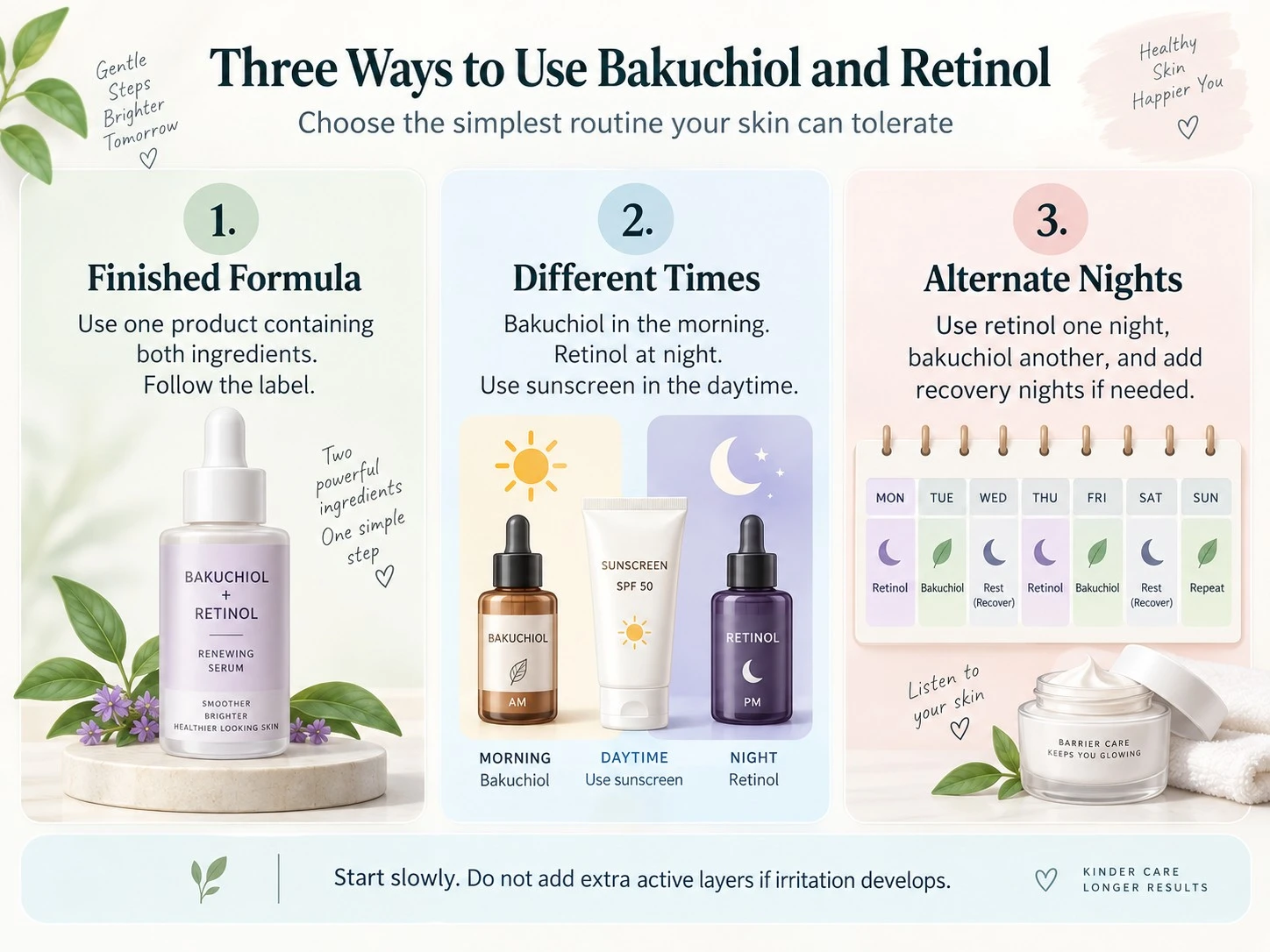
There is no universal rule that everyone must layer the ingredients on the same night. Choose the least complicated method that suits your skin and the directions on your products.
1. Use a Finished Formula Containing Both
This is the most straightforward approach. A finished product has a defined ingredient concentration, base, packaging system, and application direction. That does not guarantee zero irritation or superior results, but it avoids the uncertainty of mixing two independently formulated products in your hand.
Follow the label rather than adding a second retinol or bakuchiol product on top. “More” is not automatically better, particularly when the formula already contains exfoliating acids or other potentially irritating actives.
2. Use Them at Different Times
Bakuchiol may be used in the morning and retinol at night if both product labels permit that schedule. Retinol is generally used at night, while morning use of bakuchiol should still be followed by a broad-spectrum sunscreen. Separating the products makes the routine easier to tolerate for some users, but it does not eliminate the need for gradual introduction.
3. Alternate Nights
Alternating nights is often the most practical option for a beginner or someone who becomes dry easily. For example, use the retinol product on one night, bakuchiol on another, and keep recovery nights with cleanser and moisturizer as needed. The exact schedule should respond to your skin rather than a fixed online calendar.
If you eventually use separate products on the same night, apply them according to their labels and texture. There is no evidence-based universal answer to whether bakuchiol must go before or after retinol; a thin serum usually goes before a heavier cream, but the product manufacturer’s directions take priority. Do not pre-mix separate formulas unless the brands specifically instruct you to do so.
How to Reduce Irritation
Retinol commonly causes dryness, redness, peeling, or stinging, especially when treatment begins. The American Academy of Dermatology recommends starting with a less intense retinoid formula, using it every other night initially, and increasing slowly as tolerated.[5] Bakuchiol is often better tolerated in small studies, but it is not irritation-proof. Allergic contact dermatitis has also been reported.[6]
Use these guardrails when building your routine:
- Patch test first: Test a small area according to the product directions before broader facial use. A patch test cannot guarantee that delayed irritation will not occur, but it may reveal an obvious reaction.
- Introduce one change at a time: Keep the first product stable for several weeks before adding the second. This makes reactions easier to trace.
- Start with fewer nights: Frequency is often easier to adjust than trying to compensate for irritation after it develops.
- Use a moisturizer: A simple, fragrance-free moisturizer can reduce dryness. Some users apply moisturizer before and after retinol, sometimes called the “sandwich” method, although product directions should still guide use.
- Limit other irritating actives: Exfoliating acids, scrubs, benzoyl peroxide, and additional retinoids may increase the total irritation burden. They are not always chemically incompatible, but using several at once may be too much for your skin.
- Protect your skin during the day: Use broad-spectrum SPF 30 or higher, seek shade, and use protective clothing. Retinoids are used at night, and sun protection is essential in any routine targeting photoaging or discoloration.[5]
Avoid applying either product to broken, sunburned, or actively inflamed skin. Also keep retinol away from the eyelids, corners of the nose, and lips unless the product is specifically designed for those areas.
When Should You Stop?
Mild dryness or brief, low-level stinging can occur when starting retinol, but discomfort should not be treated as proof that the product is “working.” Reduce the frequency or pause active products if your skin becomes persistently red, tender, itchy, or flaky. During the pause, use a gentle cleanser, moisturizer, and sunscreen until your skin feels normal again.
Stop using the suspected product and seek medical advice if you develop significant swelling, blistering, hives, severe pain, eye involvement, or a spreading or persistent rash. These symptoms may indicate a reaction that needs professional assessment rather than another routine adjustment.
Pregnancy and Breastfeeding Considerations
The American Academy of Dermatology advises avoiding both prescription retinoids and over-the-counter skincare products containing retinol during pregnancy.[7] If you are pregnant or trying to conceive, do not use retinol unless your healthcare professional has given specific guidance.
Bakuchiol is often promoted online as a pregnancy-safe retinol alternative, but “not a retinoid” is not the same as “proved safe during pregnancy.” Human pregnancy safety data are inadequate for a universal assurance. Discuss bakuchiol and the complete ingredient list with your obstetrician or dermatologist. During breastfeeding, ask for individualized advice, and avoid applying active skincare ingredients where an infant could have direct skin or oral contact.
FAQs About Bakuchiol and Retinol
Should Bakuchiol Go Before or After Retinol?
There is no universal ingredient-based order. Follow each product’s instructions; when no specific order is given, apply lighter, water-based formulas before heavier creams or oils. Avoid mixing separate products together in your palm because doing so can change how evenly they are applied.
Can You Use Bakuchiol in the Morning and Retinol at Night?
Yes, this is a reasonable way to separate them if the bakuchiol product is intended for daytime use. Apply broad-spectrum sunscreen every morning. Begin with a modest frequency rather than assuming separation makes daily use immediately tolerable.
Is Bakuchiol Better Than Retinol for Sensitive Skin?
Bakuchiol caused less scaling and stinging than retinol in one small head-to-head trial, so some people may find it easier to tolerate.[1] That does not mean it is always non-irritating or that it has the same depth of evidence as retinoids. Product formula, concentration, frequency, and individual allergy can all change the outcome.
Is Bakuchiol Safe During Pregnancy?
There is not enough human pregnancy safety evidence to make a blanket claim that bakuchiol is safe. Retinol and other retinoids should be avoided during pregnancy, while bakuchiol should be discussed with a qualified healthcare professional rather than treated as an automatically approved substitute.[7]
Can You Use Bakuchiol With Prescription Tretinoin?
Do not add bakuchiol to a prescription tretinoin routine without asking the clinician who manages your treatment. Even if the ingredients are not known to be chemically incompatible, the additional product may increase irritation or complicate assessment of your prescription response.
Sources
[1] Dhaliwal et al. Prospective, randomized, double-blind assessment of topical bakuchiol and retinol for facial photoageing
[2] Chaudhuri and Bojanowski. Bakuchiol: a retinol-like functional compound revealed by gene expression profiling and clinically proven to have anti-aging effects
[3] Beringer et al. Human Clinical Trials Using Topical Bakuchiol Formulations for the Treatment of Skin Disorders: A Systematic Review
[4] Granger et al. Natural Retinol Analogs Potentiate the Effects of Retinal on Aged and Photodamaged Skin: Results from In Vitro to Clinical Studies
[5] American Academy of Dermatology Association. Retinoid or retinol?
[6] García-Melendo et al. Allergic Contact Dermatitis to Bakuchiol Used for Photodamage Prevention: A Case Report
[7] American Academy of Dermatology Association. Dermatologist-approved pregnancy skin care


