
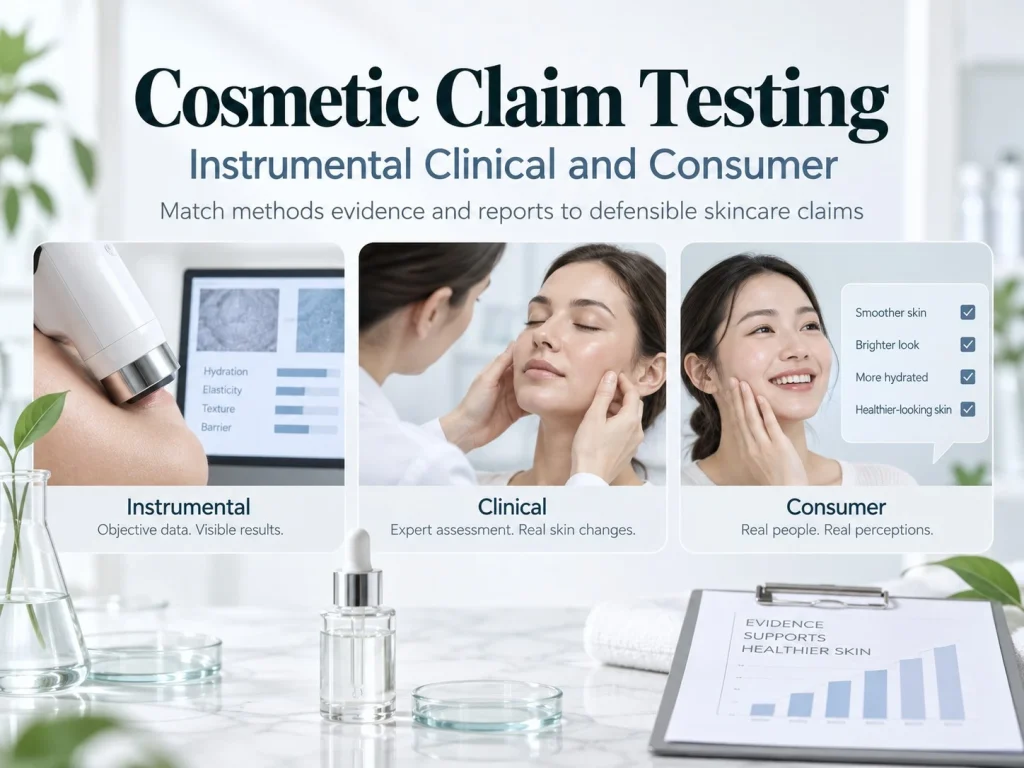

Cosmetic claim testing turns product performance into evidence that can support packaging, product pages, retailer submissions, advertising, and sales materials. The difficult part is not simply running a study. It is keeping the proposed words, tested product, participants, method, time point, statistics, and final claim aligned.
That alignment should begin before artwork is approved. A study can produce valid data yet still fail commercially if it measures the wrong endpoint, tests an unrepresentative group, uses a time point absent from the planned claim, or reports a group average that marketing later rewrites as a consumer-response percentage.
What Must Cosmetic Claim Testing Prove?
Claim substantiation must support the message a reasonable buyer or consumer is likely to take from the complete communication. That includes explicit wording, numbers, images, comparisons, footnotes, product names, and implied meanings—not only the sentence selected for testing.
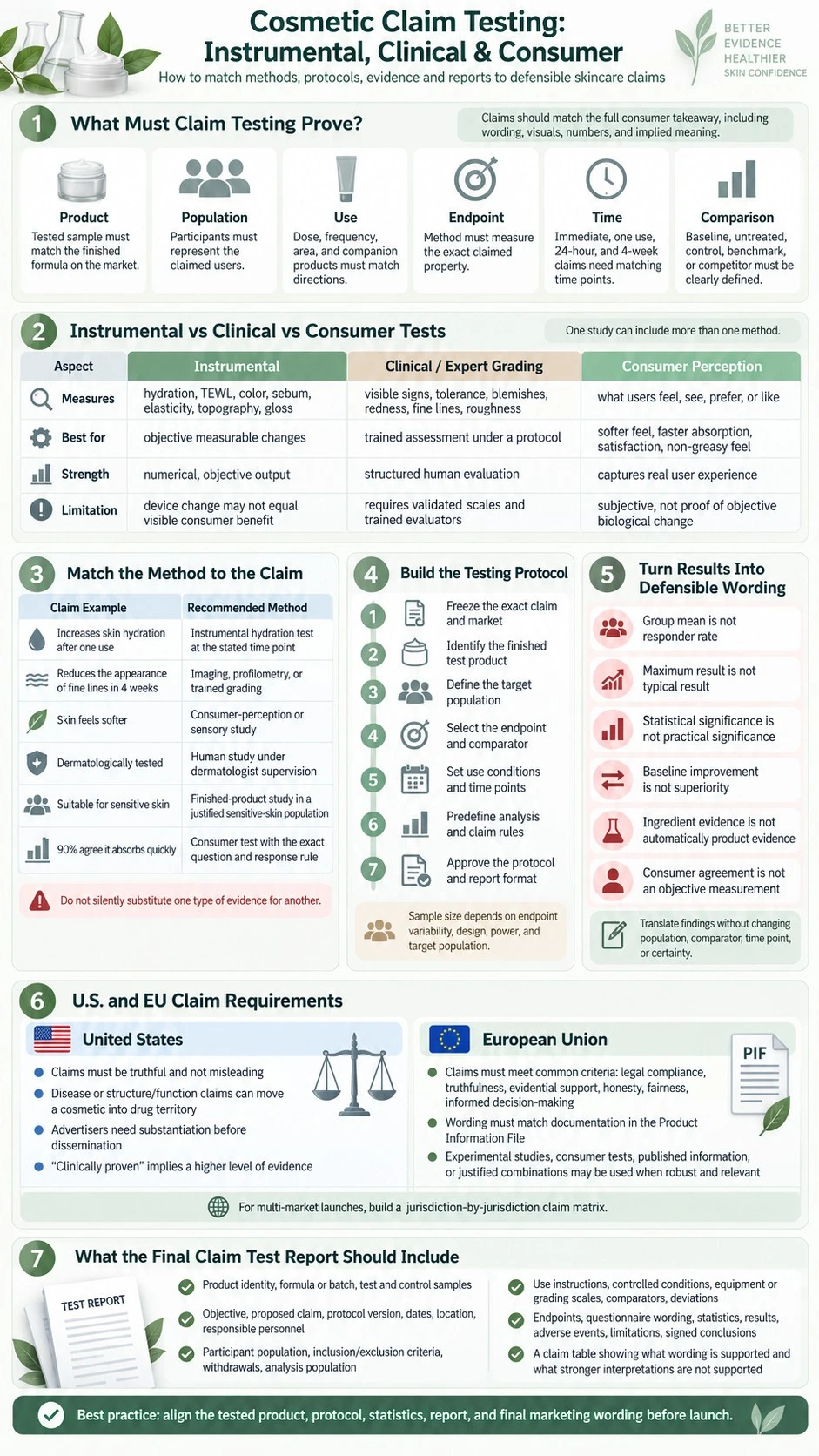
The evidence should match six elements:
- Product: The tested sample should be identifiable as the finished formula and relevant to the version placed on the market.
- Population: Participants should represent the people named or implied by the claim, such as adults with dry skin or users with self-perceived sensitive skin.
- Use: Dose, frequency, application area, companion products, and use conditions should reflect the instructions behind the claim.
- Endpoint: The method must measure the property actually claimed, not a convenient surrogate with a different meaning.
- Time: “Immediate,” “after one use,” “24-hour,” and “after four weeks” are different claims and require matching observations.
- Comparison: A claim against baseline, untreated skin, a control product, or a named competitor requires a design capable of supporting that exact comparison.
EU guidance states that cosmetic claims should have adequate and verifiable support, reflect the weight of available evidence, and not extend beyond what the data show.[1] In the United States, advertisers must possess a reasonable basis before disseminating an objective claim; the required level of support depends on the claim and the consequences of it being false.[2]
Claim efficacy testing is not a substitute for safety, stability, compatibility, or cosmetic microbiological testing. These programs answer different questions and should be planned as connected but separate parts of product development.
Instrumental vs Clinical vs Consumer Claim Tests
The three categories are useful for planning, but they are not mutually exclusive. “Clinical” often describes the human-study setting and oversight, while instrumental measurement, expert grading, and participant questionnaires describe endpoints within that study. A well-designed facial moisturizer study may include corneometry, investigator grading, and user responses in one protocol.
| Method | What it measures | Suitable claim direction | Main strength | Main limitation |
|---|---|---|---|---|
| Instrumental | Physical or biophysical parameter captured by a device or analytical method | Hydration, water loss, color, elasticity, surface topography, sebum, gloss, or combing force | Objective numerical output under defined conditions | A numerical change may not equal a visible or meaningful consumer benefit |
| Clinical or expert grading | Visible signs, tolerance, or defined attributes assessed by a trained evaluator | Appearance of fine lines, roughness, redness, flaking, blemishes, or tolerance | Structured human assessment with professional oversight | Grading still requires validated scales, training, consistency, and bias control |
| Consumer perception | What target users report seeing, feeling, liking, or experiencing | Feels softer, looks more radiant, absorbs quickly, non-greasy feel, or satisfaction | Directly captures experience relevant to purchase and repeat use | Subjective answers do not establish an objective biological or physical change |
Instrumental Testing
Instrumental testing is strongest when the claim names a measurable property. Common examples include capacitance-based measurements for skin hydration, transepidermal water loss for water-vapor flux, colorimetry for defined color parameters, suction-based measurements for elastic behavior, standardized imaging or profilometry for skin-surface features, and sebum measurements for surface lipids.
The instrument does not validate a marketing phrase by itself. The endpoint, anatomical site, environmental controls, acclimation period, operator technique, calibration, baseline variability, control condition, and statistical analysis all affect interpretation. A device reading described as “improved barrier” may be too broad if the protocol measured only one water-loss parameter under limited conditions.
Clinical or Expert-Grading Studies
Clinical evaluation uses trained assessors and predefined scoring criteria to judge attributes that require human interpretation. Depending on the protocol, the evaluator may be a dermatologist, another medically qualified professional, or a trained investigator. The title and qualifications of the evaluator should match any supervision claim.
“Dermatologically tested” and “clinically tested” describe how testing was conducted; they do not automatically support a specific magnitude of efficacy. EU technical guidance explains that “dermatologically tested” implies human testing under a dermatologist’s supervision, while “clinically tested” refers to testing on humans under qualified supervision according to a clinical protocol or in a clinical setting.[3]
Consumer-Perception Tests
Consumer tests collect subjective responses after participants use or experience the product. They are appropriate for sensory, appearance, convenience, and satisfaction claims that participants can reasonably observe: “92% agreed skin felt smoother,” for example, is a perception claim, not an instrumental measurement.
Question wording can determine whether the result is useful. Questions and answer scales should be clear, balanced, non-leading, and fixed before data collection. The claimed percentage must map directly to the relevant question and response rule. EU guidance also calls for a target-population sample, defined inclusion and exclusion criteria, a validated protocol, appropriate statistics, and interpretation that does not overstate the test.[3]
How to Match the Test Method to the Claim
Start by classifying what the words promise. Then choose the endpoint and design that can directly support that promise.
| Planned claim type | Primary evidence | Useful supporting evidence | Common mismatch |
|---|---|---|---|
| “Increases skin hydration after one use” | Instrumental hydration measurement at the stated time point | Consumer report of moisturized feel | Using only a softness questionnaire to claim measured hydration |
| “Reduces the appearance of fine lines in four weeks” | Standardized imaging, profilometry, or trained grading with a defined scale | Consumer perception of smoother-looking skin | Converting an instrumental change into a claim that every user visibly improved |
| “Skin feels softer” | Consumer-perception or sensory study | Relevant instrumental surface measurement | Using device data alone for a claim about personal feel |
| “Dermatologically tested” | Human study under dermatologist supervision with favorable relevant results | Tolerance observations and adverse-event records | Using a consumer questionnaire without dermatologist supervision |
| “Suitable for sensitive skin” | Finished-product study in a justified sensitive-skin target population with tolerance endpoints | Expert assessment and participant feedback | Relying only on an ingredient list or a general patch test |
| “90% agree the product absorbs quickly” | Consumer test with the exact concept measured by a clear question | Trained sensory-panel data | Reporting the percentage without the base size, use period, or question context |
More testing is not automatically better. Add a second method only when it supports a separate part of the communication or reduces a real interpretation gap. An instrumental endpoint plus a consumer response can support two complementary statements, but one cannot be silently substituted for the other.
How to Build a Cosmetic Claim Testing Protocol
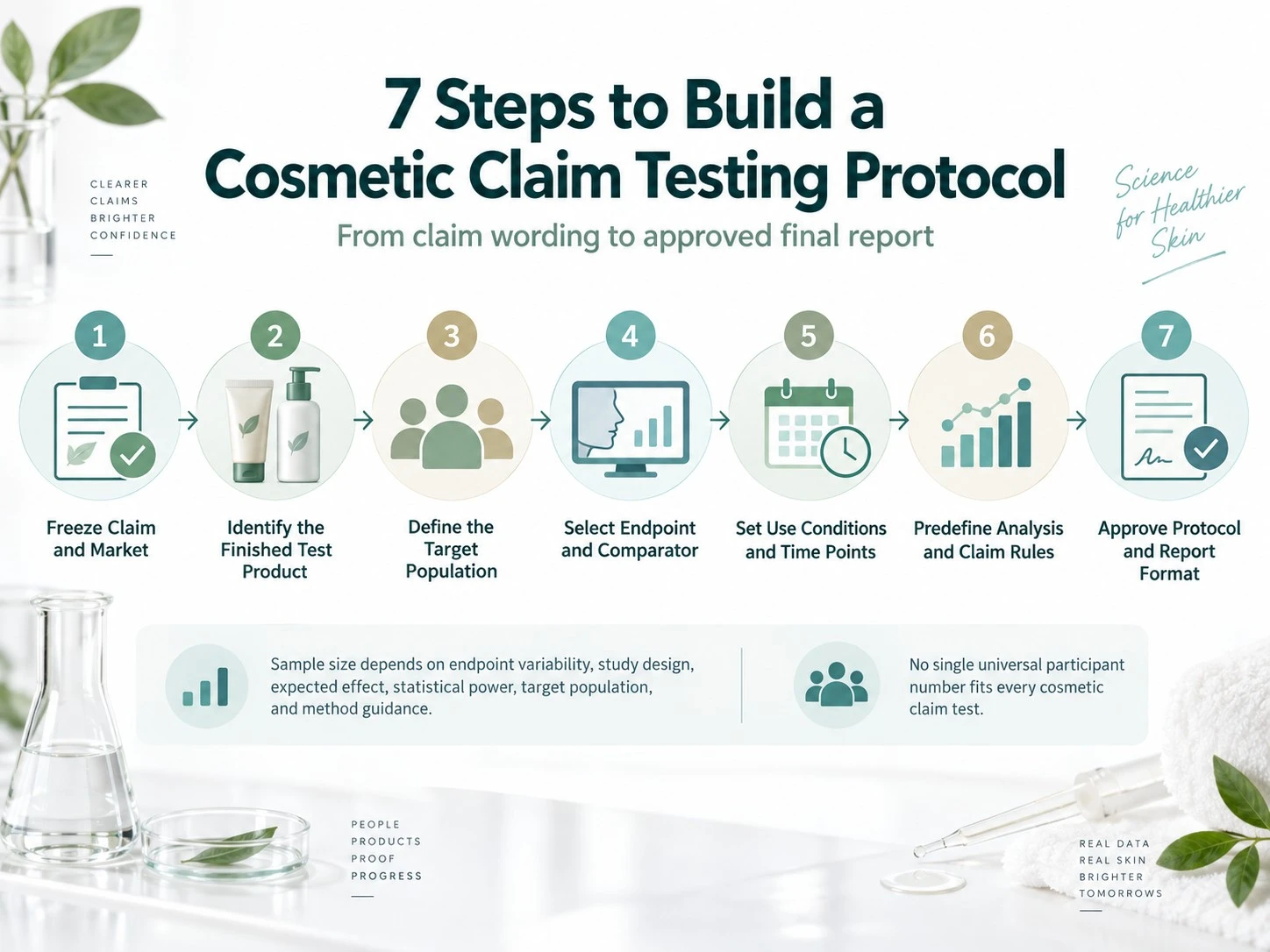
Use this sequence before the laboratory begins recruitment or measurement. It reduces expensive protocol amendments and prevents the final report from answering a different question from the one marketing intends to ask.
- Freeze the exact claim and market. Record every proposed quantitative, comparative, timing, supervision, target-user, and exclusivity statement, including likely implied meanings in visuals and headlines.
- Identify the finished test product. Define the formula code, batch, packaging, storage status, use instructions, and whether the commercial version could change before launch.
- Define the target population. Set relevant age range, skin or hair characteristics, inclusion and exclusion criteria, and prohibited or controlled companion products. Do not recruit a convenient group that differs materially from the claimed users.
- Select the endpoint and comparator. Choose a validated or scientifically justified method that measures the claimed property. Define whether the comparison is baseline, untreated site, vehicle, benchmark, control product, or competitor.
- Set use conditions and time points. Align application amount, frequency, area, climate or controlled-room conditions, acclimation, washout, and measurement schedule with the proposed claim.
- Predefine analysis and claim rules. State the primary endpoint, analysis population, missing-data treatment, statistical method, responder definition, questionnaire scoring, and wording that each possible result could support.
- Approve the protocol and report format. Obtain technical, regulatory, and marketing agreement before study start, then require deviations, adverse events, raw-output traceability, statistics, limitations, and conclusions in the final report.
There is no responsible universal participant number for every cosmetic claim test. Sample size should follow the endpoint’s variability, design, expected effect, statistical power, target population, subgroup plans, and applicable method guidance. EU best-practice guidance requires scientifically and statistically valid design, qualified personnel, quality systems, a validated protocol, and reliable, reproducible methods rather than prescribing one number for all claims.[3]
How to Turn Test Results Into Defensible Claim Wording
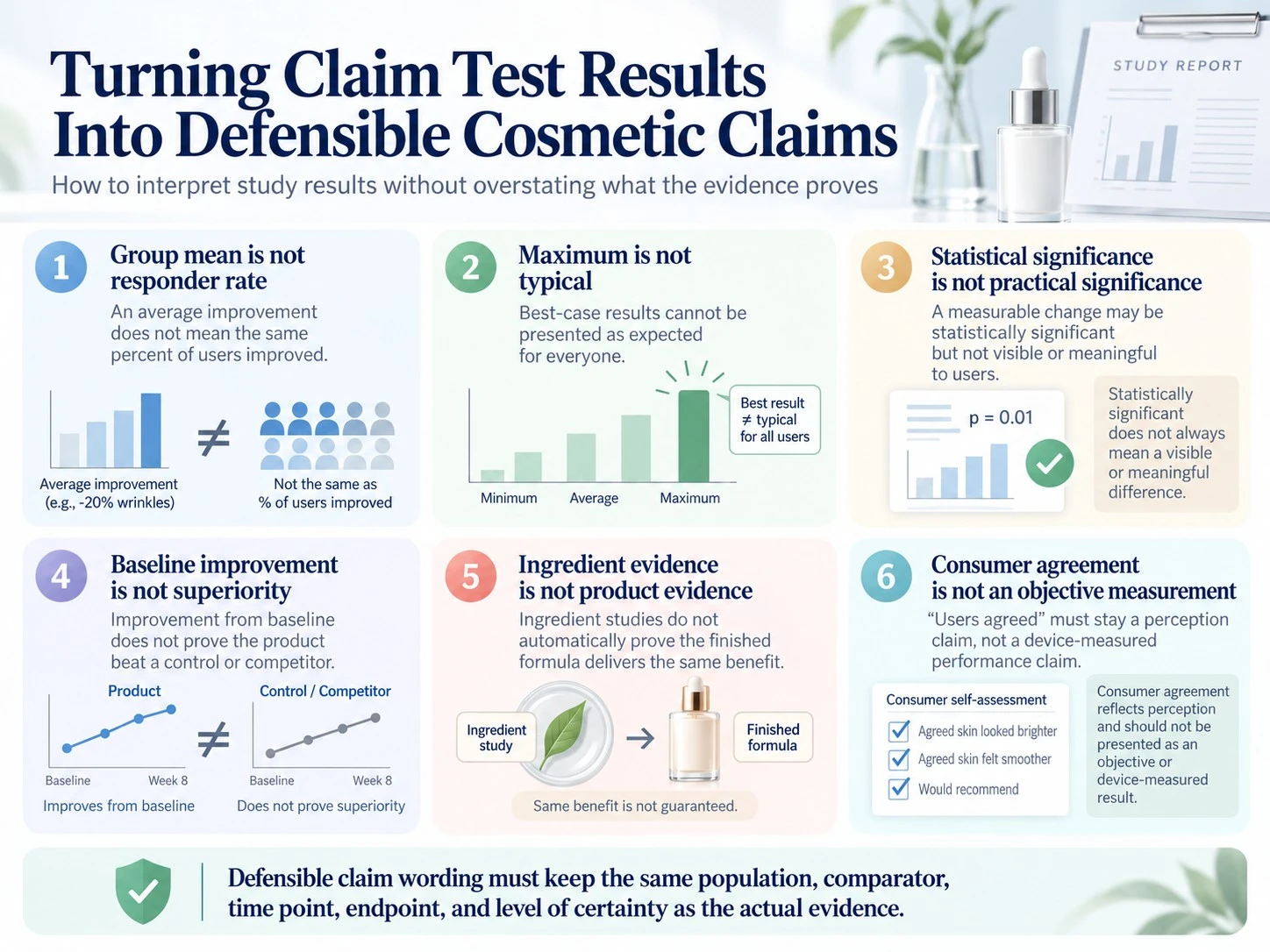
The report does not write the advertisement automatically. Technical, regulatory, and marketing teams should translate the findings without changing the unit of analysis, population, comparator, time point, or certainty.
- Group mean is not responder rate: A statistically significant average improvement does not mean the same percentage of participants improved.
- Maximum is not typical: The best individual result cannot be presented as the expected outcome unless the claim clearly and prominently identifies what the number represents.
- Statistical significance is not practical significance: A small, consistent device change may be statistically significant but not visible or meaningful to users.
- Baseline improvement is not superiority: Improvement from baseline does not prove the product outperformed a vehicle, benchmark, or competitor.
- Ingredient evidence is not automatically product evidence: Published data may support plausibility, but formulation, concentration, delivery, use, and interactions affect whether the finished product delivers the claimed benefit.
- A favorable questionnaire is not an objective measurement: “Users agreed” must remain a perception statement and should retain its population, time point, and response basis.
Claims about ingredient properties extrapolated to a finished cosmetic need adequate, verifiable evidence relevant to the product and claim; ingredient presence alone may be insufficient.[1] For higher-risk health-related claims in the United States, evidence quality, study design, controls, outcome measures, duration, and the full body of relevant evidence become especially important, and consumer anecdotes do not replace scientific support.[4]
U.S. and EU Cosmetic Claim Requirements
In the United States, cosmetic labeling must be truthful and not misleading. Wording that says or implies a product treats or prevents disease, or affects the structure or function of the body, can make the product a drug under U.S. law even when the product also changes appearance.[5] Claim testing cannot convert a drug claim into a cosmetic claim; the intended-use boundary must be reviewed before the protocol is commissioned.
Advertising claims also need substantiation before dissemination. The FTC evaluates the claim conveyed, the product, the type of claim, the benefits of a truthful claim, the cost of substantiation, the consequences of a false claim, and the amount of substantiation experts would consider reasonable.[2] A specific statement such as “clinically proven” can convey a higher evidence promise than a limited appearance or sensory claim.
In the European Union, cosmetic claims must meet common criteria for legal compliance, truthfulness, evidential support, honesty, fairness, and informed decision-making. The responsible person must ensure that claim wording is consistent with the documentation supporting the claimed effect in the Product Information File.[1] The method is not selected by label alone: experimental studies, consumer-perception tests, published information, or a justified combination can be used when they are relevant and sufficiently robust.[3]
For a multi-market launch, create a claim matrix by jurisdiction. Keep the intended message, permitted wording, support, qualifications, translations, artwork location, and report reference together. A literal translation can change the strength or implication of a claim, so local review should cover the consumer takeaway rather than words alone.
What Should the Final Claim Test Report Include?
A useful report must let a qualified reviewer connect the tested sample and method to the product and claim. At minimum, expect clear documentation of:
- Product identity, formula or batch reference, test and control samples, and relevant storage or handling conditions.
- Study objective, proposed claim, protocol version, dates, test location, responsible personnel, and qualifications.
- Participant population, recruitment criteria, sample-size rationale, withdrawals, exclusions, and analysis population.
- Use instructions, controlled conditions, equipment or grading scales, calibration or validation information, time points, comparators, and deviations.
- Defined endpoints, questionnaire wording and scales, statistical methods, complete results, adverse events, limitations, and signed conclusions.
- A claim table stating which wording is supported, under what conditions, and which stronger interpretations are not supported.
Keep the approved claim wording and report reference connected to the formula version in the finished cosmetic product specification or controlled claim matrix. If the formula, directions, packaging delivery system, target group, or claim wording changes materially, assess whether the evidence still applies instead of reusing the report automatically.
Plan Claim Testing Before Your Skincare Launch
ZICAIL can discuss claim direction alongside formula selection, sample confirmation, packaging, production planning, and product documentation for private-label and OEM/ODM skincare projects. Testing scope and final regulatory responsibility depend on the product, target markets, and proposed wording.
Before contacting the team, prepare the product type, formula status, target countries, intended users, draft claims, comparison basis, required launch date, and available test budget. Share your project brief with ZICAIL to align the development and testing questions that need to be resolved before commercial production.


