
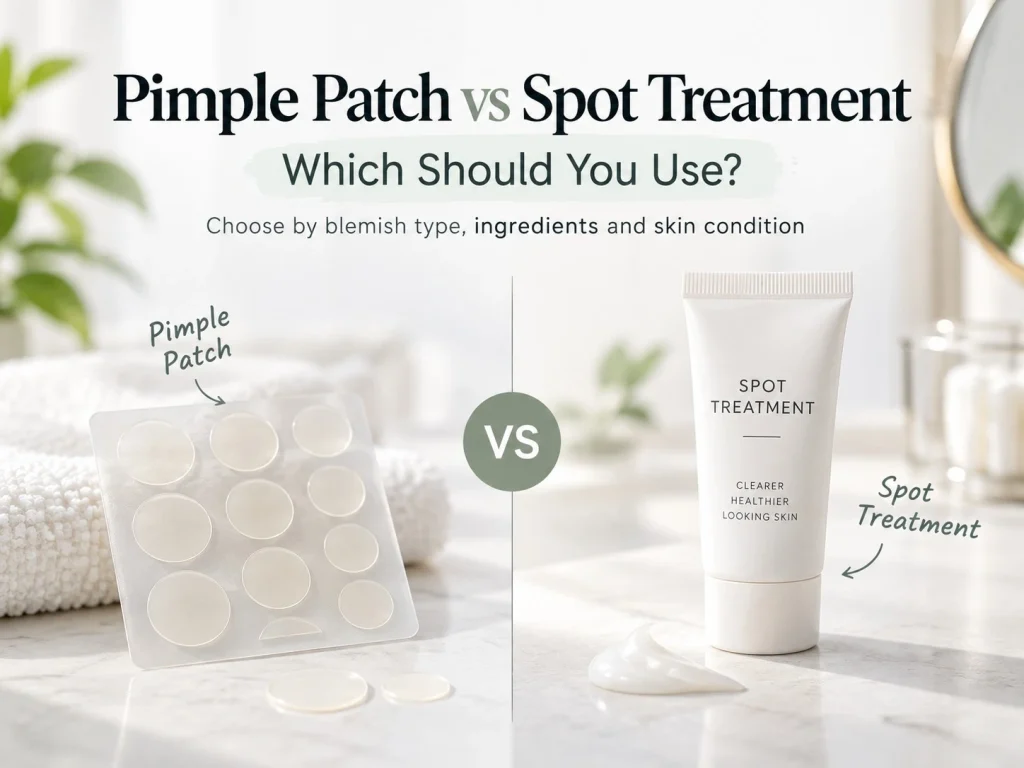


Pimple patches and spot treatments can both be useful, but they do not always solve the same problem. This comparison focuses on plain hydrocolloid stickers and leave-on acne treatments. Medicated patches overlap with the treatment category, so the ingredient list matters as much as the format.
What Each Option Does and Why the Ingredient Matters
Plain Hydrocolloid Patches
Hydrocolloid is an absorbent dressing material that takes up fluid and forms a gel while covering the skin. It can help manage a superficial, draining spot and provide a physical barrier against touching. Its acne-specific evidence is promising but limited; wound-dressing research does not establish that every cosmetic sticker clears acne.[1]
That physical job differs from delivering an acne drug. Some patches contain added acne ingredients or use a microdart design. Read the package before treating all stickers as interchangeable. The guide to hydrocolloid and microdart pimple patches explains that separate format choice.
Leave-On Spot Treatments
A spot treatment is a gel, cream or liquid used for targeted care. What it does depends on the active ingredient, rather than whether the packaging calls it a “rescue,” “drying” or “overnight” product. Two common acne ingredients perform different jobs:[2]
- Benzoyl peroxide: reduces acne-causing bacteria and is useful for mild inflammatory pimples. Higher strength is not automatically the best starting choice.
- Salicylic acid: exfoliates and helps open clogged pores, making it useful for blackheads, whiteheads and some pimples.
Use the active ingredient and directions to judge the treatment’s purpose. The salicylic acid guide provides more detail if that is the ingredient you are considering.
The word “spot” also does not always mean “apply only to one visible pimple.” Some acne medicines are directed over the entire affected area.[3] Follow the actual instructions rather than inferring the application area from the product name.
Pimple Patch vs Spot Treatment: Side-by-Side Comparison
This table compares a plain hydrocolloid patch with a leave-on acne treatment. A medicated patch needs to be assessed as both a cover and an ingredient-containing product.
| Decision factor | Plain hydrocolloid pimple patch | Leave-on spot treatment |
|---|---|---|
| Main job | Absorb accessible fluid and cover one spot | Act on acne through the chosen ingredient |
| Relevant skin condition | Superficial, draining blemish when the label allows it | Intact skin with a blemish or clogged pore appropriate for the active |
| Physical protection | Creates a cover that discourages touching | Does not usually create a physical shield |
| Ingredients to check | Hydrocolloid, adhesive and any added actives | Active ingredient, strength and complete formula |
| Main tolerance concern | Adhesive sensitivity or irritation from added ingredients | Dryness, peeling, burning or other irritation |
| Routine placement | Clean, dry patch site before leave-on skincare | Exact product directions determine area, amount and frequency |
| What it cannot promise | Prevention of future acne or clearance of every deep bump | Guaranteed overnight removal of every pimple |
For a one-off spot, ask whether your main need is a protective cover or an acne ingredient. For repeated breakouts, the bigger question is whether your routine treats the acne-prone area consistently rather than reacting to each new spot.
Choose Based on the Blemish’s Current Condition
A small white or yellow center needs a closer look. A pustule is an inflamed, pus-filled pimple. A closed comedone is a clogged pore that creates a white or skin-colored bump. They are different types of blemish, even though both may be called a “whitehead” in everyday conversation.[4]
If a superficial spot is already releasing fluid, an absorbent patch has something to take up. If it is a firm, closed bump, a plain sticker has less to absorb; an appropriate acne ingredient is usually the more relevant choice. Do not squeeze or puncture the spot to make a patch work.[5]
Raw or irritated skin changes the decision. Do not assume a strong acne treatment is suitable for a scraped or freshly squeezed area, or that every cosmetic patch is suitable for broken skin. Check both labels. If a patch is suitable, its immediate role is covering the area rather than adding more actives.
A deep, tender lump needs different expectations. A sticker can discourage picking, but it cannot be relied on to resolve a deep nodule or cyst. Repeated painful lumps deserve treatment beyond choosing between these two retail formats.[6]
Can You Put Spot Treatment Under a Pimple Patch?
Do not make this your default. A plain patch is normally applied directly to clean, dry skin. Gel, cream or lotion underneath changes that contact and can interfere with adhesion. Letting a treatment dry first does not establish that the covered combination is appropriate.[7]
Choose one product for that spot at a given time unless the combination is specifically supported. Using treatment on uncovered skin and a patch on a different suitable blemish is different from sealing medication under a sticker; still check both products’ directions.
A medicated patch already contains its own formula. Adding a separate acid or benzoyl peroxide treatment is not a necessary upgrade; using multiple topical acne medicines can increase dryness and irritation.[3] Cover a medication only when its instructions or your clinician specifically support doing so.
How to Fit Your Choice Into a Skincare Routine
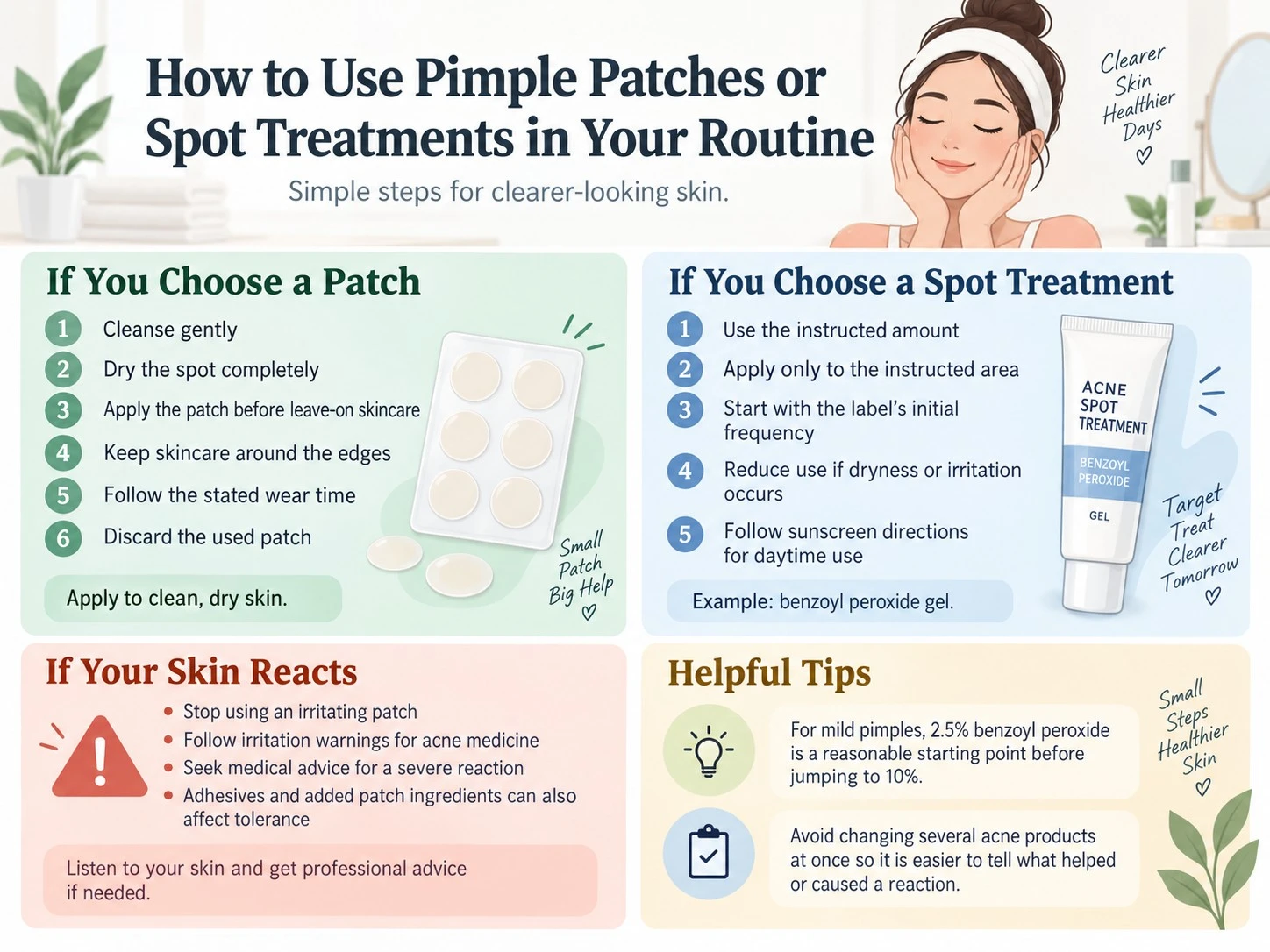
Keep the application simple and make the product directions the deciding factor.
- If you choose a patch: gently cleanse, dry the patch site fully and apply it before leave-on products. Keep skincare around the edges, follow the stated wear time and discard the used sticker. The guide to pimple patch placement in your routine covers layering details.[7]
- If you choose a treatment: use the instructed amount on the instructed area. For example, benzoyl peroxide gel directions can call for a thin layer over the affected area, starting at the label’s initial frequency and reducing use if bothersome dryness occurs. Follow any sunscreen instructions for daytime use.[3]
- If your skin reacts: stop using an irritating patch. For an acne medicine, follow its irritation warnings and seek medical advice for a severe reaction.[3] Adhesives and added patch ingredients can also affect tolerance.[5]
For adults trying benzoyl peroxide for mild pimples, a 2.5% product is a reasonable starting option instead of immediately choosing 10%. It can reduce the chance of dry, irritated skin.[8] Avoid changing several acne products at once; otherwise, it becomes harder to tell what helped or caused a reaction.
What Results Can You Expect?
A patch can absorb fluid during its wear period, so a surface spot may look flatter after removal. A white or cloudy patch reflects absorbed moisture and gel formation; it does not prove that the entire blemish has disappeared.[1]
Acne medication works on a different timeline. An individual pimple can improve sooner, but ongoing acne control requires consistent use. For adult acne, fewer breakouts commonly take four to eight weeks of appropriate treatment. Do not judge a prevention routine solely by what happens to one spot overnight.[8]
Compare outcomes that matter to your goal: less touching, less visible surface fluid, fewer new breakouts or better tolerance. A sticker filling with fluid and a medicine helping prevent new lesions are different kinds of success, not proof that one format is always faster or stronger.
When You Need More Than Spot Care
If new blemishes keep appearing, repeatedly covering or dabbing each one leaves the wider acne problem unaddressed. Appropriate acne medication may need to treat the acne-prone area rather than only the pimples you can currently see.[8] A consistent routine for acne-prone skin helps organize that broader approach.
Seek dermatology care for multiple deep, painful bumps, scarring, or a persistent painful lesion that is not improving. Do not compensate by squeezing, using stronger products repeatedly or layering treatments under a patch.[6]
FAQs About Pimple Patches and Spot Treatments
Are pimple patches or spot treatments better for blackheads?
An appropriate acne treatment is more useful than a plain absorbent sticker. Blackheads are clogged pores, not draining wounds. Salicylic acid can help unclog them, although frequent congestion may need a broader routine rather than isolated dots of treatment.[2]
Which option works better overnight?
A hydrocolloid patch can be useful overnight for a fluid-releasing surface spot if its directions allow overnight wear. An acne medicine may be more relevant for an intact pimple. Neither format guarantees the blemish will disappear by morning.
Should you use a pimple patch after popping a pimple?
Avoid popping pimples. If a spot is already open, stop manipulating it, gently clean the area and check whether the patch permits use on that skin condition. Do not apply a strong spot treatment to damaged skin just to make it dry faster.
Can pimple patches replace a regular acne treatment?
No. Plain patches address individual spots and discourage picking; they do not reliably prevent new clogged pores. Recurring acne needs a consistent treatment approach appropriate for the types of breakouts you have.[5]
Sources
[1] Nguyen N, et al. Narrative Review of the Use of Hydrocolloids in Dermatology: Applications and Benefits
[2] American Academy of Dermatology Association. Acne: Diagnosis and treatment
[3] The Humane Company. HUMANE ACNE SPOT TREATMENT—benzoyl peroxide gel
[4] American Academy of Dermatology Association. How to treat different types of acne
[5] Cleveland Clinic. How Do Pimple Patches Work?
[6] American Academy of Dermatology Association. Tips to treat a deep, painful pimple
[7] Hero Cosmetics. Mighty Patch Original
[8] American Academy of Dermatology Association. Adult acne treatment dermatologists recommend


