


The question is partly about product residue and partly about whether your face is clean enough for the next step. Those are different issues. You can tolerate a no-rinse formula but still need another remover for stubborn makeup, or remove light makeup successfully and simply prefer a water rinse afterward.
What No-Rinse Actually Means
No-rinse means the product’s directions allow you to finish cleansing without washing it away with water. Some micellar waters are explicitly intended for this use, including formulas marketed for sensitive skin.[1] It does not mean that rinsing is forbidden, or that every person must leave the product on.
Micellar water contains cleansing agents called surfactants, which form small clusters called micelles. These help lift oil and makeup so you can wipe them away with a pad.[2] It is a cleanser, not plain water. But the presence of a surfactant alone does not tell you how the complete formula will feel on your skin.
Products also differ. Testing of 30 micellar waters found variation in pH and packaging claims. That assessment measured the products, not whether rinsing prevented irritation or acne in users.[3] A “skin-friendly pH” claim should therefore not be treated as proof that you personally need—or do not need—a rinse.
A manufacturer-funded observational study reported improved skin sensations among people using one no-rinse micellar solution designed for sensitive skin. However, it relied on self-reports and did not randomly compare rinsing with leaving the product on.[4] That supports a formula-specific conclusion, not a universal rule for every bottle.
When Rinsing Is a Sensible Choice
A rinse is reasonable when it solves a specific problem, rather than simply adding another cleansing step.
- A lingering film bothers you: rinse before applying leave-on skincare if your face feels coated, sticky or slippery. The sensation alone does not prove the formula is harmful; it may simply be a finish you dislike.
- The product stings or causes a rash: wash it off and stop using it. Do not treat repeated irritation as something you must tolerate because the bottle says “gentle” or “no-rinse.”[5]
- Your directions call for rinsing: follow the bottle rather than generic advice about micellar water. The category name does not override a product-specific instruction.
Having sensitive skin does not automatically mean every micellar water must be rinsed off. Equally, having oily skin does not mean you need a harsh second wash. Avoid scrubbing to chase a squeaky-clean feeling; gentle cleansing is the better aim.[6]
If symptoms persist after you stop the product, seek medical advice. The next decision is whether the formula or technique suits you, not how many extra times you can wash your face.
Does Rinsing Finish Removing Sunscreen and Makeup?
Not necessarily. Rinsing removes some remaining cleanser, but it should not be assumed to remove everything that the micellar step left behind. Match the remover to what you are wearing: waterproof and long-wear makeup may need a micellar formula specifically designed for that job.[2]
If mascara, foundation or sunscreen still appears to remain, use a suitable remover or gentle rinse-off cleanser rather than repeatedly dragging the same pad across your skin. The distinction between micellar water and a separate cleanser matters here: deciding whether to rinse a formula is different from deciding whether cleansing is complete.
For layered or water-resistant sunscreen, check that your cleansing method is intended to remove it. The guide to removing sunscreen covers that task in more detail. An optional second cleanse is one way to finish removal; the double cleansing guide explains when that extra step is useful.
Stop once removal is complete and your skin is comfortable. If getting there takes repeated scrubbing, change the remover or technique rather than adding more passes.
How to Rinse Micellar Water Gently
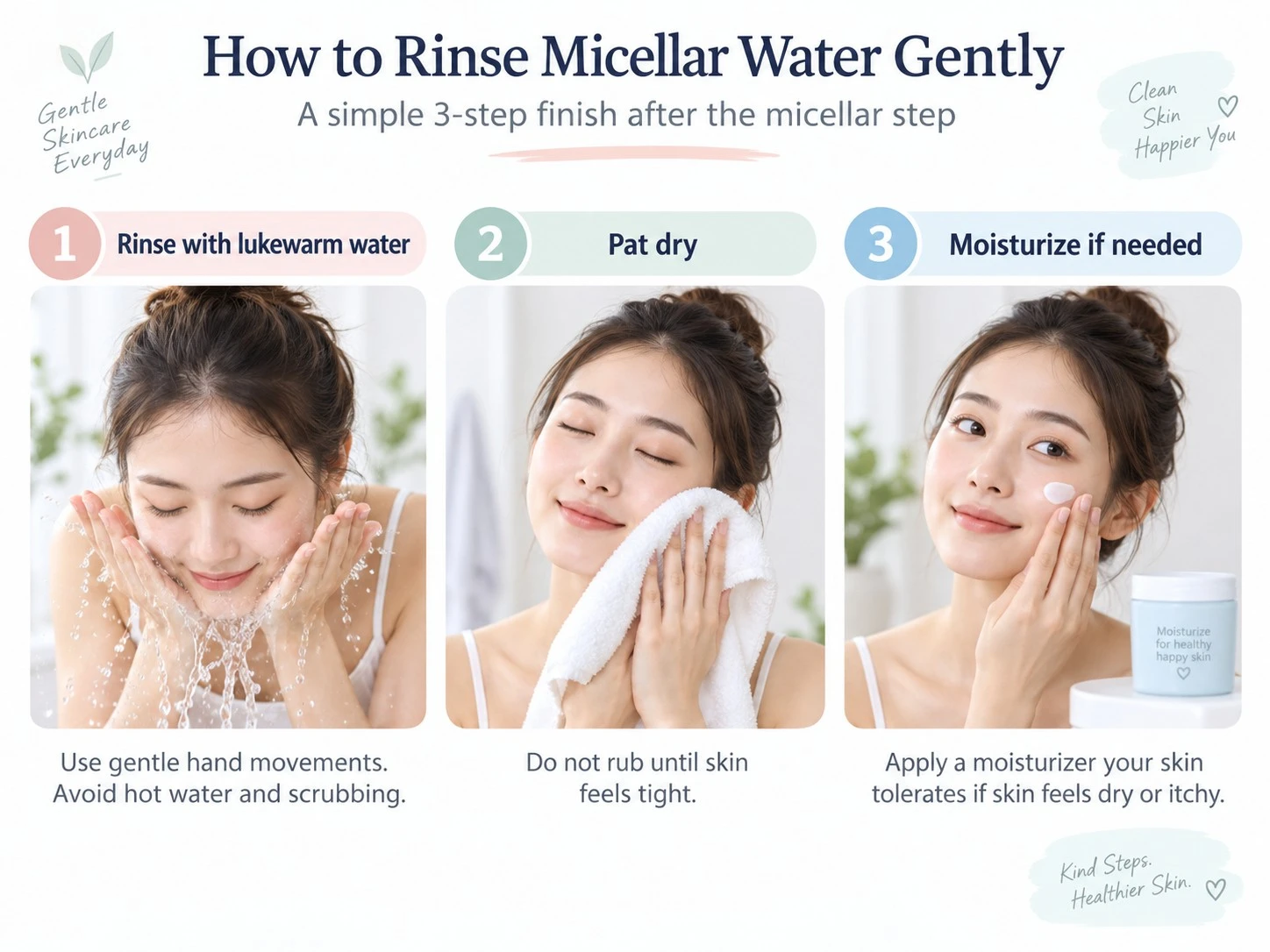
Use gentle face-washing technique for a final water rinse after the micellar step. If sunscreen or makeup remains, complete removal with a suitable cleanser first.
- Rinse with lukewarm water: use gentle hand movements to wash away the remaining product. Avoid hot water, scrubbing tools and repeated rubbing.
- Pat dry: use a soft, clean towel rather than rubbing your face until it feels tight.
- Moisturize as needed: apply a moisturizer your skin tolerates, especially if it feels dry or itchy after cleansing.[6]
FAQs About Rinsing Micellar Water
Can you leave micellar water on overnight?
Yes, if it is intended for no-rinse use, cleansing is complete and your skin tolerates it. You do not need to wake up later to wash away a comfortable no-rinse formula. Remove makeup properly before bed rather than treating a quick wipe as sufficient for every product.[1]
Should you rinse micellar water before moisturizer?
Not automatically. After using a no-rinse formula as directed, you can continue with moisturizer. If you prefer rinsing or dislike the finish, rinse first and moisturize afterward.[2] Do not use moisturizer to cover up ongoing stinging from the cleanser.
Does leaving micellar water on cause acne?
Not inevitably. The evidence discussed here does not establish that leaving every no-rinse micellar water on causes breakouts, or that rinsing prevents them. If you notice a consistent reaction, stop that formula and reassess your cleansing routine instead of assuming all micellar waters behave the same way.
Do you need to rinse after removing eye makeup?
Some micellar waters allow no-rinse use for eye makeup removal.[1] Use only a formula intended for the eye area, and keep it out of the eye itself.[7] If micellar water gets into the eye and causes irritation, rinse the exposed eye gently with room-temperature water for 10–15 minutes. Seek care for eye pain or symptoms that do not go away.[5]
Sources
[1] Bioderma. Sensibio H2O Micellar Water
[2] Garnier. The Ultimate Guide to Cleansing with Micellar Water: Discover the Best Techniques and Products
[3] Skadiņa D, Nokalna I, Balcere A. Assessment of Micellar Water pH and Product Claims
[4] Taieb C, et al. Interest in Micellar Solution to Reduce Unpleasant Skin Sensations
[5] National Capital Poison Center. Is micellar water safe?
[6] American Academy of Dermatology Association. Face washing 101
[7] U.S. Food and Drug Administration. Eye Cosmetic Safety


