


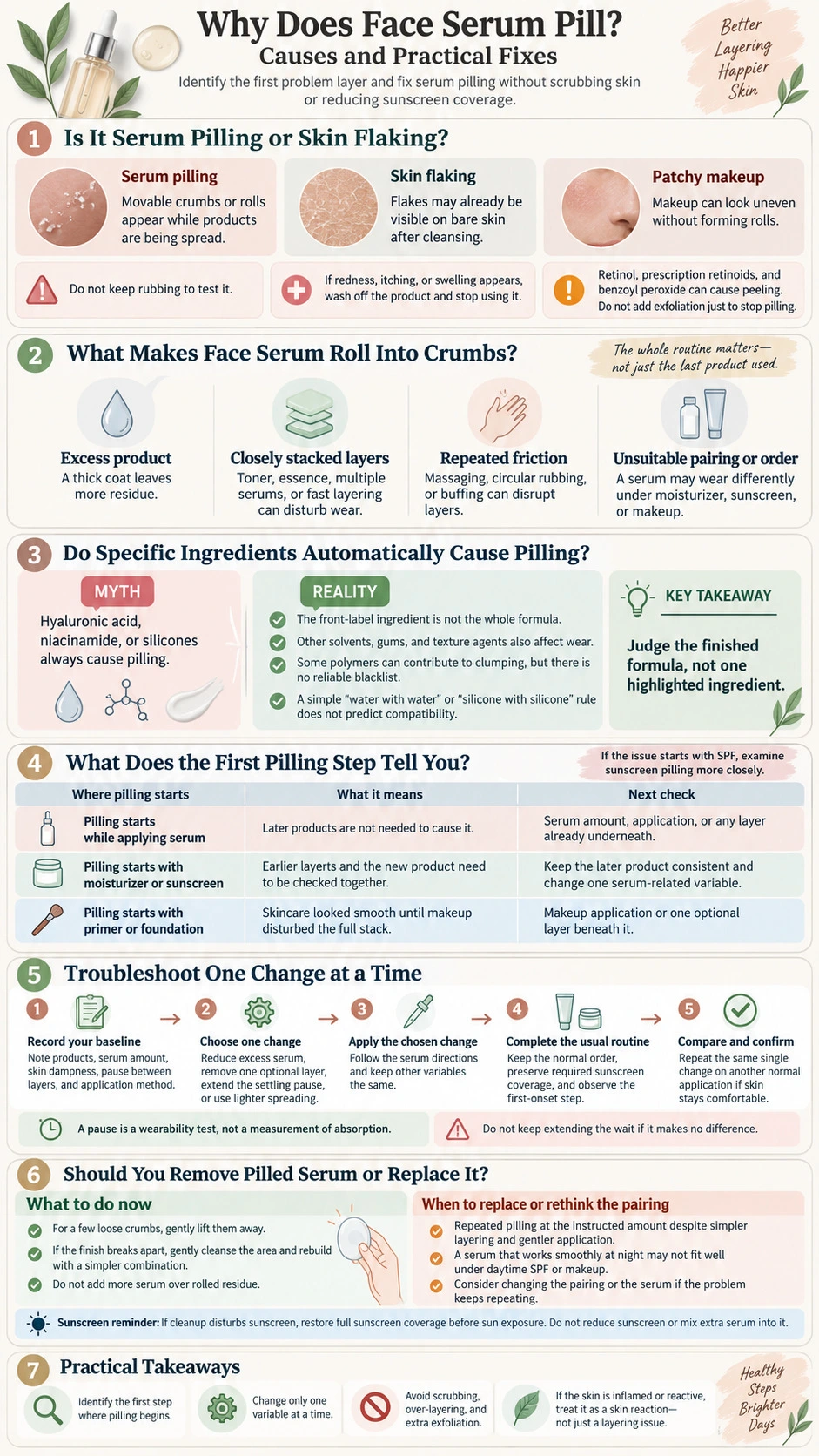
A serum that looks smooth on its own can roll up when the next product goes on. Before replacing it, separate what you can observe from what you can only guess: the first failing step helps narrow the comparison, but it does not identify a single guilty ingredient.
Is It Serum Pilling or Skin Flaking?
Pilling produces movable crumbs or rolls as applied products are spread across the skin.[1] Skin flaking may already be visible after a gentle cleanse, before you add serum. Makeup can also look patchy without forming rolls. These observations help describe the problem; they do not diagnose its cause.
Look during your usual application rather than deliberately rubbing until something comes off. Bare-skin scales and product residue can coexist, so do not assume every white fleck is serum or that every fleck needs exfoliation.
If an active serum is leaving your bare skin dry or peeling, treat that separately. Retinol, prescription retinoids and benzoyl peroxide can increase sensitivity or peeling; adding exfoliation can worsen dryness.[3] Do not use a scrub to force a serum to stop rolling.
Redness, itching or swelling changes the task. Gently wash off a cosmetic that causes a reaction and stop using it. Get medical advice for a severe reaction or one that does not settle.[2]
What Makes Face Serum Roll Into Crumbs?
Check the whole application, not only the last bottle you used:
- Excess product: a thicker coat can leave more residue to collect during layering.[1] Check the normal serum amount against your label; dropper and pump doses vary.
- Closely stacked layers: adding another product before the earlier layer has settled is a variable worth testing.[1] Extra toner, essence or multiple serum layers also make it harder to see which pairing changes the finish.
- Repeated friction: continued massaging, circular rubbing or buffing can disturb applied layers. Rubbing methods were associated with more pilling events in facial layering research.[4]
- An unsuitable pairing or order: a formula may wear differently alone and under another product. Follow product-specific order instructions; a water-based serum applied over an oil layer is one combination to reconsider.[1]
The research used ten simplified base formulas with a selected sunscreen and foundation, and participants chose their application methods. It supports investigating the full combination, but it does not prove that patting prevents every case or that all commercial serums behave alike.[4]
Do Hyaluronic Acid, Niacinamide or Silicones Cause Pilling?
The ingredient named on the front of a serum is not the whole formula. A niacinamide serum, for example, can also contain water, solvents and gums.[5] Those additional ingredients matter when you assess the finished product; the visible rolls do not establish that niacinamide itself is the cause.
Some polymers used to thicken skincare can contribute to clumping.[1] That possibility is not a reliable blacklist. Hyaluronic acid, silicone-free labeling or a water-first ingredient list does not by itself predict how your serum will wear under a particular moisturizer or foundation. A simple “water with water, silicone with silicone” rule cannot establish compatibility for the complete formulas.
What Does the First Pilling Step Tell You?
The first visible change narrows what to compare. It does not reveal the composition of each crumb or prove that the most recently applied product is faulty.
| First appearance | Useful interpretation | Next comparison |
|---|---|---|
| While applying serum, before later products | Later moisturizer, sunscreen and makeup are not needed to produce this result | Serum amount, application and any layer already underneath |
| When moisturizer or sunscreen goes on | The earlier layers and new product need checking together | Keep the later product consistent and change one optional serum variable |
| Only while applying primer or foundation | The skincare looked smooth until makeup disturbed the complete stack | Makeup application or one optional layer beneath it |
If the issue starts with SPF, sunscreen pilling deserves closer attention. Removing serum at a later application may help reveal an interaction, but improvement would not prove that the serum is defective.
How to Troubleshoot Serum Pilling One Change at a Time
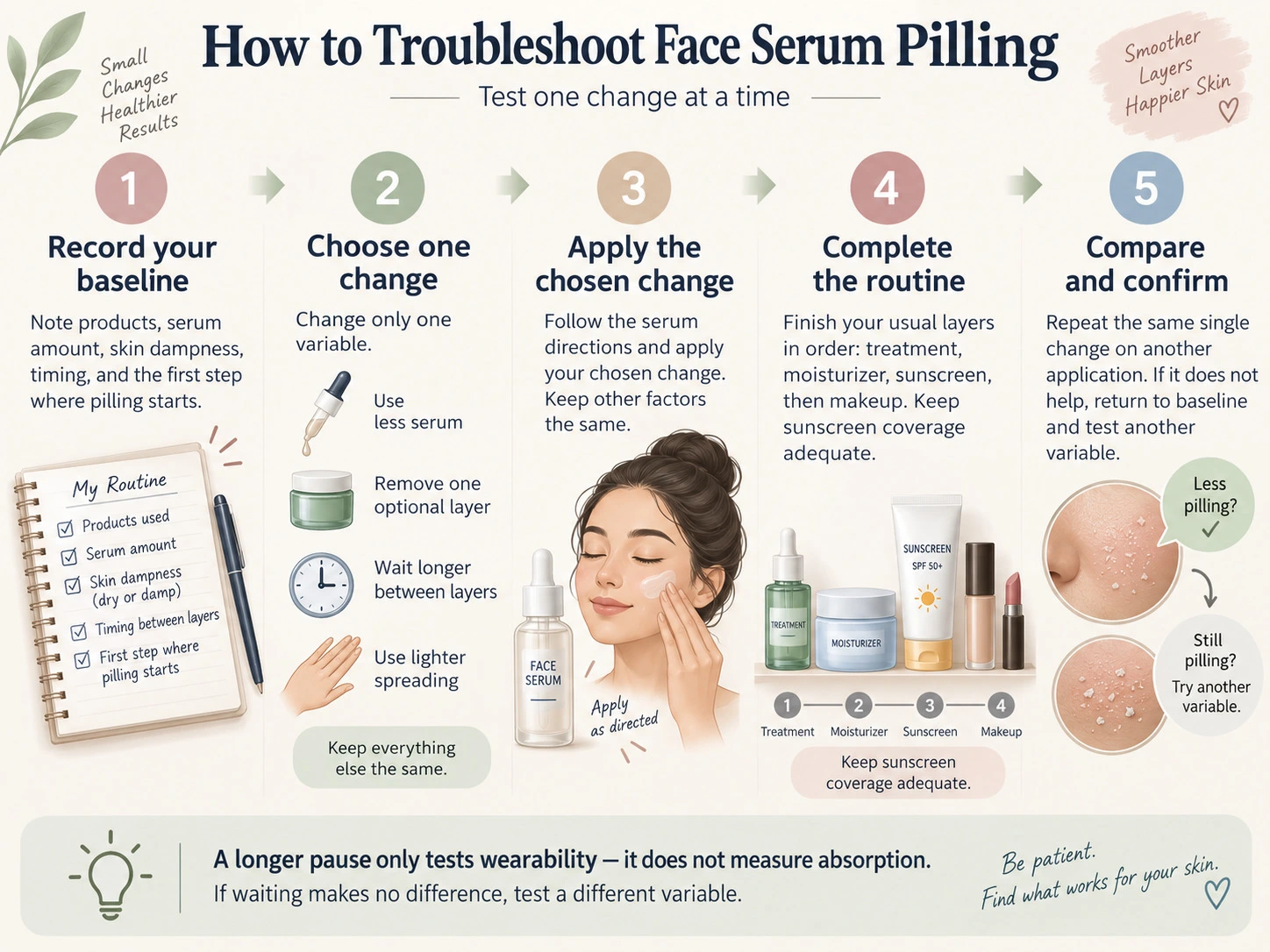
Use ordinary applications on comfortable skin. This is a practical comparison, not a validated diagnostic test. A typical routine places treatment before moisturizer and sunscreen, then makeup; product-specific and prescription instructions take priority.[6]
- Record your baseline: note the products, serum amount, skin dampness, pause between layers and application method. During one usual application, record the first step at which rolls appear. Stop rubbing once they do.
- Choose one change: select one variable for the next application: correct an excessive serum amount, remove one optional overlapping layer, extend a settling pause, or use lighter spreading. Keep every other variable as consistent as practical.
- Apply the chosen change: follow the serum’s directions. Some labels specify a few drops, not a full dropper.[5] If amount is not your selected variable, keep it unchanged. Do the same for skin dampness, timing and technique.
- Complete the usual routine: add the remaining skincare layers in their normal order and amounts. Preserve prescribed treatments and adequate sunscreen coverage; sunscreen needs enough product to cover exposed skin.[7] Observe whether the first-onset step changes.
- Compare and confirm: if your skin remains comfortable, repeat the same single change at another usual application. A consistent improvement suggests a useful adjustment. If it does not help, return to your baseline and test a different variable next time.
A pause is a test of how the layers wear, not a measurement of ingredient absorption. Do not keep extending the wait indefinitely when it makes no difference; the guide to waiting between skincare steps explains that distinction.
Should You Remove Pilled Serum or Replace It?
For a few loose crumbs on comfortable skin, try gently lifting them away rather than rubbing the whole face. If substantial residue remains or the finish is breaking apart, gently cleanse the affected area and rebuild with a simpler combination. Avoid repeated buffing or adding more serum over the rolled residue.
If the cleanup removes or disturbs sunscreen, restore its intended coverage before sun exposure and follow its reapplication directions.[7] You cannot calculate the remaining SPF from the number of visible crumbs. Mixing extra serum into sunscreen is not a suitable repair.
Consider changing the pairing or serum when pilling repeatedly occurs at its instructed amount despite simpler optional layering and gentler application. A serum that wears smoothly without daytime SPF or makeup may fit an evening routine if its directions allow. For a replacement, choose a face serum for both your skin concern and the routine it needs to fit, then check its wear with your actual moisturizer and SPF.
FAQs About Face Serum Pilling
Does pilling mean the serum has not absorbed or is not working?
Not necessarily. Visible rolls show a wear problem, not how much of an ingredient reached your skin. The pilling research did not measure serum treatment results or ingredient absorption, so it cannot answer whether a particular serum is effective.[4]
How long should you wait after serum before moisturizer?
Follow any label instruction and let the layer settle before applying the next product. There is no universal waiting time that guarantees a smooth result. If a longer pause does not help, compare another variable instead of assuming more time will solve it.
Should you apply serum to damp skin to prevent pilling?
Only when the product’s directions allow it. Damp skin is not a universal pilling fix for every serum. If comparing dampness, hold the amount, products and blending method steady; do not change several things at once.
Can you mix serum into moisturizer to stop pilling?
Do not use mixing as your first test. It changes how the two products are applied and makes the cause harder to isolate. Follow their directions, compare separate layers first, and keep sunscreen separate rather than adding serum to it.
Sources
[1] The Ordinary. How to Prevent and Solve for Product Pilling
[2] American Academy of Dermatology Association. How to test skin care products
[3] American Academy of Dermatology Association. How to safely exfoliate at home
[4] Lua BL et al. Understanding the causes of skincare product pilling
[5] The Ordinary. Niacinamide 10% + Zinc 1%
[6] American Academy of Dermatology Association. Should I apply my skin care products in a certain order?
[7] U.S. Food and Drug Administration. Sunscreen: How to Help Protect Your Skin from the Sun


