


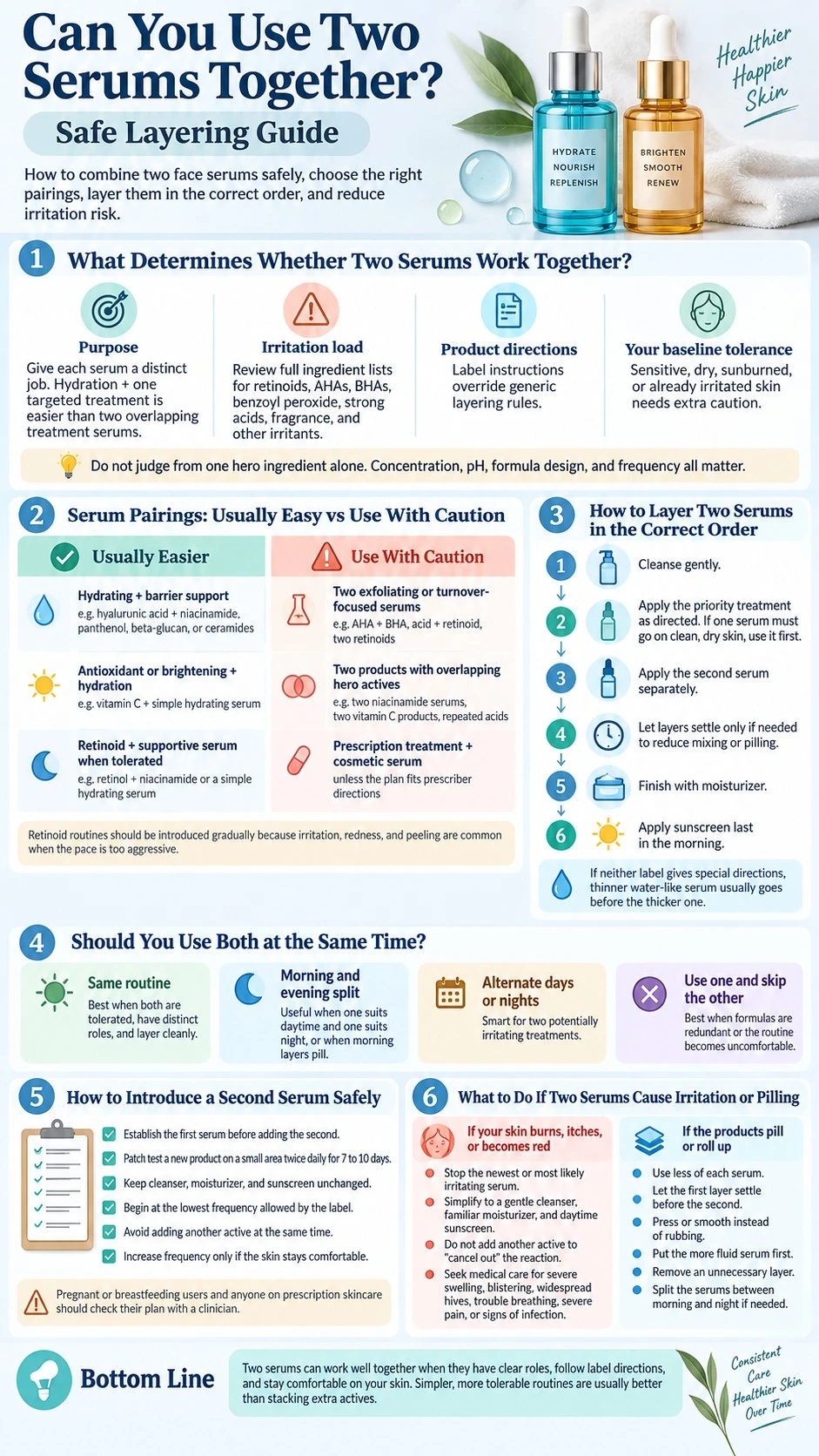
Using two serums is not automatically better than using one. A well-chosen pair can address two compatible needs, such as hydration plus uneven tone, but extra layers also create more chances for duplicated actives, irritation, or pilling.
Before combining two bottles, identify what each serum contributes, whether either product has special application instructions, and which one you would keep if your skin became uncomfortable. A routine with clear roles is easier to evaluate and use consistently.
What Determines Whether Two Serums Work Together?
Four checks matter more than the number of serums.
- Purpose: Give each serum a distinct job. A hydrating serum plus one targeted treatment is easier to justify than two products that both exfoliate or contain closely related actives.
- Irritation load: Review the full ingredient lists for retinoids, alpha hydroxy acids (AHAs), beta hydroxy acids (BHAs), benzoyl peroxide, strong acidic formulas, fragrance, or other ingredients your skin finds irritating. Exfoliating while using retinol, prescription retinoids, or benzoyl peroxide can worsen dryness or irritation.[2]
- Product directions: Follow label or prescriber instructions about timing, frequency, dry-skin application, and combinations. Those directions take priority over a generic “thin to thick” rule.
- Your baseline tolerance: A pairing that works for someone else can still be too much for sensitive, dry, recently exfoliated, sunburned, or already irritated skin.
Do not decide from one highlighted ingredient alone. Concentration, pH, delivery system, supporting ingredients, and application frequency all affect how a finished serum behaves. Internet “never mix” charts often ignore those variables.
Also distinguish chemical incompatibility from practical intolerance. Two ingredients may coexist in finished skincare yet still feel too irritating when you layer two separate high-strength products. Conversely, separating products between morning and evening may help because it lowers routine complexity, not because the ingredients destroy each other on contact.
Serum Pairings: Usually Easy vs Use With Caution
This table is a screening tool, not a substitute for the directions on the two products.
| Pairing pattern | Common examples | Practical approach | Main concern to watch |
|---|---|---|---|
| Hydrating plus barrier support | Hyaluronic acid or glycerin serum plus niacinamide, panthenol, beta-glucan, or ceramide serum | Often reasonable in one routine if both products are already tolerated | Redundancy, tackiness, or pilling rather than an ingredient conflict |
| Antioxidant or brightening plus hydration | Vitamin C serum plus a simple hydrating serum | Usually layer according to product directions and texture | Stinging from the treatment serum or pilling under sunscreen |
| Retinoid plus a supportive serum | Retinol plus niacinamide or a simple hydrating serum | Can be used together when tolerated; introduce the retinoid gradually and follow its directions | Dryness, redness, scaling, or peeling from the retinoid |
| Two exfoliating or turnover-focused serums | AHA plus BHA, exfoliating acid plus retinoid, or two retinoid products | Usually simplify or alternate rather than stacking by default | Cumulative irritation, over-exfoliation, and difficulty identifying the cause |
| Two products with overlapping hero actives | Two niacinamide serums, two vitamin C products, or repeated acids | Choose the better-fitting formula unless a professional or product system gives a reason to use both | Unnecessary dose, cost, irritation, and no clear additional job |
| Prescription treatment plus a cosmetic serum | Prescription retinoid, acne, rosacea, or pigment treatment plus an OTC serum | Follow the prescriber’s plan and add only supportive products that do not disrupt it | Changing treatment exposure or worsening a medical condition |
The ingredient-specific answer can be more precise than a broad chart. ZICAIL has separate guides on using niacinamide with retinol and niacinamide with vitamin C. If your pair is vitamin C and retinol, timing often comes down to formula directions and tolerance; the dedicated vitamin C and retinol guide covers those options.
Topical retinoids commonly cause irritation, redness, and peeling, especially when introduced too aggressively. Starting with a small amount on alternate nights can improve tolerance.[3] That is why a retinoid-containing serum usually controls the pace of a two-serum routine, even when the second serum is gentle.
How to Layer Two Serums in the Correct Order
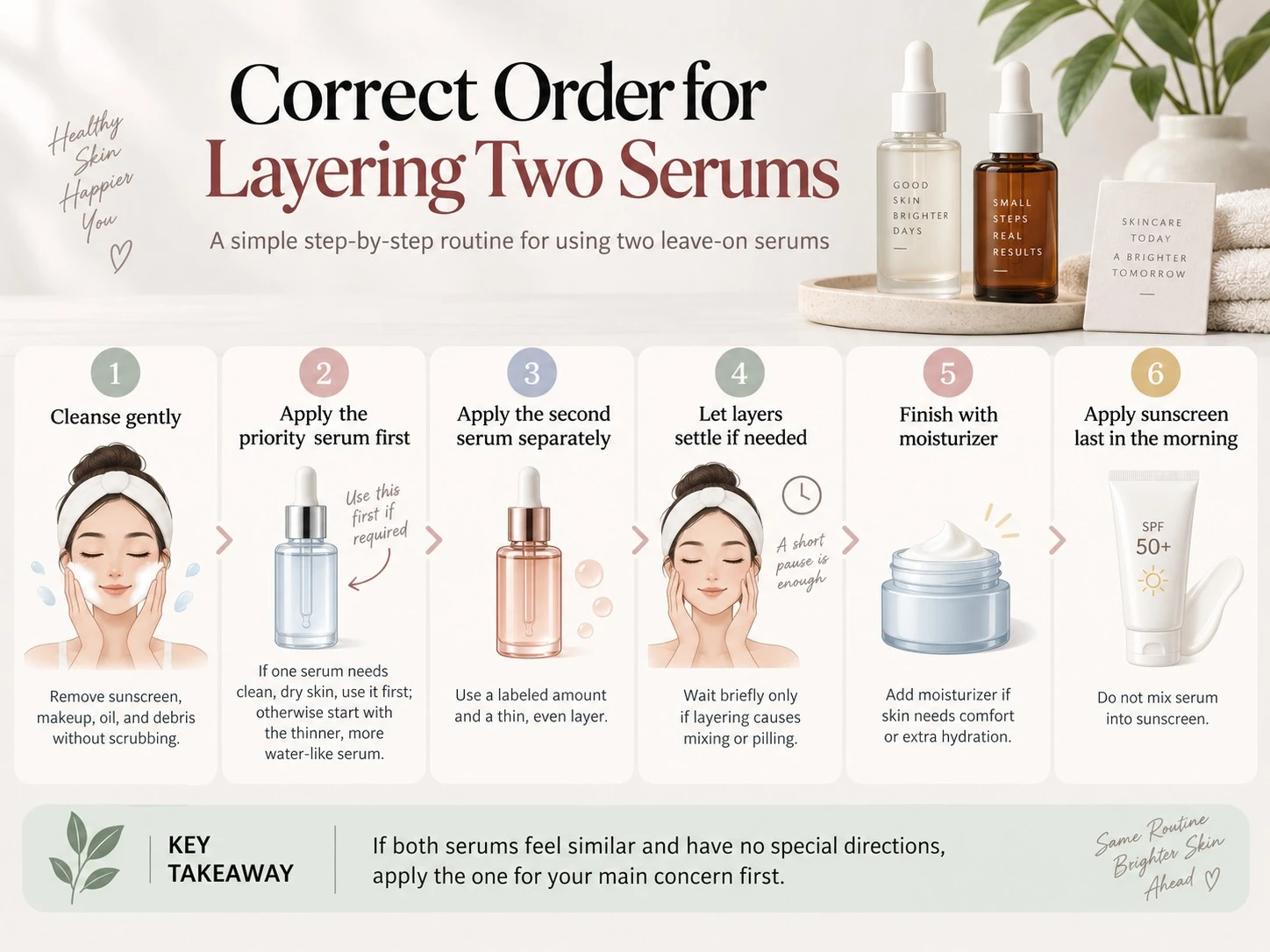
Use this sequence when both products are leave-on serums and neither label gives conflicting directions.
- Cleanse gently. Remove sunscreen, makeup, excess oil, and debris without scrubbing. Pat the skin to the condition required by the treatment product—some hydrating serums suit slightly damp skin, while some active products specify dry skin.
- Apply the priority treatment as directed. If one serum must go directly on clean, dry skin, use it first. Otherwise, start with the thinner, more water-like formula.
- Apply the second serum separately. Use the labeled amount and spread a thin, even layer. Do not double each dose merely because you are using two products.
- Let the layers settle if needed. You do not need a universal countdown. Give the first layer enough time to stop feeling very wet if immediate layering causes mixing, uneven spread, or pilling.
- Finish with moisturizer. Use a moisturizer when your skin needs more comfort or when an active serum tends to dry the skin.
- Apply sunscreen last in the morning. Do not mix a serum into sunscreen or dilute the sunscreen layer.
When both serums have the same texture and neither has special directions, apply the product for your main concern first. The order matters less than using sensible amounts and keeping the final routine comfortable. For the broader routine sequence, see ZICAIL’s face serum application guide.
Should You Use Both Serums at the Same Time?
Using both in one routine is only one option. Choose the schedule that creates the clearest, most tolerable routine.
- Same routine: Best when both products are already tolerated, have distinct purposes, layer cleanly, and do not create excessive irritation.
- Morning and evening split: Useful when one serum suits daytime use and the other is easier to manage at night, or when too many morning layers cause sunscreen or makeup to pill.
- Alternate days or nights: Sensible for two potentially irritating treatments, especially during introduction. This reduces cumulative exposure and makes reactions easier to trace.
- Use one and skip the other: Appropriate when the formulas are redundant, the second product adds no clear goal, or the routine becomes uncomfortable or impractical.
Consistent use of one suitable treatment often creates a clearer, easier-to-evaluate routine than irregular use of several products.
How to Introduce a Second Serum Safely
Establish the first serum before adding the second. If you start both on the same day and develop a reaction, you will not know which formula—or whether the combination—caused the problem.
Before full-face use, test a new skincare product on a small area twice daily for seven to ten days, using the amount and contact time you would normally use. Stop if the test area becomes red, itchy, or swollen.[1] An at-home use test can reveal an obvious reaction, but it cannot diagnose a specific allergy.
Then add the second serum conservatively:
- keep cleanser, moisturizer, and sunscreen unchanged;
- begin at the lowest frequency allowed by the label;
- avoid adding another exfoliant, mask, scrub, or active at the same time;
- observe comfort during application and through the following day; and
- increase frequency only if the skin remains comfortable.
If you are pregnant, trying to become pregnant, breastfeeding, or using prescription skincare, check the plan with the appropriate clinician. Retinoids, including prescription retinoids and over-the-counter retinol products, should be avoided during pregnancy.[4]
What to Do If Two Serums Cause Irritation or Pilling
First identify whether the problem is happening to your skin or only to the product layers. Burning, itching, swelling, or worsening redness is a skin reaction. Soft flakes or little rolls that form while rubbing are usually pilling.
If your skin burns, itches, or becomes red
Stop the newest or most likely irritating serum and simplify the routine to products you already tolerate. Do not apply another active serum to “cancel out” the reaction. Redundant exfoliating ingredients and repeated retinol or acid exposure can increase dryness and irritation.[2]
Use a gentle cleanser, a familiar moisturizer, and daytime sun protection while the skin settles. ZICAIL’s skin barrier guide explains common signs of barrier disruption and a simpler recovery routine.
If a reaction is severe or does not improve after the suspected product is removed, seek medical care. Swelling of the face or eyes, blistering, widespread hives, trouble breathing, severe pain, or signs of infection need prompt assessment.
If the products pill or roll up
Pilling is usually an application or formula-layering problem rather than proof that the ingredients are unsafe together. Try one change at a time:
- use less of each serum;
- allow the first layer to settle before applying the second;
- press or smooth instead of repeatedly rubbing;
- place the more fluid serum first;
- remove an unnecessary layer; or
- split the serums between morning and night.
Also test each serum separately under your moisturizer and sunscreen. If only one combination pills, the issue may involve film-forming polymers, silicones, gums, oils, or simply too much total product. Changing the order can help, but sometimes the two finished formulas do not layer elegantly and are better used at different times.
FAQs About Using Two Serums Together
Can you mix two serums in your hand?
Layering them separately is usually the safer default. Hand-mixing makes the amount and spread of each product harder to control and may conflict with a formula’s application directions. Mix them only when the manufacturer explicitly says the products are designed to be combined.
How long should you wait between two serums?
There is no universal waiting time. Apply the next layer when the first is no longer very wet if immediate application causes uneven spread or pilling. A product that specifically requires dry skin or a set wait time should be used according to its directions.
Which serum goes first if both have the same texture?
Follow any product-specific instructions first. If neither product specifies an order, apply the serum for your main concern first, then the supporting serum. You can reverse them if that produces a smoother layer without changing tolerance.
Can you use two serums both morning and night?
You can if both formulas are intended for that frequency and your skin remains comfortable. Count total daily exposure to repeated actives, however. Two serums used twice daily can create four active-product applications, which may be unnecessary even when each bottle is acceptable alone.
How many serums are too many?
There is no fixed number for everyone. You have too many when products repeat the same job, cause irritation or pilling, make sunscreen harder to apply, or prevent you from identifying what works. For most routines, one or two purposeful serums are easier to manage than several overlapping treatments.
Sources
[1] American Academy of Dermatology Association. How to test skin care products
[2] American Academy of Dermatology Association. How to safely exfoliate at home
[3] DermNet. Topical therapy for acne
[4] American Academy of Dermatology Association. Dermatologist-approved pregnancy skin care


