

A cleansing balm formulation combines an oil-rich cleansing phase, a structuring system and, for a water-rinsable product, a suitable emulsifier system. Its performance depends on their interaction: a smooth balm can remove makeup well yet leave an unwanted film, while a fast-rinsing prototype can become too soft during storage.
For skincare brands, the development task is to compare these trade-offs against a benchmark and agree on a reproducible formula, process and packaging specification.
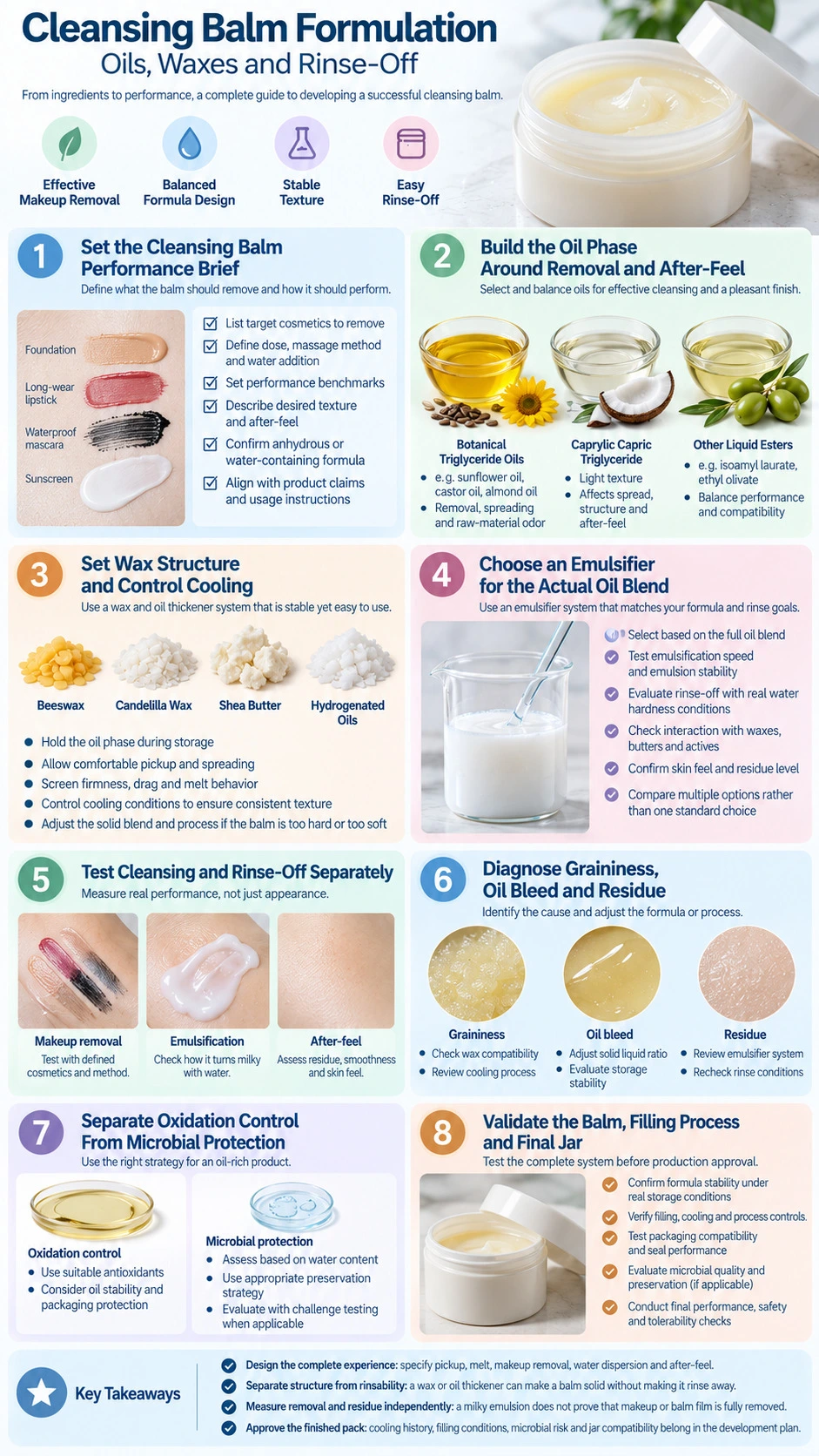
Set the Cleansing Balm Performance Brief
Start with the products the balm must remove: everyday foundation, long-wear lipstick, water-resistant sunscreen or a defined combination. Set the intended dose, massage method, water addition and rinse directions. These become test conditions, not assumptions left to each evaluator. Align them with the intended cleansing balm usage instructions.
Specify the desired pickup and finish in observable terms. “Soft enough for a spatula at the agreed room temperature,” “spreads without persistent particles” and “leaves a light, non-tacky after-feel” give more usable feedback than “luxurious” or “deep cleansing.” Choose a benchmark, then state which attributes should match it and which should differ.
Confirm whether the formula is anhydrous, meaning formulated without water, or contains an aqueous phase. Balm is a texture description, not proof of a water-free composition: a published cleansing balm prototype includes water, glycerin and betaine.[1] The distinction changes ingredient incorporation and microbial assessment.
Build the Oil Phase Around Removal and After-Feel
Choose liquid ingredients for the complete oil blend, not for a single hero-oil story. Supplier prototypes combine botanical oils, caprylic/capric triglyceride and other esters, illustrating several routes rather than one required base.[1] A separate prototype uses almond oil, caprylic/capric triglyceride and ethyl olivate alongside its solid ingredients.[2]
| Liquid ingredient family | Examples found in supplier prototypes | Main development question |
|---|---|---|
| Botanical triglyceride oils | Sunflower oil, castor oil, sweet almond oil | Does the blend meet removal, spreading, raw-material odor and positioning requirements? |
| Caprylic/capric triglyceride | Caprylic/Capric Triglyceride | How does this triglyceride component change the blend’s spread, structure and after-feel? |
| Other liquid esters | Isoamyl Laurate, Ethyl Olivate | Can the chosen ester balance the oil blend’s handling and removal performance while remaining compatible with the structuring and rinse systems? |
These are screening questions, not fixed performance rankings. A named oil does not guarantee waterproof-makeup removal, and an ester is not automatically residue-free. Compare blends against the actual target cosmetics before selecting the winning direction.
Request raw-material specifications covering identity, odor, color and relevant quality indicators. Record the supplier and grade; a substitution can alter the prototype even when the marketing ingredient name remains unchanged. Reserve distinctive botanical oils for a purpose that survives the product’s short contact and rinse-off use, rather than assuming leave-on benefits transfer to a cleanser.
Set Wax Structure and Control Cooling
The structuring system must hold the liquid phase during storage while allowing comfortable pickup and spreading. Options can include botanical waxes, solid fats, butters, waxy co-emulsifiers and other oil thickeners. In one supplier balm, sorbitan olivate, a hydrogenated olive-oil blend and sunflower seed wax are identified as structuring agents.[2] Another uses hydrogenated palm and rapeseed oils together with silica, demonstrating a different architecture.[1]
There is no universal wax percentage or melting point that produces the right result across these systems. Screen firmness, drag, melt behavior and resistance to oil release together. If a prototype feels too hard, investigate the solid blend and processing history before simply increasing liquid oil; the change can affect both storage behavior and rinsing.
Cooling is part of the formulation. Experiments on wax-structured oil gels show that cooling rate can alter microstructure and hardness, with the magnitude depending on wax composition.[3] Those results support controlling cooling during balm development; they do not establish a best cooling rate for every cosmetic formula.
Record heating temperature, hold time, addition order, mixing, fill temperature and cooling conditions. Set each parameter from the selected grades and equipment. Compare texture after the same conditioning period, since a freshly filled jar and a fully set jar are different evaluation states. Scale-up should reproduce the required product behavior, rather than merely copying a laboratory stirrer speed.
Choose an Emulsifier for the Actual Oil Blend
For a self-emulsifying cleansing balm, the surfactant system helps disperse the oil phase into rinse water. Select a grade intended for this application and check compatibility with the liquid oils and solid ingredients. For example, a blend with the INCI names Polyglyceryl-4 Olivate and Ethyl Olivate is marketed specifically for rinseable oil-based cosmetics.[4]
Do not treat every ingredient sold as an “emulsifier” or “emulsifying wax” as interchangeable. Sorbitan olivate is described as a waxy co-emulsifier for water-in-oil and water-in-silicone systems, including applications that resist wash-off.[5] Its presence in a cleansing balm alongside a separate rinse surfactant shows why ingredient role and full-system performance matter.[2]
Start from the supplier’s application guidance, then screen the exact formula under intended water-contact conditions. HLB, a descriptor of hydrophilic–lipophilic balance, can help organize emulsifier selection. Treat it as a screening aid and confirm the performance of the chosen grade in the complete balm.
Reject the assumption that more emulsifier always produces a better balm. Judge changes against pickup, spreading, water dispersion, residual film and safety assessment. A fast milky transition is only one endpoint.
Test Cleansing and Rinse-Off Separately
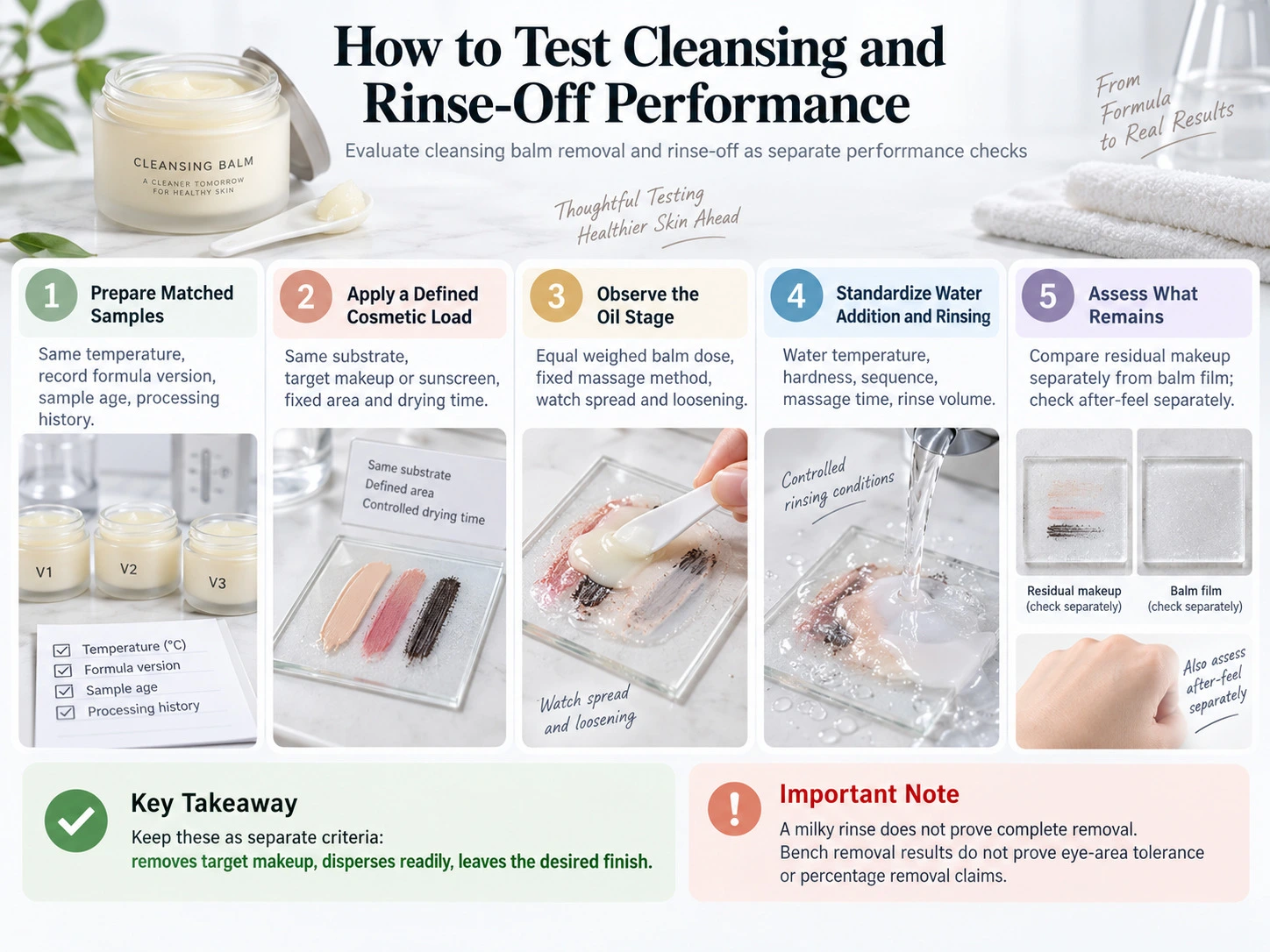
Use a documented comparison protocol so a change in rinsing technique does not masquerade as a formula improvement. The following is a development workflow, not a standardized efficacy test or a universal pass threshold.
- Prepare matched samples: Condition prototypes and the benchmark at the same temperature. Record formula version, sample age and processing history; use fresh material for the initial screen and retain aged samples for later comparison.
- Apply a defined cosmetic load: Use the same substrate, target makeup or sunscreen, application area and drying period. Bench substrates help screen removal; they do not reproduce every aspect of skin or substantiate a skin-tolerance claim.
- Observe the oil stage: Apply an equal weighed balm dose and a fixed massage method. Record spreading, persistent particles and how the cosmetic film loosens or disperses. Final removal is assessed after rinsing, since mobilized makeup can still remain on the substrate.
- Standardize water addition and rinsing: Define water temperature, hardness, addition sequence, massage time and total rinse volume. Record dispersion speed, uniformity, visible oil separation and the rinse endpoint under those conditions.
- Assess what remains: Compare residual cosmetic material separately from balm film. Use an agreed visual or instrumental method for removal, then conduct appropriately safety-reviewed human-use assessment for after-feel, comfort and the intended application area.
Keep “removes the target makeup,” “disperses readily” and “leaves the desired finish” as separate acceptance criteria. A second cleanser can conceal poor balm rinsability during development; evaluate the balm’s own performance first, then assess the intended complete routine if relevant.
Do not claim a percentage removal rate from an informal visual score. Any quantified claim needs a defined, suitable method and supporting results. Eye-area use also needs its own safety review; a successful bench makeup-removal result does not establish eye tolerance.
Diagnose Graininess, Oil Bleed and Residue
Graininess or uneven pickup
Inspect when particles appear: immediately after manufacture, during setting or only after temperature exposure. Check incomplete melting, ingredient dispersion and changes in the solid structure. Compare one formula under controlled cooling histories before changing several ingredients at once. Cooling-sensitive wax networks make process variation a plausible investigation route, not a confirmed diagnosis.[3]
Oil bleed or a sweating surface
Determine whether the liquid is oil released from the balm, water from a water-containing formula or external condensation. Compare bulk retains with filled jars and record storage orientation and temperature. Investigate liquid-to-solid balance, compatibility and thermal history together. Increasing wax may improve hold but can also change pickup and the rinse experience.
An oily film after rinsing
Use the controlled rinse protocol to establish whether the remaining material is makeup, balm or both. Then screen the emulsifier–oil combination and solid blend separately. Do not assume the consumer used the product incorrectly, or treat a milky appearance as proof that the formulation is performing as intended.
Separate Oxidation Control From Microbial Protection
Oxidation control protects susceptible ingredients against chemical deterioration. An antioxidant such as tocopherol is used for that purpose in a supplier balm formula.[2] Select its grade and level within the full stability plan; adding vitamin E does not, by itself, establish shelf life or microbial protection.
For a nominally anhydrous balm, have the laboratory document whether the finished product qualifies as microbiologically low risk. ISO 29621 provides a risk-assessment framework that considers production and intended use; “no added water” is not the complete assessment.[6] Raw materials, manufacturing, packaging and finger contact can introduce microorganisms into cosmetics.[7]
Consider foreseeable use around a sink, including water introduced during repeated opening and scooping. Low water activity—the availability of water to support microbial growth—is relevant, but any measured result must be interpreted with the formula and use scenario. An internal dry-bulk result should not automatically represent every condition in an opened jar.
For products that are not low risk, agree on suitable antimicrobial-protection evaluation. ISO 11930 is primarily designed for water-soluble or water-miscible cosmetics and allows modification for products with an internal water phase.[8] Ask the laboratory to establish method suitability, including recovery and neutralization, when planning preservative challenge testing for the selected balm system. Do not transfer another formula’s passing result to your own.
Validate the Balm, Filling Process and Final Jar
A shelf-life proposal needs evidence from the approved product configuration. Cosmetic stability guidance requires the manufacturer to specify and justify the methods, conditions and acceptance criteria; it does not prescribe one universal protocol.[9] Build the stability testing plan around expected storage, distribution and use.
- Physical and performance stability: Track appearance, odor, color, particles, oil release and texture. Repeat the relevant removal and rinse checks after aging, rather than accepting an unchanged surface alone.
- Filling and setting: Establish acceptable bulk and fill conditions, fill-weight control, cooling and conditioning. Compare production samples with the approved reference for air pockets, shrinkage, pickup and uniformity.
- Product-contact compatibility: Assess the actual jar, liner, inner cover, seal and any metal coating with the final formula. Include leakage and closure behavior under agreed orientations and exposures in packaging compatibility testing.
- Handling and decoration: Check scooping access, spatula fit, closure seating and whether labels or printing tolerate expected handling and oil contact. A refill or tube format needs its own dispensing and component assessment.
Approve the formula version, raw-material grades, manufacturing parameters, pack specification and acceptance criteria together. If an oil supplier, structurant grade, liner or fill process changes, review which relevant checks must be repeated before accepting the substitution.
Develop Your Cleansing Balm With ZICAIL
ZICAIL’s cleansing balm development service supports formula, jar and closure review, printed packaging samples and commercial production. The published starting MOQ is 1,000–5,000 pieces, with the final minimum depending on packaging and customization. Printed packaging samples can be arranged for a fee, with the agreed fee credited to the bulk order.[10]
Send your cleansing balm brief with the destination market, benchmark, removal targets, preferred pickup and finish, fill weight, pack concept, order quantity and launch timing. Agree on the sample, test and packaging scope before setting the production schedule.


