

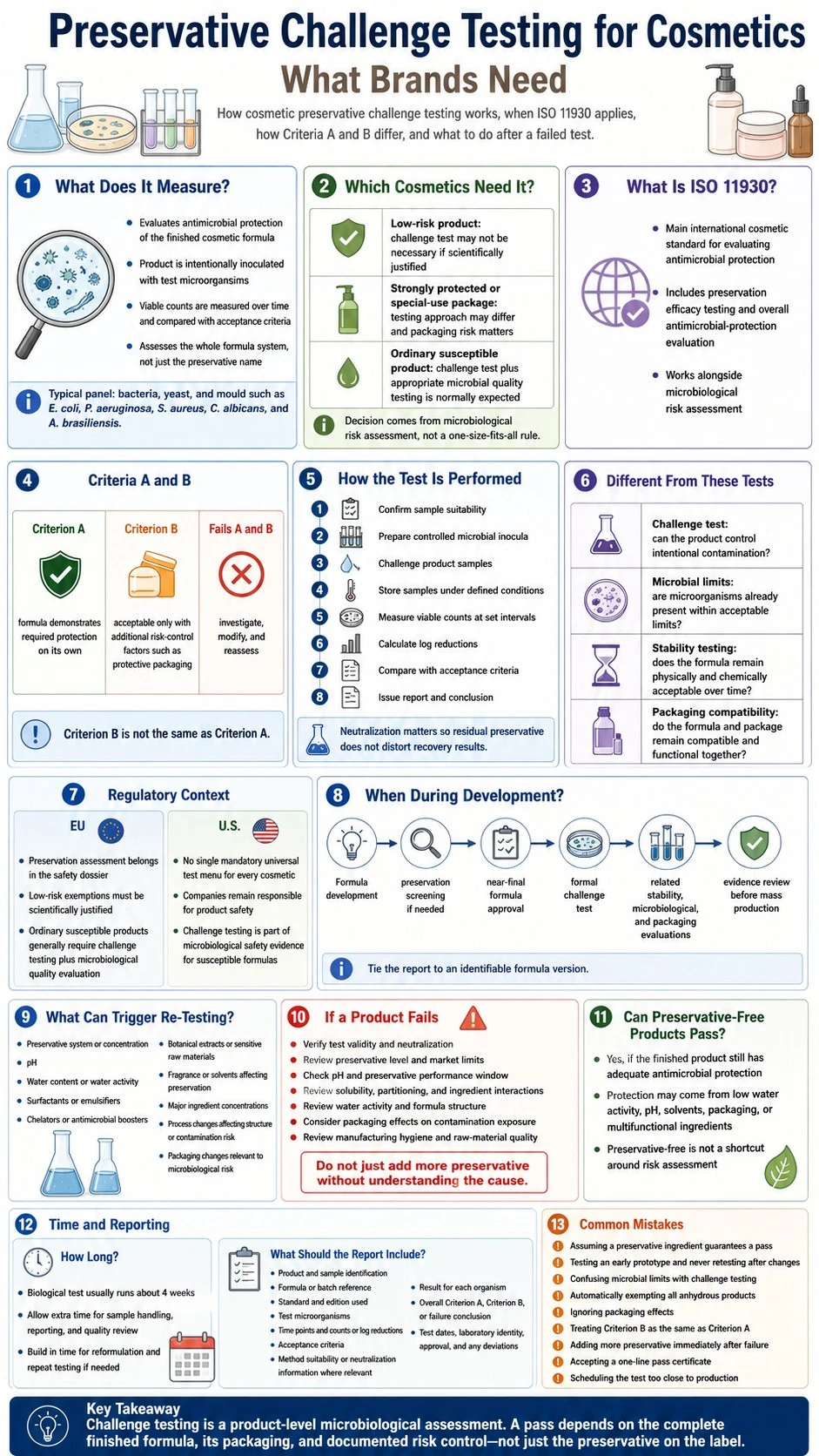
A preservative can be permitted for cosmetic use and still fail to protect a particular formula. Its performance depends on concentration, pH, water activity, ingredient interactions, manufacturing conditions, packaging, and the complete formulation—not simply whether a preservative name appears on the ingredient list.
That is why preservative challenge testing is a product-level test. Instead of asking whether phenoxyethanol, organic acids, parabens, or another preservation system “should work,” the test asks whether the finished formula actually controls microbial contamination under a defined challenge.
For skincare brands, this makes challenge testing one of the key microbiological decisions between laboratory development and commercial launch.
What Does a Preservative Challenge Test Actually Measure?
The test evaluates the antimicrobial protection of the finished cosmetic formulation. Under ISO 11930, microorganisms are intentionally introduced into the product, their viable counts are monitored at defined intervals, and the reductions are interpreted against acceptance criteria.[1]
A typical ISO 11930 test panel includes representative bacteria, yeast, and mould such as Escherichia coli, Pseudomonas aeruginosa, Staphylococcus aureus, Candida albicans, and Aspergillus brasiliensis.[6]
The test therefore examines more than the ingredient labelled as the preservative. It evaluates the combined protection created by the entire formula, which can include:
- the preservative system;
- pH;
- water activity;
- chelating ingredients;
- solvents or glycols;
- surfactants;
- formula structure;
- other antimicrobial contributors.
This is why two products using the same preservative at the same nominal percentage can produce different challenge-test results.
Which Cosmetics Need Preservative Challenge Testing?
Do not apply the rule “all cosmetics need a challenge test” or the opposite rule “anhydrous products never need one.” The correct decision comes from microbiological risk assessment.
ISO 11930 excludes products that have been shown to present a low microbiological risk under the principles of ISO 29621.[1][2] EU safety-report guidance provides a particularly useful practical framework for deciding when preservation testing is relevant.[4]
| Product Situation | Typical Microbiological Approach | Key Requirement |
|---|---|---|
| Scientifically justified low-risk product | A preservation challenge test may not be necessary | The low-risk conclusion should be supported by a documented scientific rationale |
| Single-use or strongly protected package | The required testing may differ from an ordinary repeatedly opened product | Packaging and actual contamination exposure must be included in the risk assessment |
| Ordinary microbiologically susceptible product | Challenge testing plus appropriate finished-product microbiological quality testing is normally expected | The finished formula must demonstrate adequate protection |
Examples of potentially lower-risk systems can include products with sufficiently low water activity, high alcohol content, extreme pH, or other conditions that do not support microbial survival or growth. Packaging can also contribute to the overall risk assessment.[2][4]
However, adding a preservative does not by itself make a formula microbiologically low risk. ISO 29621 specifically treats low-risk status as a property of the complete product environment and use conditions rather than the mere presence of an antimicrobial ingredient.[2]
What Is ISO 11930?
ISO 11930:2019, Cosmetics — Microbiology — Evaluation of the antimicrobial protection of a cosmetic product, is the principal international cosmetic standard for interpreting preservation-efficacy testing and microbiological risk assessment.[1]
It includes two related routes:
- a preservation efficacy test for formulas that require experimental challenge testing; and
- an overall antimicrobial-protection evaluation that can incorporate microbiological risk assessment.[1]
This distinction matters because the purpose is not simply to force every cosmetic through an identical laboratory procedure. The purpose is to establish that the finished product has a tolerable microbiological risk.
What Do ISO 11930 Criteria A and B Mean?
ISO 11930 uses two levels of acceptance. Brands often see “Criterion A” or “Criterion B” on a laboratory report without understanding the practical difference.
| Result | Practical Meaning | What the Brand Should Do |
|---|---|---|
| Criterion A | The formulation itself demonstrates the required level of protection against microbial proliferation | The preservation result can generally stand without relying on additional product-control factors |
| Criterion B | The preservation result can be acceptable only when additional risk-control factors make the overall microbiological risk tolerable | Document the supporting risk assessment, such as protective packaging or other relevant controls |
| Does not meet A or B | The tested preservation strategy has not demonstrated adequate protection under the test | Investigate the failure, modify the product or protection strategy where necessary, and reassess |
A pump or other protective package can be relevant to a Criterion B assessment because it may reduce contamination exposure compared with a repeatedly accessed jar.[6] This does not mean packaging can rescue every weak formula; the complete microbiological risk still needs to be defensible.
How Is a Cosmetic Challenge Test Performed?
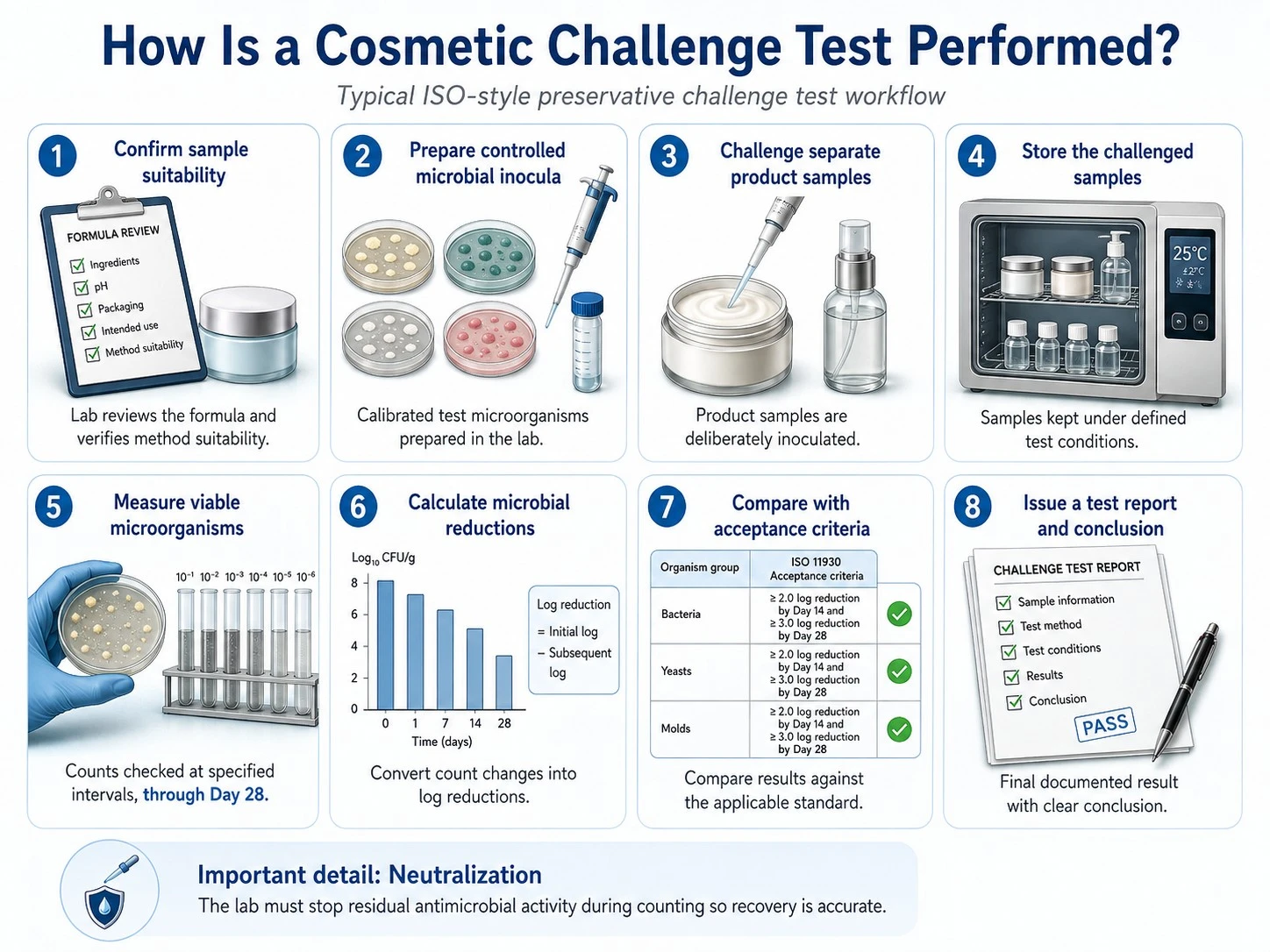
The laboratory procedure is more controlled than simply adding bacteria to a jar and observing what happens. A typical ISO-style workflow includes:
- Confirm sample suitability. The laboratory identifies the formula and ensures the analytical method can recover viable microorganisms despite the product’s antimicrobial activity.
- Prepare controlled microbial inocula. Defined test organisms are prepared at calibrated concentrations.
- Challenge separate product samples. The formula is deliberately inoculated under controlled conditions.
- Store the challenged samples. The samples remain under the conditions defined by the test method.
- Measure viable microorganisms at specified intervals. ISO 11930 evaluation commonly includes observations through Day 28.[6]
- Calculate microbial reductions. Changes from the initial inoculated counts are converted into log-reduction results.
- Compare the results with the applicable acceptance criteria.
- Issue a test report and conclusion.
Neutralization is an important technical detail. The laboratory must be able to stop or overcome residual antimicrobial activity during counting; otherwise, preservative carried into the test medium can continue killing microorganisms and make recovery appear artificially low.
Challenge Test vs Microbial Limits vs Stability Testing
These tests answer different questions and should not be treated as interchangeable.
| Test | Main Question | What a Passing Result Does Not Prove |
|---|---|---|
| Preservative challenge test | Can the product’s antimicrobial protection control an intentional microbial challenge? | That the manufactured batch started with acceptable microbial quality |
| Microbial limits testing | Does the tested product contain microorganisms within acceptable microbiological limits? | That the preservation system can handle contamination during future consumer use[7] |
| Stability testing | Does the formula remain physically and chemically acceptable over intended storage conditions? | That its preservation system passes a microbial challenge |
| Packaging compatibility testing | Do the formula and intended package remain compatible and functional together? | That the formula itself has adequate antimicrobial protection |
A robust development plan may therefore contain all four evaluations when they are relevant. Passing one should not be used to fill an evidence gap belonging to another.
What Does the EU Require for Preservation Challenge Testing?
For cosmetics placed on the EU market, Annex I of Regulation (EC) No 1223/2009 requires the Cosmetic Product Safety Report to address microbiological quality and include the results of the preservation challenge test.[3]
The European Commission’s guidance for preparing the safety report adds useful context: low microbiological-risk products can be scientifically justified without challenge testing, while other ordinary susceptible products require both preservation challenge testing and finished-product microbiological quality evaluation.[4]
This means the correct EU question is not simply:
“Do we have a challenge-test certificate?”
It is:
“Does the safety dossier contain an appropriate preservation assessment for this exact product, and is any exemption scientifically justified?”
What About Challenge Testing for the U.S. Market?
The United States does not prescribe one mandatory testing menu for every cosmetic product. Manufacturers and responsible companies remain responsible for product safety, and cosmetics must not contain harmful microorganisms.[5]
Challenge testing is therefore best treated as part of the evidence used to substantiate the microbiological safety of susceptible formulations rather than as a universal FDA-issued checkbox.
For a global product, a manufacturer should define the test protocol against the actual launch markets rather than assume that one local laboratory method automatically satisfies every jurisdiction.
When Should the Challenge Test Be Done During Product Development?
The most useful timing is after the preservation strategy and formula are representative of the intended commercial product but early enough that a failure can still be corrected without delaying packaging purchase or production.
A practical sequence is:
- develop the formula;
- screen preservation during R&D when necessary;
- approve a near-final formula;
- run the formal challenge test;
- complete related stability, microbiological, and packaging evaluations;
- review the complete evidence before mass production.
The challenge test should be linked to an identifiable formula version. A report on Prototype 2 is weak evidence for Commercial Formula 7 if the changes materially affected the preservation system.
The full testing sequence should therefore be planned alongside the broader skincare product testing program rather than ordered as an isolated certificate at the end.
What Formula Changes Can Trigger Re-Testing?
Not every minor manufacturing adjustment automatically invalidates a previous challenge test, but any change capable of affecting microbiological protection should be assessed through formal change control.
Examples include changes to:
- the preservative system or concentration;
- pH;
- water content or water activity;
- surfactant or emulsifier system;
- chelators or antimicrobial boosters;
- botanical extracts or other contamination-sensitive raw materials;
- fragrance or solvents where they influence preservation;
- major ingredient concentrations;
- manufacturing process where it affects product structure or contamination risk;
- packaging when the packaging contributes materially to the microbiological risk assessment.
The decision should be technical and documented. “The INCI still looks almost the same” is not enough to conclude that old preservation data remain representative.
What Happens if a Cosmetic Fails the Challenge Test?
A failed challenge test is not solved simply by adding more preservative. The failure should first be investigated so the team understands why the antimicrobial protection was insufficient.
The investigation can include:
- checking that the test and neutralization method were valid;
- reviewing preservative concentration and permitted-use limits for the target markets;
- checking formulation pH against preservative performance;
- reviewing solubility and partitioning of the preservative between formula phases;
- checking for ingredient interactions that reduce availability;
- reviewing water activity and formula structure;
- considering whether protective packaging can legitimately reduce use-phase contamination risk;
- reviewing manufacturing hygiene and raw-material microbiological quality.
The appropriate correction might be a preservative adjustment, pH change, additional hurdle, formula redesign, packaging change, or combination of measures. Once the relevant change is made, the revised product should be reassessed rather than inheriting the previous failed result.
Can a Preservative-Free Cosmetic Pass a Challenge Test?
Yes. A challenge test evaluates antimicrobial protection of the finished product, not whether a conventional preservative appears on the ingredient declaration.
A formula may control microbial growth through several hurdles, such as low water activity, pH, high solvent concentration, packaging, or ingredients with multifunctional antimicrobial effects. Conversely, a product containing a formally recognized preservative can still fail if that preservative does not perform adequately in the finished formulation.
This is why “preservative-free” and “self-preserving” should not be treated as shortcuts around microbiological risk assessment.
How Long Does Preservative Challenge Testing Take?
An ISO 11930 test follows microbial performance through a period of approximately four weeks, with measurements at defined intermediate time points.[6] Commercial laboratory turnaround can be longer because sample receipt, preparation, controls, reporting, and quality review add time around the biological test itself.
For project planning, do not schedule challenge testing immediately before the production date. A failed result can require formulation changes followed by another complete test cycle.
The testing budget should also allow for that possibility. The wider relationship between formulation, testing, compliance, packaging, and rework is covered in How Much Does Skincare Product Development Cost?.
What Should Be Included in a Challenge-Test Report?
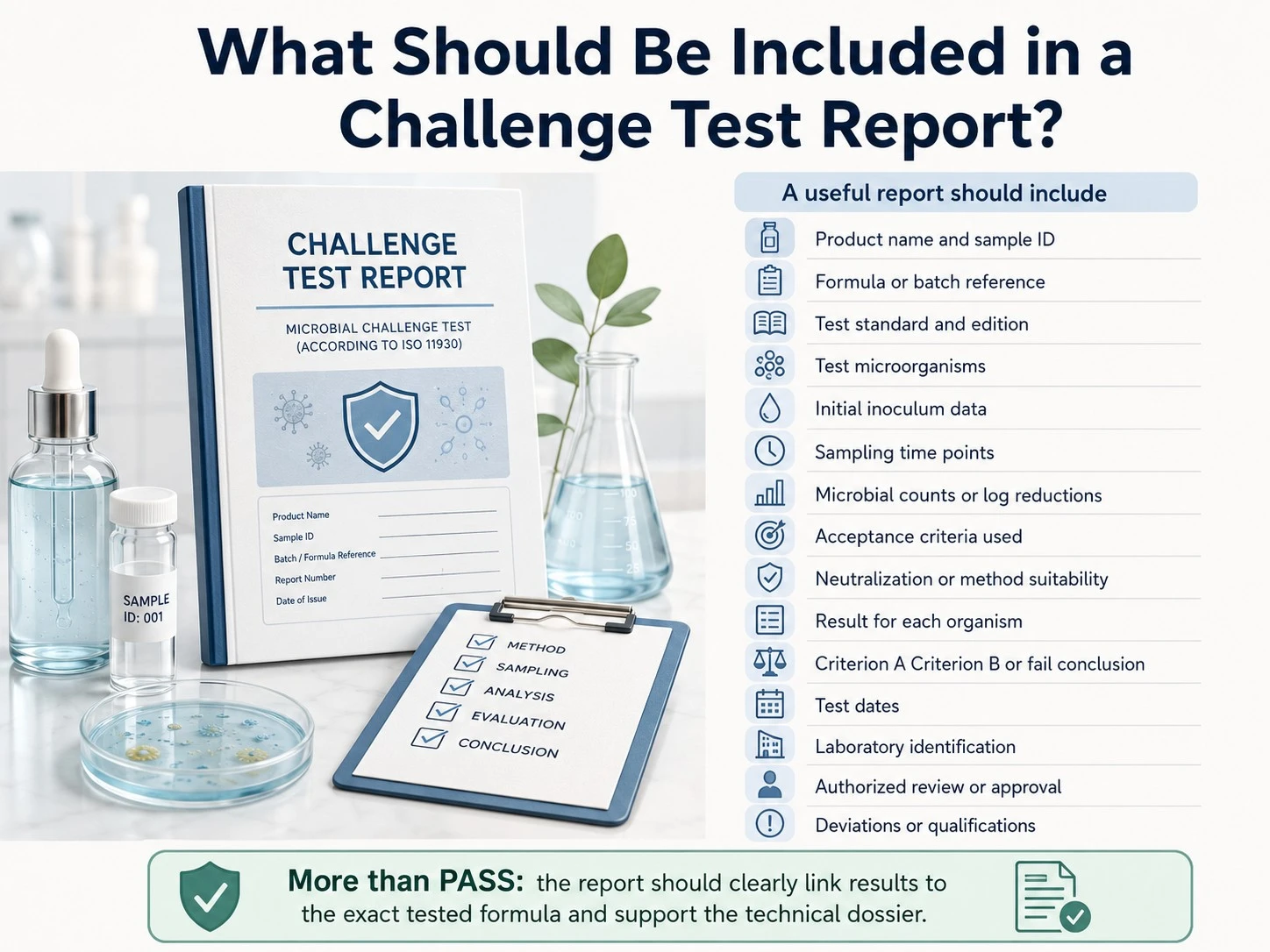
Brands should receive more than an email stating “PASS.” A useful report should let a technical reviewer connect the test to the exact commercial product and understand how the conclusion was reached.
Check for:
- product name and sample identification;
- formula or batch reference where available;
- test standard and edition;
- test microorganisms;
- initial inoculum information;
- sampling time points;
- microbial counts or calculated reductions;
- acceptance criteria used;
- method-suitability or neutralization information where relevant;
- result for each organism;
- overall Criterion A, Criterion B, or failure conclusion where ISO 11930 is used;
- test dates;
- laboratory identification;
- authorized review or approval;
- any deviations or qualifications affecting interpretation.
The challenge-test report should become part of the controlled technical dossier for the approved formula. It is one of the product-specific documents a brand should expect to access when reviewing manufacturer documentation.
Common Preservative Challenge Testing Mistakes
- Assuming a preservative ingredient guarantees a pass. The test evaluates the entire finished formula.
- Testing an early prototype and never revisiting the result. Material formula changes can affect preservation.
- Confusing microbial limits with challenge testing. Initial product cleanliness and future antimicrobial protection are different questions.
- Calling every anhydrous product automatically exempt. Low-risk status should come from risk assessment rather than a category shortcut.
- Ignoring packaging. Packaging can change contamination exposure and may be relevant to overall microbiological risk.
- Treating Criterion B as identical to Criterion A. Criterion B requires additional risk-control justification.
- Adding more preservative immediately after failure. First identify why the preservation system failed.
- Accepting a one-line pass certificate. The report should identify the tested product, method, results, and conclusion.
- Ordering the test immediately before production. There must be time to investigate, reformulate, and repeat testing if necessary.
Final Thoughts
Preservative challenge testing is not simply a certificate confirming that a formula “contains enough preservative.” It is an experimental assessment of whether the finished cosmetic product has adequate antimicrobial protection under a defined microbial challenge.
For most microbiologically susceptible skincare formulas, that evidence needs to be considered alongside microbial quality, stability, packaging, manufacturing controls, and the target-market safety dossier. Low-risk products can follow a different route, but the exemption itself should be based on documented scientific risk assessment rather than assumption.
If your brand is developing a new skincare formula, define the target markets, product format, packaging, preservation strategy, claims, and testing requirements before formula approval. ZICAIL can incorporate those inputs into custom skincare formulation so preservation, stability, compatibility, and production-readiness decisions are addressed before scale-up rather than after a failed commercial batch.


