

A finished product specification turns a product brief into a controlled release standard. Without it, a brand and manufacturer may agree that a cream should be “smooth,” “stable,” or “within pH,” yet still use different methods, conditions, or pass/fail judgments.
A useful specification is neither a marketing sheet nor a collection of arbitrary numbers. It converts development evidence, process capability, safety, packaging performance, and market requirements into one version-controlled release standard.
What Is a Finished Cosmetic Product Specification?
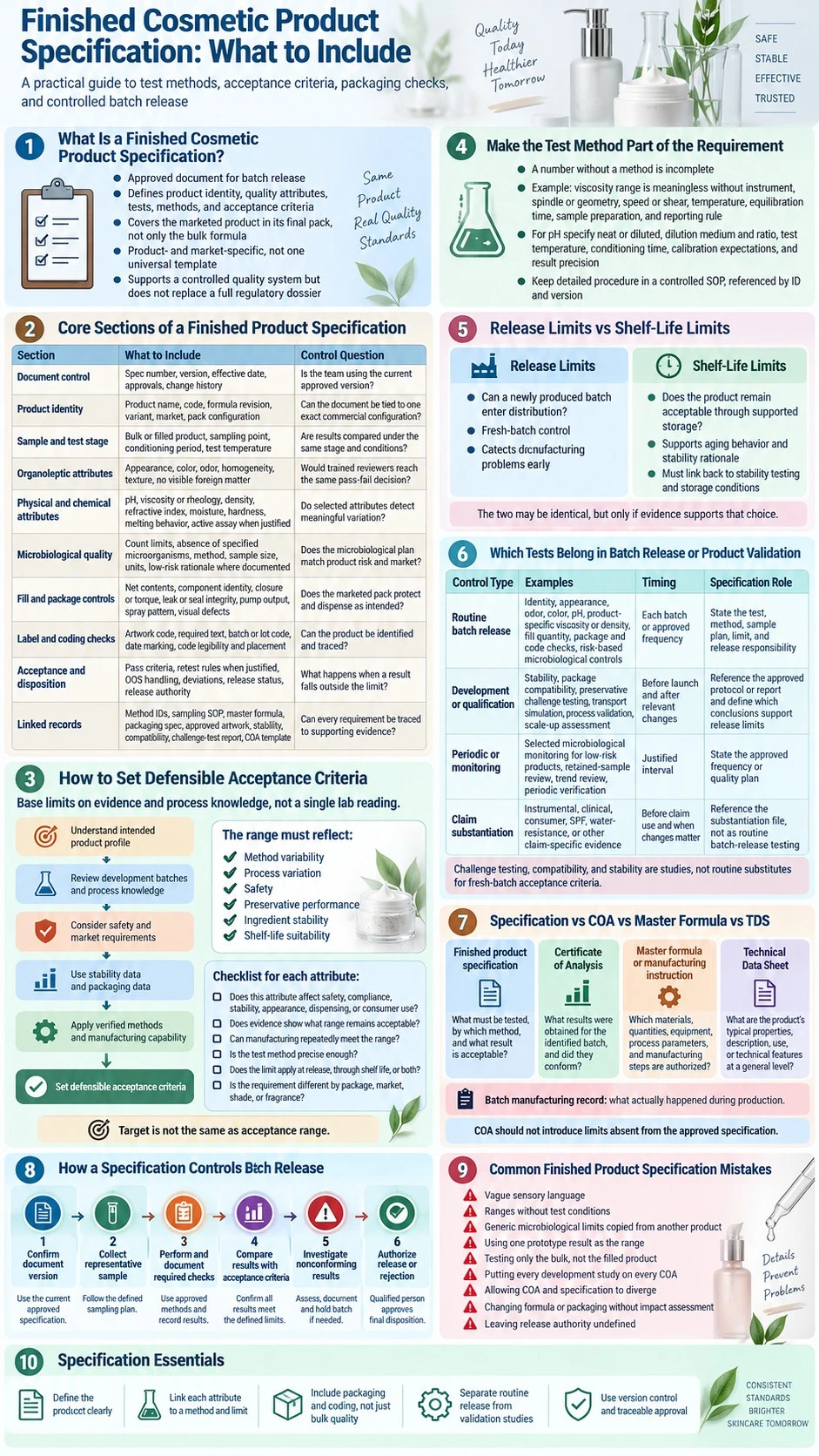
A finished cosmetic product specification is an approved document that lists the identity, quality attributes, tests, methods, and acceptance criteria used to determine whether a produced batch is suitable for release. The document may distinguish bulk requirements from filled-product requirements, but “finished product” should ultimately refer to the product presented in its intended container-closure system.
Cosmetic GMP guidance covers the production, control, storage, and shipment of cosmetic products. [2] FDA’s cosmetic GMP inspection checklist also expects finished-product records to document sampling, individual laboratory controls, test results, and control status. [1] These sources support a controlled quality system, but they do not provide one universal specification template or one set of limits for every cosmetic.
The specification should therefore be product- and market-specific. A low-water balm, facial mist, eye-area serum, and rinse-off cleanser have different risks, relevant tests, packaging functions, and acceptable ranges.
Do not confuse a release specification with a complete regulatory dossier. For an EU cosmetic, the safety report considers composition, physical and chemical characteristics, stability, microbiological quality, challenge-test results, impurities, and relevant packaging characteristics. [5] A finished-product specification can reference evidence from that work, but it does not replace the Cosmetic Product Safety Report or Product Information File.
Core Sections of a Finished Cosmetic Product Specification
The table below is a practical framework, not a universal legal form. Include a field only when it identifies the product, controls a meaningful risk, supports release, or preserves traceability.
| Specification Section | What to Include | Practical Control Question |
|---|---|---|
| Document control | Specification number, version, effective date, page control, prepared-by, reviewed-by, approved-by, and change history | Is the team using the current approved version? |
| Product identity | Brand or project name, product name, internal code, formula code and revision, shade or fragrance variant, product category, intended market, and pack configuration | Can the document be tied to one exact commercial configuration? |
| Sample and test stage | Bulk or filled product, sampling location, conditioning period after manufacture, test temperature, sample quantity, and storage condition before testing | Are results being compared from the same production stage and conditions? |
| Organoleptic attributes | Appearance, color, odor, homogeneity, texture, and absence of visible foreign matter, with an approved reference where useful | Would a trained reviewer reach the same pass/fail decision? |
| Physical and chemical attributes | Product-relevant parameters such as pH, viscosity or rheology, density or specific gravity, refractive index, moisture, hardness, melting behavior, or active assay when justified | Do the selected attributes detect meaningful formula or process variation? |
| Microbiological quality | Applicable count limits, absence of specified microorganisms, test method, sample size, units, and any documented low-risk rationale | Does the microbiological plan match the product, user, site of application, and market? |
| Fill and package controls | Net contents or fill weight, component identity, closure or torque check, leak or seal integrity, pump output, spray pattern, wiper fit, visual defects, and critical dimensions when relevant | Does the marketed pack protect and dispense the product as intended? |
| Label and coding checks | Artwork or label code, required text verification, batch or lot code format, date marking where applicable, code legibility, and placement | Can the product be identified, traced, and checked against the approved artwork? |
| Acceptance and disposition | Pass criteria, retest rules when scientifically justified, out-of-specification handling, deviation reference, release status, and release authority | What happens when one result falls outside the approved limit? |
| Linked records | Test-method IDs, sampling SOP, master formula, packaging specification, approved artwork, stability protocol or report, compatibility report, challenge-test report, and COA template | Can an auditor follow each requirement to the governing method or evidence? |
Microbiological criteria should not be copied blindly from another product. ISO 17516 supports assessment of cosmetic microbiological quality, while low-risk products may follow a documented risk-based approach rather than automatic routine testing. [3] ISO 29621 provides guidance for identifying microbiologically low-risk finished products. [4] Product use around the eyes, on mucous membranes, on damaged skin, or by especially vulnerable users can justify tighter attention. [5]
Packaging belongs in the specification when it affects identity, protection, dosing, leakage, or traceability. Development-stage packaging compatibility testing should support these finished-pack checks rather than being reduced to a visual inspection on release day.
How to Set Defensible Acceptance Criteria
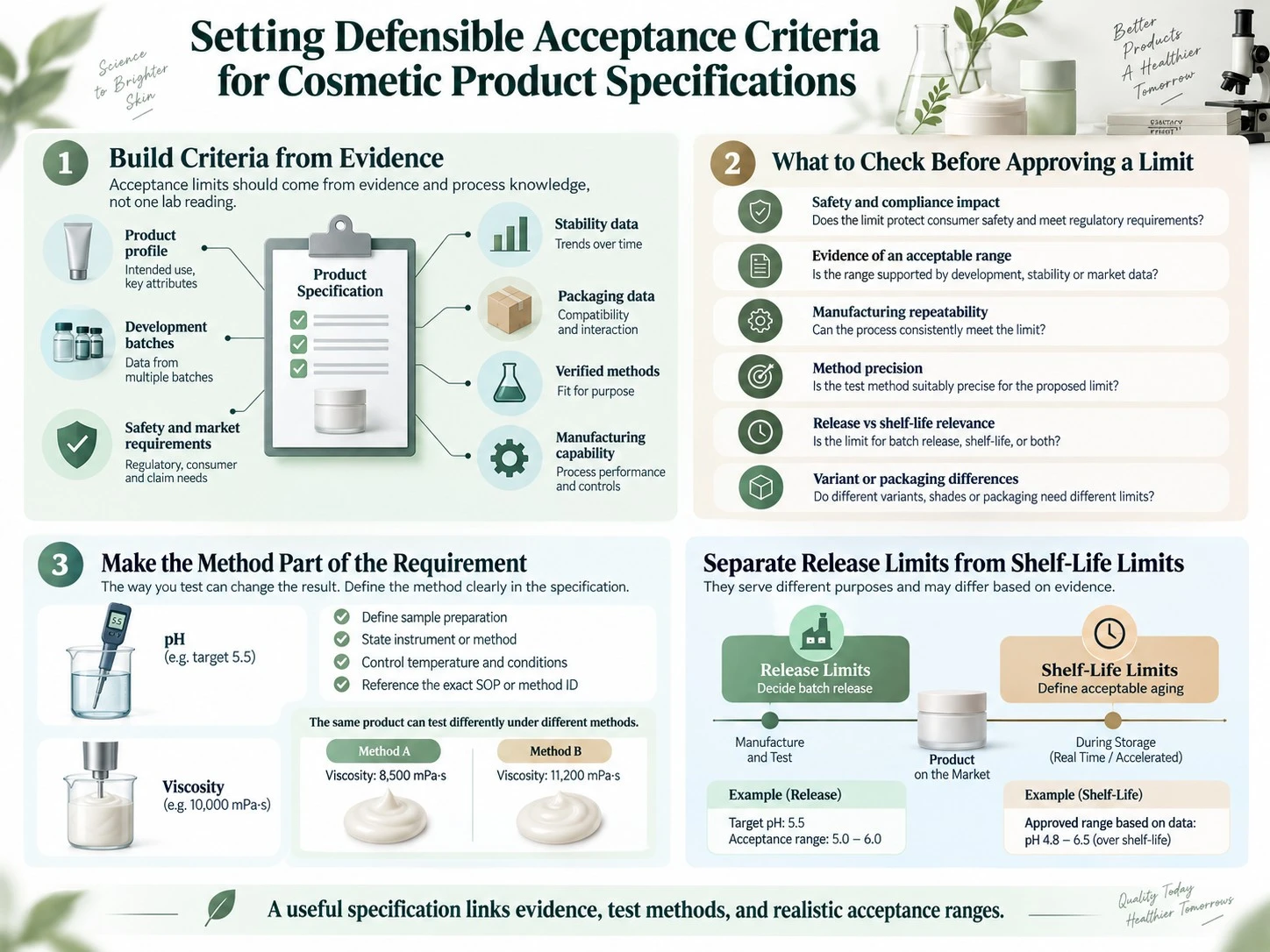
Acceptance criteria should come from evidence and process knowledge, not from a single laboratory reading. Start with the intended product profile, development batches, safety and market requirements, stability and packaging data, verified methods, and demonstrated manufacturing capability.
A target and an acceptance range are not the same thing. A formulator may target pH 5.5, while the approved release range accounts for method variability, process variation, safety, preservative performance, ingredient stability, and the range shown to remain suitable over shelf life. The widest manufacturable range is not automatically the right range, and an unrealistically narrow range creates avoidable failures without improving quality.
Use these checks before approving any numerical limit:
- Does the attribute change product safety, compliance, stability, appearance, dispensing, or consumer use?
- Does development or stability evidence show what range remains acceptable?
- Can the manufacturing process repeatedly meet the proposed range?
- Is the measurement method precise enough to distinguish a real shift from test variation?
- Does the limit apply at release, throughout shelf life, or both?
- Is the requirement different for a new packaging format, market, shade, or fragrance variant?
Make the Test Method Part of the Requirement
A number without a method is incomplete. “Viscosity: 20,000–30,000 cP” is ambiguous unless the document also identifies the instrument or method, spindle or geometry, speed or shear condition, temperature, equilibration time, sample preparation, and reporting rule. The same product can produce materially different viscosity readings under different conditions.
The same principle applies to pH. State whether the sample is tested neat or diluted, the dilution medium and ratio if used, the test temperature, conditioning time, meter calibration expectations, and result precision. For color or odor, define the reference, lighting or evaluation condition, and permissible variation where subjective judgment could differ.
Keep long procedural detail in a controlled test method or SOP and reference its exact ID and version from the specification. This keeps the specification readable while preventing undocumented method changes.
Separate Release Limits From Shelf-Life Limits
Release criteria answer whether a newly produced batch can enter distribution. Shelf-life criteria answer whether the product remains acceptable through the supported storage period. The two sets may be identical, but that should be an evidence-based decision rather than an assumption.
For example, a viscosity drift that is acceptable by the end of shelf life may still be too far from the normal release window and signal a manufacturing problem in a fresh batch. Conversely, a release range should not be so narrow that normal, safe aging is treated as failure. Link the specification to the cosmetic stability testing program that justifies the shelf life and storage conditions.
Which Tests Belong in Batch Release or Product Validation?
Routine release testing and development validation answer different questions. A batch test asks whether this batch meets approved criteria. A validation or qualification study asks whether the formula, preservative system, pack, claim, or process performs as intended over time or under defined conditions.
| Control Type | Typical Examples | Usual Timing | What the Specification Should Do |
|---|---|---|---|
| Routine batch release | Identity, appearance, odor, color, pH, product-specific viscosity or density, fill quantity, package and code checks, and risk-based microbiological controls | Each batch or an approved sampling frequency | State the test, method, sample plan, limit, and release responsibility |
| Development or qualification | Stability, package compatibility, preservative challenge testing, transport simulation, process validation or scale-up assessment | Before launch and after relevant changes | Reference the approved protocol or report and define which conclusions support release limits |
| Periodic or monitoring | Selected microbiological monitoring for documented low-risk products, retained-sample review, trend review, periodic verification, or supplier-dependent checks | At a justified interval | State the approved frequency or point to the governing quality plan |
| Claim substantiation | Instrumental, clinical, consumer, SPF, water-resistance, or other claim-specific evidence | Before claim use and when changes could affect relevance | Reference the substantiation file; do not imply that every claim study is a routine batch-release test |
Preservative challenge testing evaluates whether a formulation can resist introduced microbial contamination under the chosen method; it is not normally repeated as the only release test for every batch. The preservative challenge testing guide explains its development role. Packaging compatibility and stability are also studies, not substitutes for clear fresh-batch acceptance criteria.
The microbiological plan must remain risk-based. Water activity, formula type, manufacturing controls, packaging, intended users, application area, and market expectations can change the appropriate program. “Not tested every batch” must still mean controlled through a documented risk assessment, monitoring strategy, and release decision.
Specification vs COA, Master Formula and TDS
These records work together, but each answers a different question:
- Finished product specification: What must be tested or checked, by which method, and what result is acceptable?
- Certificate of Analysis: What results were obtained for the identified batch or sample, and did they conform to the specification?
- Master formula or manufacturing instruction: Which materials, quantities, equipment, process parameters, and manufacturing steps are authorized?
- Technical Data Sheet: What are the product’s typical properties, description, use, or technical features at a general rather than batch-specific level?
- Batch manufacturing record: What actually happened during production, including materials, quantities, process observations, yields, checks, deviations, and approvals?
A COA should not introduce new limits that do not exist in the approved specification. A TDS should not be used as proof that an individual batch passed testing. The ZICAIL guide to COA, SDS, and TDS documents explains the evidence boundary of each file.
How a Specification Controls Batch Release
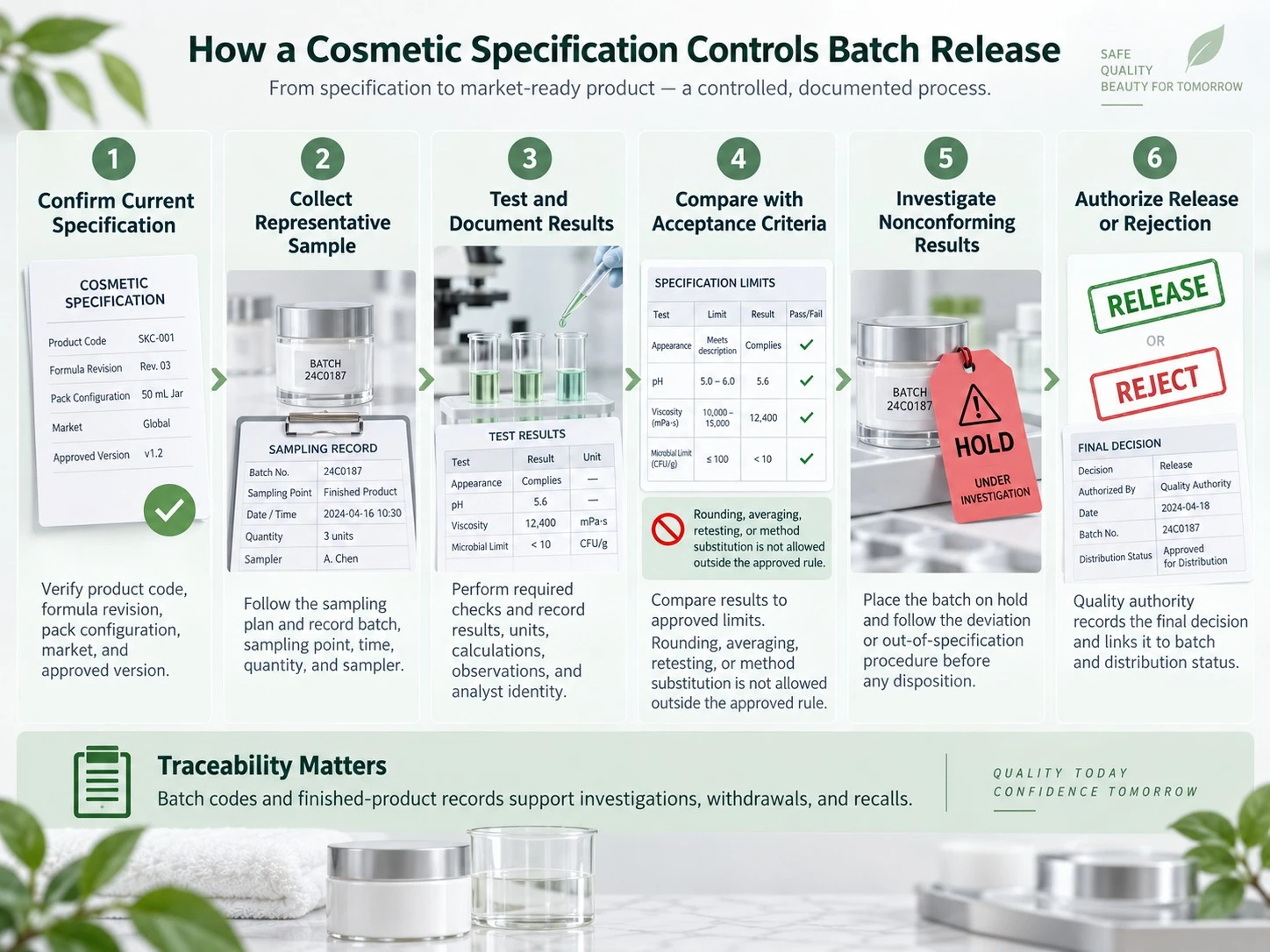
A controlled release workflow should make the decision traceable from sample to authorization:
- Confirm the document version. Match the product code, formula revision, pack configuration, market, and current approved specification.
- Collect a representative sample. Follow the approved sampling plan and record the batch, sampling point, time, quantity, and sampler.
- Perform and document each required check. Use the referenced method and record actual results, units, calculations, observations, and analyst identity.
- Compare results with the acceptance criteria. Do not round, average, retest, or substitute methods outside the approved rule.
- Investigate nonconforming results. Place the batch on hold and follow the controlled out-of-specification or deviation procedure before any disposition.
- Authorize release or rejection. The designated quality authority records the decision and links it to the batch and distribution status.
Batch and finished-product code records support investigations, withdrawals, and recalls. Keep the specification connected to the system described in the cosmetic batch code and traceability guide, rather than treating coding as a printing-only check.
Common Finished Product Specification Mistakes
- Using vague sensory language: “Normal,” “pleasant,” or “standard” is difficult to reproduce without an approved reference or clearer descriptor.
- Listing a range without test conditions: Method changes can create an apparent batch shift even when the product has not changed.
- Copying generic microbiological limits: Criteria must reflect product risk, application area, users, and target market.
- Treating one prototype result as the target range: One data point does not define normal process variation or shelf-life behavior.
- Testing only the bulk: A passing bulk does not confirm fill accuracy, pack integrity, pump output, coding, or artwork identity.
- Putting every development study on every COA: Stability, compatibility, challenge, and claim studies usually support the control strategy rather than creating a fresh result for every batch.
- Allowing the COA and specification to diverge: Test names, methods, units, limits, and revision status should agree.
- Changing formula or packaging without impact assessment: A new fragrance, preservative level, supplier, bottle, pump, or fill size can affect relevant limits or supporting evidence.
- Leaving release authority undefined: Someone must have documented responsibility for hold, release, rejection, deviation approval, and controlled change.
Build a Controlled Product Specification With ZICAIL
A private-label project is ready for specification work when the product format, formula revision, target markets, claims, pack configuration, intended shelf life, and required supporting tests are defined. ZICAIL provides R&D, production, and quality-control support across sample preparation, manufacturing coordination, inspection, and quality follow-up.
Prepare your product brief, target markets, packaging drawings or component details, required claims, reference samples, and any retailer-specific standards. Then contact ZICAIL to review the project scope and identify which specification fields and supporting records need agreement before production.


